
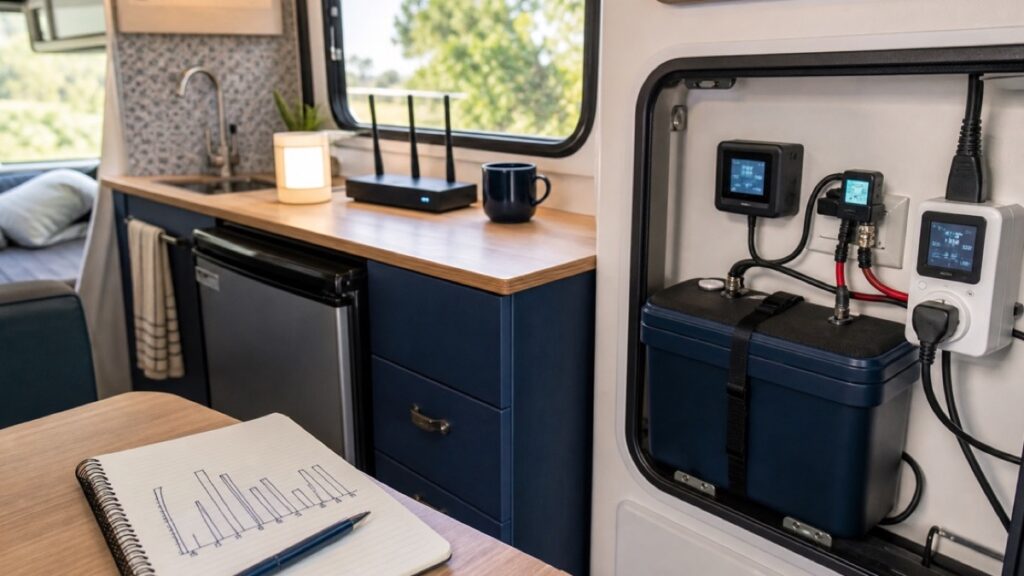
How long will a 100Ah lithium battery last? Divide its usable watt-hours by the load’s battery-side watts. A nominal 12.8V, 100Ah battery contains about 1,280Wh, so a hypothetical 100W AC load might run roughly 10 hours after a 90% usable-capacity allowance and 90% conversion efficiency. The honest answer changes with exact voltage, cutoff, temperature, load cycling, inverter efficiency, idle draw, and battery current limits.
One Equation, Two Separate Checks
Runtime is an energy question; whether the battery can start and sustain the load is a power/current question. Passing one does not pass the other.
hours ≈ (nominal volts × Ah × usable fraction) ÷ (load watts ÷ conversion efficiency + parasitic watts)
For a direct DC load, use measured battery-side watts or set conversion efficiency to 100%. Keep inverter idle draw, monitor draw, heaters, and always-on controls visible instead of hiding them in a guessed percentage.
NIST treats ampere-hours and watt-hours as different quantities, and U.S. Department of Energy material defines watts as a rate of power and watt-hours as energy over time. The voltage term is what converts a battery’s Ah label into a nominal Wh estimate.
“12V 100Ah” is not a complete energy record
A current Victron Lithium SuperPack NG table, for example, publishes its exact 12.8V 100Ah model at 1,280Wh nominal. If another product uses a different nominal voltage or publishes its own Wh rating, use that product’s value. Do not silently multiply every 12V label by either 12.0 or 12.8 depending on which produces the preferred result.
Nominal energy is not automatically delivered energy. The BMS and downstream equipment stop discharge at defined limits; the owner may reserve part of the bank; cold conditions can change available capacity; wiring creates voltage drop; and AC conversion consumes energy. Treat every percentage as an input to verify, not a LiFePO4 constant.
Estimate Your Load—Then Save the Inputs
This calculator performs transparent planning arithmetic. It does not know the exact battery’s temperature, state of health, BMS cutoff, load surge, inverter efficiency curve, or cable losses. Enter values from current manuals or measurements and keep the result with those inputs.
Planning estimate only. Verify the exact battery’s continuous/peak current, BMS cutoff, temperature range, inverter loss curve, conductor/protection design, and actual load profile.
If you do not know efficiency, measure DC input power and AC output load under the intended operating condition rather than selecting an optimistic maximum. Victron’s current Inverter Smart specifications illustrate why: maximum efficiency and zero-load power differ by model and system voltage, and maximum efficiency is not a guarantee at every load.
For a load rated in amps rather than watts, voltage still matters. A measured 5A DC load on a stable 12.8V bus is approximately 64W at that instant. A label current may describe a maximum, however, so a watt-hour meter or shunt log is better for a cycling device.
AC and DC measurements belong on different sides
If a 12V refrigerator is connected directly to the battery-side distribution, measure its DC watt-hours and do not apply an inverter efficiency penalty. If a household refrigerator is powered through an inverter, record both AC load energy and battery-side energy when possible. Their difference includes inverter behavior plus any other device operating on the measured DC path.
Avoid counting the same loss twice. A battery-side shunt measurement already includes the inverter’s conversion and idle demand; reducing that measured Wh again by a guessed efficiency would understate runtime. Conversely, an AC plug meter cannot see inverter idle draw or unrelated DC loads, so those must be added separately.
Charging while the test runs creates a net-energy result. That can answer “Will this system make it through a day?” but not “How long does the battery alone last?” Save charge-source Wh and load Wh separately so cloudy-day and no-charge cases can be modeled later.
Loads Cycle; Nameplates Do Not Keep Time
A refrigerator does not normally draw its compressor nameplate power continuously. A furnace fan, pump, or coffee maker also follows an operating schedule. Runtime depends on the energy used across time, not the sum of every maximum label multiplied by 24 hours.
Suppose a hypothetical RV refrigerator measures 55W while its compressor runs and operates for 18 minutes during one observed hour. Add a 6W control load that runs continuously.
- Compressor: 55W × 0.30 hour = 16.5Wh.
- Controls: 6W × 1 hour = 6Wh.
- Observed hour: 22.5Wh total, equivalent to a 22.5W average for that hour.
- Daily model: 22.5Wh × 24 = 540Wh only if that duty cycle remains representative.
Using the earlier 1,280Wh nominal example with a hypothetical 90% usable allowance gives 1,152Wh before other losses. Dividing by 540Wh/day suggests about 2.13 days. Ambient temperature, door openings, food loading, ventilation, defrost behavior, low-voltage cutoff, and charging can change the duty cycle, so record at least a representative hot day and overnight period.
Solar charging changes net battery depletion; it does not change battery capacity. If the load uses 540Wh in a day and the controller actually records 350Wh delivered to the battery after all system behavior, the modeled net depletion is about 190Wh for that day. Do not substitute panel nameplate watts for measured daily battery-side charge energy.
Find the Energy That Simple Division Misses
Several losses are easy to omit because they occur outside the appliance.
Inverter idle and light-load behavior
An inverter consumes power while on even when the appliance is off. At very small loads, idle power can be a meaningful part of the total. ECO/search modes may reduce draw but may not wake reliably for every device; use the exact inverter manual and test the load.
BMS and low-voltage shutdown
The battery may stop discharge before an arithmetic model reaches zero energy. The inverter can also shut down first because of its configured threshold or voltage drop under load. Use the intended cutoff hierarchy and preserve a deliberate reserve.
Temperature and battery condition
Published capacity is measured under stated conditions. Cold temperature, age, imbalance, or a partially charged starting state can reduce the energy available for the run. Do not “correct” these with a universal factor; use exact documentation and measurements.
Always-on system loads
Propane detectors, cellular routers, shunts, Bluetooth electronics, DC-DC chargers, standby relays, and heating controls can remain active after the headline appliance turns off. Measure the RV’s baseline draw with the intended system state.
A battery monitor does not remove the need for correct wiring. All charge and load paths must pass through the chosen measurement point if its state-of-charge calculation is expected to represent the whole bank. Compare the logged amp-hours with logged watt-hours when bus voltage varies.
A Long Runtime Estimate Can Still Be an Impossible Load
A 100Ah battery may contain enough energy for a short high-power event while lacking the documented current capability to supply it. Estimate battery-side current before treating runtime as permission.
For a hypothetical 1,000W AC load at 90% conversion efficiency, battery-side power is about 1,111W before idle draw. At 12.8V, ideal current is roughly 86.8A. Voltage sag and additional losses can raise current. That may sit near the continuous boundary of some 100Ah batteries and far beyond others; only the exact data sheet and installation determine whether it is acceptable.
A 3,000W inverter does not make the battery deliver 3,000W continuously, but it creates the possibility of a load that demands it. The actual appliance watts determine energy use; inverter rating, surge, efficiency, low-voltage settings, and DC requirements determine feasibility. See the 100Ah battery inverter sizing guide for that separate decision.
Replace the Guess with One Measured Day
Use the estimate to plan a test, not to promise a runtime.
Stop the test for heat, odor, swelling, damaged insulation, loose connections, unexpected voltage drop, repeated protective shutdown, or any condition outside current manuals. Do not deliberately force a BMS to its cutoff as a routine capacity test unless the exact manufacturer supplies that procedure.
Your next action is to log one representative 24-hour load profile with the intended inverter and charging sources. Enter the measured average load, exact nominal voltage, chosen reserve, observed conversion loss, and idle draw above. Then compare the estimated battery current with every exact time-rated limit in the battery, inverter, conductor, and protection path.
Leave a Reply