Can you charge LiFePO4 below freezing? Usually, do not allow charge current into a cold battery unless the exact battery manual and the complete protection system explicitly permit it. A battery with verified self-heating may warm its cells before charging, and an exact model may have a BMS cutoff, but a generic “LiFePO4” label or lithium charge-controller preset proves neither.
That answer is deliberately conditional. The safe boundary belongs to an exact battery model, while the practical outcome depends on cell temperature, sensor position, every connected charger, heater logic, BMS behavior, and the documented recovery sequence.
Three Different Temperature Questions
Charging, discharging, and storing a LiFePO4 battery are different operating states. A battery can still power a refrigerator below the temperature where its manual prohibits charging. It may also be permitted to sit in colder storage when disconnected, provided its state of charge and storage instructions are respected.
A temperature range is not a protective device
When a manual says “charge: 32–122°F,” it tells you the permitted operating range. It does not automatically mean the battery will block a charger at 31°F. To claim automatic protection, the exact documentation must identify a low-temperature charge cutoff, its sensor/control owner, and ideally its recovery behavior.
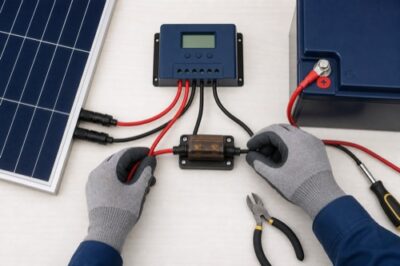
The same distinction applies to a solar controller. A controller’s own operating-temperature range describes the controller enclosure. A remote sensor might adjust lead-acid charge voltage, report temperature, or trigger a lithium interlock—but those are different functions. Read the exact control logic rather than treating any temperature sensor as cold-charge protection.
Cell temperature matters more than the weather app
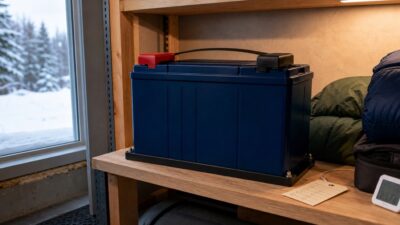
Outdoor air can warm quickly after sunrise while a battery inside a metal box remains cold-soaked. The opposite can happen when a battery sits in a heated cabin beside an exterior controller. Protection should represent the cells closely enough for the battery maker’s rule, not the nearest convenient ambient reading.
Who Actually Stops the Current?
A cold-weather design needs one clearly assigned owner for charge inhibition and a way to verify that it works. Redundant protection can be sensible, but only when the devices coordinate instead of repeatedly connecting and disconnecting around different thresholds.
Internal BMS cutoff
The battery monitors itself and refuses charge current below its documented trigger.
- Confirm exact-model support
- Find trigger and recovery values
- Know whether discharge remains available
Self-heating battery
Incoming energy may warm cells before normal charging begins.
- Verify heater activation logic
- Check minimum available charge current
- Separate heating time from charging time
External interlock
A controller, relay, or coordinated BMS signal stops every charger.
- Locate the sensor correctly
- Prove fail-safe behavior
- Include solar, alternator, shore, and generator charging
An internal cutoff is a last protective layer, not a substitute for correct charging configuration. Repeatedly driving a BMS into disconnect can confuse chargers, create cycling, erase diagnostic context, or leave other equipment reacting to a suddenly open battery circuit.
Self-heating also needs careful reading. Some products heat only when charge current is available and the cells are within a stated heater range. The solar array may deliver too little morning current to run the heater as expected, and the battery can spend much of a short winter day warming rather than storing energy.
An external strategy is only as strong as its coverage. Turning off one solar controller does nothing to an active alternator charger or inverter/charger. Inventory every source that can energize the bank and document what each one does when the sensor fails, communications stop, or the BMS opens.
Five 100Ah Batteries, Five Exact-Model Answers
The first Solar Power Picks battery set demonstrates why the chemistry name cannot supply one universal answer. These examples are documentation comparisons, not cold-chamber tests.
Its manual documents automatic charging recovery at 41°F (5°C). It does not self-heat.
Its documented recovery point is 37.4°F (3°C). It also has no internal heater.
The shared manual contains conflicting 25°F/32°F language. This standard model is not heated.
The permitted charge range begins at 32°F, so the installation must prevent colder charging.
Its charge range starts at 32°F, but the exact Basic model does not provide a low-temperature block.
The LiTime and Renogy values even differ on recovery. Both stop at the freezing boundary, but LiTime waits until 41°F while Renogy publishes 37.4°F. That hysteresis helps prevent rapid reconnect/disconnect behavior, yet it also means a system may remain unavailable after ambient air rises above freezing.
The Battle Born BB10012 review uses 32°F as the conservative rule because the exact current manual does not tell one consistent story. A public table should preserve that conflict rather than selecting the more convenient lower number.
Power Queen and Redodo show the other important case: both publish a 32°F lower charge boundary, but neither reviewed Basic/Classic variant supplies automatic cold-charge interruption. A buyer who assumes “the BMS handles it” could remove the only effective control from the design.
A Cold-Soaked RV After Sunrise
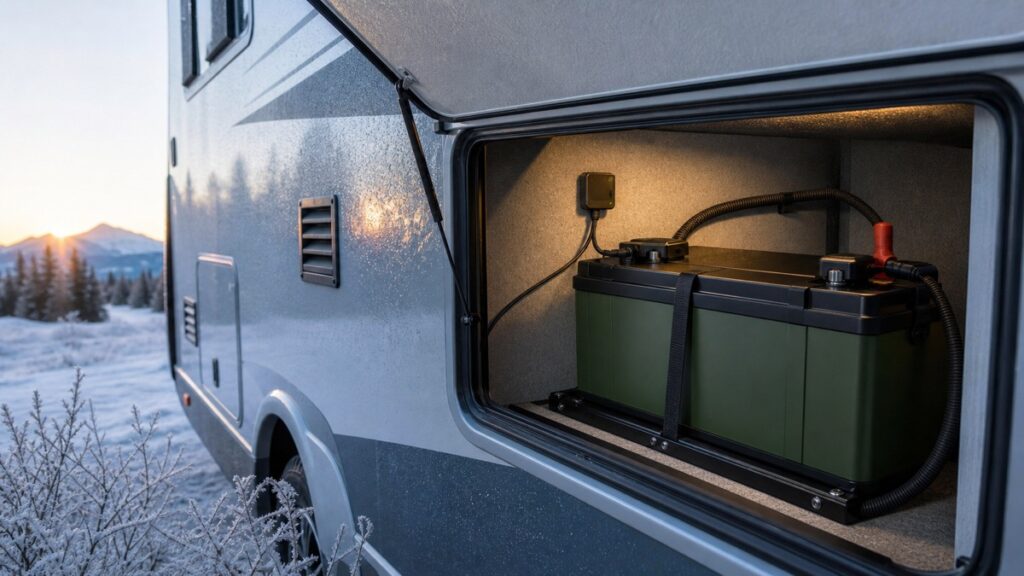
Consider a hypothetical RV parked overnight at 20°F (-6.7°C). Its roof array receives sun at 8:15 a.m.; the exterior air crosses 32°F at 10:00; the battery, inside an unheated compartment, does not reach its documented recovery threshold until noon.
Available sunlight does not mean the cells may accept charge. The control owner should keep charge current blocked.
The cold-soaked battery can still be below its trigger. An ambient sensor elsewhere may give a misleading go signal.
A documented BMS or external interlock may reconnect. Verify stable temperature and charger behavior.
Current, voltage, and every active charge source must still stay inside the exact battery limits.
If the battery is a self-heating model, insert a separate heating phase into that timeline. Available PV energy first has to support the heater’s documented conditions; only then does ordinary charging begin. Do not calculate charge time as though all morning array output immediately became stored watt-hours.
For a controller preset or custom profile, use the exact battery manual and map its requirements to the actual controller fields. The dedicated LiFePO4 charge-controller settings guide explains that mapping; it does not replace the battery’s low-temperature rule.
Restart Only After the Evidence Changes
When protection has stopped charging, the objective is not to “beat” the cutoff. The objective is to confirm that the cells have returned to a permitted state and that the complete system will restart as documented.
Repeated disconnects are a diagnostic problem. Possible causes include a sensor that does not represent the cells, a controller profile that conflicts with the battery, inadequate heater current, a second uncontrolled charger, communications failure, or an internal battery fault. Preserve logs and involve the manufacturers before changing multiple settings at once.
Heat, swelling, odor, damaged insulation, corrosion, water intrusion, an impact event, or unexplained voltage requires isolation under the equipment instructions and qualified diagnosis. Cold weather does not make those symptoms a normal protection event.
Name the Protection Owner Before Winter
Before relying on a LiFePO4 bank through freezing weather, complete this responsibility check:
- Exact battery: record model, revision, manual, charge cutoff, recovery temperature, and heater behavior.
- Temperature representation: identify which sensor measures the cells closely enough and what happens if it fails.
- Every charger: include solar, alternator, shore, generator, inverter/charger, and portable sources.
- Control owner: name the BMS, controller, relay, or communications path that positively blocks current.
- Cold-soak test plan: verify the documented behavior safely before an unattended winter cycle.
- Recovery evidence: define the temperature/state that permits restart and the signs that require escalation.
The final answer is not simply “32°F.” It is: this exact device stops all charge current, using this sensor and trigger, and reconnects only under this documented condition. Until that sentence can be completed and verified, keep the cold battery isolated from charging.
Write that control statement on the system record so a future owner can verify the same protection path before the next winter.