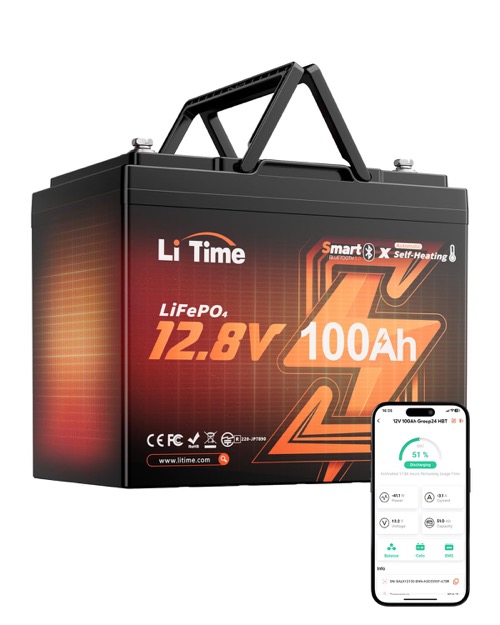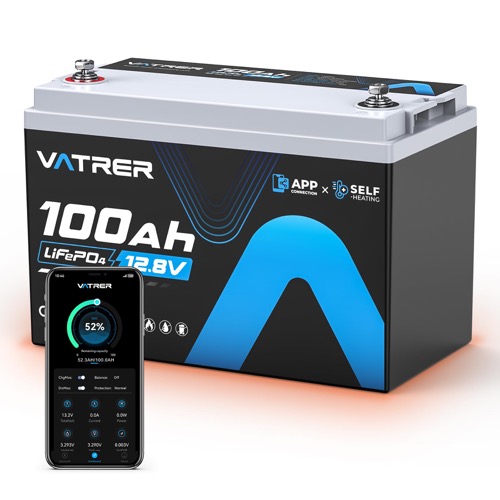
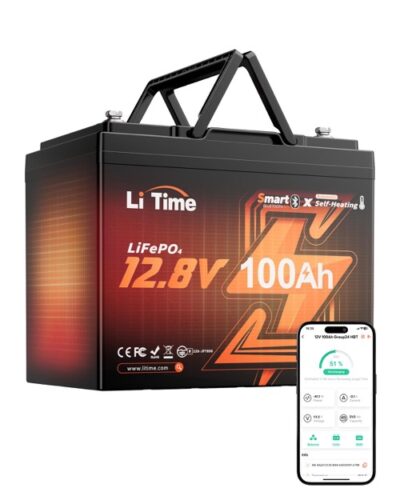
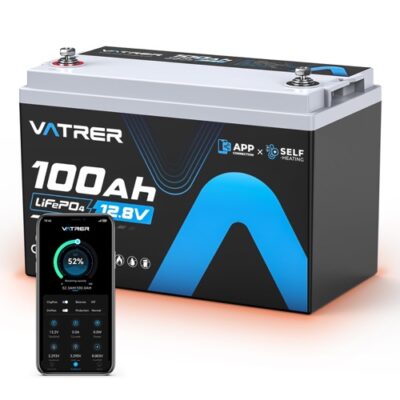
LiTime vs Vatrer 100Ah self-heating looks like a tie at 12.8V, 100Ah, 1,280Wh, 100A continuous, Bluetooth, IP65, and automatic heating around freezing. It is not. LiTime publishes the more complete sequence and fits Group 24; Vatrer occupies Group 31 and leaves surge and large-bank limits less resolved.
Choose LiTime
You want compact dimensions, warm-up estimates, a one-second pulse, and cleaner bank rules.
Choose Vatrer
You have a Group 31 tray, steady moderate loads, and a value advantage large enough to justify two confirmations.
The Heater Threshold Is Similar; Evidence Quality Is Not
LiTime heats from -20 to 5°C with at least 10A and publishes approximate 70–90-minute warm-up from -10°C and 100–150 minutes from -20°C. Vatrer starts below 0°C, stops at 5°C, and requires more than 10A, but its exact warm-up timing is not equally detailed.
Case Length Is a 2.71-Inch Decision
LiTime is about 10.24 inches long; Vatrer about 12.95. Vatrer is also roughly 1.5 pounds heavier. A Group 31 tray can make Vatrer a convenient replacement, while a compact RV or boat compartment strongly favors LiTime.
Neither published case includes cable bends, terminal covers, fuse, disconnect, restraint, or service space. Heat function does not justify an unventilated, inaccessible, or wet compartment.
LiTime Owns the Published Startup Case
LiTime documents 500A for one second. Vatrer publishes 100A continuous but no attributable exact timed pulse. A pump or inverter whose startup is measured and shorter than one second can therefore be evaluated against LiTime; Vatrer needs an exact-model answer.
Vatrer’s Parallel Claim Needs Confirmation
LiTime clearly publishes 4S4P. Vatrer’s technical table says up to ten parallel, while other official copy says 4S4P. For one to four batteries the practical difference is small; for a larger parallel bank it is a purchasing blocker until the delivered revision is confirmed.
| Planned bank | LiTime | Vatrer action |
|---|---|---|
| Single 12V battery | Clear | Clear |
| Up to 4P or 4S | Documented | Supported by both official statements |
| 5–10P | Outside published 4P | Get exact-revision confirmation because official copy conflicts |
Owner Evidence Favors LiTime Coverage, Not Necessarily Reliability
LiTime has 24 captured exact reviews including positive and critical cases; Vatrer has 14 that are almost entirely positive. LiTime’s sample exposes terminal-stack and low-input/parallel concerns. Vatrer’s sample offers less visibility into failure and remedy. We discount the positive skew rather than declaring Vatrer more reliable.
More useful for identifying both successful use and specific failure modes, but still not a random reliability sample.
Useful for application examples, but too one-sided to establish a reliability advantage.
Final Decision
LiTime earns the default win because it is smaller and closes more engineering questions. Vatrer remains rational when an existing Group 31 compartment and real price advantage dominate, continuous loads stay below 100A, and the buyer confirms surge and bank rules before relying on them.