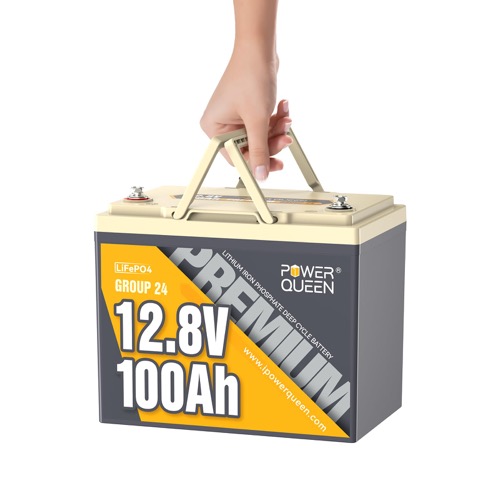
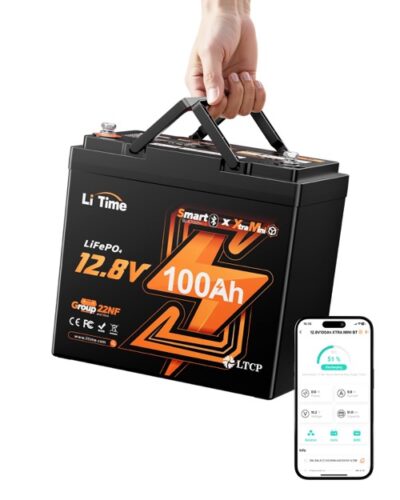
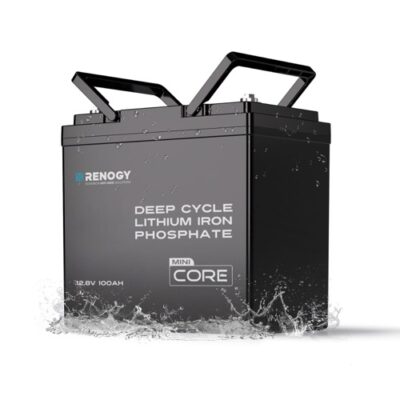
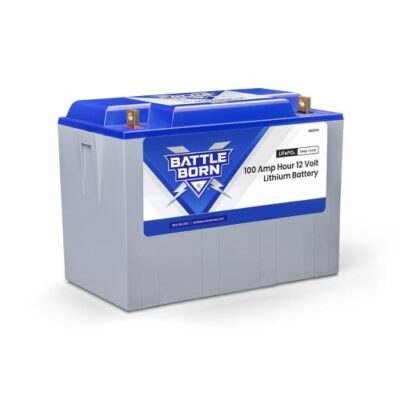
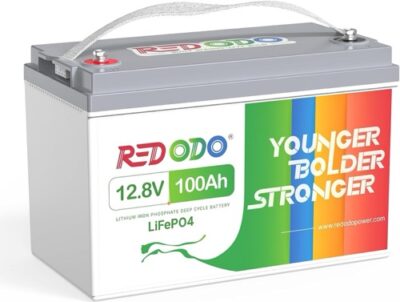
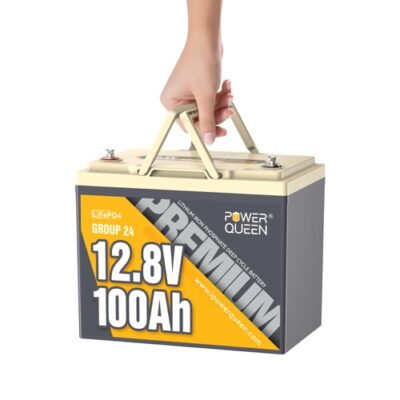
Choosing the best 12V 100Ah LiFePO4 batteries starts with the job behind the 100Ah label. Five batteries can share nominal capacity while differing in continuous current, surge duration, cold protection, physical footprint, monitoring, bank rules, warranty structure, and the quality of the evidence available for the exact model.
This ranking uses five completed exact-ASIN reviews and one common 24-row specification schema. Hard limits come from current manufacturer manuals and exact product pages; Amazon evidence contributes specific owner observations and dated marketplace context. Solar Power Picks did not capacity-test these batteries, and the ranking does not convert Amazon stars into an editorial score.
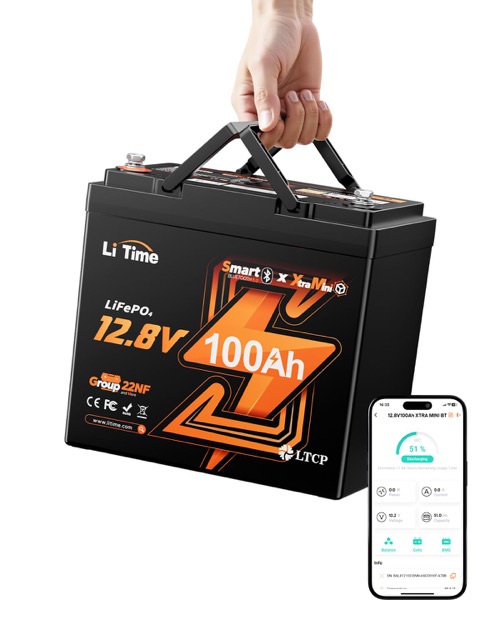
The default winner is LiTime’s Xtra-Mini Smart because it combines compactness, direct Bluetooth, 100A continuous current, and documented cold-charge cutoff with fewer system add-ons. That answer changes when a five-second startup surge, a longer 30-second surge, conventional Group 31 fit, premium documentation, or Group 24 replacement value is the actual priority.
What “Best” Means in a 100Ah Battery
Capacity class was only the entry requirement. Four products publish 12.8V and 1,280Wh; Battle Born publishes 12V and 100Ah, producing 1,200Wh by multiplication. None receives credit for energy the site did not measure. Instead, the first rating category considers how completely capacity and cycle conditions are documented and what the exact owner evidence can responsibly add.
Current capability is separate. Every pick supports 100A continuous discharge, but charge current and peak behavior differ. A large one-second pulse does not automatically beat a smaller surge that lasts five or thirty seconds. The relevant winner is the battery whose continuous ceiling and surge curve match the inverter’s documented DC demand.
BMS and temperature scoring rewards explicit thresholds, not a generic protection list. A battery that blocks cold charging but does not heat itself solves a different problem from a self-heated model. A battery with neither feature can still work in a controlled environment, but the system must provide reliable temperature protection.
Build and ownership combines enclosure, terminals, torque, monitoring, primary documentation, warranty structure, and exact-model owner evidence. A small recent sample lowers confidence rather than proving the product bad. A longer history exposes more possible failure and support outcomes, so complaint count alone is not a fair cross-product score.
How the ranking separates evidence from marketing
| Ranking dimension | What counted | What did not count |
|---|---|---|
| Capacity evidence | Exact-model rated energy, usable limits, and documented conditions | Amp-hours treated as proof that every battery performs identically |
| Current envelope | Continuous current plus amperage and duration of every surge | The largest peak number without its time limit |
| BMS and temperature | Published cutoff and recovery behavior for the exact model | Protection borrowed from a heated or smart sibling |
| Ownership and documentation | Manual quality, installation data, warranty terms, and exact-ASIN patterns | Marketplace stars converted directly into an editorial score |
How confident is each evidence layer?
These define the operating boundaries used in the ranking, while internal conflicts are called out instead of averaged away.
They reveal applications and failure modes, not population-wide rates or laboratory performance.
Both change over time and neither is converted directly into an editorial score.
Continuous Current Decides More Than Amp-Hours
A 100Ah battery describes stored charge, not how quickly the BMS will allow that charge to leave. All five reviewed batteries publish 100A maximum continuous discharge. At 12.8V nominal, that is a preliminary 1,280W DC boundary; Battle Born’s 12V rating produces 1,200W by the same simple math.
Neither result is an AC appliance recommendation. Inverter loss and low-voltage operation increase DC current, while motor or compressor startup can exceed the steady load. Cable resistance, terminal temperature, fuse and disconnect ratings, BMS timing, and ambient temperature can become the real limit before the nameplate inverter wattage is reached.
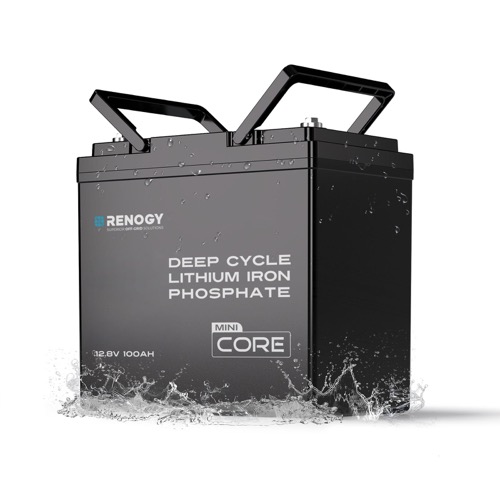
The peak numbers require their durations. LiTime lists 500A for one second. Renogy lists 300A for five seconds. Battle Born lists 200A for 30 seconds and a half-second allowance for larger loads. Power Queen and Redodo each have direct manual/web conflicts, so a surge-dependent design needs exact-revision confirmation rather than a ranking-table shortcut.
Charging can be asymmetric. Battle Born caps charge at 50A, while the other four list 100A maximum continuous charge; LiTime, Power Queen, and Redodo recommend 20A, Renogy lists 50A standard. Add the current from solar, alternator, converter, and inverter/charger when multiple sources can operate at once.
Four current questions that change the decision
Cold Protection Splits the Shortlist
LiTime and Renogy clearly document a 32°F (0°C) charge cutoff plus a warmer recovery threshold. That hysteresis matters because it keeps the BMS from rapidly reconnecting at the exact boundary. Neither battery is self-heating, so charging can remain unavailable until the compartment warms or an external system supplies heat.
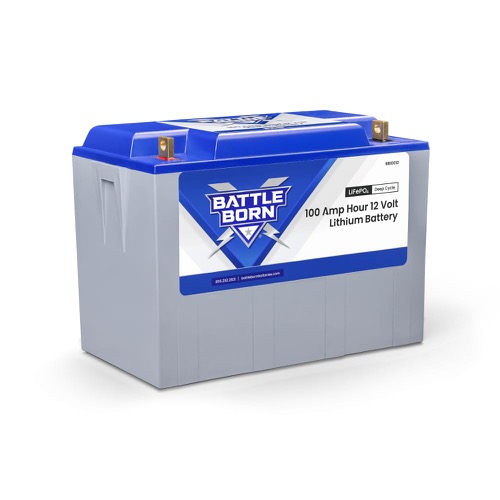
Battle Born also documents cold protection, but its current shared manual conflicts internally. A technical table starts charging at 25°F (-3.9°C), while charging guidance starts at 32°F and the BMS prose says current is blocked below 32°F. This roundup treats 32°F as the conservative operating boundary and does not award the standard model heat that belongs to BB10012H.
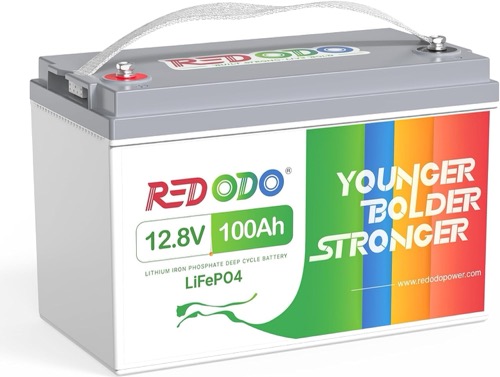
Power Queen Classic and Redodo Basic do not provide low-temperature charge cutoff. Their published charge ranges still begin at 32°F, which leaves enforcement to the installation. A controller with a correctly placed battery-temperature sensor, conditioned mounting, or engineered external heat can solve the problem; a generic lithium preset alone may not.
Discharge below freezing does not prove cold charging is safe. Several batteries permit loads down to -4°F (-20°C), creating a morning when the lights work but solar input should still be blocked. Every charging source must follow the temperature plan, not only the solar controller.
Cold-weather tie-breaker: A BMS cutoff can prevent unsafe charging, but it cannot warm the battery. The winning product still depends on where the cells sit and how the system restores charging after a freeze.
A complete cold-charge plan
Fit, Monitoring, and the Cost of Missing Hardware
LiTime and Renogy share a 9.02 × 5.43-inch base, with LiTime slightly shorter and roughly 2.7 pounds lighter. Power Queen occupies a true Group 24 case. Redodo uses a longer Group 31 envelope, while Battle Born is a heavier Group 27/31 replacement with flag terminals.
Group labels do not finish an installation. Measure height with hardware, terminal-cover space, cable bends, hold-down geometry, fuse placement, disconnect access, and the path of any temperature sensor. A physically smaller battery can improve cable routing or create unsafe crowding depending on how the gained space is used.
Only LiTime provides Bluetooth inside the reviewed battery. Renogy identifies an optional 300A shunt for app monitoring; the other three also need external monitoring when accurate state of charge matters. A shunt can be better for a multi-battery bank, but its price, wiring, and setup belong in the value calculation.
IP65 appears across the set. That is not a synonym for waterproof or submersible. Marine and exterior compartments still need appropriate enclosure, terminal protection, restraint, and access for inspection.
Battery-level Bluetooth
Simpler for one hidden battery and useful for seeing that case’s protection state. LiTime is the only reviewed model with it built in.
Bank-level shunt
Better suited to measuring all charging and load current across a multi-battery bank, but it adds wiring, setup, and installed cost.
Bank Expansion Needs More Than a 4S4P Label
LiTime, Renogy, Power Queen, and Redodo publish 4S4P as the relevant maximum. Battle Born permits up to four in series and states no numerical parallel limit. Those are product boundaries, not bank designs. Fault current, balanced connections, branch protection, busbars, charger capacity, state of charge, and access become more demanding as battery count rises.
Renogy’s manual creates a specific tension by mentioning up to eight parallel units in one passage while showing 4P as the maximum configuration elsewhere. This roundup uses 4S4P until Renogy confirms a larger exact-model design. Selecting the larger statement because it is convenient would undermine the point of using primary sources.
Power Queen’s owner evidence adds a different warning. One buyer reports being told that two units sold under the same visible model but bought in separate orders were incompatible. That single report cannot prove every revision differs, but it is consequential enough to require written serial/revision confirmation before an older bank is expanded.
Matched capacity on the label is not sufficient. Batteries should meet the exact manufacturer’s requirements for model compatibility, age, state of charge, wiring, and pre-connection preparation. Staged expansion deserves planning before the first purchase.
Reading Owner Evidence Without Inventing a Failure Rate
The five research sets are not statistically interchangeable. LiTime has ten recent, almost wholly positive exact-variant reviews. Renogy has eight, including one serious failure and refund-delay report. Power Queen’s 17-review set was deliberately balanced across ratings to expose failure modes. Redodo’s 11 reviews span the Zooms-to-Redodo era and include several multi-year reports. Battle Born uses three manually retained detailed reports plus Amazon topic counts because the final Apify run hit the account limit.
This evidence can answer concrete questions: Did owners fit the battery into real compartments? Which applications appear? Was app visibility useful? Did anyone report cold-charge concerns, revision problems, a replacement, or a difficult remedy? It cannot establish the percentage of all units that fail, reach rated capacity, or receive a successful warranty outcome.
Longer history naturally accumulates more varied reports. Redodo should not be punished simply for having more years in which a complaint could appear, while LiTime should not be declared more reliable because its exact variant is newer and the captured sample positive. The ranking therefore separates product evidence from evidence confidence.
Size the Bank Before Choosing the Battery
Start with daily energy in watt-hours, required autonomy, allowed depth of discharge, total system efficiency, and a reserve.
Preliminary bank-energy calculation
required nominal Wh = daily Wh × autonomy days ÷ (usable DoD × system efficiency) × reserve factor
Worked example: 900Wh/day × 2 days ÷ (0.80 × 0.90) × 1.10 ≈ 2,750Wh nominal. That points to three 1,280Wh batteries before series voltage, parallel current, inverter demand, winter production, and manufacturer bank rules are checked.
Work from energy to hardware
- Estimate energy: total daily watt-hours and the required autonomy period.
- Add real limits: usable depth of discharge, conversion loss, temperature, and reserve.
- Check current: compare continuous and startup demand with the complete DC path.
- Select the bank: choose voltage, unit count, and an approved series/parallel arrangement.
- Verify charging: confirm current, voltage, cold behavior, and recovery time across every source.
The cluster’s battery-bank calculator can perform the preliminary arithmetic, but it does not choose conductors, fuses, busbars, disconnects, charger settings, thermal controls, or a legal installation. A qualified designer should review systems with high fault current, large inverters, propulsion loads, unusual environments, or unfamiliar code requirements.
Checks That Prevent an Expensive Mismatch
Confirm the exact model and feature version first. “Smart,” “heated,” “Mini,” “Classic,” and “Basic” are not decorative words; they can change monitoring and temperature behavior. Save the current manual and warranty for the exact ASIN or SKU instead of relying on a family page after purchase.
Next, compare the continuous DC load and surge duration with the battery and full current path. Verify every charging source’s combined maximum, target voltage, temperature behavior, and equalization settings. Measure the enclosure with terminals and cable bends, then obtain the exact torque value rather than borrowing it from a similar M8 bolt.
For banks, confirm series/parallel limits and revision compatibility in writing. Record arrival voltage, serials, charger settings, torque, and a known commissioning load. Those records do not turn installation into a laboratory test, but they make a shipping problem, BMS event, imbalance, or warranty conversation easier to diagnose.
Final checks before using the ranked cards
- Confirm the exact feature version: Smart, heated, Mini, Classic, and Basic are not interchangeable labels.
- Measure terminals, cable bends, hold-downs, protection, and service clearance.
- Match surge amperage and duration to the load’s actual startup trace.
- Choose who enforces low-temperature charging limits.
- Get revision compatibility in writing before planning later bank expansion.
- Save the current manual, warranty, serials, torque, and commissioning records.
The best 12V 100Ah LiFePO4 batteries are the ones whose constraints are ordinary for your system. LiTime is the most complete default package here. Renogy wins when its longer five-second surge and external-shunt architecture fit better; Battle Born earns a premium-support niche; Redodo supplies the deepest owner timeline; and Power Queen remains a conditional Group 24 value. The right choice is the one that removes a real system problem without creating a harder one elsewhere.