Solar Power Picks logo with sun, solar panel, and green energy icon

  • Home
  • Reviews
  • Best
    • Best portable power stations
    • Best Solar Panels
    • Best Solar Generators
    • Best Solar Charge Controllers
    • Best Solar Batteries
  • Guides
    • Portable Power Stations Guides
    • Solar Panels Guides
    • Solar Generators Guides
    • Solar Charge Controllers Guides
    • Solar Batteries Guides
  • Comparisons
    • Portable Power Stations Comparisons
    • Solar Panels Comparisons
    • Solar Generators Comparisons
    • Solar Charge Controllers Comparisons
    • Solar Batteries Comparisons
  • Calculator

30A vs 40A Solar Charge Controller: Two Real Models Compared

COMPARED PRODUCTS

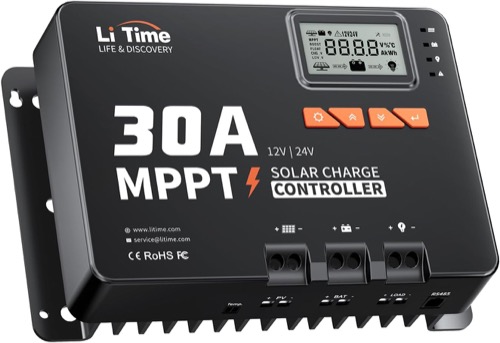
LiTime 30A MPPT Review: A Practical Bluetooth LiFePO4 Controller

Product A

LiTime 30A MPPT Review: A Practical Bluetooth LiFePO4 Controller

Check price at Amazon Jump to details
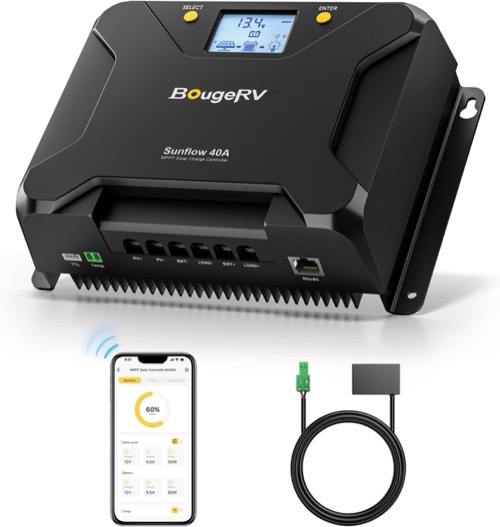
BougeRV Sunflow 40A MPPT Review: Capable Hardware, Uneven Controls

Product B

BougeRV Sunflow 40A MPPT Review: Capable Hardware, Uneven Controls

Check price at Amazon Jump to details

A 30A vs 40A solar charge controller decision should begin with battery-side current and battery-voltage-specific PV watts, not the assumption that ten extra amps always improve a system. The exact LiTime 30A Smart MPPT and BougeRV Sunflow 40A both accept 12V or 24V banks, use a 100V-class PV input, include Bluetooth and local displays, and provide 20A load outputs. BougeRV adds capacity; LiTime adds longer warranty coverage.

The apparent sizing shortcut creates two risks. A 40A model can be wasted on a bank limited to 25A, while a 30A model can clip a suitable larger array that the battery could accept. Both products also leave maximum PV Isc and terminal wire size unresolved in the reviewed material, so neither can be approved from its output suffix alone.

This wrapper uses exact-model evidence and the catalog snapshot dated August 3, 2026. Captured Amazon reviews inform ownership questions but do not become Solar Power Picks measurements or safe wiring specifications.

Quick Verdict — 30A vs 40A Solar Charge Controller

Choose LiTime 30A If Choose BougeRV 40A If
The design stays within 450W at 12V or 900W at 24V The design needs up to 600W at 12V or 1,200W at 24V
Battery charging demand remains at or below 30A The bank can accept and the array can produce 31A–40A
A three-year warranty outweighs extra capacity IP34, a published ambient range, or 200-day app history matters
LiTime’s supported chemistry set matches the bank Flooded, AGM, or user-defined support is required

BougeRV is the performance winner where its extra 150W/300W allowance and 40A ceiling are used. LiTime is the more conservative fit when 30A already covers the design and a three-year warranty matters more than environmental documentation. Neither gets an unconditional recommendation until the proposed array’s PV Isc and the required conductor termination are confirmed with the manufacturer.

📌 Output is not input — Thirty or forty amps identifies battery-side charge capacity. It does not disclose how much short-circuit current the PV terminals tolerate.

Which Size Fits Common Systems?

Scenario Winner Why Limit to Verify
12V array at or below 450W LiTime 30A class covers published allowance Estimated charge current and battery limit
12V array from 451W to 600W BougeRV Higher 12V PV ceiling PV Isc and authorized overpaneling
24V array at or below 900W LiTime More output may remain unused Cold Voc and terminal fit
24V array from 901W to 1,200W BougeRV Adds 300W published capacity Thermal conditions and 40A cable path
LiFePO4 system seeking long warranty LiTime Three years versus 18 months Cold-charge strategy remains external/unresolved
Flooded lead-acid bank BougeRV Flooded preset is explicitly listed Sensor and compensation behavior
Long app-history requirement BougeRV Advertises up to 200 days Phone/app compatibility and data retention
Lowest dated purchase price BougeRV $129.99 versus $144.99 Seller, bundle, and warranty eligibility

Solar Array Compatibility: Capacity Versus Guardrails

LiTime publishes a 100V maximum PV open-circuit voltage. BougeRV lists 100V as absolute, with protection at 95V and recovery at 90V. Those additional thresholds illustrate why normal operation should not be planned next to the absolute limit. Use module Voc, number in series, the published temperature coefficient, and the site’s design-low temperature.

At 12V, LiTime permits 450W while BougeRV permits 600W. At 24V, the numbers are 900W and 1,200W. These watt rows are not generic input ratings; each belongs to its battery voltage and remains subordinate to voltage and current limits.

Array Boundary LiTime 30A BougeRV 40A
Maximum PV Voc 100V 100V absolute; 95V protect / 90V recover
Maximum PV Isc Not published in reviewed exact-model data Not published in reviewed exact-model data
PV watts at 12V 450W 600W
PV watts at 24V 900W 1,200W
Section winner BougeRV for watts; tie on unresolved current Larger envelope does not remove evidence gap

Both products advertise MPPT behavior, but peak tracking statements cannot determine annual yield for an installed array. Cable loss, shade, panel temperature, battery state, clipping, and thermal derating change the operating result. Treat the missing Isc figures as stop points for parallel-string approval rather than filling them with the 30A and 40A output ratings.

⚠️ Hard voltage limit — Approved excess watts may be clipped. Excess corrected Voc is not clipped safely, and a protective threshold should not be used as the normal design target.

Charge Current and Battery Profile Fit

LiTime’s 30A ceiling maps naturally to smaller banks or arrays. BougeRV can deliver up to 40A when conditions and battery acceptance allow. A preliminary estimate divides array watts by the target charging voltage, but the final decision also checks the controller’s published watt row, conversion behavior, battery/BMS current limit, and other simultaneous chargers.

LiTime lists LiFePO4, sealed lead-acid, and gel profiles with adjustable parameters. BougeRV adds flooded, AGM, and user-defined options. More presets do not guarantee a correct battery configuration: verify the resulting voltage stages, maximum current, equalization behavior, and temperature rules against the exact battery manual.

Bank Question LiTime BougeRV
Maximum charge output 30A 40A
Bank voltages 12V / 24V automatic 12V / 24V
Explicit chemistry choices LiFePO4, sealed, gel LiFePO4, sealed, gel, flooded, AGM, custom
Lithium low-temperature cutoff Not published Not published
Section winner BougeRV for range and current Both need a documented cold-charge strategy

Neither reviewed evidence set establishes a controller-managed LiFePO4 cold cutoff. Over-temperature protection inside the controller is a different function. The battery BMS or another approved device must implement the battery maker’s cold-charging rule if the controller cannot.

🔋 Battery check — Add every possible charger before comparing current with the BMS limit. A 40A solar controller plus alternator and shore charger can exceed a bank limit even when each source is acceptable alone.

Wiring, Terminals, and Controlled Loads

LiTime measures 9.65 × 7.09 × 3.25 inches and weighs 4.41 lb. BougeRV measures 227 × 159 × 75 mm and weighs 1.79 kg, making it somewhat lighter and narrower depending on orientation. Actual fit includes cable bends, ventilation, disconnect access, and room to retorque or inspect terminals.

Neither exact-model evidence publishes maximum terminal conductor size. That is a material gap because 40A on a low-voltage battery circuit can require substantial copper depending on run length and conditions. Do not infer that the opening accepts the cable calculated for ampacity and voltage drop, and never trim strands.

Connection Detail LiTime BougeRV
Maximum terminal wire size Unresolved Unresolved
Load output 20A 20A programmable
Local controls LCD, four buttons, LEDs Display and buttons
Package weight 2.0 kg 1.79 kg
Section winner Tie pending terminal data BougeRV is lighter; both need exact conductor confirmation

Their 20A load outputs are separate from charge output. Suitable small DC loads must stay inside continuous and surge limits and use correct branch protection. Inverters, large pumps, and heaters generally require a protected battery-side connection sized from their own manuals rather than a controller load terminal.

🔧 Installation stop — Obtain terminal range, strip length, torque, protection, grounding, and sequence instructions for the exact revision before purchasing cable or energizing either unit.

Monitoring and Configuration: Similar Hardware, Different Data Emphasis

Both controllers include Bluetooth and a local numeric display, avoiding the optional dongle required by some competing products. LiTime uses the LiTime Solar app, while BougeRV’s app advertises up to 200 days of stored data. Long history can help reveal seasonal patterns or intermittent clipping, but it does not make an incompatible array acceptable.

Local buttons matter when the controller is reachable and phone pairing fails. App access matters when the unit is hidden or history is needed. Before installation, confirm that every critical parameter can be set through the intended interface and that the phone version, firmware, permissions, and mounting location support reliable communication.

Monitoring Requirement Better Fit Reason
Built-in Bluetooth Tie Both include it
Numeric local screen Tie Both provide local display/control
Advertised long data history BougeRV Up to 200 days stated
Four-button local navigation LiTime Exact control layout documented
Section winner BougeRV, slightly History is a differentiator; core access is otherwise similar

Captured owner reports include successful app and installation experiences as well as model-specific complaints. Use them to build a commissioning checklist rather than a reliability score: connect the app, compare displayed values with safe independent measurements, save the final profile, and verify that data continues after the compartment is closed.

Environment, Protection, and Warranty

BougeRV documents IP34 and an operating range of -35°C to 65°C. IP34 still means a protected installation, especially around cable entries and terminals; it is not a reason to mount the controller in rain or bilge water. LiTime describes a die-cast aluminum enclosure, but the reviewed product evidence does not publish an IP rating or ambient range.

LiTime’s documentation gap does not prove poor sealing or a narrow temperature range. It means the installation cannot rely on a published value until LiTime confirms it. In exchange, LiTime provides a three-year warranty compared with BougeRV’s 18 months.

Ownership Factor LiTime BougeRV
Published IP rating Unresolved IP34
Published ambient range Unresolved -35°C to 65°C
Warranty 3 years 18 months
Amazon snapshot 4.4 / 156 4.2 / 113
Section winner Split BougeRV documents environment; LiTime covers longer

Marketplace averages are not controlled durability data, particularly with 113 and 156 ratings. Review patterns can identify what to inspect — heat, Bluetooth, manuals, terminals, or output — but should not be converted into a failure percentage. Confirm exact seller and regional warranty conditions before assigning value to either term.

🗣️ Evidence note — A missing specification is a documentation limitation; a customer complaint is an attributed event. Neither should be rewritten as a universal product property.

Price and Complete-System Value

The August 3 catalog listed LiTime at $144.99 and BougeRV at $129.99. BougeRV was cheaper while offering more charge and PV capacity, which makes it the stronger controller-only value on that date. Prices and coupons change, so recheck both exact ASINs and bundles.

LiTime’s longer warranty can offset the $15 difference for buyers who value coverage. BougeRV may avoid a later upgrade if 31A–40A is genuinely required. Conversely, purchasing 40A can increase cable and protection requirements without improving energy harvest when a small array or battery caps current below 30A.

Value Test Better Model What Must Be True
Lowest dated controller price BougeRV Exact listing and seller remain comparable
Most PV capacity per dollar BougeRV System can use larger allowance
Longer warranty LiTime Three-year terms apply to purchase channel
Cheapest adequate 30A design Recheck live price Both fit all inputs and required accessories
Section winner BougeRV on snapshot value LiTime’s warranty is the meaningful concession

Category Winners

Category Winner Evidence-Backed Reason
Array capacity BougeRV 600W/1,200W versus 450W/900W
Battery configuration BougeRV More listed chemistry/custom options and 40A output
Installation Tie Neither publishes terminal size; both have 20A load output
Monitoring BougeRV Both include Bluetooth/display; BougeRV states longer history
Environmental documentation BougeRV IP34 and ambient range are published
Warranty LiTime Three years versus 18 months

30A vs 40A Solar Charge Controller — Which Should You Buy?

Choose LiTime 30A if the final design remains within 30A, 450W at 12V or 900W at 24V, its chemistry options match the battery, and a three-year warranty matters more than BougeRV’s added output. Accept that IP rating, operating range, PV Isc, terminal size, and controller-managed lithium cold cutoff require clarification.

Choose BougeRV 40A if the battery can accept 31A–40A, the array benefits from 600W/1,200W limits, and IP34 or longer app history has practical value. Its honest concession is the 18-month warranty, plus the same unresolved PV Isc, terminal-size, and lithium cold-protection questions.

The tie-breaker in a 30A vs 40A solar charge controller choice is the highest permitted and expected battery-side solar current after checking the exact bank. If it stays at 30A or below, choose on warranty and documentation. If it exceeds 30A and every PV, battery, cable, and thermal boundary passes, BougeRV’s additional capacity becomes useful rather than decorative.

Product A

LiTime 30A MPPT Review: A Practical Bluetooth LiFePO4 Controller

LiTime 30A MPPT Review: A Practical Bluetooth LiFePO4 Controller

Get it now:

Check latest price

What to know

  • Bluetooth is built in
  • Strong local controls
  • LiFePO4-oriented design
  • 20A load output

Best if

  • Bluetooth is built in
  • Strong local controls
  • LiFePO4-oriented design
  • 20A load output

Skip if

  • App polish varies
  • Support evidence is mixed
  • Some limits remain unpublished
  • No documented lithium cold cutoff

The LiTime 30A MPPT is a practical middle-ground choice for 12V/24V LiFePO4 systems that want both an LCD and built-in Bluetooth. Manufacturer documentation now fills the earlier 100V and 450W/900W PV gaps. The hardware earns positive owner feedback, while the app, documentation, and support experience are less consistent. Best fit: The LiTime 30A MPPT is a practical middle-ground choice for 12V/24V LiFePO4 systems that want both an LCD and built-in Bluetooth.

BrandLiTime
Model / SKU30A Smart MPPT (ASIN B0BJ75NLRM)
Controller typeMPPT
Rated charge current30A
Battery-system voltage12V / 24V automatic selection
Battery compatibilityLiFePO4, sealed lead-acid, and gel
Max PV open-circuit voltage (Voc)100V
Max PV input current (Isc)Not published for this model
Max PV power by battery voltage450W @ 12V; 900W @ 24V; 48V not supported
Load output20A rated load output
Charging profilesChemistry presets with adjustable parameters
Temperature sensing / low-temp protectionOver-temperature protection; controller-managed lithium low-temp cutoff not published
Display / local controlsLCD, four buttons, and status LEDs
App / communicationsBuilt-in Bluetooth; LiTime Solar app
Maximum terminal wire sizeNot published for this model
Maximum efficiency≥99% tracking; up to 98% peak conversion
Enclosure / operating temperatureDie-cast aluminum; IP and operating range not published on product page
Dimensions / weight9.65 × 7.09 × 3.25 in; 4.41 lb / 2.0 kg
Warranty3 years
Product B

BougeRV Sunflow 40A MPPT Review: Capable Hardware, Uneven Controls

BougeRV Sunflow 40A MPPT Review: Capable Hardware, Uneven Controls

Get it now:

Check latest price

What to know

  • Built-in Bluetooth
  • 40A MPPT output
  • 100V-class PV input
  • Published load and environmental limits

Best if

  • Built-in Bluetooth
  • 40A MPPT output
  • 100V-class PV input
  • Published load and environmental limits

Skip if

  • 12V/24V only
  • IP34 still requires protected mounting
  • App experience is mixed
  • 18-month warranty

Built-in Bluetooth, a 100V PV ceiling, and useful published limits make the Sunflow competitive, although app polish and the short warranty trail premium alternatives. Best fit: 12V/24V RV and cabin systems that want 40A charging with Bluetooth included.

BrandBougeRV
Model / SKUSunflow 40A MPPT / ISE218 family (ASIN B0CFKZ5Q97)
Controller typeMPPT
Rated charge current40A
Battery-system voltage12V / 24V
Battery compatibilityLiFePO4, sealed, gel, flooded, AGM, and user-defined
Max PV open-circuit voltage (Voc)100V absolute; 95V protection and 90V recovery
Max PV input current (Isc)Not published
Max PV power by battery voltage600W @ 12V; 1,200W @ 24V
Load output20A programmable load output
Charging profilesBattery presets plus user-defined settings
Temperature sensing / low-temp protectionInternal temperature behavior; external sensor and lithium low-temp cutoff not published
Display / local controlsLocal display and buttons
App / communicationsBuilt-in Bluetooth; app stores up to 200 days of data
Maximum terminal wire sizeNot published
Maximum efficiencyNot published
Enclosure / operating temperatureIP34; -35°C to 65°C
Dimensions / weight227 × 159 × 75 mm; 1.79 kg
Warranty18 months

Product Comparison

Feature LiTime 30A MPPT Review: A Practical Bluetooth LiFePO4 Controller BougeRV Sunflow 40A MPPT Review: Capable Hardware, Uneven Controls
Product Image
LiTime 30A MPPT Review: A Practical Bluetooth LiFePO4 Controller
BougeRV Sunflow 40A MPPT Review: Capable Hardware, Uneven Controls
Price $152.99 $144.99 N/A
Rating
4.2 / 5
4.2 / 5
Category Solar Charge Controllers Solar Charge Controllers
Brand LiTime BougeRV
Model / SKU 30A Smart MPPT (ASIN B0BJ75NLRM) Sunflow 40A MPPT / ISE218 family (ASIN B0CFKZ5Q97)
Controller type MPPT MPPT
Rated charge current 30A 40A
Battery-system voltage 12V / 24V automatic selection 12V / 24V
Battery compatibility LiFePO4, sealed lead-acid, and gel LiFePO4, sealed, gel, flooded, AGM, and user-defined
Max PV open-circuit voltage (Voc) 100V 100V absolute; 95V protection and 90V recovery
Max PV input current (Isc) Not published for this model Not published
Max PV power by battery voltage 450W @ 12V; 900W @ 24V; 48V not supported 600W @ 12V; 1,200W @ 24V
Load output 20A rated load output 20A programmable load output
Charging profiles Chemistry presets with adjustable parameters Battery presets plus user-defined settings
Temperature sensing / low-temp protection Over-temperature protection; controller-managed lithium low-temp cutoff not published Internal temperature behavior; external sensor and lithium low-temp cutoff not published
Display / local controls LCD, four buttons, and status LEDs Local display and buttons
App / communications Built-in Bluetooth; LiTime Solar app Built-in Bluetooth; app stores up to 200 days of data
Maximum terminal wire size Not published for this model Not published
Maximum efficiency ≥99% tracking; up to 98% peak conversion Not published
Enclosure / operating temperature Die-cast aluminum; IP and operating range not published on product page IP34; -35°C to 65°C
Dimensions / weight 9.65 × 7.09 × 3.25 in; 4.41 lb / 2.0 kg 227 × 159 × 75 mm; 1.79 kg
Warranty 3 years 18 months
Buy Now View Deal View Deal

30A vs 40A Solar Charge Controller: Which Size Fits?

Decision: Choose 30A only when the calculated charging current and the exact model's PV limits cover the array with margin. The BougeRV 40A offers more output and built-in Bluetooth; the LiTime 30A can be the better compact lithium-oriented fit when its lower ceiling is sufficient.

Before buying, verify cold Voc, PV Isc, PV watts, charge current, conductors, fusing, and battery settings against the current manuals.

Frequently Asked Questions

How do I know whether I need a 30A or 40A controller?

Estimate battery-side charging current, then check cold PV Voc, array Isc, PV watts at the actual battery voltage, and the battery's current limit. Choose a model that passes every limit with the required margin.

Do LiTime 30A and BougeRV 40A include Bluetooth?

Yes. Both reviewed models list built-in Bluetooth, so neither requires a separate monitoring dongle for its standard app connection.

Which controller has better weather documentation?

BougeRV publishes IP34 and a -35°C to 65°C range. LiTime's reviewed product-page evidence does not publish an IP rating or operating-temperature range.

Does either model provide lithium low-temperature cutoff?

The reviewed exact-model specifications do not publish a controller-managed cutoff for either product. Confirm protection through the battery BMS or another verified control.

Which product has the longer warranty?

LiTime publishes a three-year warranty. BougeRV publishes 18 months, so the higher-output product does not have the longer coverage.

×

About Solar Power Picks

Portable Solar Power, Backup Power, and Off-Grid Gear Guides

Your trusted source for honest, in-depth product reviews and comparisons.

Quick Links

  • Best Picks
  • Reviews
  • Guides
  • Comparisons
  • Calculator
  • Privacy policy
  • Favorites

Categories

  • Portable Power Stations
  • Solar Batteries
  • Solar Charge Controllers
  • Solar Generators
  • Solar Panels

© 2026 Solar Power Picks. All Rights Reserved.

We may earn a commission when you purchase through links on our site. Learn more