The best budget solar charge controllers reduce purchase cost without transferring unacceptable uncertainty to the battery, wiring, or property. A documented 10A controller can be a better value than a “30A” model whose PV voltage, current, terminal, enclosure, and warranty limits are missing.
Cheap hardware becomes expensive when it damages a battery, requires a remote service trip, or forces repeated rewiring. The correct budget question is therefore not “which controller has the most amps per dollar?” but “what is the smallest consequence if this controller or its documentation is wrong?”
We assessed these five products using exact listing evidence and captured owner reports, including multi-year service, early failures, inaccurate displays, reverse drain, and two smoking-USB allegations. Solar Power Picks did not perform hands-on electrical or safety testing.
Budget rule — Save money by shrinking the system and feature requirements, not by pretending an unpublished electrical limit does not exist.
The Five Budget Positions
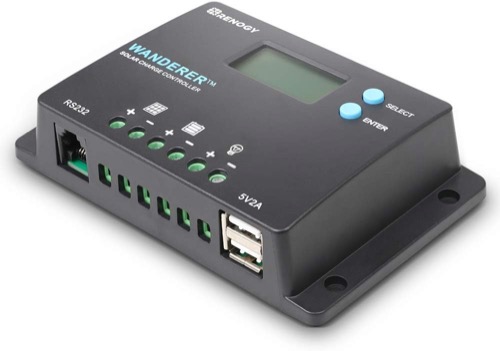
Renogy Wanderer is the overall value because it publishes a defensible small-system envelope. The other four remain on the shortlist for narrower reasons: extremely low entry price, a two-pack, or SAE-connected portability. None should be scaled to the faceplate current without exact documentation.
| Product | Budget Badge | Type / Rated Output | Published PV Boundary | Battery System | Honest Role |
|---|---|---|---|---|---|
| Renogy Wanderer 10A | Best Overall Budget Controller | PWM / 10A | 50V; 130W @ 12V, 260W @ 24V | 12V / 24V | Documented sheds, lighting, fences, and maintenance |
| Anern 30A | Lowest Price with a Safety Red Flag | PWM / 30A faceplate | Voc/Isc/watts not published | 12V / 24V lead-acid | Supervised experiment with USB unused |
| Rolokit 30A | Best Disposable Maintainer Economics | PWM / 30A faceplate | Voc/Isc/watts not published | 12V / 24V lead-acid | Visible single-panel maintenance |
| ACEIRMC 30A Two-Pack | Best Two-Site Bundle | PWM / 30A each | Voc/Isc/watts not published | 12V / 24V lead-acid | Two separate noncritical projects or a shelf spare |
| SUNAPEX 20A | Best SAE Portable Convenience | PWM / 20A | 300W stated; Voc/Isc not published | 12V | One portable 100W-class setup after variant verification |
The sequence reflects recommendation strength, not amp rating. Wanderer’s 10A ceiling is real and restrictive; it still ranks ahead because a buyer can determine when it fits. The budget models below it require a deliberately smaller and more observable application.
How We Chose the Best Budget Solar Charge Controllers
We treated documentation as a product feature with economic value. Published Voc, watts, terminal size, operating range, battery profiles, warranty, and support reduce installation guesswork and lower the chance of replacing the wrong component. Unknowns received no favorable assumptions.
Owner evidence was weighted by detail and consequence. A month of chicken-coop fan service is useful but does not validate 30A. One of two dead bundle units matters more than a generic five-star line, and two independent reports of smoke from Anern’s USB ports are serious even though they cannot establish a model-wide rate.
| Criterion | Budget Impact | Weight |
|---|---|---|
| Documented safe envelope | Prevents buying panels, cable, or batteries the controller cannot support | High |
| Failure consequence | Determines whether disposable hardware is rational | High |
| Battery compatibility | An unsupported chemistry can cost more than the controller | High |
| Inspectability | Cheap systems need easy measurements and replacement | Medium |
| Useful included features | LCD, load modes, SAE leads, or spare units can avoid other purchases | Medium |
| Owner duration/detail | Specific service reports outrank initial impressions | Medium |
Evidence note — A low price does not lower battery fault current. Fusing, conductor sizing, polarity, and safe de-energization remain full-price requirements.
Best Overall Budget Controller: Renogy Wanderer 10A
Wanderer is the only model in this roster with a comparatively complete design basis. Renogy publishes 50V maximum PV Voc, 130W at 12V or 260W at 24V, 10A charge and load circuits, 12 AWG terminal maximum, local LCD/USB, several timer modes, common battery selections, and an operating range.
Owners describe years of service in 50W sheds, small lighting, and RV systems, while two report early electrical/display failures. Bluetooth requires a BT-1 module and may not provide the historical logging some buyers expect. The small terminals also make long, low-voltage cable runs a design concern.
This is not the cheapest checkout price. It is the least uncertain value for a system that genuinely fits below 10A. Buy a larger documented controller rather than parallel more panels or trim cable strands to keep the Wanderer.
Lowest Price with a Safety Red Flag: Anern 30A
Anern offers an LCD, USB ports, lead-acid modes, and a programmable load output at roughly the cost of a cable adapter. Unfortunately, the reviewed record does not publish PV Voc, Isc, watts, terminal capacity, IP rating, temperature range, or warranty.
More importantly, two owners separately described smoke from the USB area, including replacement-unit recurrence in one account. Those reports do not prove every unit is unsafe, but they are enough for this article to advise against USB use and against installing the controller near combustibles or leaving it unattended.
Anern is not an affirmative recommendation for a new system. It is included to show the boundary of budget buying: an existing owner may evaluate it on a tiny supervised lead-acid setup, but a buyer should spend more for documented hardware.
Best Disposable Maintainer Economics: Rolokit 30A
Rolokit’s value argument is that failure may cost less than a restaurant meal when the project is visible and unimportant. Owner examples include a 100W-class camper maintainer and a fountain. One controller failed on the second day; another account referenced similar cheap hardware lasting four years as well as units lasting only months.
PV Voc, Isc, allowed watts, terminal/torque, operating temperature, and warranty remain unresolved. Lithium is not supported in the reviewed profile. Its LCD, USB, and timer are conveniences, not evidence that a 30A array is safe.
Choose it only when the battery is supported lead-acid, the panel remains modest, the site is dry and inspected, and downtime has little consequence. Travel to a remote gate or replacement of a sulfated battery destroys the disposable-price logic.
Best Two-Site Bundle: ACEIRMC 30A Two-Pack
ACEIRMC sells two nominal 30A PWM controllers together. The strongest owner example used separate small systems for chicken-coop fans over several months. A second controller can also serve as a shelf spare, which may have real value at an accessible hobby site.
The bundle doubles hardware but not documentation. PV Voc, Isc, watts, terminal limits, load-output current, and environmental rating were not published. Owners reported one of two units dead, a display becoming inaccurate after eight months, and possible nighttime battery drain.
Do not combine the pair and call it a documented 60A controller. Parallel charging on one bank requires manufacturer-approved coordination. Its cleanest use is one independently protected controller per small project, each commissioned and monitored on its own.
Best SAE Portable Convenience: SUNAPEX 20A
SUNAPEX provides fixed SAE-style wiring, a local display, PWM charging, and a stated 300W maximum for a 12V portable or maintenance system. A detailed owner example supports operation around one nominal 100W panel.
The evidence mixes variants: one review references USB-A/USB-C ports not established in the canonical profile, while connector bundles can involve SAE/MC4 adapters and clips. Maximum PV Voc and Isc are missing, and no formal IP code supports exposed-weather assumptions.
Choose SUNAPEX for connector convenience only after matching the received revision to its manual, verifying polarity with a meter, and rating every adapter/lead for the expected current. A high-voltage 300W residential panel is not equivalent to three hundred watts of voltage-matched portable modules.
Cost-of-Failure Matrix
| Product | Suitable Budget Context | Best For | Skip If | Cost That Can Erase Savings |
|---|---|---|---|---|
| Wanderer 10A | Documented 50–130W 12V-class system | Long-term small project | More output or larger cable is required | Buying BT-1 and upgrading soon afterward |
| Anern 30A | Existing supervised lead-acid experiment | No-USB evaluation only | Any unattended/combustible installation | Heat/smoke event or battery damage |
| Rolokit 30A | Visible maintainer where replacement is trivial | Cheapest basic charging | Remote travel or valuable battery | Service trip and undercharged battery |
| ACEIRMC two-pack | Two separate small protected sites | Bundle/spare economics | Both units are expected to combine | Two commissioning jobs and variable QC |
| SUNAPEX 20A | Portable SAE ecosystem, one modest panel | Fast setup | Variant/manual cannot be matched | Wrong polarity, adapter loss, or incompatible panel |
Find the Real Budget Before Choosing Hardware
Add the Parts That Every System Still Needs
Controller price excludes suitable PV and battery fuses/breakers, disconnects, conductors, terminals, mounting enclosure, cable glands, connectors, and measurement tools. A $10 controller does not make improvised wiring acceptable. In fact, missing terminal specifications can force redesign or justify buying a better controller before any cable is cut.
Also price monitoring and replacement. Wanderer already supplies local values but charges extra for Bluetooth. The generic models supply an LCD yet may require an independent meter to verify calibration. A spare ACEIRMC helps only if swapping it is safe, settings are known, and the original failure did not originate elsewhere in the system.
Match the Product to Failure Consequence
A decorative fountain or supervised bench can tolerate downtime. A remote gate, ventilation fan in hot weather, livestock water system, medical load, or valuable lithium bank cannot. As consequence rises, documentation, warranty, alarms, and proven support become economically rational.
The controller should never be the only protection against a dangerous failure. Appropriate fusing and disconnects are required regardless of price. For critical energy, redundancy and monitoring must be designed at the system level rather than expected from a budget controller.
Value check — If a single site visit, damaged battery, or missed day of service costs more than the price gap to documented hardware, the cheaper controller is not the budget choice.
Keep the Array Close to Evidence
The strongest use evidence for these generic controllers centers on one modest panel, often around 100W. That does not create a universal 100W limit, but it shows where uncertainty is less severe than at a supposed 30A ceiling.
Before expansion, obtain PV Voc, Isc, watts by battery voltage, terminal size/torque, and thermal limits. If the manufacturer cannot provide them, stop expanding. Replacing the controller is more responsible than using the battery-side amp label as permission for parallel strings.
Treat Display Values as Clues
Budget LCDs make setup easier but are not precision battery monitors. Ephemeral percentage icons depend on voltage and programmed assumptions. ACEIRMC has an inaccurate-display report; the generic products may also show voltage at the controller that differs from battery posts due to cable drop.
Compare with a suitable meter during commissioning. Record resting battery voltage, charging voltage/current, full-sun terminal temperature, and overnight change. De-energize at heat, odor, smoke, resetting, blank display, or unexplained overvoltage.
Do Not Buy Features You Cannot Safely Load
USB and programmable load terminals are attractive at this price. Their published continuous current, surge behavior, conversion quality, and protection may be incomplete. The Anern smoke reports make a dedicated reputable USB converter the safer choice, while inverters and high-inrush motors belong on appropriately protected battery-side circuits.
Use dusk/timer output only for a modest load within the exact rating. If the rating is unknown, a separate documented controller or relay arrangement may cost less than troubleshooting repeated cycling.
Preliminary Budget-System Examples
These output-demand estimates divide array watts by representative charging voltage. They do not establish product compatibility where Voc/Isc/watts are missing.
| Hypothetical Project | Array Watts | Series Voc at STC | Battery | Approx. Output Demand | Still Must Verify |
|---|---|---|---|---|---|
| Shed lighting | 60W | 22V | 12V lead-acid | 60 ÷ 14.4 = 4.2A | Cold Voc, panel current, terminal fit, daily load |
| Camper maintainer | 100W | 22V | 12V lead-acid | 100 ÷ 14.4 = 6.9A | Winter energy, cable drop, overnight drain |
| Two separate coops | 2 × 50W | 22V each | Two 12V banks | 3.5A each | Independent protection and settings at both sites |
| 24V lighting | 200W | 44V | 24V lead-acid | 200 ÷ 28.8 = 6.9A | Exact 24V PV limit and cold voltage |
Budget Buying Mistakes
- Ranking nominal amps above published electrical limits.
- Assuming “30A” defines maximum array Isc or watts.
- Counting two controllers as a combined output without manufacturer approval.
- Using USB after heat, odor, discoloration, or smoke.
- Putting anonymous indoor hardware in a wet or combustible enclosure.
- Buying an SAE adapter without verifying polarity and current rating.
- Trimming conductor strands to fit an undocumented terminal.
- Ignoring the travel, battery, and rewiring cost of controller failure.
Bottom Line — Best Budget Solar Charge Controllers
The Renogy Wanderer 10A is the best overall budget choice because its modest published envelope can be designed around responsibly. Rolokit can make sense as an inspected disposable maintainer, ACEIRMC as two independent noncritical controllers, and SUNAPEX as a verified SAE-connected portable setup. Anern’s two smoking-USB reports and missing limits make it a product to replace or evaluate very cautiously—not a new-buy recommendation.
For any of these best budget solar charge controllers, confirm cold PV Voc, array Isc, permitted watts, battery chemistry/current, conductor and terminal fit, enclosure, load/USB ratings, and nighttime behavior. When those facts cannot be obtained, lower the consequence and scale or buy the documented Wanderer. Cheap becomes value only when uncertainty is contained before the battery is connected.