
Solar Power Picks logo with sun, solar panel, and green energy icon

  • Home
  • Reviews
  • Best
    • Best portable power stations
    • Best Solar Panels
    • Best Solar Generators
    • Best Solar Charge Controllers
    • Best Solar Batteries
  • Guides
    • Portable Power Stations Guides
    • Solar Panels Guides
    • Solar Generators Guides
    • Solar Charge Controllers Guides
    • Solar Batteries Guides
  • Comparisons
    • Portable Power Stations Comparisons
    • Solar Panels Comparisons
    • Solar Generators Comparisons
    • Solar Charge Controllers Comparisons
    • Solar Batteries Comparisons
  • Calculator
Home / Solar Charge Controllers / Best / Waterproof Solar Charge Controllers: When the Voyager Fits

Waterproof Solar Charge Controllers: When the Voyager Fits

OUR PICKS

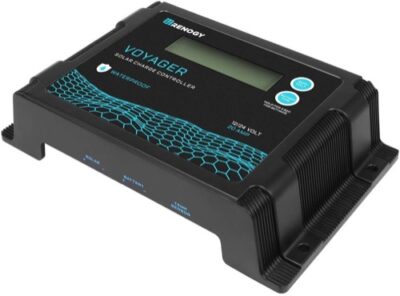
Renogy Voyager 20A Review: Waterproof PWM with Clear Limits

Documented IP67 PWM option

Renogy Voyager 20A Review: Waterproof PWM with Clear Limits

Check price at Amazon Jump to details

Waterproof solar charge controllers need both credible enclosure protection and a documented electrical fit. The Renogy Voyager 20A is the single candidate retained on this page. That is a limited shortlist, not a claim that it is the only suitable outdoor controller on the market or the right choice for every exposed installation.

One Candidate, With a Clearly Defined Outdoor Role

The reviewed Voyager combines a documented IP67 enclosure with a local interface and a 12V/24V PWM charging role. Those characteristics make it worth considering for a suitable small outdoor system. They do not turn it into a high-voltage MPPT controller or a complete power-management center.

This page keeps one candidate because other products in the reviewed pool leave unresolved electrical-limit, enclosure or exact-product questions. A longer list would not make those uncertainties disappear. Their omission is not evidence that every alternative is defective, and it is not a ranking of all products sold worldwide.

Start by deciding whether an exposed-controller installation is actually necessary. A different protected mounting location can sometimes change the product requirements, but any enclosure or mounting change must still meet the equipment’s ventilation, temperature and installation instructions.

Draw the Boundary Around the Enclosure Rating

An ingress rating applies to the rated equipment under its specified conditions. It does not automatically apply to field-made joints, external connectors, fuse holders, cable entries or the battery enclosure. Those parts can remain the weak points even when the controller body is protected.

Do not extend a waterproof label into assumptions about every outdoor condition. Sun exposure, temperature, corrosion, cable strain and the way water reaches connections are separate practical considerations. Use the manufacturer’s mounting and environmental instructions rather than inventing a broader approval from the label.

The useful buying question is therefore not simply whether the controller can be outside. Ask how the complete charging path will be protected and inspected at the intended site. A sealed-looking box cannot answer those questions for the surrounding wiring.

Part of the installation What to verify What the controller rating does not settle
Controller enclosure Exact rating and mounting instructions Suitability for every exposure or temperature
External connections Compatible protection and mechanical support Weather resistance of field-made joints
Battery location The battery’s environmental requirements Protection of the battery enclosure
Maintenance access A practical inspection and isolation plan Long-term condition without inspection

Check the Panel Match Before Choosing PWM

The Voyager’s PWM topology is appropriate only when the panel and battery architecture fit that type of controller. It should not be chosen solely because its enclosure is attractive. An array that needs a different voltage-conversion approach may require a different controller or installation design.

Check the exact PV voltage and power limits for the selected battery voltage, along with applicable current restrictions. Use module open-circuit data and relevant temperature information for the voltage assessment. The nameplate watts alone do not establish compatibility.

The PWM and MPPT comparison helps distinguish the electrical choice from the enclosure choice. If the array does not fit the Voyager’s documented role, retain the array requirements rather than stretching them to make the one candidate on this page work.

Plan Connections for Inspection, Not Just First Assembly

Outdoor wiring should be arranged so that connections are supported, protected and accessible according to the equipment instructions and the installation design. Avoid depending on an improvised adapter or a connector whose polarity and rating have not been verified.

Think about how the site will be inspected after weather, movement or ordinary use. The appropriate maintenance plan depends on the environment and manufacturer guidance. Access to a display is helpful, but an indicated charge state is not a complete inspection of the cable path.

Use the charge-controller wiring guide for planning context, then follow the exact equipment requirements. This buying guide is not a universal connection sequence or a substitute for a qualified installation where required.

Outdoor boundary: protecting the controller body is one part of the design. The external wiring, protection devices and battery still need their own suitable arrangement.

Keep Battery Requirements in the Outdoor Decision

The battery can face different temperatures from the controller, particularly when one is shaded or enclosed and the other is exposed. Confirm the battery’s permitted charging conditions and how the system will meet them. Enclosure protection does not create low-temperature charge control.

Match the selected charging profile to the battery documentation. Do not assume a lithium option authorizes charging in any weather, and do not assume every controller sharing a family name supports the same setup. The exact delivered revision matters.

If the system is intended for unattended use, identify how faults or unexpected charging behavior will be noticed and resolved. The Voyager’s local interface is a particular workflow; it is not a promise of remote notification or continuous supervision.

When to Choose a Different Outdoor Solution

Leave this shortlist if the array exceeds the electrical limits, the battery requirements cannot be met or the site needs monitoring functions the candidate does not provide. A one-product page is not a reason to compromise any of those requirements.

This is a research-led assessment using documented features and the evidence supporting the linked Voyager review. Solar Power Picks does not claim to have performed enclosure, immersion or long-term outdoor durability testing. Owner experiences can raise useful inspection questions without proving a service-life guarantee.

Before purchasing, confirm the exact unit, included hardware and applicable manual. Compare the total outdoor-system cost, not only the controller price. If another documented solution is needed, widen the search rather than treating the single retained candidate as an obligation to buy.

  • Confirm that PWM suits the actual array and battery.
  • Separate the controller’s rating from protection of external parts.
  • Plan battery temperature behavior independently of weather sealing.
  • Keep an accessible inspection and fault-response plan.
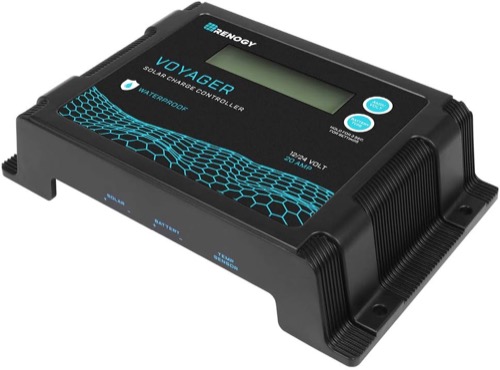
Documented IP67 PWM option

Renogy Voyager 20A Review: Waterproof PWM with Clear Limits

Renogy Voyager 20A Review: Waterproof PWM with Clear Limits

Get it now:

Check latest price

What to know

  • Controller type: PWM
  • Rated battery-side charge current: 20A
  • Supported battery-system voltage: 12V / 24V automatic recognition
  • Maximum PV open-circuit voltage (Voc): 25V @ 12V; 55V @ 24V
  • App, communications, and data history: No app or communication port

The Voyager 20A combines a documented IP67 enclosure with a local display and a defined 12V/24V PWM role. Its enclosure rating is the reason it remains on this outdoor shortlist. It does not extend that rating to external connectors, fuses, splices or the battery enclosure; those parts still need their own suitable protection and installation plan.

BrandRenogy
Exact model / revision / ASINNew Edition Voyager 20A (VOYP20 / RCC20VOYP; ASIN B07YXZMKD2)
Controller typePWM
Rated battery-side charge current20A
Supported battery-system voltage12V / 24V automatic recognition
Battery chemistry and profile supportSealed/AGM, gel, flooded, and lithium
Maximum PV open-circuit voltage (Voc)25V @ 12V; 55V @ 24V
Maximum PV short-circuit/input current (Isc)20A controller limit; verify array Isc and required margin
Maximum PV power by battery voltage260W @ 12V; 520W @ 24V
Minimum PV/start voltage requirement15V minimum PV input for the reviewed 12V/24V New Edition Voyager
Load output and low-voltage disconnectNo dedicated load terminals
Grounding topologyCommon positive / positive ground
Charging stages and custom voltage controlFour-stage PWM with battery presets and adjustable lithium charging limit
Temperature sensing and lithium low-temperature behavior-3mV/°C/2V compensation for lead-acid; no lithium low-temp cutoff published
Display and local controlsBacklit LCD and two-button controls
App, communications, and data historyNo app or communication port
Maximum terminal conductor size6 AWG
Controller self-consumption0.24W at 12V; 0.74W at 24V
Published tracking/conversion efficiencyNot applicable; PWM controller
Cooling method and thermal deratingNot published for the reviewed revision
Electrical protectionsPV/battery reverse-polarity, overcharge, short-circuit, reverse-current, overload, over-discharge, and controller/battery overtemperature protection
Enclosure, ingress rating, and operating temperatureIP67; -35°C to 45°C (-31°F to 113°F)
CertificationsNot published for the reviewed revision
Dimensions, weight, and included accessories6.08 × 3.83 × 1.40 in; 0.55 lb
Warranty2 years

Voyager Fits Only When Both the Enclosure and Electrical Requirements Match

The Voyager 20A remains the documented starting point on this limited outdoor shortlist. Its enclosure is a useful feature, but the array, battery, connections and site must also fit. Choose a different documented solution when the project needs another topology, input envelope or monitoring arrangement.

Frequently Asked Questions

Why is there only one waterproof controller on this page?

Only the Voyager remains in this shortlist after the current evidence and identity review. Other reviewed candidates have unresolved questions that matter to a recommendation. This is a limited selection, not a claim that no other suitable waterproof controller exists.

Does an IP67 controller make the whole solar system waterproof?

No. The controller’s enclosure rating does not automatically cover the external wiring, joints, protective devices or battery housing. Each part must be suitable for its environment and installed correctly. Follow the rating conditions and the manufacturer’s mounting instructions.

Can I choose Voyager just because my panels are outdoors?

Not on that basis alone. The controller must also fit the panel arrangement, battery and charging requirements. Its PWM topology and input limits remain relevant even when weather protection is a priority. Consider a different design when the electrical requirements do not match.

Does weather sealing protect a lithium battery from cold charging?

No. Weather protection and temperature-based charging restrictions are different subjects. The battery’s permitted conditions and the supported control arrangement need to be checked separately. A lithium profile or protected enclosure does not establish complete cold-charge protection.

What should be inspected around an outdoor controller?

Follow the equipment guidance for the site, including the condition and support of connections, cable entries, protection devices and the battery arrangement. A working status display does not prove that every external connection remains suitable after weather or movement.

Has Solar Power Picks tested Voyager’s waterproof performance?

No first-party ingress or immersion testing is claimed. The page relies on documented enclosure information and the research behind the linked review. Those sources support a comparison of features, not a guarantee of performance in every outdoor exposure.

×

About Solar Power Picks

Portable Solar Power, Backup Power, and Off-Grid Gear Guides

Your trusted source for honest, in-depth product reviews and comparisons.

Quick Links

  • Best Picks
  • Reviews
  • Guides
  • Comparisons
  • Calculator
  • Privacy policy
  • Favorites

Categories

  • Portable Power Stations
  • Solar Batteries
  • Solar Battery Maintainers
  • Solar Charge Controllers
  • Solar Generators
  • Solar Panels

© 2026 Solar Power Picks. All Rights Reserved.

We may earn a commission when you purchase through links on our site. Learn more