Bateria Power SunRock 10A Review: Compact MPPT with a Narrow PV Window
At a Glance
KEY FEATURES
- Controller: MPPT as specified by the manufacturer; 10A rated charge output.
- System: 12V; AGM, gel, sealed, flooded, deep-cycle lead-acid, and LiFePO4.
- PV boundary: 30V; operating PV range stated as 15V-30V maximum Voc; Not published maximum PV power.
- Controls: LCD and local buttons; No app or communications port.
- Best fit: Small portable 12V solar systems needing a compact controller with broad battery selection.
PROS
- Compact inline MPPT packaging fits portable and maintenance systems.
- Local voltage and current display adds useful visibility.
- SAE accessories can simplify small-system assembly.
CONS
- SAE polarity must be measured before connection.
- PV window, display accuracy, and nighttime draw require testing.
- Sensitive radio installations may need interference mitigation.
Editor's Choice
Editorial assessment based on exact-model documentation and qualitative exact-ASIN owner evidence; no first-party bench test or population-rate claim
Will the Bateria Power SunRock 10A Fit Your Solar Array?
Estimate required charging current and check it against the documented limits for Bateria Power SunRock 10A.
Solar Charge Controller Size Calculator
What size charge controller do I need?
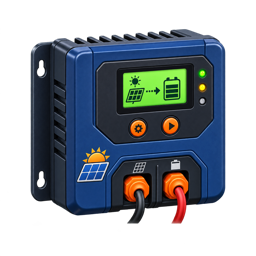
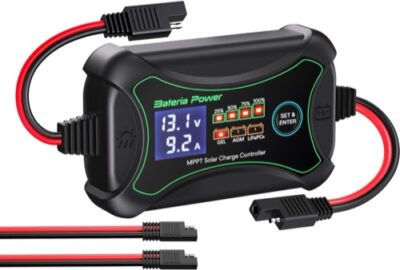
The SunRock 10A targets small 12V systems that need more battery flexibility than a basic maintainer. It supports common lead-acid types and LiFePO4, provides a tiny LCD, and is described by the manufacturer as MPPT. Its stated PV operating range is only 15V–30V, making panel matching more restrictive than on 75V or 100V controllers.
Owner reports cover motorcycles, boats, a UTV, shop lighting, ham radio, and portable LiFePO4 boxes. They also include a dead-on-arrival unit, a controller that died after an hour, incomplete charging, radio-frequency noise, and one long troubleshooting story that ultimately traced poor output to undersized wire. The SunRock can be useful, but it is not a plug-any-panel-into-it device.
| Best For | Main Strength | Main Limitation | Evidence Confidence |
|---|---|---|---|
| Compact 12V systems around 35W–100W with local status needs | Broad battery selection in a small format | 30V ceiling, unpublished Isc/watts, and mixed QC | Medium |
The SunRock's Compact Size Comes With a Narrow Electrical Window
The expanded exact-ASIN evidence supports the Bateria Power SunRock 10A as a genuinely compact controller for small solar systems. Owners use it for motorcycles, boats, portable battery boxes, workshops, radio equipment, and maintainers. Its strongest appeal is packaging: numeric voltage/current information and MPPT behavior in a form that can fit where a conventional finned controller cannot.
The same evidence surfaces four boundaries: a narrow PV operating window, nonstandard or surprising SAE polarity, display accuracy or failures, and radio-frequency noise in sensitive installations. Critical accounts also debate low-light behavior and self-consumption. These are reasons to measure the delivered unit, not statistics about every unit.
A small controller still needs correctly sized conductors. One detailed owner traced weak output to wiring that had been adequate only for a much smaller panel. Keep cable runs short, protect the battery side, and do not interpret low controller output until voltage drop and panel capability have been measured. For LiFePO4, compare the fixed or selectable charge target with the exact battery specification.
Choose the SunRock when 10A is enough, space is scarce, and you can verify polarity and readings. Buyers who need adjustable profiles, extensive history, very low radio noise, or broader PV-voltage flexibility should compare a larger, more configurable controller despite the packaging penalty.
A 15V–30V Window Leaves Little Series Flexibility
The controller is intended for 12V batteries and accepts PV in a stated 15V–30V operating range, with 30V as the ceiling. That can suit one 12V-class panel. Two such panels in series can easily exceed 30V open circuit even before cold-weather correction.
Maximum PV Isc and panel watts were not published in the reviewed evidence. The 10A output label does not answer either. A nominal 100W panel is present in multiple owner examples and is a reasonable evidence-backed scale, but exact Voc/Isc still need confirmation.
| Array Characteristic | Reviewed Boundary | Planning Effect |
|---|---|---|
| Battery voltage | 12V only | No 24V/48V bank support |
| PV operating range | 15V–30V stated | Panel Vmp must fit above charging voltage |
| Maximum PV Voc | 30V | Series wiring is generally constrained |
| Rated output | 10A | Battery-side ceiling, not PV Isc |
| Maximum PV Isc | Not published | Parallel expansion cannot be approved from current evidence |
| Maximum PV watts | Not published | Stay conservative or obtain exact documentation |
Panel rule — Check the label and datasheet, not “12V panel” marketing. Use cold-corrected Voc below 30V and confirm Vmp remains high enough to charge the battery in heat.
The narrow window creates a two-sided calculation. Cold weather raises module Voc, which threatens the 30V ceiling; hot cell temperature lowers Vmp, which can leave less conversion headroom above a charging battery. A module that looks compatible at standard test conditions can approach a different boundary at either seasonal extreme. Use the panel maker’s temperature coefficients and the site’s design temperatures rather than a fixed percentage borrowed from an unrelated installation.
A single 36-cell “12V-class” module is the intuitive layout, but that label still does not resolve every case. Modern compact, flexible, shingled, or so-called 12V panels can use different internal cell arrangements. Two smaller modules in parallel retain roughly the same voltage while adding current, yet the SunRock’s missing PV-current limit prevents approval of that arrangement without documentation.
The Best Troubleshooting Review Was Initially Wrong
One owner replaced a PWM controller and initially accused the SunRock of poor efficiency. With a small panel, the reviewer saw about 8W versus 12.5W previously. After installing a nominal 100W panel, the SunRock still showed roughly 12W. The owner later discovered that a very small conductor left from the original panel was limiting current.
After correcting the wire, the reviewer reported about 4A through SunRock, 4.5A through a Victron 75/15, and 3A through PWM. This is valuable because the owner updated the conclusion instead of blaming the controller. It also shows why conductor loss must be eliminated before comparing algorithms.
| Stage of Owner Investigation | Observation | Lesson |
|---|---|---|
| Small panel and undersized wire | Low SunRock output | Multiple bottlenecks were possible |
| Larger panel, same wire | Output remained low | Panel watts alone did not solve cable loss |
| Properly sized conductor | About 4A SunRock, 4.5A Victron, 3A PWM | Wiring changed the conclusion materially |
| Night behavior | Initial 2W consumption later stopped | Short snapshots can misrepresent final state |
The numbers are owner measurements with unknown irradiance, meter uncertainty, panel temperature, and battery charge stage. They support plausible MPPT-like improvement over PWM in that corrected setup, but they do not certify tracking efficiency.
Diagnostic principle — Before judging a controller, measure PV voltage/current, controller output, and voltage drop across the actual cable under load. A larger panel cannot overcome an undersized conductor safely.
Ham-Radio Noise Is a Product-Specific Tradeoff
A QRP ham-radio operator liked the small controller and price but reported radio-frequency noise. The owner wrapped the controller-to-radio power cord multiple times through a mix-43 toroid and said the interference disappeared.
That is a specific owner mitigation, not a guarantee or universal filter design. Radio installations vary by frequency, antenna, grounding, cable routing, common-mode paths, and receiver sensitivity. Adding a toroid without understanding the noise path may not solve another station and could affect cable handling.
For radio use, test across intended bands and charge states before permanent installation. Separate antenna/feedline from switching electronics, use correct bonding and filters, and seek amateur-radio EMC guidance. Buyers without sensitive receivers may never notice the switching noise.
Test at low, medium, and high charge current because a switching converter’s noise can change with operating point. Listen with the panel disconnected, controller energized, and controller actively charging so the source can be isolated. Do not transmit into an improvised setup until antenna separation, conductor routing, and equipment grounding are known; the owner’s toroid solution addressed that station, not every possible conducted or radiated path.
| Noise-Sensitive Use | Risk Level | Verification |
|---|---|---|
| QRP HF station beside controller | High | On-air noise-floor test across bands |
| Audio equipment | Conditional | Listen under different charge current |
| Motorcycle battery maintenance | Low | Still inspect electronics/vehicle interaction |
| Shop lighting | Low-to-conditional | Check LED/radio interference if relevant |
Motorcycle and Boat Maintenance Are Better Fits Than Expansion
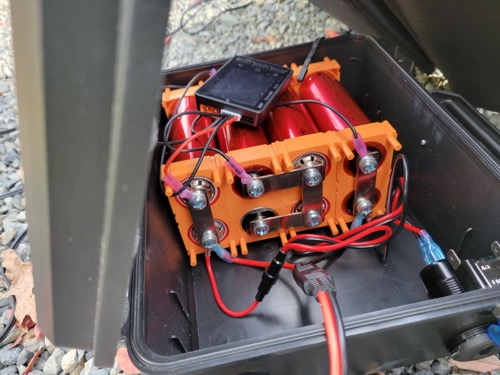
One owner maintained two motorcycle batteries through winter using 35W panels and reported easy starts after six months. Another kept boat batteries charged. A UTV owner liked the simplicity, and a shop owner used a 100W panel with a deep-cycle battery and lighting for about a month.
The shop report claims five 60W bulbs plus one 100W bulb while a single 100W panel kept the battery at 100%. Those load labels, hours, and battery state are internally difficult to reconcile if they are conventional continuous-watt lamps. Treat it as a satisfaction account, not an energy-balance model.
| Use Case | Evidence Fit | Main Check |
|---|---|---|
| 35W motorcycle maintainer | Strongest | Battery profile and parasitic loads |
| 100W UTV/portable kit | Plausible | Panel Voc/Isc and conductor size |
| Boat battery maintenance | Plausible | Dry mounting, corrosion, protection |
| Continuous shop lighting | Unclear energy details | Measure actual watt-hours and battery state |
| Multi-panel expansion | Weak | 30V ceiling and missing Isc/watt limit |
Battery Profiles Are Broad; Temperature Protection Is Not
SunRock lists AGM, gel, sealed, flooded, deep-cycle lead-acid, and LiFePO4. Local buttons choose the profile. No external temperature sensor or lithium low-temperature cutoff was documented.
For LiFePO4, use the battery maker’s charge voltage/current, float, BMS, and cold-charge rules. One owner tested a 20Ah LiFePO4 portable station but had limited duration. For lead-acid maintenance, verify that float behavior matches the battery and that controller self-consumption does not exceed winter harvest.
One owner used the controller as a monitor/isolator to recharge separate battery sets from one panel while preventing secondary draw. The circuit details were not supplied, so this should not be copied as a supported multi-bank architecture.
Maintaining two batteries is not automatically safe through selector switches or parallel leads. Batteries at different states of charge can exchange current, and a manual selector can interrupt the reference the controller expects. A documented dual-bank controller, isolator, or battery-to-battery design is preferable when the banks must remain electrically independent.
Two Early Failures Keep Reliability in Question
| Reliability Signal | Weight |
|---|---|
| Dead on arrival | Clear QC failure, easy to detect |
| Died after roughly one hour | Serious early-life failure |
| Nearly one year on motorcycles | Meaningful positive duration |
| Month-long shop system | Useful but short |
| Generic positive comments | Low without duration/details |
Test the received unit promptly inside the return window. Compare its display with an appropriate meter and monitor current/temperature under strong sun before relying on it at a remote location.
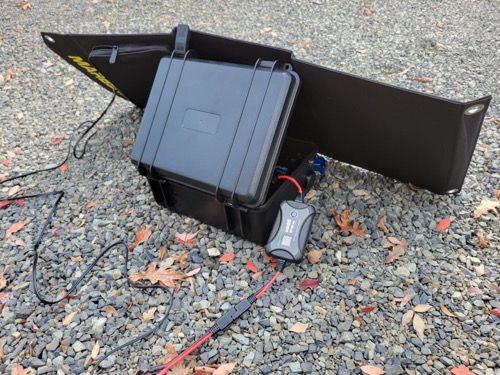
Local Display, No App, and Dry Mounting
The tiny LCD shows voltage, charge current, status, and error information. There is no app or communications port. This is appropriate for a small battery box if the screen remains accessible.
No IP rating, operating range, dimensions, terminal maximum, or warranty was supplied. Keep the controller dry and ventilated. Protect battery and PV conductors, observe the exact connection sequence, and never trim strands to force a cable into an unknown terminal.
The accessory output includes USB/DC capability, but a dedicated load-terminal rating is not published. Do not connect an inverter or high-surge equipment through it.
SunRock Commissioning Checklist
- Confirm exact ASIN/revision and matching manual.
- Calculate cold Voc below 30V and verify Vmp above battery charging voltage.
- Obtain the PV Isc and watts limit before adding panels.
- Size conductors for ampacity and voltage drop; recheck an old small cable.
- Choose battery profile values from the battery manual.
- Provide LiFePO4 cold-charge protection elsewhere if required.
- Compare LCD voltage/current with independent measurements.
- Test for radio interference if used near communications gear.
- Keep electronics dry, ventilated, and accessible.
- Exercise the unit during the return window for early failure.
Alternatives
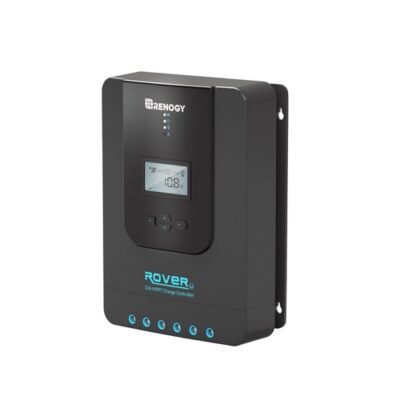
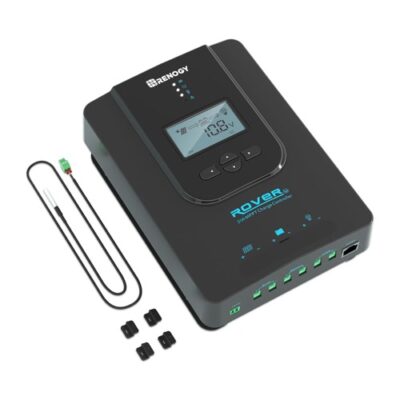
Victron’s 75/15 offers explicit PV Isc, 75V input, built-in Bluetooth, and a five-year warranty, at higher cost and size. Renogy’s Rover 20A adds a local screen and broader documented power. A simple waterproof PWM maintainer may be better outdoors if conversion efficiency and lithium support are less important.
Pros & Cons Analysis
Based on documented specifications and owner feedback
Pros
- Compact — Compact portable format.
- Supports — Supports common lead-acid types and LiFePO4.
- LCD — LCD status display.
- Real — Real customer setup photos available.
Cons
- Check: 12V battery systems only.
- Check: 30V PV ceiling restricts series wiring.
- Check: PV Isc limit not published.
- Check: No weather rating or communications.
Bottom Line: A Useful Compact Controller with Limited Headroom
Verdict: The SunRock 10A has credible small-system use evidence and a compact interface. The corrected wiring comparison suggests useful conversion, but Solar Power Picks cannot independently certify MPPT behavior or a maximum array beyond the supplied limits.
Best reason to buy: A protected 12V motorcycle, UTV, boat, radio, or portable system uses one compatible panel and benefits from local readings and broad battery selection.
Reason to pause: The 30V ceiling, unpublished Isc/watts/terminals, radio noise, and two early failures make established controllers safer for expansion or unattended service.
Frequently Asked Questions
Is the Bateria Power SunRock 10A MPPT or PWM?
The exact model is documented as MPPT as specified by the manufacturer. That topology does not replace checks of PV voltage, input current, output current, and battery compatibility.
What battery voltage does the Bateria Power SunRock 10A support?
12V. Confirm detection and selection behavior in the current exact-model manual.
What is the maximum PV voltage?
30V; operating PV range stated as 15V-30V. Use cold-corrected array Voc rather than the panel's warm-day value.
How much solar can it handle?
Not published. The PV voltage, PV current, and battery-side charge-current limits must all be satisfied at the same time.
Does the Bateria Power SunRock 10A work with lithium batteries?
AGM, gel, sealed, flooded, deep-cycle lead-acid, and LiFePO4. Match every charging value and low-temperature strategy to the battery documentation.
Does it include app monitoring?
No app or communications port. Verify whether any required accessory is included in the exact bundle.
Can I connect an inverter to its load terminals?
Normally no. High-current and surge loads should use a correctly fused battery-side connection unless the controller manual explicitly permits the planned load.
Who should buy the Bateria Power SunRock 10A?
Small portable 12V solar systems needing a compact controller with broad battery selection.
Technical Specifications
| Brand | Bateria Power |
|---|---|
| Exact model / revision / ASIN | SunRock 10A (ASIN B0BNKGC5SM) |
| Controller type | MPPT as specified by the manufacturer |
| Rated battery-side charge current | 10A |
| Supported battery-system voltage | 12V |
| Battery chemistry and profile support | AGM, gel, sealed, flooded, deep-cycle lead-acid, and LiFePO4 |
| Maximum PV open-circuit voltage (Voc) | 30V; operating PV range stated as 15V-30V |
| Maximum PV short-circuit/input current (Isc) | Not published |
| Maximum PV power by battery voltage | Not published |
| Minimum PV/start voltage requirement | 15V minimum PV Voc for the reviewed 12V controller |
| Load output and low-voltage disconnect | USB/DC accessory output; dedicated load-terminal rating not published |
| Grounding topology | Not published for the reviewed revision |
| Charging stages and custom voltage control | Battery-type selection through local controls |
| Temperature sensing and lithium low-temperature behavior | No external sensor or low-temperature cutoff documented |
| Display and local controls | LCD and local buttons |
| App, communications, and data history | No app or communications port |
| Maximum terminal conductor size | Not published |
| Controller self-consumption | Not published for the reviewed revision |
| Published tracking/conversion efficiency | Not published |
| Cooling method and thermal derating | Not published for the reviewed revision |
| Electrical protections | Overcharge, overtemperature, overvoltage, overcurrent, short-circuit, over-discharge, and reverse-polarity protection |
| Enclosure, ingress rating, and operating temperature | Protected dry mounting; operating range not published |
| Certifications | Not published for the reviewed revision |
| Dimensions, weight, and included accessories | Not published |
| Warranty | Not published |