ACEIRMC 30A PWM 2-Pack Review: Two Cheap Controllers, Two Sets of Unknowns
At a Glance
KEY FEATURES
- Controller: PWM; 30A nominal per controller rated charge output.
- System: 12V / 24V automatic; Open, AGM, gel, and other lead-acid batteries; not lithium.
- PV boundary: Not published maximum Voc; Not published maximum PV power.
- Controls: LCD, buttons, and two USB ports; No app or communications port.
- Best fit: Two very small, low-cost lead-acid systems where replacement cost matters more than documentation.
PROS
- Two controllers can serve separate small systems or provide a ready spare.
- Basic local controls support simple 12V or 24V projects.
- Low purchase cost suits measured, noncritical experimentation.
CONS
- The pair must not be treated as one coordinated 60A controller.
- PV, load, thermal, and warranty limits are poorly documented.
- Nominal current and terminal behavior require conservative verification.
Editor's Choice
Editorial assessment based on exact-model documentation and qualitative exact-ASIN owner evidence; no first-party bench test or population-rate claim
Will the ACEIRMC 30A PWM 2-Pack Fit Your Solar Array?
Estimate required charging current and check it against the documented limits for ACEIRMC 30A PWM 2-Pack.
Solar Charge Controller Size Calculator
What size charge controller do I need?
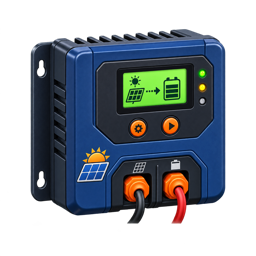
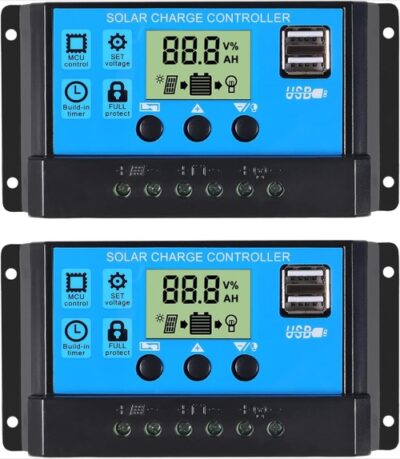
The ACEIRMC package supplies two nominal 30A PWM controllers for less than many brands charge for one basic unit. Each has automatic 12V/24V detection, an LCD, programmable load behavior, and dual USB outputs. That can be appealing for two chicken coops, sheds, fences, or maintenance batteries.
The price is also the warning. The reviewed evidence does not publish maximum PV Voc, PV Isc, allowable panel watts, terminal capacity, load-output current, ingress rating, operating temperature, dimensions, or warranty. The owner owner record contains two different one-of-two failures and a serious reverse-drain allegation. This cannot responsibly be treated as a documented 30A power component.
| Best For | Package Advantage | Main Problem | Evidence Confidence |
|---|---|---|---|
| Two small, noncritical lead-acid projects in protected locations | Two independent controllers at very low cost | Core electrical and environmental limits are missing | Low for the 30A envelope; medium for small owner use cases |
Two Controllers Are Useful Spares, Not One 60A Controller
A defensible use when each controller has its own panel, battery, fuse, and verified settings.
Low acquisition cost can justify keeping a second identical unit for a noncritical project.
Requires battery-maker approval and individually protected inputs; the pair is not automatically a coordinated 60A system.
Weak fit because several electrical, thermal, and warranty limits are unpublished.
The exact-ASIN owner record is smaller than those for established controller lines, but it clarifies the ACEIRMC two-pack’s real proposition: inexpensive duplicated hardware. Owners describe basic charging, easy connection, and value for small projects. Critical accounts raise output, durability, heat, instructions, and controller-failure concerns. These observations are useful for acceptance testing but cannot establish a product-wide rate.
The printed 30A label should be treated as nominal until the delivered revision, terminal capacity, thermal behavior, and documentation support the intended continuous current. The listing does not publish a PV Voc limit, PV power table, load-terminal current limit, operating-temperature range, or warranty period. Missing limits are not permission to guess. They are reasons to keep the design conservative or choose a better-documented controller.
| Two-pack plan | Required separation | Verification |
|---|---|---|
| Two independent batteries | Separate array, controller, fuse, and battery circuit | Commission each unit alone |
| One bank, two controllers | Separate protected PV inputs and battery leads | Confirm both profiles agree and the battery accepts combined current |
| One controller plus spare | Store the spare dry with identity and setup notes | Bench-check both during the return period |
Never join controller outputs to create an assumed 60A rating, and never connect two controllers to the same panels. If both charge one bank, each needs its own PV source and battery-side protection, and the battery documentation must permit the combined charge current. The programmable load terminals are for a bounded DC circuit only; their unpublished current ceiling makes an inverter connection especially inappropriate.
The pack fits low-consequence projects where the buyer can measure voltage, current, temperature, and disconnect behavior. For a remote cabin, expensive battery bank, or unattended critical load, published limits and accountable support are worth more than receiving a second low-cost controller.
The Two-Pack Changes the Value Calculation
A two-controller bundle is not the same as a redundant controller. Each unit operates its own panel, battery, settings, conductors, and protection. If one fails, the other does not automatically take over unless the entire system was deliberately engineered for that behavior.
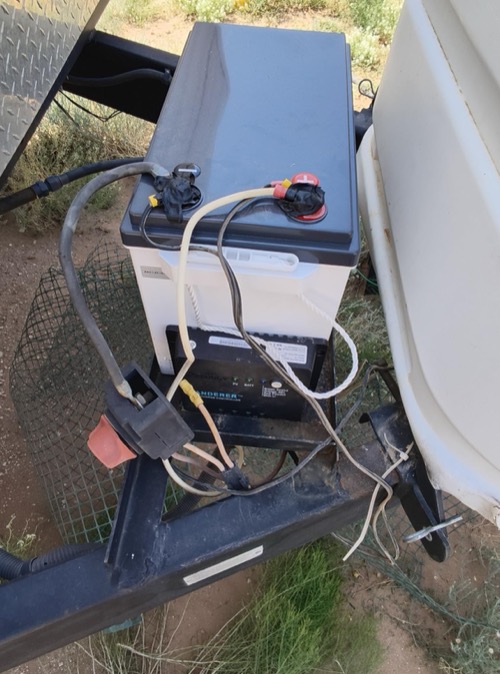
The bundle makes most sense for separate modest systems. One owner ran two 85W panels with a 12V battery and one or two automotive fans in a chicken coop for several months. That is a concrete use case: low-voltage ventilation where replacement cost is modest and failure is visible.
| Possible Use | Why Two Units Help | Risk That Remains |
|---|---|---|
| Two separate coops or sheds | Each site gets its own simple controller | Neither site’s safe PV ceiling is documented |
| Main system plus shelf spare | Replacement hardware is available | Settings and wiring still require recommissioning |
| Two panel directions on one bank | Independent tracking periods may help | Parallel controllers need manufacturer-approved coordination |
| One controller per battery | Electrical isolation is clearer | Batteries cannot be assumed interchangeable |
| Both units combined for “60A” | None established | Outputs must not be added without explicit documentation |
Do not describe the box as a 60A solution. The nominal 30A marking belongs to each controller, and the supplied evidence does not validate even that rating with terminal, thermal, or panel limits.
Bundle rule — Two unknown 30A envelopes do not become one known 60A envelope. Treat every unit as a separate, conservatively sized controller until exact documentation proves otherwise.
What the 30A Label Does Not Tell You
PWM controllers switch panel energy toward battery voltage rather than converting a higher PV operating voltage into additional battery current. A suitable array normally uses panels electrically matched to the bank. Series wiring or a high-voltage module can exceed an unpublished ceiling without delivering the MPPT benefit buyers may expect.
The listing record calls each unit 30A, but does not disclose PV Voc, PV Isc, panel watts, or terminal capacity. Those omissions prevent a responsible design near 30A. A small 85W-panel installation provides evidence for that scale only; it cannot validate ten times the power.
| Missing Limit | Why It Is Required | Conservative Response |
|---|---|---|
| Maximum PV Voc | Cold panel voltage can damage electronics | Use only a small voltage-matched panel after obtaining confirmation |
| Maximum PV Isc | Parallel panels can exceed input hardware | Do not size from 30A output label |
| PV watts by bank voltage | Defines practical array scale | Keep the project modest or choose documented hardware |
| Terminal wire/torque | Determines safe current connection | Reject any design requiring guesswork or strand trimming |
| Load-output rating | Fans and motors have startup current | Use protected battery-side switching for uncertain loads |
An owner said the holes were small and exact amperage was not visible. Another mentioned needing overhead clearance for mounting screws. These physical details reinforce that the controller should be dry-fitted before cable purchase.
Lead-Acid Only Means Exactly That
The reviewed product material lists open/flooded, AGM, gel, and other lead-acid modes. Lithium is not supported. The controller’s three-stage direct, boost, and float behavior is intended around lead-acid assumptions.
Do not connect LiFePO4 because a USB output or adjustable display resembles a newer lithium-capable model. Battery profile labels can change across visually similar generic controllers. Use the exact model/revision and verify its programmed voltages against the battery maker.
For lead-acid, confirm absorption/boost, float, and any equalization behavior. Automatic 12V/24V detection still needs verification at commissioning. Connect sources in the exact documented order; one owner summarized a battery-first, panel-second sequence, but the current manual should govern.
Chemistry warning — The low purchase price does not justify experimenting with an unsupported lithium bank. Use a controller with a documented LiFePO4 algorithm and temperature strategy.
The Reverse-Drain Report Needs Careful Handling
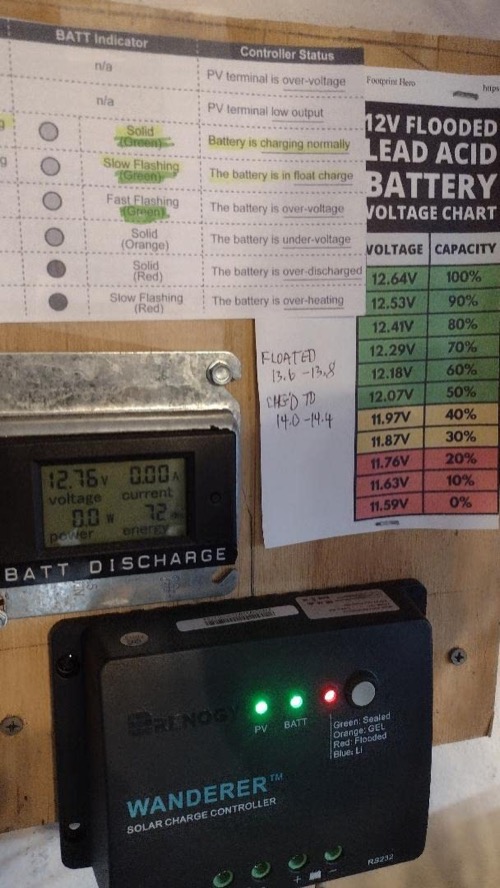
Do not copy the diode modification automatically. A diode introduces voltage drop and heat, may interfere with sensing, and does not correct an internal fault. First isolate loads, measure current safely at night, verify polarity, inspect wiring, and contact the seller/manufacturer. A controller that permits material reverse current should be removed from service.
| Nighttime Diagnostic | Purpose | Interpretation Limit |
|---|---|---|
| Record battery voltage after charge and before dawn | Identifies overnight change | Voltage alone is affected by resting behavior and loads |
| Disconnect or measure known loads | Separates consumption from reverse flow | Use appropriate DC measurement equipment |
| Measure controller PV-side current in darkness | Tests the reported path | Meter placement and polarity must be correct |
| Swap the second bundle unit | Checks unit-specific behavior | Do not expose another battery without protection |
| Replace suspect controller | Removes unsafe uncertainty | Cheapest and safest outcome may be different products |
Two Different Partial Failures Matter
These reports are unusually relevant to a two-pack. A bundle can conceal a 50% failure experience behind an apparently usable purchase. They do not establish a statistical defect rate, but they undermine the assumption that buying two guarantees a dependable spare.
Other reports are short: “works,” “good price,” or general praise. They confirm receipt and basic operation, not 30A performance or long life.
| Owner Evidence | Detail Level | Weight |
|---|---|---|
| Chicken-coop fans for several months | Specific panels, battery class, loads, duration | Strongest positive use-case evidence |
| One of two dead | Clear bundle-level failure | Material caution |
| One display inaccurate after eight months | Duration and seller response included | Material QC/support evidence |
| Overnight reverse-drain allegation | Serious measured claim but incomplete setup | Requires verification, cannot generalize |
| One-line positive reviews | Minimal | Low evidentiary value |
LCD, USB, and Load Output Are Convenience Features
The LCD displays battery status and voltage; buttons select modes; two USB ports can power small devices. Exact USB ratings were not supplied. One owner valued the status display, while another said exact current was unavailable.
Programmable load terminals may support timer or low-voltage behavior, but the continuous and surge rating is missing. The chicken-coop automotive fans are a more demanding load than small LEDs because motors can draw extra startup current. A battery-side fused circuit and appropriately rated relay may be safer, but only a documented control-output rating can authorize the controller’s role.
The enclosure is not waterproof. Multiple owners explicitly kept it from direct weather. Mount it inside a dry ventilated box while preventing condensation and retaining airflow.
What a Responsible Small Installation Looks Like
The article cannot supply a universal panel size because the manufacturer did not supply the necessary limits. A defensible project remains well below the nominal 30A class, uses one voltage-matched panel, a supported lead-acid battery, short conductors, separate protection, and visible operation.
| Design Element | Responsible Choice | Unacceptable Shortcut |
|---|---|---|
| PV | Modest matched panel with verified Voc/current | Large array justified only by “30A” label |
| Battery | Supported lead-acid chemistry | Unsupported lithium experiment |
| Location | Dry, ventilated, serviceable enclosure | Direct rain or sealed heat trap |
| Load | Small known DC load with surge checked | Inverter or unknown motor through unrated terminals |
| Monitoring | Independent voltage/current verification | Trusting display after an anomalous reading |
| Failure impact | Noncritical system with regular inspection | Remote critical charging without alarms |
Two-Pack Commissioning Checklist
- Label the two units A and B and record serial/revision markings.
- Test each independently with the same modest known-good panel and battery.
- Verify 12V/24V detection before enabling loads.
- Compare both displays with a suitable meter.
- Measure nighttime current after isolating other loads.
- Confirm no unit or connection heats abnormally.
- Keep both controllers dry and ventilated.
- Do not parallel outputs or combine ratings without written approval.
- Retain seller details and test within the return period.
- Replace any unit with unstable voltage, reverse flow, failed display, or poor clamping.
Alternatives Cost More Because They Publish More
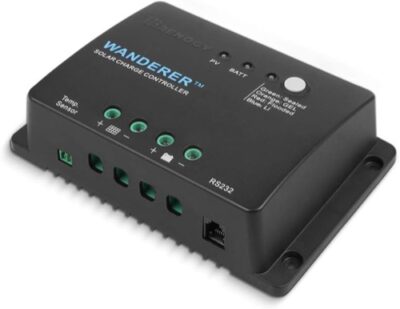
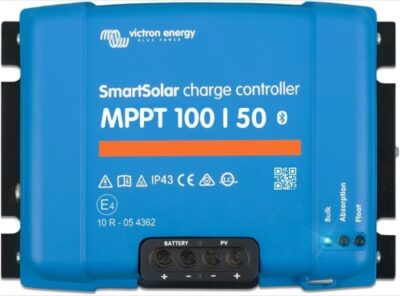
The Renogy Wanderer 10A is lower-current but provides clearer voltage, power, terminal, and environmental information. ECO-WORTHY’s 30A Bluetooth PWM adds a documented 50V ceiling and app access, though its own owner evidence is mixed. A small Victron SmartSolar costs more but provides explicit Voc/Isc and MPPT conversion.
The comparison should be based on the cost of uncertainty. If the array, battery, or structure is valuable, spending more for published limits and support may be cheaper than diagnosing drain or replacing a failed unit.
The two-pack still has a legitimate educational niche. Two independent benches can demonstrate PWM charging, load timers, or panel orientation without sharing one battery circuit. Even there, use fused low-energy sources, supported lead-acid batteries, and supervision. A classroom or hobby setting should expose the limitations explicitly rather than presenting the front-panel 30A label as verified engineering data.
Pros & Cons Analysis
Based on documented specifications and owner feedback
Pros
- Two — Two controllers are included.
- LCD — LCD and dual USB outputs.
- Automatic — Automatic 12V/24V detection.
- Low — Low entry price.
Cons
- Check: Lead-acid only.
- Check: PV Voc and Isc limits are not published.
- Check: No weather rating.
- Check: Sparse warranty and terminal documentation.
Bottom Line: Value Only at a Modest, Noncritical Scale
Verdict: The ACEIRMC two-pack can operate small lead-acid projects, and the chicken-coop report shows a plausible use. It does not provide enough technical evidence for a confident 30A design.
Best reason to buy: Two separate, inexpensive, observable systems need basic LCD/load control and neither failure would cause serious loss.
Reason to pause: Missing electrical limits, lead-acid-only profiles, two partial bundle failures, and the reverse-drain allegation make better-documented hardware the responsible choice for anything ambitious or unattended.
Frequently Asked Questions
Is the ACEIRMC 30A PWM 2-Pack MPPT or PWM?
The exact model is documented as PWM. That topology does not replace checks of PV voltage, input current, output current, and battery compatibility.
What battery voltage does the ACEIRMC 30A PWM 2-Pack support?
12V / 24V automatic. Confirm detection and selection behavior in the current exact-model manual.
What is the maximum PV voltage?
Not published. Use cold-corrected array Voc rather than the panel's warm-day value.
How much solar can it handle?
Not published. The PV voltage, PV current, and battery-side charge-current limits must all be satisfied at the same time.
Does the ACEIRMC 30A PWM 2-Pack work with lithium batteries?
Open, AGM, gel, and other lead-acid batteries; not lithium. Match every charging value and low-temperature strategy to the battery documentation.
Does it include app monitoring?
No app or communications port. Verify whether any required accessory is included in the exact bundle.
Can I connect an inverter to its load terminals?
Normally no. High-current and surge loads should use a correctly fused battery-side connection unless the controller manual explicitly permits the planned load.
Who should buy the ACEIRMC 30A PWM 2-Pack?
Two very small, low-cost lead-acid systems where replacement cost matters more than documentation.
Technical Specifications
| Brand | ACEIRMC |
|---|---|
| Exact model / revision / ASIN | 30A PWM 2-Pack (ASIN B0B8VQ9ZL9) |
| Controller type | PWM |
| Rated battery-side charge current | 30A nominal per controller |
| Supported battery-system voltage | 12V / 24V automatic |
| Battery chemistry and profile support | Open, AGM, gel, and other lead-acid batteries; not lithium |
| Maximum PV open-circuit voltage (Voc) | Not published |
| Maximum PV short-circuit/input current (Isc) | Not published |
| Maximum PV power by battery voltage | Not published |
| Minimum PV/start voltage requirement | Not published for the reviewed revision |
| Load output and low-voltage disconnect | Programmable DC load terminals; exact current limit not published |
| Grounding topology | Not published for the reviewed revision |
| Charging stages and custom voltage control | Three-stage direct, boost, and float charging |
| Temperature sensing and lithium low-temperature behavior | No external sensor or low-temperature cutoff documented |
| Display and local controls | LCD, buttons, and two USB ports |
| App, communications, and data history | No app or communications port |
| Maximum terminal conductor size | Not published |
| Controller self-consumption | Not published for the reviewed revision |
| Published tracking/conversion efficiency | Not published |
| Cooling method and thermal derating | Not published for the reviewed revision |
| Electrical protections | Overcurrent, short-circuit, reverse-connection, and open-circuit protection; automatic recovery is claimed |
| Enclosure, ingress rating, and operating temperature | Indoor/protected mounting; operating range not published |
| Certifications | Not published for the reviewed revision |
| Dimensions, weight, and included accessories | Not published |
| Warranty | Not published |