Renogy Wanderer Li 30A Review: Simple PWM Value for 12V Systems
At a Glance
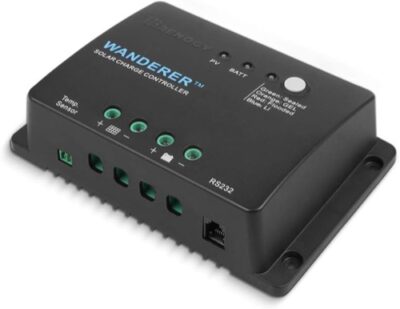
KEY FEATURES
- Output: 30A PWM controller for 12V battery systems.
- PV limits: 25V Voc and up to 400W of 12V-class solar.
- Battery support: Sealed/AGM, gel, flooded, and LiFePO4 profiles.
- Monitoring: Status LEDs; optional BT-1 adds Renogy DC Home.
- Best fit: Small matched-voltage RV, cabin, shed, or lighting systems.
PROS
- Simple 30A PWM platform suits modest 12V systems.
- Local controls and programmable DC load terminals cover common basic needs.
- Optional BT-1 monitoring can add convenient visibility.
CONS
- PWM operation requires a voltage-matched array below the 25V Voc ceiling.
- Lithium mode does not provide a published low-temperature cutoff.
- IP20 construction requires a dry, protected installation.
Editor's Choice
Editorial assessment based on exact-model documentation and qualitative exact-ASIN owner evidence; no first-party bench test or population-rate claim
Will the Renogy Wanderer Li 30A Fit Your Solar Array?
Estimate required charging current and check it against the documented limits for Renogy Wanderer Li 30A.
Solar Charge Controller Size Calculator
What size charge controller do I need?
Lithium Mode Does Not Replace the Battery Safety Plan
The expanded exact-ASIN owner evidence supports the Wanderer Li 30A as a straightforward controller for smaller 12V RV, shed, trailer, and cabin systems. Positive accounts emphasize simple setup, dependable basic charging, and useful optional monitoring. Critical accounts mention battery-profile confusion, Bluetooth pairing, terminal access, intermittent output, display behavior, and support. The practical response is a battery-first commissioning sequence, not a reliability percentage.
PWM architecture matters before any feature comparison. The controller pulls the panel toward battery voltage, so the array must be designed for a 12V bank and kept within the documented 25V PV open-circuit ceiling. A high-voltage residential module can waste much of its nameplate power and may violate the input limit. Calculate cold Voc for every panel arrangement instead of relying on a sunny operating reading.
The dedicated load terminals can automate modest DC loads, but their programmed schedule and disconnect behavior need testing with the real circuit. An inverter should remain on a fused battery-side connection unless Renogy documentation for the exact configuration explicitly says otherwise. Optional BT-1 monitoring should also be tested from the final enclosure; metal compartments and app changes can affect the workflow.
Choose the Wanderer Li when low cost, local control, and a voltage-matched 12V array matter more than MPPT harvest. Choose an MPPT controller when the array voltage, cable run, shade pattern, or available panel choice makes voltage conversion valuable. In either case, the battery’s charging specification remains the final authority.
Quick Verdict on the Renogy Wanderer Li 30A
This Renogy Wanderer Li 30A review finds a sensible budget controller for a small, voltage-matched 12V array where PWM is the correct technology. Renogy documents a 25V PV ceiling, up to 400W of solar, 30A charge output, AWG 8 terminals, multiple battery profiles, load controls, and optional BT-1 monitoring. Owners repeatedly describe straightforward installation, useful battery selection, secure wire openings, and successful shed, RV, cabin, or lighting systems.
Its low price does not make it a universal bargain. It cannot support a 24V battery bank or higher-voltage series panels, detailed built-in feedback is limited to LEDs, and Bluetooth costs extra. One supplied buyer also received a unit with no output and returned it.
| Best For | Main Strength | Main Limitation | Evidence Confidence |
|---|---|---|---|
| Small 12V matched-voltage arrays | Low-cost simplicity and easy wiring | PWM, 12V only, no numeric display | High for specs; medium for ownership patterns |
Evidence Snapshot
Manufacturer documentation supplies the technical limits. Customer observations are used to assess usability and plausible system fit rather than to promote PWM as universally equal to MPPT.
PWM Limits and Array Matching
The Wanderer is a PWM controller. It effectively brings the panel operating voltage toward battery voltage during charging, so it works best with a nominal 12V panel or parallel group whose voltage is matched to a 12V battery. It cannot harvest the same voltage-conversion advantage as MPPT from higher-voltage panels.
| Limit | Documented Value | What It Means | Evidence Status |
|---|---|---|---|
| Controller type | PWM | Best with a voltage-matched 12V array | Renogy documentation |
| Rated charge current | 30A | Maximum PV/charge current class | Renogy documentation |
| Battery voltage | 12V only | 24V and 48V banks are unsupported | Renogy documentation |
| Maximum PV Voc | 25V | Cold-corrected panel Voc must stay below this | Renogy documentation |
| Maximum PV power | 400W @ 12V | Published upper array-power value | Renogy documentation |
| PV/charge current | 30A | Current must remain within the controller rating | Renogy documentation |
The 25V ceiling rules out many higher-voltage series strings. Even a single nominal 12V panel needs a cold-Voc check because open-circuit voltage rises at low temperature. Do not choose panels by wattage alone.
One Australian owner reports 7.85A from a 160W folding panel in late-afternoon winter sun. Another replaced an older controller that was producing only 1A–2A in full sunlight and reports improved charging after the swap. Both observations depend on their panels, wiring, batteries, weather, and measurement methods.
Compatibility Check — PWM can be a good value when panel and battery voltages are closely matched. It is the wrong choice when the array relies on higher-voltage strings or when maximum energy harvest justifies MPPT.
Compact Hardware and Wiring
Renogy documents a compact enclosure measuring 6.45 × 4.31 × 1.76 inches and weighing 0.65 lb. The maximum terminal size is AWG 8, giving more conductor room than the smallest generic PWM controllers.
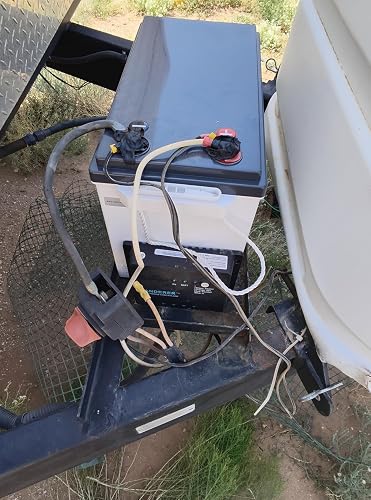
One owner highlights the terminal openings as the product’s main advantage after struggling with tiny connectors on a very cheap controller. The reviewer says each wire was secured within about ten minutes without repeated stripping or improvised retention. That is a useful usability report, not permission to exceed Renogy’s conductor or torque specification.
| Installation Point | Published Detail | Practical Effect |
|---|---|---|
| Maximum terminal size | AWG 8 | Accommodates appropriate 30A-class conductors |
| Enclosure | IP20 | Dry, protected mounting is required |
| Operating range | -20°F to 113°F | Stay within temperature and ventilation requirements |
| Local interface | LEDs and battery-type button | Simple but limited numeric information |
| Load output | Programmable DC terminals | Can protect suitable small loads from deep discharge |
Some marketplace copy has described more protective enclosure ratings for related or revised products, but current exact-model documentation governs this review. IP20 does not support exposed rain, marine spray, or a condensing compartment.
Installation Check — Verify conductor size, terminal torque, overcurrent protection, connection order, grounding, ventilation, and mounting location in the exact manual.
Battery Selection, LEDs, and Optional Bluetooth
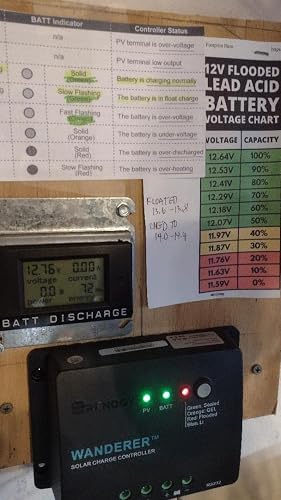
The controller supports sealed/AGM, gel, flooded, and LiFePO4 battery profiles. Battery type is selected locally, and LEDs communicate basic panel, battery, load, and fault states. Owners repeatedly call the controller simple or easy to use.
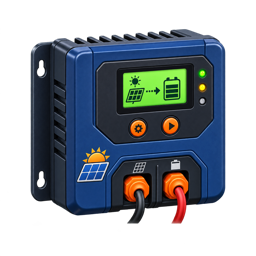
There is no built-in numeric LCD. Buyers who want voltage, current, state, and fault details on a screen must add the compatible BT-1 Bluetooth module and use Renogy DC Home, or rely on separate battery monitoring. The optional approach keeps the base price low but narrows the price advantage when app access is required.
Charging Profiles and Temperature Behavior
Renogy describes four-stage PWM charging—bulk, boost, float, and equalization—for applicable lead-acid batteries. Lithium uses its own profile and should not receive lead-acid equalization. The correct mode must be selected before relying on the controller.
The current documentation describes an optional remote temperature sensor and temperature compensation for supported lead-acid configurations. It does not specify a controller-managed lithium low-temperature cutoff. A LiFePO4 battery in freezing conditions therefore needs documented BMS protection or another approved control method.
| Battery / Use | Fit | Reason | Must Verify |
|---|---|---|---|
| 12V AGM cabin battery | Good | Published profile and simple indicators | Correct capacity and compensation |
| 12V flooded lead-acid | Good | Multi-stage profile with equalization | Battery maker’s equalization rules |
| 12V LiFePO4 | Good, conditional | Dedicated profile | BMS current and low-temperature cutoff |
| 24V battery bank | Poor | Unsupported | Choose a 24V-capable controller |
| High-voltage residential panel | Poor | 25V Voc ceiling and PWM design | Choose suitable MPPT hardware |
The manufacturer does not publish a conversion-efficiency percentage for this PWM model, which is appropriate: PWM behavior depends strongly on voltage matching. Comparing it with MPPT solely by rated amps would obscure the actual system tradeoff.
What Owners Reveal About Wanderer Li Setup
| Theme | Supporting Reviews | What the Evidence Supports | Limitation |
|---|---|---|---|
| Easy installation/use | At least 7 | Simplicity is the clearest recurring strength | Several comments are brief |
| Successful shed/RV/cabin/light use | At least 6 | Small 12V systems are a credible fit | Arrays, batteries, and duration differ |
| Better terminal openings | 1 detailed report | Wiring can be easier than ultra-cheap controllers | Isolated comparison |
| Optional Bluetooth valued | 2 | App visibility is useful when purchased | Accessory and app were not broadly reviewed |
| Specific current observation | 1 | 7.85A was observed from a 160W panel in stated conditions | Not a controlled efficiency test |
| Dead on arrival | 1 | A serious individual failure occurred | Cannot establish prevalence |
The reviews strongly support ease of use and value in modest systems. They do not support the claim that PWM is always nearly equal to MPPT. The correct comparison depends on panel voltage, climate, array size, battery voltage, and energy-harvest priorities.
Warranty and Ownership Cost
Renogy publishes a one-year warranty for the current Wanderer Li 30A. That is shorter than the periods listed for the MPPT products in this starter set, although the controller’s purchase price is also dramatically lower. Keep the receipt and serial information and confirm regional terms before installation.
Total cost depends on the desired interface. The base controller is inexpensive, but adding a BT-1 module reduces the gap to controllers with Bluetooth built in. Conversely, a simple shed or lighting system may need no app at all, preserving the Wanderer’s value. Also account for the dry enclosure, overcurrent protection, suitable cable, connectors, and battery monitoring. A $28 controller does not make the rest of the electrical installation optional, and replacing it later with MPPT can cost more than selecting the correct technology at the start.
PWM Versus MPPT in This Exact Use Case
PWM is not inherently defective or outdated; it is simply less flexible. With a nominal 12V panel whose operating voltage is only modestly above battery charging voltage, a small system may meet its daily energy target at low cost. The Wanderer’s simple design can therefore be rational for a maintainer panel, shed lighting, a modest folding-panel setup, or a lightly used RV.
MPPT becomes more valuable when panel operating voltage is substantially higher than battery voltage, when series wiring reduces cable loss, when array power grows, or when limited sun makes additional harvest important. An MPPT controller can convert excess panel voltage into battery-side current instead of pulling the panel close to battery voltage. The gain is system- and weather-dependent, not a universal percentage.
The decision should compare daily energy, not just controller price. Estimate the loads, seasonal solar resource, shading, panel orientation, battery losses, and reserve requirement. If the PWM design already meets the target with margin, the Wanderer can be sufficient. If the target is tight, MPPT may avoid adding more panel or battery capacity later.
Buying and Commissioning Checklist
Confirm that every panel’s cold-corrected Voc remains below 25V and that the combined current and power remain within the 30A and 400W limits. Make sure the bank is 12V and that its exact chemistry has a suitable profile.
Plan a dry IP20 mounting location and suitable protection. Verify AWG 8 is large enough for the actual run rather than merely fitting the terminal. Decide whether LEDs provide enough information or whether the BT-1 and its added cost are necessary.
- Verify nominal panel class, cold Voc, total current, and total watts.
- Verify 12V battery profile, BMS current, and cold-charge protection.
- Verify conductor size, terminal torque, fusing, load limit, and enclosure.
- Verify whether optional Bluetooth changes the value comparison.
Owner Pattern — Most positive reports describe simple jobs done well: keeping a 12V battery charged, running lights or a fridge, and replacing a flimsy generic controller.
System-Fit Matrix
| System / Buyer | Fit | Why | Must Verify |
|---|---|---|---|
| 100W–200W nominal 12V panel | Good | Voltage-matched PWM use | Cold Voc and battery profile |
| Up to 400W parallel 12V-class array | Conditional | Within published watt class | Total current, wiring, and cold Voc |
| RV or shed lighting system | Good | Simple controls and programmable load | Load current and low-voltage settings |
| Buyer wanting the lowest base price | Good | Very low snapshot price | Cost of optional monitoring |
| Built-in Bluetooth requirement | Poor | BT-1 is separate | Accessory availability |
| 24V battery or series array | Poor | 12V-only and 25V maximum Voc | MPPT/24V alternative |
| Exposed marine/outdoor location | Poor | IP20 | Dry enclosure and condensation protection |
| Buyer maximizing winter/cloud harvest | Conditional | PWM may sacrifice available panel voltage | Compare with MPPT using exact system data |
Wanderer Li Alternatives by Array Architecture
LiTime’s 30A MPPT is the step-up option when higher PV voltage, 24V battery support, an LCD, or built-in Bluetooth matters. It costs much more but offers voltage conversion and a broader interface.
Victron’s SmartSolar 100/30 provides the strongest documentation and app ecosystem in the same 30A output class. It suits more ambitious arrays but has no built-in numeric display.
The Wanderer remains attractive when the system genuinely does not need those capabilities. Paying for MPPT brings little value if the array is tiny, voltage matched, and already meets the energy target; choosing PWM to save money is false economy if panel voltage or winter harvest makes MPPT necessary.
Who Should Buy It — and Who Should Skip It
Buy it if:
- You have a small, voltage-matched 12V solar array.
- A simple LED interface and low base price suit the project.
- AWG 8 terminal capacity and easy local battery selection are useful.
- Optional rather than included Bluetooth is acceptable.
Skip it if:
- You use a 24V battery bank or higher-voltage series panels.
- Built-in Bluetooth or a numeric display is required.
- The installation is exposed to weather or condensation.
- Maximum harvest from a larger or mismatched-voltage array matters.
Pros & Cons Analysis
Based on documented specifications and owner feedback
Pros
- Low purchase price — It is inexpensive for a name-brand 30A controller.
- Simple setup — Owners repeatedly describe easy wiring and straightforward battery selection.
- AWG 8 terminals — One owner specifically praised the larger, more secure wire openings.
- Multiple battery profiles — Common lead-acid types and LiFePO4 are supported.
- Optional monitoring — BT-1 adds app visibility when basic LED feedback is not enough.
Cons
- PWM rather than MPPT — It is inefficient for higher-voltage panels and cannot use MPPT voltage conversion.
- 12V only — It does not support 24V or 48V battery banks.
- No numeric display — Built-in feedback is limited to LEDs and a battery-type button.
- Bluetooth costs extra — The BT-1 module is not included.
- One dead-on-arrival report — A sampled buyer received a unit with no output and returned it.
Renogy Wanderer Li 30A: Our Verdict
Verdict: The Wanderer Li 30A is a good low-cost PWM controller for straightforward 12V systems, backed by easy-installation reports and useful AWG 8 terminals.
Buy it if: Your nominal 12V panels stay within 25V Voc and 400W, simple LED feedback is enough, and the battery profile matches the exact bank.
Skip it if: You need 24V support, higher-voltage strings, built-in monitoring, outdoor exposure, or the energy-harvest advantages of a properly sized MPPT controller.
Frequently Asked Questions
Is the Renogy Wanderer Li 30A an MPPT controller?
No. It is a PWM controller intended for a voltage-matched 12V solar array. Do not expect MPPT conversion from higher-voltage panels.
What is its maximum solar input?
Renogy specifies a 25V maximum PV open-circuit voltage and up to 400W on a 12V system. Check cold-corrected Voc and the exact manual limits.
Can it charge a 24V battery?
No. This Wanderer model is designed for 12V battery systems.
Does it support LiFePO4 batteries?
Yes, it includes a lithium profile. Confirm that the profile and the battery BMS cover the required voltages, current, and low-temperature behavior.
Is Bluetooth included?
No. Status LEDs are built in; Renogy DC Home monitoring requires the separately sold BT-1 module.
Can it be mounted outdoors?
Renogy publishes IP20 for the current exact-model documentation, so it belongs in a dry, protected location rather than exposed weather.
What wire size fits the terminals?
Renogy publishes AWG 8 as the maximum terminal size. Follow the manual's conductor preparation and torque requirements.
When is PWM a sensible choice?
PWM can be economical for a small 12V array whose panel operating voltage closely matches the battery charging voltage. Use MPPT when higher-voltage strings, larger arrays, or maximum energy harvest matter.
Technical Specifications
| Brand | Renogy |
|---|---|
| Exact model / revision / ASIN | Wanderer Li 30A (RNG-CTRL-WND30-LI) (ASIN B07G1PL1B9) |
| Controller type | PWM |
| Rated battery-side charge current | 30A |
| Supported battery-system voltage | 12V |
| Battery chemistry and profile support | Sealed/AGM, gel, flooded, and LiFePO4 |
| Maximum PV open-circuit voltage (Voc) | 25V |
| Maximum PV short-circuit/input current (Isc) | 30A rated PV/charge current |
| Maximum PV power by battery voltage | 400W @ 12V; 24V / 48V not supported |
| Minimum PV/start voltage requirement | Not published for the reviewed revision |
| Load output and low-voltage disconnect | Dedicated programmable DC load terminals |
| Grounding topology | Negative ground |
| Charging stages and custom voltage control | Four-stage PWM: bulk, boost, float, equalization |
| Temperature sensing and lithium low-temperature behavior | Optional remote sensor; -3mV/°C/2V compensation; no lithium low-temp cutoff specified |
| Display and local controls | Status LEDs and battery-type button; no numeric LCD |
| App, communications, and data history | Optional BT-1 module; Renogy DC Home; RS232 |
| Maximum terminal conductor size | AWG 8 |
| Controller self-consumption | Less than 10mA |
| Published tracking/conversion efficiency | Not applicable; PWM controller |
| Cooling method and thermal derating | Not published for the reviewed revision |
| Electrical protections | Reverse-polarity, overcharge, overload, short-circuit, and reverse-current protection |
| Enclosure, ingress rating, and operating temperature | IP20; -20°F to 113°F (-29°C to 45°C) |
| Certifications | Not published for the reviewed revision |
| Dimensions, weight, and included accessories | 6.45 × 4.31 × 1.76 in; 0.65 lb |
| Warranty | 1 year |