Renogy Rover 40A Review: Useful Output, LCD, and Installation Caveats
At a Glance
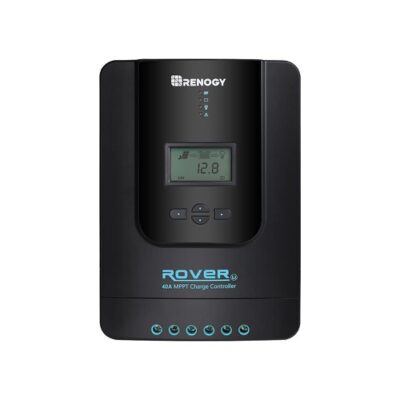
KEY FEATURES
- Output: 40A MPPT controller for automatic 12V/24V non-lithium systems.
- PV limits: 100V Voc; 520W @ 12V and 1,040W @ 24V.
- Battery support: Lead-acid and lithium profiles with an included temperature sensor.
- Monitoring: Built-in LCD; optional BT-2 adds Renogy DC Home app access.
- Best fit: RV and small off-grid systems that can use more than 30A.
PROS
- 40A MPPT output suits meaningful RV and off-grid upgrades.
- Local LCD supports setup without optional Bluetooth.
- User settings allow battery-specific configuration.
CONS
- Mounting, cover, and terminal access can complicate tight installations.
- Lithium profiles and voltage readings require independent verification.
- Bluetooth and support experiences are uneven.
Editor's Choice
Editorial assessment based on exact-model documentation and qualitative exact-ASIN owner evidence; no first-party bench test or population-rate claim
Will the Renogy Rover 40A Fit Your Solar Array?
Estimate required charging current and check it against the documented limits for Renogy Rover 40A.
Solar Charge Controller Size Calculator
What size charge controller do I need?
The Rover 40A Decision Is About Battery Profile and Installation Space
Useful when 40A adds real harvest and the controller has ventilated mounting space.
Conditional on exact voltage targets, sensing, and low-temperature strategy.
Confirm the required Bluetooth module and the data actually available.
Weak fit when terminal access, cover clearance, or cable bends are compromised.
The expanded owner material supports the Rover 40A as a common step up from small PWM controllers, especially in RV and off-grid systems. It also shows that the most important problems are not solved by the 40A label. Battery-profile accuracy, grounding expectations, mounting access, terminal fit, optional Bluetooth, and support all affect whether the controller works well in a particular installation.
Owners report stronger harvest than prior PWM hardware, readable local information, and successful long-term use. Critical accounts describe Bluetooth failures, voltage differences, lithium-profile limitations, grounding confusion, terminal or cover access, intermittent charging, and difficult remedies. Those reports are commissioning prompts, not failure statistics.
| Rover 40A check | Method | Decision |
|---|---|---|
| Charge profile | Compare every programmed voltage with battery documentation | Use user mode only when the required values are understood |
| Voltage accuracy | Measure controller and battery terminals under the same load | Resolve material differences before unattended use |
| Mechanical fit | Mock up cover removal, cable bend radius, and screwdriver access | Relocate rather than forcing conductors or fasteners |
| Communications | Identify module, app, range, and available history | Buy only if the real workflow meets the monitoring need |
At sustained output, inspect lug torque, conductor temperature, and ventilation. Route inverters and high-surge equipment directly through a protected battery-side circuit. If a ground-fault symptom appears, stop and reconcile panel, controller, battery, chassis, and inverter topology from the manuals rather than experimenting with bonds.
The Rover 40A makes sense when its electrical envelope and local controls fit and the installation can accommodate its physical access needs. Compare a 30A model if the array cannot exploit 40A, and compare a more thoroughly integrated ecosystem if dependable remote monitoring is central.
Quick Verdict on the Renogy Rover 40A
This Renogy Rover 40A review finds a capable controller for 12V/24V systems that can actually use more than 30A and benefit from an included local LCD. Renogy documents a 100V PV ceiling, 520W and 1,040W array limits, several battery profiles, an included temperature sensor, IP32 construction, and a three-year warranty. Owners describe successful RV, camping, and off-grid systems, including several 400W arrays.
The main hesitation is installation evidence. Two detailed owner reports describe a loose connection or heat damage around a terminal, although another owner explains that conductor placement inside the clamp can be easy to misread. Bluetooth is also optional rather than included, and the current product page does not publish an exact-model PV Isc limit.
| Best For | Main Strength | Main Limitation | Evidence Confidence |
|---|---|---|---|
| 12V/24V systems needing 31A–40A or local data | 40A output with LCD and documented battery support | Terminal caution; Bluetooth costs extra | High for most specs; medium for owner patterns |
Evidence Snapshot
Manufacturer documentation supplies the values in the specifications table. Owner measurements remain attributed to their individual systems and are not treated as laboratory confirmation of efficiency.
Electrical Limits and Array Sizing
Rover’s 40A rating describes maximum battery-side charge output, not allowable PV input current. Renogy publishes a 100V maximum PV open-circuit voltage and array-power limits of 520W for 12V and 1,040W for 24V. Its current product page does not publish maximum PV short-circuit current, so that value should be confirmed in the current exact-model manual before a parallel-string design is finalized.
| Limit | Documented Value | What It Means | Evidence Status |
|---|---|---|---|
| Controller type | MPPT | Converts panel operating voltage to battery charge output | Renogy documentation |
| Rated charge current | 40A | Maximum battery-side output | Renogy documentation |
| Maximum PV Voc | 100V | Cold-corrected series-string Voc must remain below this | Renogy documentation |
| Maximum PV Isc | Not published for this model | Parallel-string current requires manual confirmation | Documentation gap |
| PV power at 12V | 520W | Published array-power limit for a 12V battery | Renogy documentation |
| PV power at 24V | 1,040W | Published array-power limit for a 24V battery | Renogy documentation |
One detailed owner used four 100W panels in parallel with two 125Ah batteries and observed about 18.5A under the described conditions. That reviewer initially expected a simple 400W ÷ 12V result, but panel operating voltage, irradiance, temperature, battery voltage, state of charge, and conversion losses all affect real current. The report is useful context, not proof that every 400W array will produce the same value.
Another RV owner reports four 100W panels and year-plus service with lithium batteries. The system description supports practical compatibility but does not establish a controlled yield comparison with another controller.
Compatibility Check — Verify cold-corrected Voc, the exact Isc limit, PV watts for battery voltage, 40A output, and battery/BMS charge current separately.
Terminals, Enclosure, and Installation
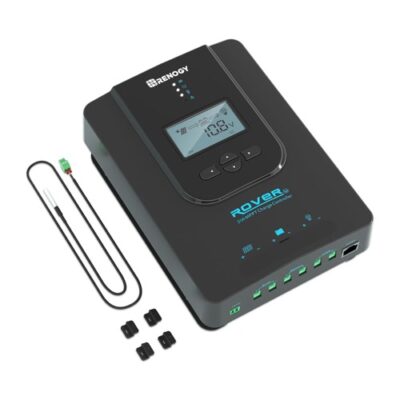
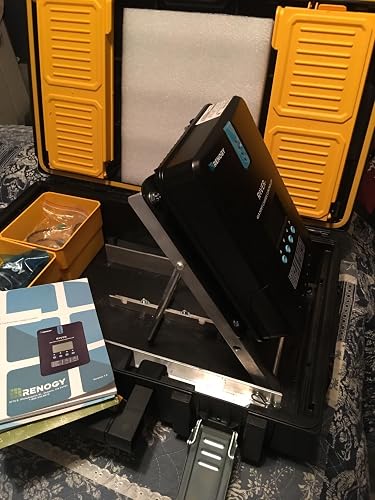
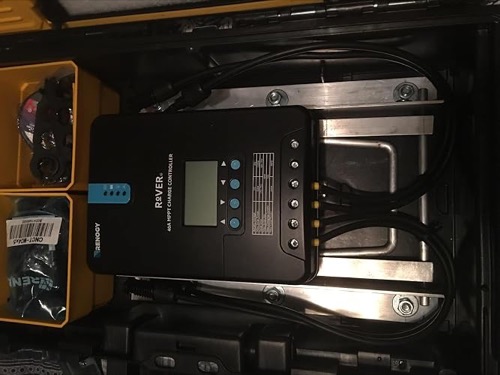
Renogy publishes a maximum terminal size of 10 mm² or AWG 8. The controller measures 238 × 172 × 77 mm and weighs 2 kg, making it substantially larger than simple PWM units. The included remote temperature sensor and local LCD add installation value, while IP32 still requires a protected, dry mounting location.
A different detailed installer explains that the clamp can accept a conductor incorrectly if it is placed on the wrong side of the moving plate. That account offers a plausible installation mechanism without disproving the other owners’ experiences. The correct response is careful manual-based preparation, placement, torque, strain relief, and inspection—not dismissal or alarmism.
| Installation Point | Documented Detail | Practical Effect |
|---|---|---|
| Maximum conductor | 10 mm² / AWG 8 | Do not force larger cable or trim strands |
| Enclosure | IP32 | Protected indoor or compartment mounting only |
| Operating temperature | -35°C to 45°C | Ventilation remains necessary under high output |
| Temperature sensor | Included | Supports battery-temperature compensation where applicable |
| Load terminals | Programmable | Suitable only for loads within documented limits |
Installation Check — A hot, loosening, discolored, or softened terminal is not normal. Isolate the system and follow the manufacturer or a qualified installer’s diagnostic procedure.
LCD, Bluetooth, and Setup
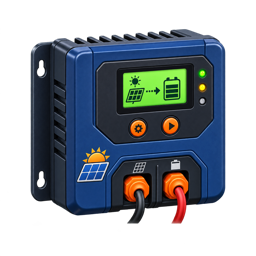
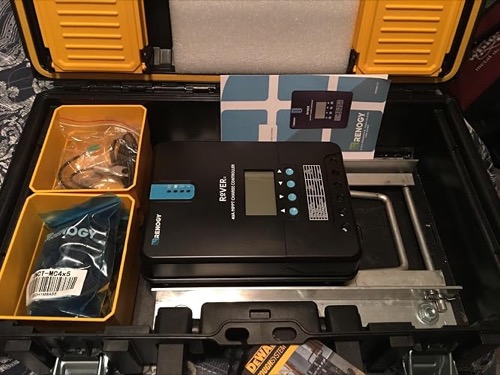
The built-in LCD distinguishes Rover from phone-first controllers. It shows battery voltage, charging status, current-related information, load state, and menu options without requiring a mobile connection. One camping-system owner considered that a major upgrade over LED-only PWM hardware.
Bluetooth requires Renogy’s BT-2 module, sold separately. The DC Home app can provide real-time information, history, settings, firmware updates, and alarms, but supplied feedback is mixed. One desert RV owner found the module needed periodic unplugging and reconnecting. Other owners praise the overall controller but do not discuss app stability.
Documentation also receives mixed feedback. A detailed owner says the instructions were easy enough to follow and created a laminated quick reference. Another says Renogy’s instructions were thin and adds specific installation notes learned during setup. Buyers should download the current manual before mounting the controller, especially when lithium settings, load terminals, or the optional communication module are involved.
Battery Support and Charging Behavior
Renogy documents sealed/AGM, gel, flooded, and lithium support. Lead-acid charging uses multiple stages; lithium uses a simpler profile and low-temperature protection. Battery voltage is automatically detected for non-lithium configurations, while lithium setup deserves explicit confirmation rather than relying on automatic behavior.
The included remote sensor supports temperature compensation where the selected chemistry uses it. For lithium, verify the exact cutoff mechanism and whether the battery BMS provides the primary cold-charge protection. A controller feature and a battery-level BMS rule can complement each other but are not interchangeable.
Several owners who moved from PWM or lower-capacity hardware report faster or more satisfactory charging. One buyer says the Rover replaced an inconsistent budget MPPT controller; another describes strong service in a 400W RV system. These comparisons are not standardized, so they support owner satisfaction rather than a universal efficiency advantage.
| Battery / Use | Fit | Reason | Must Verify |
|---|---|---|---|
| 12V lead-acid RV bank | Good | Published profile and 520W PV allowance | Sensor placement and charge settings |
| 24V lead-acid cabin | Good | 1,040W published allowance | Auto-detection and battery limits |
| 12V LiFePO4 | Good, conditional | Lithium mode and temperature protection | Manual voltage selection, BMS, cold cutoff |
| Battery limited to 30A | Conditional | Controller’s extra output cannot be used | Configure current or choose a smaller unit |
What the owners Report
| Theme | Supporting Reviews | What the Evidence Supports | Limitation |
|---|---|---|---|
| Successful RV/camping/off-grid operation | At least 7 | The exact 40A variant works in varied small systems | System sizes and durations differ |
| Local LCD valued | At least 2 detailed reports | Phone-free data is a practical advantage | Display accuracy was not independently tested |
| Terminal or cable problem | 2 detailed reports | Connection design deserves careful attention | Cannot establish prevalence or one root cause |
| Bluetooth reset friction | 1 detailed report | Optional module may need occasional recovery | Isolated and software/accessory dependent |
| Year-plus service | At least 2 | Longer successful ownership exists | Not a controlled reliability study |
| Exact-model failure/return | 1 | A serious negative experience exists | Single report with disputed warranty context |
Most reviewers are positive, but the technically detailed terminal reports carry more decision value than several short approvals. They do not justify calling Rover unsafe; they justify making conductor installation and inspection part of the buying decision.
Warranty and Long-Term Ownership
Renogy publishes a three-year warranty for this Rover model. Buyers should retain purchase records, photograph the completed wiring, and read the current exclusions before commissioning. A warranty does not replace installation quality, and it may not cover damage caused by conductor preparation, incorrect torque, incompatible equipment, moisture, or operation outside documented limits.
The owner record includes multiple owners describing year-plus service or repeated use in RV and camping systems. It also includes one complaint that Renogy denied an earlier controller claim because of another charging source in the system. That owner’s account cannot establish the exact warranty facts, but it shows why multi-source systems should be documented carefully and cleared against each manufacturer’s instructions. Support expectations and system architecture belong in the purchase decision alongside amp rating and price.
Buying and Commissioning Checklist
Begin with the question that justifies this model: can the battery and array use more than 30A? If not, the Rover’s higher rating may provide no advantage over a smaller controller. Confirm the 520W or 1,040W array limit for the selected battery voltage and obtain the current manual’s exact PV Isc ceiling before choosing parallel strings.
The physical plan deserves equal attention. Check that AWG 8 or smaller conductors satisfy the full voltage-drop and temperature calculation, that each wire will enter the clamp in the documented position, and that the terminals remain visible for retorque or inspection if the manual requires it. Price the BT-2 before comparing total monitoring cost.
- Verify cold-corrected Voc, exact Isc, and PV watts.
- Verify battery chemistry, BMS current, sensor, and low-temperature rules.
- Verify conductor preparation, terminal torque, strain relief, and protection.
- Verify enclosure ventilation, LCD access, and optional Bluetooth cost.
Owner Pattern — Rover’s strongest recurring benefits are its local display and successful small-system use. Its clearest risk signal is connection friction, not a proven population-wide failure rate.
System-Fit Matrix
| System / Buyer | Fit | Why | Must Verify |
|---|---|---|---|
| 400W 12V RV array | Good | Published 520W allowance and several owner examples | Cold Voc, Isc, battery current |
| 24V cabin array | Good | 1,040W allowance and 40A output | Exact string design and battery profile |
| Buyer wanting local numeric data | Good | LCD is included | Display/menu workflow |
| Buyer wanting included Bluetooth | Poor | BT-2 is extra | Module cost and compatibility |
| Hidden terminal compartment | Conditional | Connection inspection matters | Access, torque, strain relief, ventilation |
| Lithium system in freezing weather | Conditional | Low-temp feature is documented | Sensor logic and battery BMS |
| Exposed outdoor or marine mount | Poor | IP32 does not support exposure | Protective enclosure and condensation |
| Battery capped at 30A | Conditional | Extra 10A offers no benefit | Current configuration or smaller controller |
Alternatives Worth Comparing
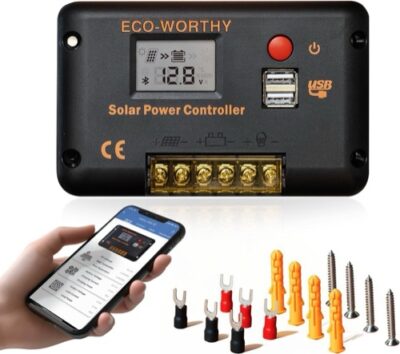
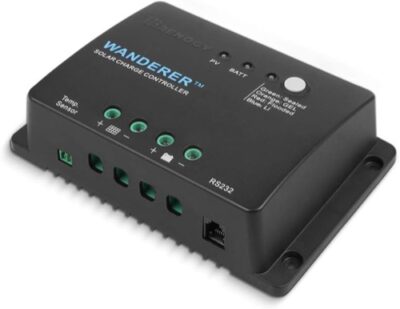
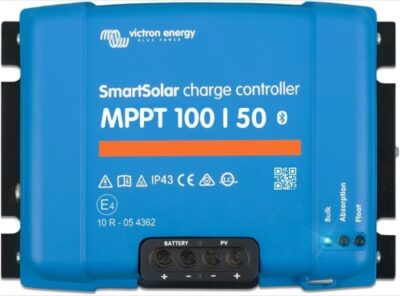
The Victron SmartSolar 100/30 is the cleaner choice when 30A is enough and Bluetooth matters. It has no local numeric screen, but app access is built in and its published Isc, terminal, and environmental data are more complete.
LiTime’s 30A MPPT includes both an LCD and Bluetooth. It is a practical LiFePO4-focused alternative when 30A fits, although its support and environmental documentation are less complete.
Rover earns its place when the extra output or local screen has system value. If neither changes the installation, its higher supplied price and optional Bluetooth make the decision harder to justify.
Who Should Buy It — and Who Should Skip It
Buy it if:
- Your 12V/24V system can genuinely use up to 40A.
- A built-in local LCD matters more than included Bluetooth.
- You can access, torque, and inspect the terminals properly.
- The controller will live in a protected, ventilated compartment.
Skip it if:
- The battery or array caps useful charge output at 30A or less.
- Bluetooth must be included in the controller price.
- Terminal access will be hidden or difficult to inspect.
- You cannot verify the exact-model PV Isc limit before final design.
Pros & Cons Analysis
Based on documented specifications and owner feedback
Pros
- Useful 40A output class — It provides more battery-side capacity than 30A models when the array and battery can use it.
- Local LCD included — Core voltage, charge, load, and setup information is available without a phone.
- Published 12V/24V limits — Renogy documents PV power, terminals, enclosure, temperature range, and warranty.
- Broad battery support — Lead-acid and lithium profiles are paired with temperature-related features.
- Multiple successful RV reports — Owners describe 400W arrays, camping use, and year-plus service.
Cons
- Bluetooth costs extra — DC Home connectivity requires the separately sold BT-2 module.
- Terminal caution — Two detailed reports describe loose connections or heat damage around a terminal.
- Isc remains unpublished — The current product page does not provide a maximum PV short-circuit-current value.
- App feedback is mixed — Owners mention occasional module resets and connection friction.
- Higher sampled price — Its August 2026 snapshot was substantially above the Victron 100/30.
Renogy Rover 40A: Our Verdict
Verdict: The Rover 40A is a versatile higher-output choice with a useful LCD and good manufacturer coverage, but terminal evidence makes installation discipline central to the recommendation.
Buy it if: Your documented 12V/24V system can use 31A–40A, you want phone-free local data, and the wiring remains accessible for correct placement and inspection.
Skip it if: Thirty amps is already enough, included Bluetooth matters, or an unpublished PV Isc limit and the sampled terminal reports create unacceptable design uncertainty.
Frequently Asked Questions
Can the Renogy Rover 40A charge a 24V battery bank?
Yes. Renogy documents 12V/24V operation, with automatic detection for non-lithium batteries. Lithium setup may require manual voltage selection and profile configuration.
How much solar can the Rover 40A accept?
Renogy specifies 520W at 12V and 1,040W at 24V with a 100V maximum PV Voc. Verify the unpublished Isc limit in the current exact-model manual before final array sizing.
Does Bluetooth come with the Rover 40A?
No. The local LCD is included, but Renogy DC Home app access requires the compatible BT-2 module, sold separately.
Does it support LiFePO4 batteries?
Renogy documents lithium support and low-temperature protection. Match every charging voltage, current limit, sensor requirement, and BMS rule to the exact battery.
What wire size fits the Rover 40A?
Renogy publishes a maximum terminal size of 10 mm² or AWG 8. Follow the exact conductor preparation and torque instructions; do not force larger wire or trim strands.
Are the Rover terminal complaints serious?
They justify careful installation and inspection, but they do not prove a universal defect. Two sampled owners reported connection or heat trouble, while another explained that conductor placement inside the clamp is easy to misread.
Can the Rover 40A be mounted outside?
Its IP32 rating is intended for protected locations and is not approval for exposed rain, marine spray, or condensation. Follow the manual's enclosure and clearance requirements.
Is the Rover 40A better than Victron's 100/30?
Rover is stronger when the system can use 31A–40A or needs a built-in LCD. Victron is easier to recommend when 30A is enough and included Bluetooth matters.
Technical Specifications
| Brand | Renogy |
|---|---|
| Exact model / revision / ASIN | Rover Li 40A (RNG-CTRL-RVR40) (ASIN B01MSYGZGI) |
| Controller type | MPPT |
| Rated battery-side charge current | 40A |
| Supported battery-system voltage | 12V / 24V automatic detection for non-lithium batteries |
| Battery chemistry and profile support | Sealed/AGM, gel, flooded, and lithium |
| Maximum PV open-circuit voltage (Voc) | 100V |
| Maximum PV short-circuit/input current (Isc) | Not published for this model |
| Maximum PV power by battery voltage | 520W @ 12V; 1,040W @ 24V; 48V not supported |
| Minimum PV/start voltage requirement | Not published for the reviewed revision |
| Load output and low-voltage disconnect | Dedicated programmable load terminals; current rating not published on the product page |
| Grounding topology | Common negative / negative ground |
| Charging stages and custom voltage control | Four-stage lead-acid; two-stage lithium |
| Temperature sensing and lithium low-temperature behavior | Remote sensor included; temperature compensation and lithium low-temp protection |
| Display and local controls | Built-in LCD and buttons |
| App, communications, and data history | Optional BT-2 module; Renogy DC Home; RS485/RJ12 |
| Maximum terminal conductor size | 10 mm² / AWG 8 |
| Controller self-consumption | 100mA or less at 12V; 58mA or less at 24V |
| Published tracking/conversion efficiency | 99% tracking; 98% peak conversion |
| Cooling method and thermal derating | Passive heatsink; output derates above 65°C controller temperature and shuts down above 80°C |
| Electrical protections | PV short-circuit, PV overvoltage, PV overcurrent, load overload/short-circuit, PV/battery reverse-polarity, and overtemperature protection |
| Enclosure, ingress rating, and operating temperature | IP32; -35°C to 45°C |
| Certifications | FCC Part 15 Class B, CE, RoHS, and RCM |
| Dimensions, weight, and included accessories | 238 × 172 × 77 mm; 2.0 kg |
| Warranty | 3 years |