
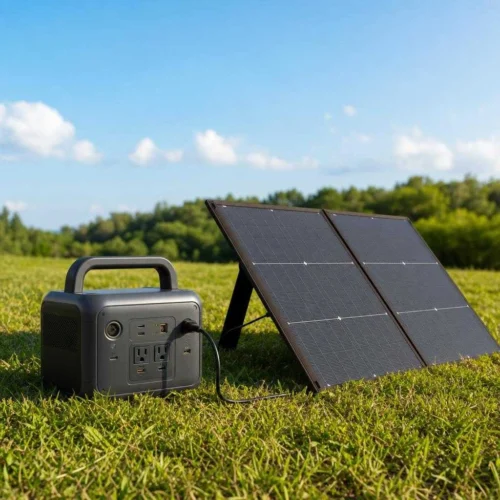
A solar generator is a battery power station connected to a compatible solar panel—not a machine that creates unlimited energy. The panel converts sunlight to DC electricity, the station regulates and stores that energy, and an inverter inside the station supplies AC electricity to suitable loads. Many products also accept wall, vehicle, USB-C, or alternator charging.
The label is convenient but imprecise. The battery station does not contain solar cells, and the panel does not provide backup after sunset without storage and the appropriate inverter. The US Department of Energy similarly separates photovoltaic generation, storage, and inverter functions in its PV system design overview.
Follow One Watt-Hour Through the System
Start with a photon striking the panel. The panel’s output changes with irradiance, temperature, angle, shade, wiring, and the station’s input behavior. A charge controller or internal power electronics regulates that input for the battery. The battery stores chemical energy, and later the inverter converts DC to AC. Every step loses some energy, which is why a 1,024Wh label never means 1,024Wh reaches an AC appliance.
Trace Sunlight Through the Battery
Estimate what a panel may collect, how long that energy may run a steady load, and whether the panel is proportionate to the battery.
Planning estimate only. Verify the exact load, manual limits, wiring, connectors, weather, and operating conditions.
The tool keeps three ideas separate. Daily harvest is the panel nameplate multiplied by useful sun and a derating assumption. Battery-equivalent fill compares that harvest with capacity. Runtime applies a separate usable-energy assumption to the battery. None of the results promises weather or appliance behavior; they make the assumptions visible.
Watts and Watt-Hours Do Different Jobs
Continuous watts decide what can run together. Surge or startup capacity screens brief motor demands.
Wh helps estimate duration: a 100W load for five hours consumes about 500Wh before losses.
A 200W label is not 200Wh every hour of the day.
An array can have acceptable wattage yet exceed a station’s voltage or current rules.
A battery can have enough energy for a device but too little inverter output to start it. It can also have enough watts to run a heater briefly but too few watt-hours to run it for long. Solar sizing adds a third independent question: can the array restore energy as quickly as the operating plan consumes it?
Open the Station and Name the Parts
- Battery cells and battery-management system: store energy and monitor electrical and thermal boundaries.
- AC charger and solar input electronics: accept supported charging sources and regulate current for the battery.
- Inverter: converts DC battery energy to the AC waveform and voltage listed for the station.
- DC converters: supply USB and vehicle-style outputs at their individual limits.
- Controls and protection: display state, switch outputs, manage temperature, and respond to overload or faults.
Marketing may present the station as a single black box, but each subsystem has a separate ceiling. A 2,000W inverter does not imply a 2,000W solar input. A 100W USB-C port says nothing about the AC outlets. An app can change settings but cannot exceed hardware limits.
The Solar Panel Is a Source, Not a Fuel Tank
A fuel tank contains a known quantity. A panel is closer to a variable-rate tap. Shade on one section, a warm cell surface, poor angle, haze, short winter days, or an input-current ceiling can reduce the flow. The battery is the tank, and its state of charge tells you how much energy remains.
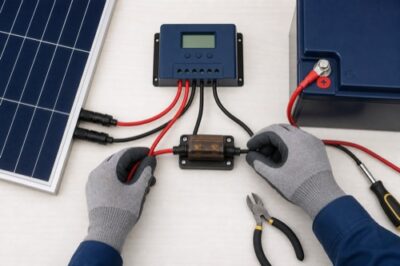
Do not join panels by nameplate watts alone. Calculate series open-circuit voltage at the coldest expected condition and parallel current, then compare them with the exact manual. Use the specified connector and polarity. If that work is unfamiliar, use the manufacturer’s approved panel or obtain qualified help.
What a Solar Generator Can—and Cannot—Run
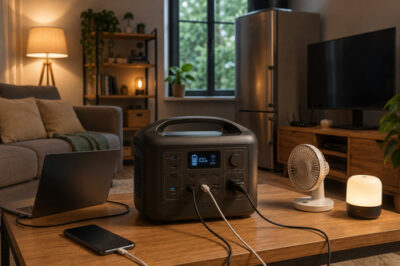
Small kits can cover communications, lighting, laptops, cameras, some CPAP plans, and other modest loads. Around 1kWh, many systems can support refrigeration, entertainment, tools, or cooking loads within their inverter and energy limits. Larger integrated systems can support selected home circuits and sometimes 240V when exact hardware and installation allow it.
A solar generator also cannot turn a grid-tied rooftop array into outage power automatically. DOE’s solar resilience guidance explains that solar alone does not provide outage resilience; appropriate storage, inverter, controls, and system design are required.
Read “Solar Generator Kit” as an Exact Bundle
Two retailers can use the same kit name while pairing different panel quantities, cable sets, station revisions, or warranties. Record the station model, panel model and count, bundle ASIN or SKU, electrical values, and included adapters. A 1kWh station with a 100W panel behaves very differently from the same station with 400W of solar, even though both listings may say “solar generator.”
- Identity: exact station and exact panel labels.
- Power: continuous, surge, AC voltage and frequency.
- Energy: capacity, chemistry, reserve, expansion status.
- Solar: input voltage/current range, connector, included watts.
- Ownership: box contents, separate warranty terms, app and registration requirements.
The BLUETTI Elite 200 V2 bundle review shows why station and panel must be read separately: the 200W module is valid, but it uses only part of the station’s 1,000W solar receiver.
Use a Three-Question Buying Test
What must run?
List simultaneous and startup watts, outlet type, voltage, and any interruption tolerance.
How long must it run?
Measure watt-hours over a representative period and add loss and reserve.
How will energy return?
Model wall, vehicle, or realistic daily solar collection—not the panel’s nameplate alone.
If a product passes all three, it is a candidate. If it passes only the watt test, it may run the appliance briefly and still fail the day. If it passes runtime but not solar recovery, it is a battery that will eventually need another source.
Recognize the Four Ways the System Can Stop
These failures belong to different components. Replacing the panel cannot fix an inverter overload. Buying a larger battery does not fix incompatible array voltage. Updating an app does not create a missing cable. Diagnose the path from source to load rather than treating the kit as one undifferentiated box.
The separation also improves support requests. Provide exact model numbers, the active charging source, measured or displayed voltage/power, battery percentage, temperature, error code, cable path, and the load attached. “Solar generator does not work” gives support very little to reproduce; a source-to-load record narrows the problem.
Wall Charging Does Not Make the Name Wrong
Most solar generators also charge from a wall outlet, vehicle, USB-C source, alternator charger, or fuel generator when the exact model supports it. The word solar describes one available source, not an obligation to use only sunlight. Starting a storm with an AC-charged battery is often more reliable than waiting for poor weather to fill it.
Multiple sources create resilience only when their limits and roles are documented. Wall power is fast before an outage; solar can extend operation when weather cooperates; vehicle or alternator charging can help during travel; a safely operated fuel generator may charge some stations during a long event. Each conversion loses energy and each connection has its own voltage, current, temperature, and cable rules.
Grid-first owner
Keeps the battery ready from AC and treats the panel as an outage or travel extender.
Solar-first traveler
Sizes daily loads below realistic collection and keeps a vehicle or grid fallback.
Hybrid resilience owner
Documents several supported sources so one failure does not end charging.
Bottom Line: It Is an Energy System in a Portable Form
A solar generator combines a power station, solar input, and compatible panel path into a rechargeable energy system. Its value comes from quiet battery power and the ability to collect sunlight—not from unlimited runtime. Understand watts, watt-hours, voltage/current compatibility, and the exact bundle, and the category becomes much easier to size honestly.

Leave a Reply