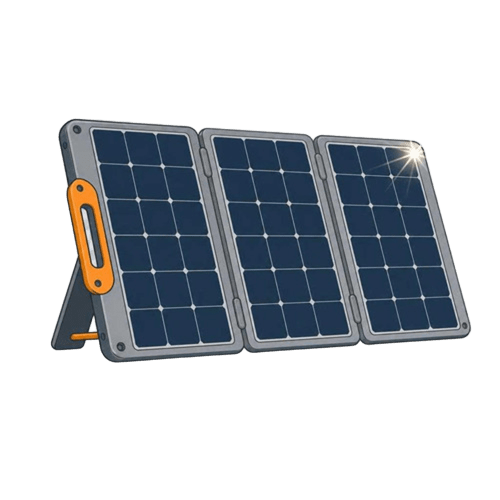
EBL 500W Solar Generator Review: A Light 519Wh Kit Built for CPAPs, Coolers, and Quiet Backup
At a Glance
KEY FEATURES
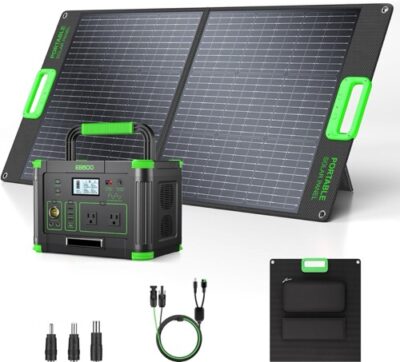
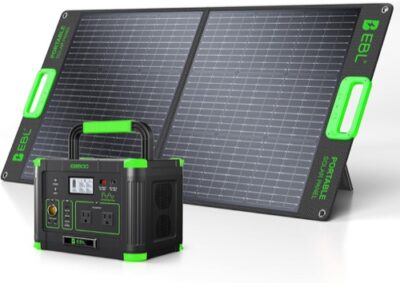
- Exact kit: EBL MP500 with Solar Apollo ESP-100 100W panel.
- Battery/output: 519.4Wh NCM, 500W continuous AC, 1,000W surge.
- Solar match: 100W panel against a 105W maximum receiver.
- Simple platform: No app, expansion battery, or published UPS transfer rating.
- Evidence confidence: Ten usable exact records after excluding a sibling product.
PROS
- 100W panel nearly matches the station's 105W input ceiling.
- 519.4Wh capacity is useful for CPAP, coolers, electronics, and lights.
- Pure-sine 500W AC plus USB-C, DC, and wireless charging offers flexible small-load use.
- About-15-pound station is manageable for vehicle camping.
CONS
- Only ten usable exact owner records limit confidence.
- NCM battery and unpublished cycle-life detail trail newer LFP platforms.
- Six-to-nine-hour charging is slow from both wall and solar sources.
- No expansion, app, or documented UPS transfer time.
Cautious value for measured small loads
Exact documentation plus ten usable exact-owner records after excluding a sibling product. Ratings reflect a coherent panel match but limited long-term evidence and a 105W recharge ceiling.
Small-sample boundary: ten supplied records were usable for this bundle, and one nearby review describing a 1,000Wh/200W sibling was excluded. The remaining evidence supports individual CPAP, cooler, solar, and fault narratives; it cannot support a typical failure rate or broad reliability claim.
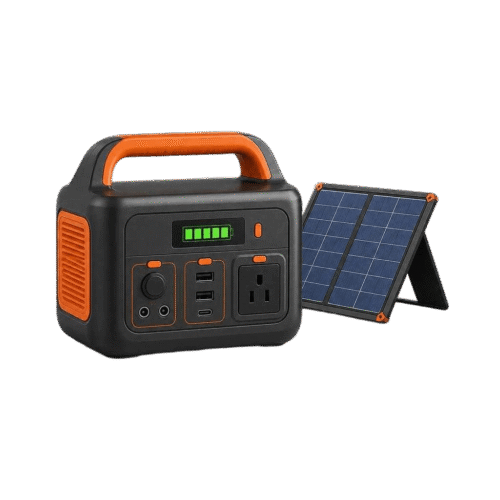
The exact EBL MP500 system pairs 519.4Wh of NCM storage and a 500W pure-sine inverter with the Solar Apollo ESP-100 panel. The panel’s 100W rating is close to the station’s 105W maximum input, so the bundle is electrically coherent. Its limits are equally clear: no expansion battery, no app, no documented UPS transfer rating, and a relatively slow charge path whether the source is wall power or sun.
Supported by an exact-use account, but must be repeated with the buyer’s own pressure, humidifier, heated hose, connection, and reserve.
One supplied owner describes multi-day cooler use; temperature, duty cycle, ambient heat, and battery reserve determine repeatability.
Phones, lights, laptop, radio, fan, and camera charging are natural fits for the port set.
500W output and 519Wh energy make heating, cooking, and demanding motor loads poor targets.
Use the exact owner cases as test designs, not promises. For CPAP, run a full night on the approved power path and record start/end state of charge. For a cooler, record watt-hours across hot daytime cycling and a cooler night. For solar, log stable input and total daily harvest. If the display shows an A06 code or another fault, stop improvising, photograph the state, disconnect the load safely, follow the exact manual, and contact the documented seller or EBL channel.
| Field-note page | Measurement | Pass condition |
|---|---|---|
| CPAP night | Exact settings, power path, hours, start/end charge | Required reserve remains after a full normal night |
| Cooler day | Ambient temperature and watt-hours over complete cycling | Daily load fits the recharge window |
| Solar session | Weather, angle, stable watts, total watt-hours | Harvest supports the planned energy balance |
| Fault baseline | Firmware/manual revision, code, load, voltage, photos | Cause is documented without unsafe repeated resets |
The 100W panel can plausibly refill 519Wh across a strong day, but the published six-to-nine-hour range remains conditional. Shade, heat, cable loss, receiver taper, and concurrent loads add time. Since the station cannot accept much more than 105W, buying a much larger panel does not create a proportionally faster charge. This is a matched low-rate system.
The Ten-Record Field Notebook
| Spec | Value |
|---|---|
| Battery Capacity | 519.48 Wh Li-ion |
| Continuous AC Output | 500 W (pure sine wave) |
| Surge / Peak | 1000 W |
| Solar Input | 100 W max (bundled folding panel) |
| Solar Recharge | ~6-9 hr full charge in good sun |
| Ports | 2 AC, 1 USB-C (60W), 3 USB-A, 2 DC, 1 car, wireless pad |
| Weight | 14.1 lb (station) |
| Extras | LED SOS flashlight, 10 devices at once |
| Best For | Camping, CPAP backup, coolers, short outages |
What the Exact MP500 Evidence Can—and Cannot—Say
If you want a light, quiet, sub-500W station with a real solar panel included, this EBL 500W solar generator review lands on a cautious yes for the right buyer. The station is easy to live with: about 15 pounds, a solid handle, pure sine wave AC, and ten outputs including a 60W USB-C and a wireless charging pad. The 519Wh pack runs low-draw gear impressively long — owners kept a CPAP going a full night with charge to spare and a small cooler cold for five days. The bundled 100W folding panel is a genuine bonus, delivering advertised watts when aimed well. Just size your expectations to the 500W ceiling and the Li-ion chemistry, and it’s one of the more sensible small kits at its price.
A 15-Pound Utility Box With Ten Output Paths
The first thing owners notice is how little it asks of you to carry. At about 15 pounds with a solid molded handle, it’s a true one-handed lift that slides onto a truck floor or into an RV cabinet without a fight. There’s no gas, no fumes, and no engine drone — it runs silently, which is exactly why buyers are comfortable using it indoors during an outage and next to where they sleep on a trip.
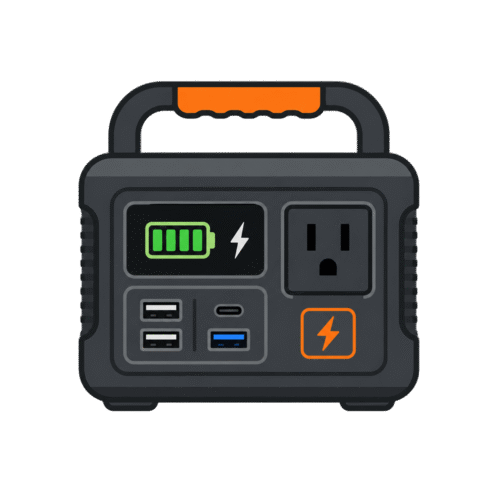
The front panel keeps things simple: a clear readout for battery level and load, physical buttons to switch the AC, DC, and USB sections on and off, and no companion app to fuss with. That plainness is a feature here — you plug in and go rather than hunting through menus.
Port selection is where it punches above the price. You get two pure sine wave AC outlets (120V, 500W total), three QC3.0 USB-A ports, a 60W USB-C PD port, two DC ports, a 12V car port, and a 10W wireless charging pad on the top deck — enough to feed up to ten devices at once. Pure sine wave output matters for sensitive electronics and CPAP machines, and the wireless pad is a handy place to drop a phone while every cable port stays busy. The one limit worth noting: USB-C tops out at 60W, so a larger 100W laptop charges more slowly than on its factory brick. And a built-in LED flashlight with steady, strobe, and SOS modes rounds it out — a small touch that earns its keep in a blackout.
CPAP, Cooler, and the 500W Boundary
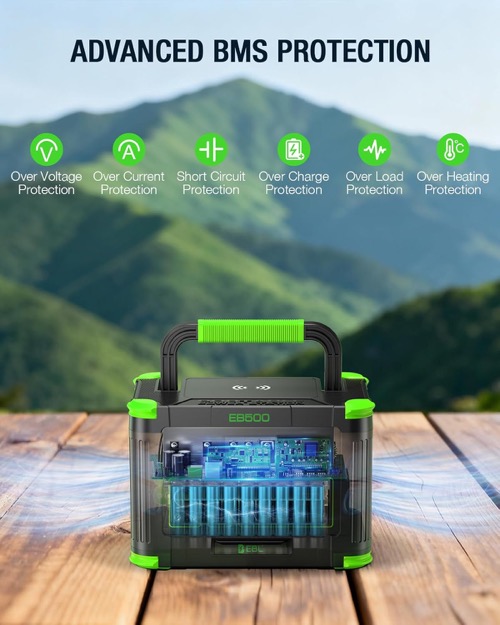
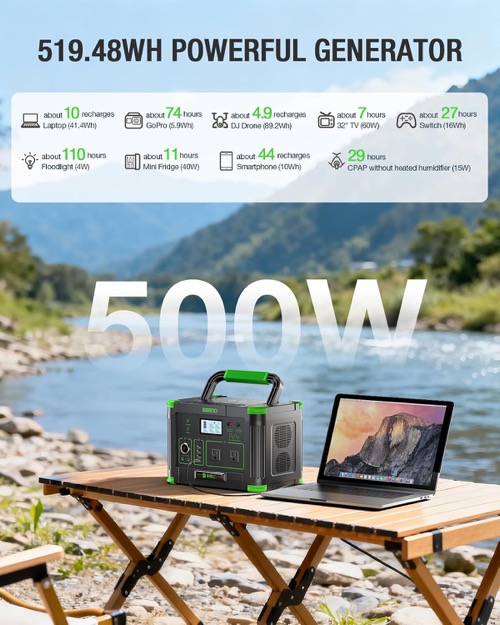
Start with the honest usable number. After inverter and conversion losses, a 519Wh Li-ion pack delivers roughly 440 watt-hours to your AC devices — call it 519 × 0.85. That figure, not the nameplate, is what your runtime math should use.
From there the story splits cleanly. Low-draw gear — especially anything that cycles, like a cooler — runs for a very long time. Higher-draw devices drain the modest pack quickly, and anything over 500W simply won’t start. That’s exactly what owners report: a CPAP holding a full night, a small cooler cold for days, but nothing kitchen-grade in the mix.
| Device (typical draw) | Estimated Runtime | Owner-Grounded Note |
|---|---|---|
| CPAP, no humidifier (~35 W) | ~11-12 hr | Owner ran one a full 8 hr with charge left |
| 12V car cooler (~23 W avg) | Days at low duty | Owner held 35°F for 5 days, full to empty |
| Mini fridge (~50 W avg) | Most of a day | Cycling keeps average draw low |
| Wi-Fi router (~10 W) | ~40 hr | Easy multi-day comms/backup |
| LED TV (~80 W) | ~5 hr | Plus a projector or fan alongside |
| Laptop (~60 W) | ~7 hr | And ~25-30 phone charges from USB |
| Near-500W load (small blender) | Under 1 hr | Capacity-limited by design |
| Hair dryer / microwave / heater | Won’t run | Exceeds the 500W inverter |
Callout — The 500W inverter decides *what* you can plug in; the 519Wh pack decides *how long* it runs. Keep every load under 500 watts — CPAPs, phones, laptops, fans, routers, TVs, coolers, cameras — and this kit is right in its element. Reach for a hair dryer, coffee maker, or space heater and it will refuse the job, by design.
Treat each runtime as a planning example. Repeat the calculation with the MP500’s starting charge, the exact load’s complete duty cycle, ambient temperature, chosen reserve, and any solar energy arriving during use.
Every Input Converges on a 105W Ceiling
There are two ways to refill it, and they serve different needs. From the wall, the included adapter tops the station up in a few hours — the dependable choice when you need a quick turnaround before leaving the driveway. There’s no app-gated super-charge mode here, just a straightforward, steady wall charge.
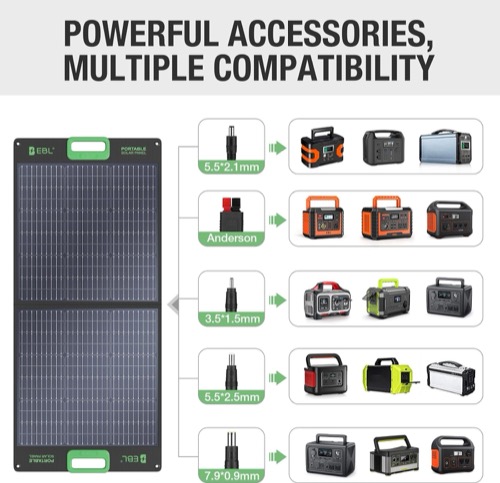
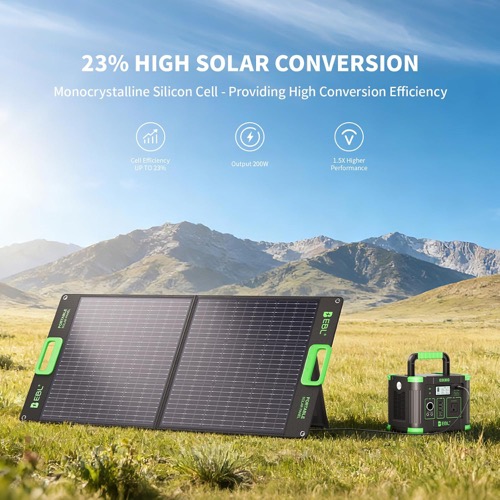
Solar is the off-grid path, and the bundled 100W monocrystalline panel is a real asset rather than a throw-in. It folds flat as a briefcase, unfolds onto two built-in kickstands, and uses high-efficiency cells rated up to 23.5%. Owner feedback is encouraging: one buyer used it in less-than-ideal light and still received the charge rate and watts as advertised, and another had solar top the station off within hours on a camping trip. The panel also ships with a 25A connector cable and a full set of DC adapters plus an Anderson cable, so it fits the EBL station and most other power stations you might already own.
The honest caveat is the 100W input cap. Because that’s the ceiling, a from-empty solar recharge takes the rated 6-9 hours of good sun, and real output still bends to angle and cloud cover. Aim the panel at the sun, and it meaningfully refills the pack over a day; leave it flat or shaded and the number drops. Treat solar as a strong daytime top-up that extends your runtime, and lean on the wall charger when speed matters.
Callout — The smartest field trick owners use is charge-through: run your cooler or CPAP off the outputs while the 100W panel trickles the station back up during daylight. It won’t outrun a heavy load, but on a low-draw camp setup the daytime solar can offset much of what you use, stretching a single charge across a multi-day trip.
The Price of Simplicity: No App, Expansion, or UPS Rating
The reason to look at this kit over a pricier name-brand rival is simple value. You get a 519Wh pure sine wave station and a 100W folding panel with a complete adapter kit in one mid-budget box — the whole point of a solar generator, rather than a battery you have to accessorize later. Comparable bundles from the biggest brands often cost noticeably more for similar usable capacity.
The trade EBL makes to hit that price is chemistry. This pack is lithium-ion, not the LiFePO4 that some rivals now use. Li-ion keeps the unit genuinely light at about 15 pounds, which owners love for hauling to camp, but it generally offers fewer lifetime charge cycles and prefers not to sit at full or empty for months. For a buyer who uses it regularly — camping seasons, road trips, occasional outages — that’s a fair bargain. For someone who wants a decade-long, set-and-forget emergency battery, a LiFePO4 unit is the longer-lived choice.
Where EBL doesn’t cut corners is the extras that make a kit pleasant: pure sine wave AC, ten outputs, a wireless pad, a real folding panel, and an LED SOS light. Those add up to everyday usefulness you’d normally pay more to get.
MP500 Mission Filter
| Use Case | Fit | Why |
|---|---|---|
| CPAP / medical backup | Strong fit | Pure sine wave AC, a full night on 519Wh |
| Camping / road trips | Strong fit | 14.1 lb, quiet, folding panel included |
| Portable cooler / mini fridge | Strong fit | Low-draw cycling stretches for days |
| Phones, laptops, router, TV | Strong fit | Ten outputs, wireless pad, 60W USB-C |
| Short home outage backup | Solid fit | Silent, fumeless, safe indoors, LED SOS |
| Solar top-up off-grid | Solid fit | 100W panel refills over a sunny day |
| High-wattage 100W laptop | Verify first | USB-C caps at 60W; use AC instead |
| Kitchen appliances / heaters | Not a fit | Over 500W won’t run on this inverter |
| Decade-long idle emergency kit | Borderline | Li-ion prefers regular use over LiFePO4 |
Buy it when you want:
- A light, quiet station to run a CPAP, cooler, and phones off-grid
- A complete kit with a real 100W folding panel already in the box
- Pure sine wave power and ten outputs at a mid-budget price
- Silent, fumeless backup you can safely run indoors during an outage
Look elsewhere if you need:
- To run high-draw gear like a microwave, hair dryer, or space heater
- A big-capacity battery for all-day or whole-home backup
- LiFePO4 longevity for a battery you’ll leave idle for years
- A sub-hour fast charge or an app to monitor it remotely
EBL MP500 Kit: Cautious Small-Sample Verdict
For campers, road-trippers, CPAP users, and anyone building a light outage kit, this EBL 500W solar generator review comes down clearly in favor — within its lane. The station is the easy part to recommend: about 15 pounds, silent, pure sine wave AC, ten outputs, and a folding 100W panel that owners found delivers its advertised watts. The 519Wh pack runs low-draw gear for impressively long stretches, keeping a CPAP going a full night and a cooler cold for days, and the whole kit lands at a mid-budget price that undercuts the big names.
The trade-offs are honest and worth respecting. The 500W ceiling rules out kitchen and heating appliances outright, 519Wh drains fast under heavy load, the panel’s 100W cap means a 6-9 hour from-empty solar refill, and the Li-ion chemistry favors regular use over decade-long idle storage. So the if/then is straightforward: if you want a light, quiet, affordable kit to keep small electronics, a CPAP, and a cooler alive off-grid or through a blackout — and you keep your loads under 500 watts — the EBL 500W solar generator is an easy yes. If you’re hoping to run a hair dryer or back up your whole house, size up to a bigger LiFePO4 unit before you buy.
Pros & Cons Analysis
Based on documented specifications and owner feedback
Pros
- Station and panel are proportionate — The 100W module uses nearly all of the 105W input ceiling instead of functioning as a token starter panel.
- Exact small-load cases exist — Supplied records include CPAP, cycling cooler, and solar use that can be converted into buyer-specific acceptance tests.
- Port diversity is practical — AC, USB-A, 60W USB-C, DC5525, car socket, and wireless charging cover varied campsite electronics.
- Pure-sine output is appropriate — Compatible electronics receive a cleaner waveform than a modified-sine budget station, within the 500W limit.
- Simple local operation — The platform does not require an app account or wireless link for normal use.
Cons
- The evidence base is narrow — Ten usable records can reveal scenarios but cannot establish typical reliability or failure frequency.
- Charging is receiver-limited — A larger panel or charger cannot bypass the 105W maximum input and all-day recovery behavior.
- Battery documentation is less competitive — NCM chemistry and missing exact cycle-life data provide less long-horizon clarity than documented LFP rivals.
- Fault handling needs discipline — An A06 report underscores the value of photos, exact load data, manual steps, and prompt channel-specific support.
- No growth or remote management — Capacity, inverter output, and software features remain fixed if the buyer's mission expands.
A Matched 100W Small-Load Kit With Limited Ownership Evidence
The EBL MP500 and ESP-100 make electrical sense together and fit measured CPAP, cooler, lighting, and device missions. Slow input, fixed capacity, NCM chemistry, and a small exact owner sample keep the recommendation cautious.
Frequently Asked Questions
Can the EBL MP500 run a CPAP overnight?
One exact owner report supports the use case, but you must test your own device, approved power path, pressure, humidifier, heated hose, hours, and reserve for a full night.
How long does the ESP-100 panel take to charge it?
EBL guidance is roughly six to nine hours under suitable conditions. Cloud, shade, heat, angle, cable loss, taper, and concurrent loads make real time variable.
Can it run a refrigerator?
A small efficient refrigerator may work if compressor startup stays within the short surge limit, but 519Wh may provide limited runtime. Measure a complete duty cycle.
What does an A06 code mean?
Use the exact MP500 manual and current EBL support path; do not infer from another model. Record the code, connected load, input state, temperature, and photos before troubleshooting.
Can a 200W panel charge it faster?
Not proportionally. The station input ceiling is about 105W, and panel voltage/current/connector limits still apply.
Is the owner evidence sufficient to judge reliability?
No. Ten usable exact records are useful qualitative context, not a representative reliability sample or failure-rate dataset.
Technical Specifications
| Brand | EBL |
|---|---|
| Kit model / SKU / ASIN | MP500 + Solar Apollo ESP-100 bundle (SKU DYCNX0006BEB-US + DYZDB0001AEB; ASIN B0GG9GX8CN) |
| Power-station model | EBL MP500 |
| Included solar-panel model and quantity | 1 × EBL Solar Apollo ESP-100 100W portable panel |
| Battery capacity | 519.4Wh |
| Battery chemistry | NCM lithium-ion |
| Cycle-life rating | Not published for this exact bundle |
| Expandable capacity | No expansion-battery port |
| Continuous AC output | 500W |
| Surge / peak output | 1,000W |
| AC voltage, frequency, and waveform | 110V ±10%, 60Hz, pure sine wave |
| AC outlets and high-current / RV / 240V outputs | 2 × AC; no high-current RV or 240V output |
| USB and DC outputs | 3 × USB-A QC 18W, 1 × USB-C 60W, 2 × DC5525, 1 × car socket, 10W wireless pad |
| Maximum station solar input | 105W maximum input power |
| PV input voltage/current range and connector | 12–26V DC, 5.5–6A PV input; MC4-to-7.9mm/8mm adapter path |
| Included panel rated power | 100W |
| Panel Voc / Vmp / Isc / Imp | Voc 23.5V / Vmp 20V / Isc 6A / Imp 5A |
| Panel construction and cell type | Foldable monocrystalline panel; 23% published cell efficiency |
| Panel weather rating | Not published for the exact ESP-100 in the bundle documentation |
| Panel dimensions and weight, folded / deployed | Folded 25 × 21 × 2.5 in; deployed 50 × 21 × 0.2 in; 10.3 lb net |
| Solar recharge estimate with included panel | 6–9 hours under the manufacturer's stated solar conditions |
| Maximum AC input and AC recharge time | 105W maximum input; manufacturer states 6–9 hours for a full charge |
| Car, alternator, and other charging methods | 12–15V vehicle input; 12V car cable included |
| UPS / EPS support and transfer time | No documented UPS/EPS transfer-time rating |
| App and connectivity | No app or wireless connectivity |
| Station dimensions, weight, operating limits, and weather rating | 11.5 × 7.95 × 7.64 in; 14.99 lb; charge 32–104°F, discharge 14–104°F; no published IP rating |
| Station and panel warranties | 12 months for purchases covered by EBL's direct warranty; Amazon orders follow the seller-channel policy |
| Included in the box | MP500, AC adapter, car cable, MC4-to-7.9mm cable, manual; ESP-100, MC4-to-Anderson/DC cable and four DC adapters |