Yes, Almost Any Portable Solar Panel Can Charge a Power Station
If you are wondering whether a portable solar panel for power station charging is as simple as plug-and-go, the short answer is yes. Any solar panel with a compatible connector, and with a voltage and current that fall inside your station’s rated solar input, will charge it in direct sun. There is no separate box to buy and no wiring to figure out — the power station does the hard part for you.
That leaves only two things you actually have to check before you order: the connector (does the panel plug into your station, or do you need an adapter?) and the input limits (does the panel’s wattage and voltage fit inside the station’s solar input window?). This guide walks through both, plus how to size a panel, how to estimate recharge time, and a worked example of whether a 400W panel can keep a fridge running. If you would rather have the numbers done for you, the solar panel calculator sizes a panel to your station and daily use in a few clicks.
How a Solar Panel Charges a Power Station
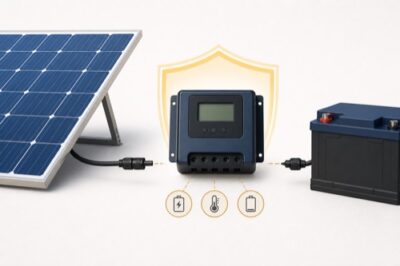
A solar panel puts out raw, variable DC power — the voltage and current swing with the sun, the angle, and the temperature. Something has to convert that messy output into a clean, controlled charge the battery can accept. In a traditional off-grid setup, that job belongs to a separate MPPT (Maximum Power Point Tracking) charge controller you buy and wire in yourself.
A portable power station already has an MPPT charge controller built into its solar input. When you plug a panel into the station’s solar port, the station’s electronics track the panel’s optimal operating point and manage the charge automatically. Every one of the panels in this guide confirms it — as the EcoFlow 400W review puts it, the panel “leans on the station’s built-in MPPT algorithm to track output,” and the Anker SOLIX PS400 has “no built-in controller” because the MPPT lives in the station. That is why you do not need a separate controller: the station is the controller.
The one time this changes is if you skip the station and wire a bare panel straight to a 12V battery bank. Then you are on your own for the MPPT or PWM controller. But for power station charging, you plug in and it works.
The Connector Problem: MC4 Panels vs Proprietary Station Ports
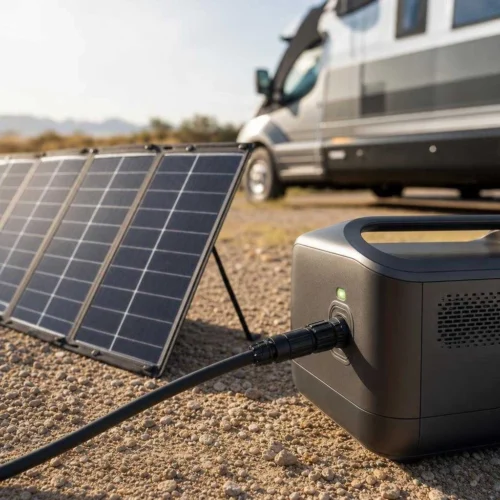
Here is the single most common reason a panel and a station do not “just work” together out of the box: the plugs do not match. Solar panels have standardized on the MC4 connector — it is the universal weatherproof solar plug, and every 400W panel we reviewed outputs over MC4. Power stations, however, use whatever input port their maker chose.
Common station solar input ports include:
- XT60 / XT-60 — used by EcoFlow, Anker SOLIX, and many others.
- Anderson (APP) — used by some Bluetti and other stations.
- DC7909 (barrel plug) — common on smaller stations from Jackery and others.
- Proprietary ports — a few ecosystems use a locking connector unique to the brand.
Because panels are MC4 and stations are not, the bridge is an MC4-to-brand adapter. Sometimes it comes in the box: the Anker SOLIX PS400 ships with two MC4 cables plus a short MC4-to-XT-60 adapter, so it clicks straight into Anker stations with no adapter hunting. Sometimes it does not: the Renogy 400W suitcase ships as just the panel with IP68 solar connectors and no universal station adapter cable, so owners have to supply the adapter that matches their station’s input port — a point buyers repeatedly wish had been included.
The takeaway: an MC4 panel can charge almost any station, but confirm the adapter situation before you order. If the panel and station are the same brand, you are usually covered. If they are different brands, budget for one inexpensive MC4-to-brand adapter — and, if your sunny spot is more than a few feet from the station, a matching-gauge MC4 extension cable so you keep the placement freedom a portable panel is supposed to give you.
Matching Panel Wattage to Your Station’s Max Solar Input
Every power station lists a maximum solar input — a wattage ceiling (and a voltage and current limit) for what its solar port can accept. This is the number that decides how big a panel makes sense. The good news is the failure mode is gentle: if the panel can produce more than the station’s limit, the station simply caps the incoming power at its maximum and ignores the rest. It is not damaged. The Renogy review confirms owners “overpanel” on purpose — one connected a panel above the C1000X’s 600W input limit, and the station “simply takes as much as it can and ignores the rest.”
Here is how panel size lines up with typical station input windows:
| Station capacity | Typical max solar input | Sensible panel size | What happens if the panel exceeds the limit |
|---|---|---|---|
| 200-300 Wh (small) | ~60-100 W | 60-100 W | Station caps input at its limit; extra watts are ignored |
| 500-1000 Wh (mid) | ~200-500 W | 200-400 W | Charges at full rated speed; no harm from a larger panel |
| 1000-1500 Wh (large) | ~500-800 W | 400-600 W | Panel can be maxed out; station simply caps at its ceiling |
| 1500-2000+ Wh (XL) | ~800-1600 W | 400-800 W (often multiple panels) | Room to add panels for a full daytime recharge |
The practical rule: it is far better to slightly overshoot the panel size than to undershoot it. A panel that occasionally hits the cap still charges at full speed; a panel that is too small leaves your station half-full at sunset. A single 400W unit is the sweet spot for most mid and large stations — and, as the DOKIO 400W review notes, one big panel replaces four 100W panels, which means fewer branch connectors, fewer joints to fail, and a cleaner install.
The Voltage Window: Why MPPT Range Matters More Than Watts
Wattage gets the attention, but voltage is what actually determines whether a station will accept a panel at all. A station’s MPPT input has a voltage range — a minimum it needs before it will start charging and a maximum it can safely accept. The panel’s voltage has to land inside that window.
Go too low and the station may not charge. The DOKIO panel outputs around 31V, which is a natural fit for the 12V and 24V solar inputs on most mid and large stations — but one owner learned the hard way that its 31V is too low to directly charge a 48V system without a boost converter. Go too high and you risk pushing past the station’s ceiling. This is where wiring matters: the Renogy 400W suitcase is two 200W sections wired in series, so its open-circuit voltage runs high — one owner measured around 47V — and the review warns not to string two of these panels in series, because the combined voltage would exceed most stations’ limits.
Series vs Parallel Wiring
When you run more than one panel, how you wire them changes the voltage and current the station sees:
- Series adds the voltages together (currents stay the same). This is useful for reaching a station’s minimum voltage over a long cable run, but it climbs toward the station’s maximum voltage fast — use series only if your station explicitly supports the higher input voltage.
- Parallel adds the currents together (voltage stays the same). This keeps voltage in a safe range but can exceed the station’s maximum input current.
A common approach for multiple panels is to make series pairs and then parallel the pairs — but only within your station’s stated voltage and current limits. Check the spec sheet before you wire anything, and when in doubt, one big single panel avoids the whole question.
How to Estimate Recharge Time From Solar
You can get a realistic recharge estimate with one simple formula:
- Recharge time (hours) = Station capacity (Wh) ÷ real panel output (W)
The trap is using the panel’s nameplate wattage. A 400W panel almost never delivers 400W in the field — owners of the EcoFlow 400W commonly report 300-375W in good sun, dropping into the 250-260W range in hot, hazy, or low-light conditions, because solar cells lose efficiency as they heat up. So use a real-world figure of roughly 75-90% of the rated wattage.
An example: a 1000Wh station paired with a 400W panel producing a realistic 350W would need about 1000 ÷ 350 ≈ 2.9 hours of strong sun to refill from empty. In practice, allow for clouds, sun angle, and cable losses, so plan on the better part of a sunny day rather than three flawless hours. Keeping cable runs short helps hold voltage and squeeze out every watt, which the DOKIO review flags as a real factor when you are chasing peak output.
Brand Ecosystems vs Brand-Neutral MC4 Panels
There are two philosophies for buying a portable solar panel for power station use, and both are valid.
Stay Inside the Brand Ecosystem
Jackery, EcoFlow, Anker SOLIX, and Bluetti all sell panels designed to pair with their own stations. The appeal is genuine plug-and-play: the connector already matches or the right adapter is in the box, the marketing promises a seamless fit, and one-brand support is simpler if something goes wrong. The Anker SOLIX PS400 is the poster child — it “clicks straight into SOLIX stations” like the C1000, C2000, and F2600 with its included MC4 and XT-60 cables. The cost is a premium price (the PS400 runs about $599) and, often, real-world output that trails the nameplate.
Go Brand-Neutral With an MC4 Panel
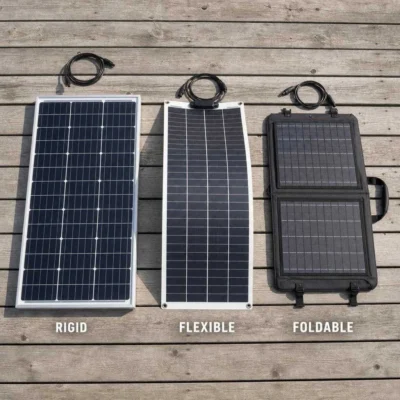
Because MC4 is universal, a brand-neutral panel is not locked to any one station. The EcoFlow 400W “isn’t locked to EcoFlow” — its MC4 output wires into other MC4-input stations or into a 12V bank through a separate controller. The DOKIO 400W is a bare MC4 slab that feeds any station whose input accepts its 31V and ~12.9A. The trade-off is that you supply the adapter for your station, but you usually get more watts per dollar and total freedom to mix brands. If you want a rigid, high-output value panel, that is the DOKIO’s lane; if you want a foldable or a lightweight option, browse the best flexible solar panels for panels that pack down small.
Will a 400W Solar Panel Run a Fridge? A Worked Example
This is one of the most-asked questions, and the answer is yes — with a nuance. A solar panel does not run a fridge directly; it charges the power station, and the station runs the fridge. So the real question is whether a 400W panel makes enough energy to keep the station topped up faster than the fridge drains it.
Run the numbers over a day. A real 400W panel produces roughly 300-380W in good sun. A typical 12V portable fridge or a modern energy-efficient full-size fridge does not run its compressor constantly — averaged over 24 hours it draws about 40-80W. During daylight, the panel is producing four to nine times what the fridge consumes, so it covers the fridge and banks a large surplus in the station for overnight running.
Over a sunny day, a 400W panel might harvest 1500-2500Wh, while a fridge might use 1000-1900Wh across 24 hours. The surplus is what carries you through the night. Where it gets tight: several cloudy days in a row, a large or older fridge, or a small station with little stored buffer. In those cases you lean harder on the station’s capacity or add a second panel. For most setups, though, a 400W panel comfortably keeps a fridge going — see the best 400W solar panels for the top options.
What Is the Best Solar Panel for a Power Station?
There is no single winner — the best panel is the one that matches your station’s connector and input window, then wins on the trade-off you care about most:
- Best for plug-and-play — the matching brand panel for your station (for example, the Anker SOLIX PS400 for a SOLIX station), because the adapter is already sorted.
- Best value — a brand-neutral MC4 panel like the DOKIO 400W, which delivers a real 400W for well under name-brand prices.
- Best foldable all-rounder — the EcoFlow 400W, which uses standard MC4 and works well with EcoFlow and non-EcoFlow stations alike.
- Best for RV and cabin backup — the Renogy 400W suitcase, rugged and weatherproof, as long as you buy the right station adapter and an MC4 extension alongside it.
Whichever you choose, the two rules never change: confirm the connector (add an MC4-to-brand adapter if needed) and keep the panel inside the station’s max solar input and voltage window.
The Bottom Line
A portable solar panel and a power station are a natural pair. The station’s built-in MPPT means there is no separate charge controller to buy, so charging comes down to two checks: does the connector match (MC4 panel to your station’s port, with an adapter if the brands differ), and does the panel fit inside the station’s solar input limits (wattage caps harmlessly, but voltage must land in the MPPT window). Size the panel to your station’s usable capacity, estimate recharge time as capacity in watt-hours divided by the panel’s real output, and you have a rig that can run a fridge through the day and bank power for the night. To size a panel to your exact station and daily load, run the solar panel calculator before you buy.

Leave a Reply