Renogy 400W Review: What a Complete 4x100W Rigid Kit Actually Delivers Off-Grid
At a Glance
KEY FEATURES
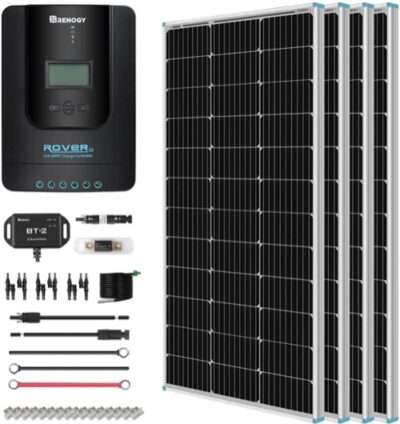
- Power output: 400 W total (4 × 100 W), monocrystalline silicon (Grade A+ cells)
- Output: 12 V DC system (24 V capable), MC4 panel connectors with included Y-branch adaptors and tray cable
- Cell efficiency: 22.5% claimed (high-tier monocrystalline)
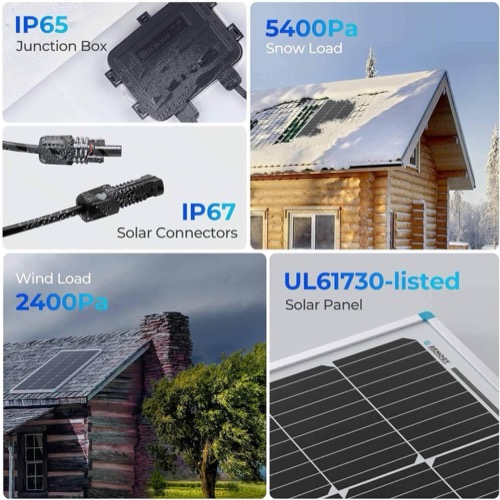
- Weatherproofing: 3.2mm low-iron tempered glass, 35mm aluminum frame, 2400 Pa wind / 5400 Pa snow load rating
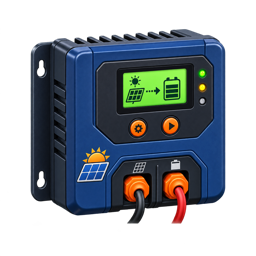
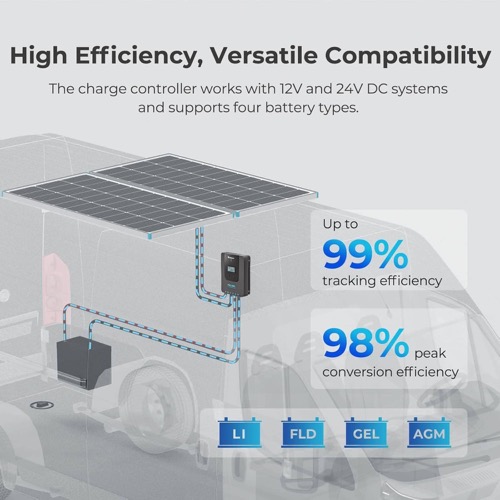
- Charge controller: 40A MPPT Rover included — 99% tracking efficiency, temperature sensor, in-line and ANL fuses, BT-1 Bluetooth module
- Best for: RV and motorhome 12V systems, off-grid sheds and cabins, boats, and van builds charging lead-acid, AGM, gel, or LiFePO4 banks
PROS
- 400W of panels run a 12V fridge all day with charge to spare
- 40A MPPT Rover controller beats cheap PWM units easily
- Complete kit — panels, brackets, cables, fuses, Bluetooth
- Sturdy 3.2mm glass and aluminum frames with wind/snow ratings
- Handles lead-acid, AGM, gel, and LiFePO4 on 12V or 24V banks
CONS
- Real winter and cloudy output drops well below the rated figure
- Reports of bad, melted, or faulty-display controllers
- No wiring diagram, and the odd 10A ANL fuse confuses new users
- Rigid glass panels can arrive broken or short internally
- One cable set runs short; warranty support can drag
Editor's Choice
Based on exact documentation and qualitative exact-ASIN Amazon owner evidence; no hands-on test or population-rate claim
Building a permanent 12V off-grid or RV system usually means shopping for parts in a dozen browser tabs — panels here, a controller there, then brackets, fuses, cable, and adaptors, each with its own compatibility footnote. A complete kit is meant to erase that headache: four 100W panels, a 40A MPPT controller, and the wiring hardware, all sized to work together straight out of one box. So the real question isn’t whether Renogy’s 400W bundle looks convenient — it’s whether it actually saves you the part-hunting once the panels are on the roof.
You know the pitch already. Everything you supposedly need to add 400 watts of solar to an RV, cabin, shed, or boat, all backed by a brand owners actually recognize. Whether “complete kit” earns that word in practice, though, comes down to a detail the marketing skips: will you still be buying extra cable and hunting for a wiring diagram before the sun does any work?
Here’s the honest framing up front. Panels and the MPPT controller are the strong part of this package, and years of owner feedback back that up. Weak spots are the missing instructions, a short cable set, an oddly small fuse, and the usual risk that ships with heavy glass panels. For most 12V off-grid jobs, that’s a fair trade — as long as you know what you’re getting into.
Still deciding? We stack it against every rival in the best 400W solar panels roundup.
Four modules
Matching labels allow controlled series/parallel design and individual fault isolation.
One MPPT controller
The exact Rover revision sets the array voltage, current, wattage, battery, and terminal boundaries.
Many interfaces
Branches, extensions, fuses, lugs, roof entries, and battery connections create more failure points than the panel count suggests.
The richer owner evidence makes completeness and topology the center of this review. Many buyers report productive RV, cabin, shed, and backup installations, sometimes adding panels later. Others describe cartons with missing or damaged pieces, confusing diagrams, mismatched expectations, controller trouble, or slow support. Inspect the shipment as a bill of materials before installation turns a return into roof work.
“400W 12V kit” does not mean the array is always wired at 12 volts. The battery bank may be nominal 12V while the MPPT controller accepts a higher-voltage PV string. Series wiring raises voltage; parallel wiring raises current. Both must remain within the exact controller’s absolute and operating limits under cold weather, full sun, and plausible fault conditions. Do not infer a safe topology from a marketing diagram or another owner’s different Rover revision.
| Topology question | Series tendency | Parallel tendency |
|---|---|---|
| Cable loss | Lower current can reduce loss | Higher current may need larger conductors |
| Partial shade | One weak module can constrain a string | Healthy branches can retain more independence |
| Controller constraint | Cold-corrected Voc is critical | Total current and protection are critical |
| Troubleshooting | Check each module and string voltage | Check each branch current and connector |
Several owner accounts discuss useful energy production, but a 400W nameplate is not an appliance budget. Start with daily watt-hours for the refrigerator, lights, communications, fans, pumps, or inverter standby; then apply local seasonal sun and system loss. Battery state can cap controller output, and roof-flat mounting can increase heat compared with a cool tilted test. Commissioning should record per-panel and combined performance so future degradation or connection faults have a baseline.
The installation also needs component-level serviceability. Leave cable loops where connectors can be reached, support conductors away from sharp roof edges, use compatible glands and sealants, protect battery conductors close to the battery, and label disconnects. Owners who later expand the array should compare the new panel labels, controller headroom, conductor ampacity, and protection rather than assuming four more matching-looking panels can be added.
Decision: choose the kit for component coordination and expansion planning, not because the carton removes the need for design. A buyer unwilling to inventory, calculate, fuse, commission, and document the system should use a qualified installer.
Wiring the 400W Kit: Series, Parallel, and Z-Brackets
Setup is where the “complete kit” label needs an asterisk. Owners with a screwdriver, wrench, and drill describe hooking it up without much trouble — one shed owner had panels mounted, wired, and charging in under an hour. Pre-drilled panels and included brackets do speed things along.
Here’s the catch, though: there’s no wiring diagram in the box. Only the controller and Bluetooth module ship with manuals, so you’re on your own for how the four panels, fuses, and controller connect. First-timers should study series versus parallel wiring before touching a wire, because it’s easy to get wrong. Series holds voltage for weak-light charging; parallel handles partial shade better.
Then there’s the cable. The kit includes one set, and owners routinely find the panel-to-controller run too short — one class A motorhome owner said it “just barely reached” from roof to electrical box. Lay all four panels in a row for a parallel setup and you’ll almost certainly need extension leads the kit doesn’t include.
Practical Tip — Buy a pair of MC4 extension cables at the same time as the kit, sized for your run. Owners almost universally end up adding length, and you don’t want to discover the cable is short with the panels already on the roof. Match the MC4 connector type so you avoid voltage drops from cheap adapters.
Batteries and Systems This Kit Charges
For a 12V kit like this, the question that matters most is which batteries it plays nice with — and the answer is broad. That 40A MPPT Rover handles lead-acid, AGM, gel, and LiFePO4, and owners run everything from flooded batteries to lithium deep-cycle banks on it without drama.
Voltage flexibility helps too. The system runs 12V by default but the controller supports 24V banks, with a 32V max battery voltage — enough headroom for most RV, boat, and cabin setups. One shed owner pairs it with two 12V LiFePO4 batteries and a 2000W inverter to run tools; another runs a 200Ah bank for a gaming PC and household appliances.
| Battery / System | Typical Use | Compatible? | Notes |
|---|---|---|---|
| Flooded lead-acid | RV, cabin, tractor | Compatible | Select the lead-acid profile on the Rover |
| AGM (sealed) | RV, boat, off-grid shed | Compatible | Common owner pairing; no gassing worry |
| Gel cell | Marine, mobility | Compatible | Set the gel profile before charging |
| LiFePO4 (12V) | Van life, RV, off-grid | Compatible | Set the LFP profile; owners run lithium deep-cycle banks |
| 24V battery bank | Larger RV / boat banks | Compatible | Rover supports 12V or 24V; 32V max battery voltage |
| 2000W inverter loads | Fridge, PC, power tools | Compatible | Wire the inverter off the battery, not the controller’s load port |
Buyer Heads-Up — The Rover’s battery type setting matters. Charging a LiFePO4 or gel battery on a plain lead-acid profile can shorten its life, so pick the right profile in the app or on the controller before you connect the bank. The included temperature sensor also tunes charging to battery temp, which protects the bank in heat and cold.
What 400 Watts Delivers in Real Sun
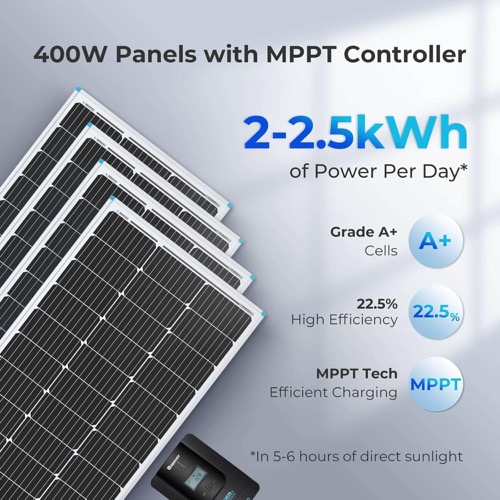
The kit is rated at 400W — which through the MPPT controller works out to roughly 328W of real output in good sun, or about 1.3 kWh on a typical day with four solid peak sun hours. Renogy quotes a rosier 2-2.5 kWh, but that only happens with long, strong summer sun. The conservative number is the one to plan around.
What does that mean day to day? Plenty. Owners report the panels run a 12V fridge all day with power left over, and one boater watched a bank climb from 60% to nearly full in about four hours while instruments and an autopilot kept running. Another refilled a 200Ah battery overnight-drained down to 77 amps back to full in roughly eight hours — and that was with clouds rolling through.
The 40A MPPT Rover is a big reason for that. Owners coming from cheap PWM controllers say the difference is obvious — the Rover holds batteries around 13.7V and drops into boost mode when they need a deeper charge. Wire the panels in series and the controller always has enough voltage to push charge, even when the light is weak.
| Condition | Estimated Output | What That Means |
|---|---|---|
| Full sun, ideal angle | ~300-328 W | Runs a 12V fridge all day and still banks charge; ~1.3 kWh on a 4-PSH day |
| Partly cloudy sky | ~150-180 W | Still strong charging; keeps most 12V loads fed |
| Overcast / heavy clouds | ~65-100 W | Trickles power in; slows drain but won’t fully refill a big bank |
| Panel angle 45° off optimal | ~200-230 W | Noticeable hit; flat-mounted RV roofs often land here |
| Winter / weak sun | ~160-200 W avg | Fewer peak sun hours; a DC-to-DC charger helps on grey stretches |
| Panels partly shaded | ~40-120 W | Series wiring suffers most; parallel handles shade far better |
Real-World Math — Using a 0.82 MPPT factor, this 400W kit delivers roughly 328W in good sun. Stretch that across four peak sun hours and you bank around 1,312 Wh for the day. A 12V/100Ah battery holds around 1,200 Wh — so on a bright day this kit can meaningfully refill a mid-size bank and still feed daytime loads.
These are estimates. Your real numbers depend on angle, sky, shade, temperature, and how far your cable has to run.
Who Needs a Rigid 400W Kit — Use-Case Fit Matrix
| Use Case | Fit | Why |
|---|---|---|
| RV / motorhome 12V system | Strong fit | 400W runs a fridge and loads; MPPT holds voltage well |
| Off-grid shed or cabin power | Strong fit | Proven multi-year service; pairs with an inverter for tools |
| Boat / marine 12V bank | Strong fit | Sturdy glass panels; refills banks fast in sun |
| Van life build | Solid fit | Rigid panels for the roof; supports LiFePO4 banks |
| Charging a LiFePO4 bank | Strong fit | Rover supports LFP; set the profile before connecting |
| First-timer wanting plug-and-play | With caveats | No wiring diagram — do your homework on series vs parallel |
| Portable / grab-and-go power | Skip | These are heavy rigid panels, not foldables |
| Partial-shade rooftop | Borderline | Wire in parallel; series output drops hard under shade |
| Full-season winter reliance | Borderline | Fewer sun hours; add a DC-to-DC charger for cloudy stretches |
| Buyer who wants Voc/Isc on the spec sheet | With caveats | Some panel electrical specs aren’t published in the listing |
| Wanting batteries and inverter in one buy | Skip | The battery-and-inverter bundle is overpriced — source those elsewhere |
| High-draw loads without a battery | Not recommended | It’s a charging kit, not a standalone generator |
Where this kit earns a recommendation is a permanent 12V install that needs to charge hard and last. Buyers running an RV, cabin, shed, or boat off-grid get a proven 400W array, an MPPT controller that leaves cheap PWM units behind, and broad battery support across lead-acid, AGM, gel, and LiFePO4 on either 12V or 24V — all wrapped in rigid panels rated for real wind and snow once they’re bolted down. That combination is exactly what a fixed off-grid system wants.
It’s the wrong buy, though, for anyone chasing a lightweight foldable to carry between sites, or a true plug-and-play package with a step-by-step wiring diagram waiting in the box. Buyers hoping to grab batteries and an inverter in one economical bundle are better served sourcing those parts separately, and anyone who can’t tolerate the small chance of a glass panel arriving cracked should weigh that risk before ordering. In short, this is a different tool for a different job — a permanent 400W rigid system, not a portable weekend panel.
Does the Complete 400W Kit Earn Its Price?
For most 12V off-grid buyers, this Renogy 400W review lands in a practical spot: it’s a proven, durable rigid kit that charges hard in good sun, and the 40A MPPT controller earns its keep over the cheap alternatives. Owners run fridges all day, refill banks in hours, and report years of service on RVs, boats, and sheds. Those are real wins, and the complete-kit convenience is genuine.
Trade-offs are just as real. There’s no wiring diagram, the cable set runs short, the 10A fuse is undersized for parallel, and heavy glass panels can arrive cracked. None of that sinks the kit for a buyer who understands basic solar wiring and will test everything the day it lands — for that person, this Renogy 400W package is an easy recommendation for a permanent 12V system. Someone after a foldable panel or a hand-held, diagram-in-the-box experience should look elsewhere and buy the fit that matches the job.
The Rigid Panels and Cabling, Up Close
First thing owners notice is that these are real, heavy, glass-fronted panels — not lightweight foldables. Each 100W panel wears a 3.2mm low-iron glass face and a 35mm aluminum frame, and the whole kit tips the scale around 56 pounds. That heft is why one owner calls it about the most durable 400W system out there.
The panels come pre-drilled and ship with Z-brackets, so mounting hardware isn’t an afterthought. Buyers regularly praise the cabling quality too — the tray cable and MC4 leads feel well made, and the connectors click together solidly. For a kit at this price, the parts feel a cut above the bargain-bin bundles.
None of this makes the build flawless, though. Rigid glass and shipping don’t always mix, and a few owners have opened boxes to cracked panels — one even had a replacement set arrive broken. Separate from shipping damage, a small number report panels that shorted internally after a few months. It’s not the norm, but it’s the reason you unbox and test right away.
Handling Wind, Snow, and Years Outdoors
There’s no single IP number quoted for this kit, but the rigid panels are clearly built for permanent outdoor mounting. The 3.2mm low-iron tempered glass and 35mm aluminum frame carry a 2400 Pa wind and 5400 Pa snow load rating — which in plain terms means they’re made to sit on a roof through real weather.
Owner track records back that up. One campervan install went up in 2020 and was still running strong in late 2025, and a shed setup ran without a hitch from 2021 into 2024. The aluminum frames don’t corrode, the glass shrugs off normal exposure, and the cabling holds up. For a permanent mount, this is the durable end of the market.
One honest caveat covers the controller and shipping. That Rover controller is meant for an indoor or protected install, not open weather, and a few owners report controller trouble — a bad unit, a faulty display, one that melted at a connection bar. Pair that with the odd cracked panel from shipping, and the pattern is clear: the hardware lasts, but you want to catch a bad unit early.
| Feature | This Kit | What It Means Outdoors |
|---|---|---|
| Panel surface | 3.2mm low-iron tempered glass | Impact-resistant; handles hail and debris better than laminate |
| Frame material | 35mm aluminum alloy | Resists corrosion; won’t warp in heat |
| Wind / snow load | 2400 Pa / 5400 Pa | Rated for rooftop mounting through storms and winter |
| Controller placement | Indoor / protected only | Mount the Rover out of the weather to avoid moisture issues |
| Connector weatherproofing | MC4 (weather-rated) | Solid outdoor connection when fully seated |
| Long-term owner reports | Multi-year service common | Durable overall; isolated panel shorts and controller failures |
Worth Knowing — A 5400 Pa snow rating is genuinely high, but it assumes the panels are properly mounted with the included Z-brackets and hardware. A panel loosely fixed or resting on an unsupported edge won’t hit that spec. Torque the brackets down and check them after the first winter.
Fuses, Warranty, and Peace of Mind
Safety-wise, the kit leans on the MPPT controller plus in-line and ANL fuses for overcurrent protection, and for most installs that’s a sensible layer. But one detail trips people up: the kit ships Y-branch connectors for parallel wiring yet includes only a 10A inline ANL fuse, which is underrated for four panels combined in parallel. More than one owner flags this as a real setup snag.
The fix is straightforward — size your fuse to your actual configuration rather than assuming the included one fits. A 10A fuse is generally fine for a series string, but a parallel row of four panels needs more. It’s the kind of thing an experienced installer catches instantly and a beginner might miss, which loops back to the missing-diagram problem.
Warranty is a mixed story. The listing headlines a 10-year panel and 3-year controller warranty, though the manufacturer field elsewhere cites a shorter 5-year panel term, so it’s worth confirming current coverage. Owners describe warranty claims that eventually get resolved — Renogy replaced a faulty-display controller after some back-and-forth — but the troubleshooting process frustrates buyers, especially those at remote sites with no cell signal.
Long-Term Ownership — The panels themselves are the durable part, with owners reporting years of service. On a kit like this, the weak points are the controller, the connectors, and a bad-batch panel — not the glass cells. Test output on arrival, mount the controller somewhere dry, and you’ll know early whether you got a good one.
Renogy 400W four-panel MPPT kit: Decision Snapshot
| Spec | Value |
|---|---|
| Max Power Output | 400 W (4 × 100 W monocrystalline) |
| Output Voltage | 12 V DC (24 V capable) |
| Connector | MC4 + Y-branch + tray cable adaptors |
| Cell Efficiency | 22.5% claimed |
| Weatherproof Rating | 3.2mm tempered glass, aluminum frame; 2400 Pa wind / 5400 Pa snow |
| Charge Controller | 40A MPPT Rover (included) + Bluetooth module |
| Cable Length | One set — runs short, extension often needed |
| Mount Type | Z-brackets, pre-drilled panels (no tilt mount) |
| Best For | 12V off-grid RVs, cabins, sheds, boats, and van builds |
Renogy 400W Review: Is the Complete Rigid Kit Worth It?
If you want a proven 400W system to run a 12V setup off-grid, this Renogy 400W review lands on a clear yes for most buyers. In good sun the four panels run a 12V fridge all day with charge to spare, the 40A MPPT controller genuinely beats the cheap PWM units, and the kit ships nearly everything you need to get charging. Just know going in: there’s no wiring diagram, the cable set runs short, the included 10A fuse is oddly small for a parallel wiring layout, and the heavy glass panels occasionally arrive cracked — so inspect and test everything the day it lands.
Pros & Cons Analysis
Based on documented specifications and owner feedback
Pros
- Charges a 12V bank fast and holds it there — owners report the four panels run a 12V fridge all day with power to spare, and one boater watched batteries climb from 60% to virtually full in about four hours while instruments and an autopilot were still running.
- Genuinely complete kit — buyers appreciate that the box holds all four 100W panels, the 40A MPPT Rover controller, Z-brackets, tray cable, adaptor kit, fuses, and the Bluetooth module. Several call it a great value because there's little left to buy for a basic install.
- MPPT controller is worth the upgrade — owners who've used cheap PWM controllers before say the 40A Rover is noticeably better, holding batteries around 13.7V and dropping into boost mode when they need a deeper charge. The consensus is that MPPT versus PWM is money well spent here.
- Proven long-term reliability — this is a kit with years of track record behind it. One campervan owner installed it in 2020 and it was still going strong in late 2025, and a shed setup ran without trouble from 2021 well into 2024.
- Easy install if you have basic tools — buyers with a screwdriver, wrench, and drill describe hooking it up without much trouble. One shed owner had panels mounted, wired, and charging in well under an hour, and others call it a great starter kit for people new to solar.
- Runs real loads with an inverter — paired with a 2000W inverter and a decent battery bank, owners run gaming PCs, vacuums, blenders, electric chainsaws, and log splitters. During peak sun the panels often keep the batteries topped while tools are in use.
- Sturdy, weather-rated panels — the 3.2mm low-iron glass and 35mm aluminum frame carry high wind and snow load ratings, and one owner flatly calls it about the most durable 400W system you can buy. The cabling and connectors draw praise for quality too.
- Flexible battery and voltage support — the Rover charges lead-acid, AGM, gel, and LiFePO4, and handles 12V or 24V banks up to a 32V max. Owners run lithium deep-cycle batteries and 200Ah banks without issue, and the temperature sensor tunes charging to battery temp.
Cons
- No wiring diagram in the box — the single most repeated complaint. Only the controller and Bluetooth module ship with manuals, so first-timers are left searching online for the correct series or parallel layout, and a few call the old setup video a poor substitute.
- One cable set forces a tight layout — a steady theme is that the panel-to-controller wiring runs short. One class A motorhome owner found it "just barely reached," and others note there aren't enough extension leads to lay all four panels in a row without buying more.
- Controller failures show up in feedback — separate from normal use, a handful of owners report a Rover that arrived bad, a faulty display, or a unit that melted at the connection bar. When the controller is the failure point, the whole system stops until it's replaced.
- Broken glass and internal shorts reported — the rigid panels are heavy and glass-fronted, so shipping damage happens. Some owners received cracked panels, one had a replacement arrive broken too, and another had three of four panels short internally after roughly four months.
- Confusing 10A ANL fuse — the kit ships Y-branch connectors for parallel wiring but includes a 10A inline ANL fuse that's underrated for four panels combined. More than one owner flags this as a real safety and setup snag that Renogy should fix.
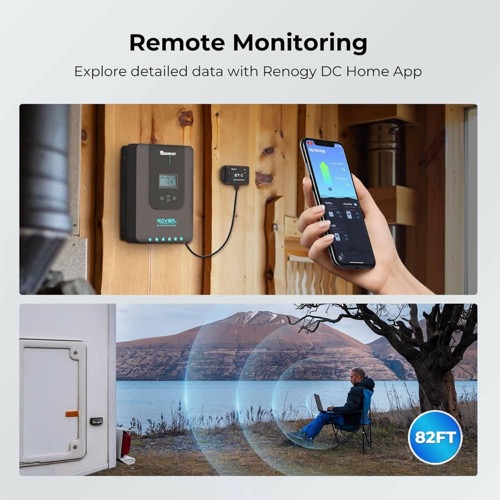
- Bluetooth monitoring is unreliable — the BT-1 module and DC Home app draw mixed reviews. Owners describe slow pairing, dropped connections, and warn it's not trustworthy as a sole battery monitor. Several add a dedicated shunt to actually track state of charge.
- Warranty support can be a slog — several owners describe back-and-forth troubleshooting before Renogy replaced a faulty part. Claims do get resolved in the end for many, but the process frustrates buyers, especially those at remote sites with no cell signal.
- Skip the pricier bundle — owners are blunt that the panels-and-controller kit is the sweet spot. The versions that add Renogy batteries and an inverter are called overpriced, with buyers recommending you source those parts elsewhere for less.
Does the Complete 400W Kit Earn Its Price?
For most 12V off-grid buyers, this Renogy 400W review lands in a practical spot: it's a proven, durable rigid kit that charges hard in good sun, and the 40A MPPT controller earns its keep over the cheap alternatives. Owners run fridges all day, refill banks in hours, and report years of service on RVs, boats, and sheds. Those are real wins, and the complete-kit convenience is genuine.
Trade-offs are just as real. There's no wiring diagram, the cable set runs short, the 10A fuse is undersized for parallel, and heavy glass panels can arrive cracked. None of that sinks the kit for a buyer who understands basic solar wiring and will test everything the day it lands — for that person, this Renogy 400W package is an easy recommendation for a permanent 12V system. Someone after a foldable panel or a hand-held, diagram-in-the-box experience should look elsewhere and buy the fit that matches the job.
Frequently Asked Questions
How much power does the Renogy 400W kit actually make in a day?
Renogy rates the kit for a daily output of 2-2.5 kWh, but that assumes strong sun and long peak-sun hours. A more conservative real-world estimate is around 1.3 kWh on a typical four-peak-sun-hour day using an MPPT-adjusted factor. Owners back this up in practice — the four panels comfortably run a 12V fridge all day with charge left over, and one boater refilled a bank from 60% to nearly full in about four hours. Expect less in winter, on cloudy days, or with flat-mounted panels.
Should I wire the four panels in series or parallel?
Both work with the 40A MPPT Rover controller, and it depends on your setup. Series keeps voltage high, which helps the controller push charge in weaker light, and several owners run the panels in series (+-+-+-+-) with good results. Parallel handles partial shade better, since one shaded panel doesn't drag the whole string down. The catch is that the kit ships Y-branch connectors for parallel but only one cable set, so a parallel row often needs extra extension leads you buy separately.
Does the kit come with instructions?
Not really, and this is the top complaint. Only the MPPT controller and the Bluetooth module include manuals — there's no wiring diagram showing how the four panels, fuses, controller, and battery connect together. If you're new to solar, plan to do some homework first on series versus parallel wiring and basic watts, volts, and amps. Owners who understand the basics call the install easy, but a total beginner should study the layout before touching a wire.
What's the deal with the 10A ANL fuse?
Several owners flag this as confusing. The kit includes Y-branch connectors used for parallel wiring, yet ships a 10A inline ANL fuse that's underrated for four 100W panels combined in parallel. A 10A fuse is generally only enough for a series configuration. If you wire in parallel, you'll likely need a higher-rated fuse for safe operation, so check your configuration's total current and size the fuse to match rather than assuming the included one fits.
Will it charge a lithium (LiFePO4) battery?
Yes. The 40A MPPT Rover controller supports lead-acid, AGM, gel, and LiFePO4, and owners run lithium deep-cycle banks with it. Just set the correct battery profile on the controller before connecting a lithium battery — charging LiFePO4 on a lead-acid profile isn't ideal. The included temperature sensor also adjusts charging based on battery temperature, which helps protect the bank in hot or cold conditions.
Is the Bluetooth module any good for monitoring?
It's a mixed bag. The BT-1 module pairs with the Renogy DC Home app to show real-time data on the controller, battery, and load, and some owners like the monthly logging and remote parameter changes. That said, a recurring warning is that it's slow to pair, drops connection, and shouldn't be trusted as your only battery monitor. Many owners add a dedicated battery shunt to accurately track state of charge.
Is the included cable long enough?
Often not. The kit comes with one cable set, and owners regularly find the panel-to-controller run too short — one class A motorhome owner said the wiring just barely reached from the roof down into the electrical box. If you're routing wires a long way, or laying all four panels in a row for a parallel setup, budget for MC4 extension cables so you can place the panels and controller where they actually need to go.
How well does it hold up outdoors long-term?
Generally very well. The panels use 3.2mm low-iron glass and a 35mm aluminum frame rated for 2400 Pa wind and 5400 Pa snow loads, and owners report years of trouble-free service — one campervan install ran from 2020 into 2025. The honest caveats: the rigid glass panels can arrive cracked from shipping, a few owners had panels short internally, and a small number saw controller failures. Inspect everything on arrival and test output right away.
What can I actually run with this kit?
With a decent battery bank and a 2000W inverter, quite a lot. Owners report running a 12V fridge all day, plus gaming PCs, vacuums, blenders, electric chainsaws, and log splitters in short stretches. During peak sun the panels often keep the batteries topped while tools are in use. It's a strong fit for off-grid sheds, cabins, RVs, vans, and boats — just size your battery and inverter to the loads you plan to run.
Technical Specifications
| Brand | Renogy |
|---|---|
| Model / SKU | 400W four-panel MPPT kit (ASIN B07CTKT56Y) |
| Panel format | Four rigid panels with MPPT controller kit |
| Rated output (Pmax) | 400W total; 100W per panel |
| Cell technology | Monocrystalline |
| Module efficiency | — |
| Voltage at maximum power (Vmp) | — |
| Current at maximum power (Imp) | — |
| Open-circuit voltage (Voc) | — |
| Short-circuit current (Isc) | — |
| Power tolerance | — |
| Maximum system voltage | — |
| Maximum series fuse | — |
| Output connector | MC4-compatible connectors |
| Output cable | — |
| Deployed dimensions | 41.8 × 20.9 × 1.38 in per panel |
| Folded dimensions | — |
| Weight | 56.4 lb combined panel weight |
| Surface and frame | Tempered glass with aluminum frame |
| Positioning / mounting | Included Z-brackets |
| Environmental protection | — |
| Wind / snow load | 2400Pa wind / 5400Pa snow |
| Operating temperature | — |
| Included accessories | Four panels, Rover 40A MPPT controller, brackets, cables, Bluetooth module, and fuses |
| Product warranty | 5-year panel term; 3-year controller term |