ECO-WORTHY 260W Flexible Solar Panel Kit Review: The Bendable, All-in-One Setup for Boats and Off-Grid Sheds
At a Glance
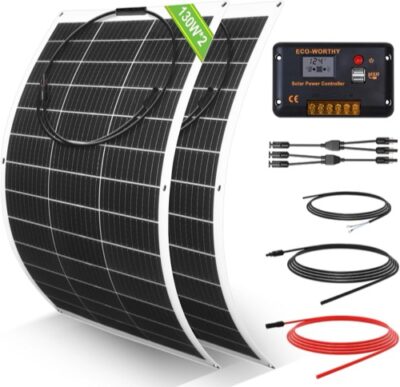
KEY FEATURES
- Power output: 260 W total (2 × 130 W), monocrystalline silicon
- Output: 12 V DC; MC4-style solar cables, tray cable to battery, Y-branch parallel connectors, plus dual USB (5V/2A) on the controller
- Cell efficiency: 22.4% (monocrystalline — high-tier claim)
- Weatherproofing: No certified IP rating — panels built for marine and uneven surfaces; the controller is not weatherproof and must be mounted indoors
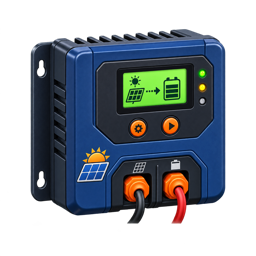
- Charge controller: Included — 30A 12V PWM, negative-ground, LCD display, supports lead-acid / gel / lithium phosphate
- Best for: Boats, RVs and motorhomes, golf carts, and off-grid battery maintenance on curved or flat surfaces
PROS
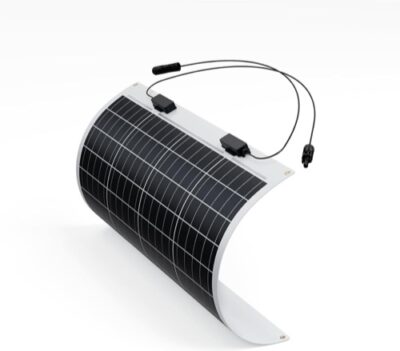
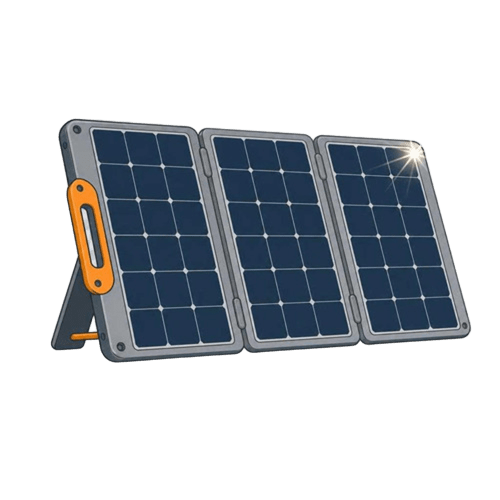
- Thin, flexible panels contour to curved boat and van roofs
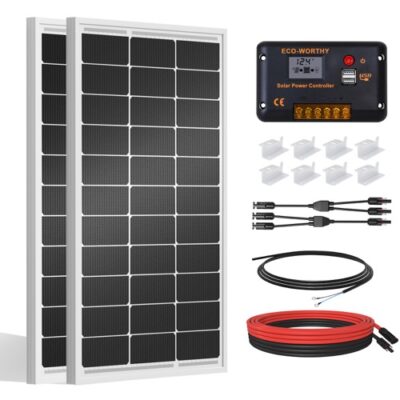
- Complete kit with a 30A controller, cables, and Y-branch included
- Keeps 12V house and storage batteries reliably charged
- Lightweight and easy to tape or stick down
- Strong value at roughly $270 for the full 260W kit
CONS
- Flat mounting drops output to about 175-190W, not the rated 260W
- Controller is basic PWM — many owners plan an MPPT upgrade
- Not enough on its own for a large lithium house bank
- Cables and connectors feel cheap and get upgraded
- Ships in two separate packages; 12V output only
Editor's Choice
Based on exact documentation and qualitative exact-ASIN Amazon owner evidence; no hands-on test or population-rate claim
A rounded cabin top or a curved van roof is where rigid glass panels stop making sense — they bridge awkwardly over the arc and refuse to sit flat. Add the hassle of sourcing a charge controller and the right wiring on top of that, and a simple charging setup starts to feel like a parts-hunting project. That double problem is exactly what this ECO-WORTHY 260W flexible kit sets out to solve.
Two thin 130W monocrystalline panels bend to follow the shape of your roof, and a 30A controller, cables, and Y-branch connectors come in the same box — all for around $270. No separate controller to spec, no wiring to piece together. What buyers really want to know is whether “flexible” and “PWM controller” quietly cost enough output to matter once they’re anchored somewhere with a half-dead battery.
Honest framing up front: these panels bend beautifully and the bundle is genuinely complete, yet flexible panels laid flat on a curve rarely hit their nameplate, and the included controller is basic. Maintaining and topping 12V batteries on a boat, RV, or shed makes that a fair trade for most owners. Trying to run a big lithium bank off two panels alone is where the math tightens.
For the full field of options, this one features in our best flexible solar panels guide.
The new owner evidence makes it important to review this as several components rather than one 260W object. Accounts include successful boat, trailer, shed, gate, pump, and battery-maintenance projects, but problems often attach to the controller, instructions, wiring, or mounting rather than to both panels simultaneously. Diagnose the two 130W modules independently before condemning the whole kit, and do the same for the controller and cable path.
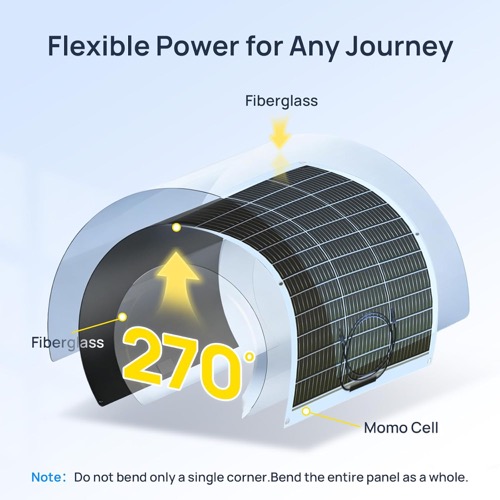
Flexible does not mean repeatedly foldable. The two frameless modules can follow a gentle supported contour, but owners’ installation stories show why substrate preparation matters: roofs, boat decks, sheds, and custom racks impose different heat, movement, wind, salt, and sealing requirements. Avoid tight radii, local screw pressure, unsupported spans, cable tension, and an adhesive scheme that traps heat or makes a failed module impossible to remove.
| Mounting approach | Advantage | Design debt |
|---|---|---|
| Reversible rack or standoffs | Cooling and replacement access | More fabrication, wind design, and penetrations |
| Full adhesive bond | Low profile and distributed support | Heat path, substrate compatibility, removal, and hidden moisture |
| Perimeter tape plus eyelets | Fast installation | Edge lift and wind loads still require engineered restraint |
| Temporary deployment | Easy commissioning and re-aiming | Not a substitute for secure travel or storm storage |
The controller is the other decision. The retained cluster table describes the imported offer as including a 30A PWM controller, while a current ECO-WORTHY regional page shows a different 260W bundle with a 15A MPPT controller. That discrepancy is exactly why the delivered model and manual must win over a generic product-family description. Confirm PV voltage/current limits, supported battery chemistry, charging setpoints, temperature behavior, terminal size, connection order, and whether Bluetooth or RS485 belongs to the controller actually in the box.
For output assessment, test each 130W panel alone and then the pair through the intended topology. Record Voc, stable loaded input, weather, angle, cable path, controller, and battery state. Unequal standalone results point toward a module, junction, or cable issue; equal modules with disappointing combined input shift attention to wiring, controller limits, battery taper, shade, or heat.
Best use: a weight-sensitive curved installation whose owner is willing to engineer thermal management and treat the bundled electronics as separately verifiable components. If a rigid rack fits, framed glass remains easier to cool, inspect, and replace.
Sticking It Down and Wiring It Up
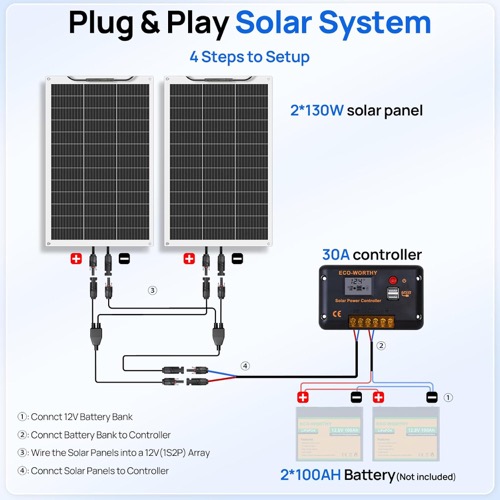
Setup is refreshingly direct for a complete solar kit. You bond the panels down, wire them through the Y-branch into the 30A controller, run the tray cable to your battery, and you’re charging. First-time buyers describe it as an easy install, and one camper owner said it was “such an easy install” with “more than enough power” once it was running.
Two things need a plan, though. The panels have no bracket — mounting is on you, whether that’s 3M VHB tape with edge sealant, adhesive, or screws through the reinforced holes. And the kit arrives in two separate packages: the panels in one, the controller and accessories in the other. A few buyers panicked when the controller wasn’t in the first box, so wait for both before you start.
Cable length is usually fine but tight. The 16.4ft solar cables and 4.92ft tray cable are, as owners put it, “just long enough” for typical installs. Quality is the bigger issue — boat owners swap the controller-to-battery run for heavier gauge to cut voltage drop, especially on longer runs. Instructions are sparse, so newcomers may want a wiring guide handy.
Practical Tip — Buy a length of heavier-gauge cable for the controller-to-battery run at the same time as the kit. Owners routinely upgrade this leg for lower voltage drop, and you don’t want to discover the included cable feels thin after you’ve already bonded the panels down. Keep MC4 connectors matched to avoid loose, corrosion-prone joints.
Thin, Bendable, and Built to Contour
First thing owners notice is how thin and light these are. Each panel is about a tenth of an inch thick and roughly 4.5 pounds, using polymer materials instead of glass and aluminum. Buyers describe them as “nice and flexible” and say they “contour to my vehicle perfectly” where a rigid panel would’ve bridged awkwardly over a curve.
That flexibility is the whole point. You can bond them straight to a lightly curved cabin roof, a van shell, or a camper top, and they follow the shape. Owners tape them down with 3M VHB and seal the edges, or peel-and-stick them on and report they “stay stuck.” For anyone fighting to mount solar on anything that isn’t dead flat, that’s a real problem solved.
The weak spot is the wiring hardware, not the panels. A recurring gripe is that the included cables and connectors feel cheap — one owner said they “need to be improved,” and boat owners routinely upgrade to heavier cable from the controller to the battery. Owners praise the panels themselves; it’s the accessories around them that pull the build quality down.
Which Batteries and Rigs It Pairs With
The big question for a 12V kit like this is “will the controller charge the battery I already have?” For most people, yes. That included 30A controller handles lead-acid, gel, and lithium phosphate, so it drops into typical RV, marine, and off-grid setups. Owners run it on AGM house banks and 100Ah lithium batteries alike.
Here’s the catch: it’s a 12V system, full stop. One golf-cart owner with a 48V lead-acid pack had to buy a separate boost controller because the bundled regulator charges at 12V. If you run 24V or 48V, the panels can still feed your system, but you’ll need a controller that matches your voltage.
| Battery Type | Typical Use | Compatible? | Notes |
|---|---|---|---|
| Flooded lead-acid | Car, tractor, golf cart (12V) | Compatible | Standard 12V 3-stage charging |
| AGM (sealed) | RV, boat, off-grid | Compatible | No gassing risk; good for sealed bays |
| Gel cell | Marine, mobility | Compatible | Controller supports a gel profile |
| LiFePO4 (12V) | RV, van, marine house bank | Compatible | Owners charge 100Ah lithium; set the LFP profile |
| 24V battery bank | Large RV / boat bank | Not compatible | 12V output only — needs a 24V controller |
| 48V system | 48V golf cart | Not compatible | One owner added a separate 48V boost controller |
Buyer Heads-Up — The controller supports lithium phosphate, but you still need to select the right battery-type setting before you connect. Charging a LiFePO4 or gel battery on the wrong profile can shorten its life, so check the setting on the LCD first — it takes a minute and saves a lot of grief.
ECO-WORTHY 260W Flexible Kit Review: The Short Take
If you want flexible panels that hug a curved roof and come with everything to start charging a 12V battery, this ECO-WORTHY 260W flexible kit review lands on a clear yes for maintenance duty. The panels are light, they stick down easily, and the bundled 30A controller means no parts hunt. Just know going in: flat-mounted you’ll see closer to 175-190W than the rated 260W, the controller is basic PWM that many owners eventually upgrade to MPPT, and the cables feel cheap enough that boat owners swap in heavier gauge. For topping batteries, it’s a solid buy — for powering a big bank alone, add panels.
What 260 Watts Really Delivers
The kit is rated at 260W — two 130W panels — which in a typical flat, curved-roof install translates to roughly 175W of real output, or about 707 Wh on a good day with four solid peak sun hours. Owners consistently confirm this pattern: laid flat, buyers report 175 to 190W across both panels, with one van owner noting he gets “up to 190” and expecting exactly that from a flat mount.
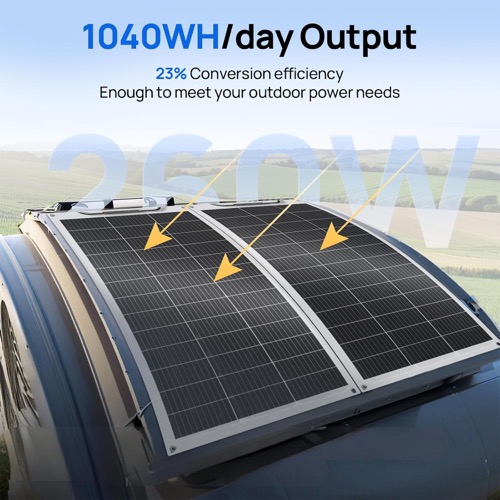
What does that mean day to day? Plenty to keep a 12V house bank topped up and steadily recharge modest daily use. Owners keep lithium batteries charged on boats, maintain batteries in an ice castle with a single panel keeping up, and hold a golf cart’s charge without plugging in as often. To be fair, that’s the kit doing what it’s best at — battery maintenance, not heavy daily cycling.
Angle is the lever most people forget. Because these get fastened to curved roofs, they never face the sun straight-on, so real amps sit below the flat-panel best case. Tilt them toward the sun and output climbs noticeably. Overcast days still trickle in useful power, just don’t expect the panels to refill a deeply drained bank on a grey afternoon.
| Condition | Estimated Output | What That Means |
|---|---|---|
| Full sun, tilted toward the sun | ~190-210 W | Best case; strong daily gain into a 12V bank |
| Full sun, flat on a curved roof | ~160-190 W | The typical marine/van result owners report |
| Partly cloudy sky | ~90-120 W | Still meaningful; slower to refill the battery |
| Overcast / heavy clouds | ~30-55 W | Keeps trickling; holds ground, won’t fully charge |
| Winter sun (northern US) | ~90-120 W avg | Fewer peak sun hours; still maintains batteries |
| Panel in partial shade | ~20-60 W | Big drop; keep both panels out of shade |
Real-World Math — Using a 0.68 real-world factor, this 260W kit delivers roughly 175W in good sun. Stretch that across 4 peak sun hours and you bank close to 707 Wh for the day. That’s enough to maintain a 100Ah lithium battery and cover a camper’s lights, fans, and phone charging with headroom on a sunny day.
These are estimates. Your actual numbers depend on angle, sky, shade, roof temperature, and how long your cable run is.
Salt Air, Rain, and Roof Heat
There’s no certified IP rating listed here, just the design intent — ECO-WORTHY builds these for off-grid, marine, and uneven surfaces. In practice, owners run them on sailboats and fishing boats and they shrug off rain and spray without complaint. Treat the panels as weather-resistant for their intended marine and rooftop life.
The controller is a different story. It’s not weatherproof, so it belongs inside a cabin, a battery compartment, or a dry, ventilated corner of a shed — not out on deck or exposed on a roof. Owners who mind that placement report no issues; the ones who don’t are asking for trouble in wet conditions.
Heat is the quiet limiter with flexible panels. Bonded flat to a roof with no air gap, they run hotter than a framed panel on standoffs, and cells lose efficiency as temperature climbs — the panels are rated up to 85°C. Leave a little airflow behind them where you can, seal the edges well, and expect the cables and connectors to be the first thing that shows wear.
| Feature | This Kit | What It Means Outdoors |
|---|---|---|
| IP rating | None certified | Marine-intent design; panels handle rain and spray |
| Frame / backing | Frameless flexible polymer | Contours to curves; no metal to corrode |
| Panel surface | Polymer laminate (no glass) | Light and bendable; more heat-sensitive than glass |
| Controller housing | Not weatherproof | Must be mounted indoors or in a dry compartment |
| Connector weatherproofing | Not stated | Cables feel cheap; seal and upgrade for wet runs |
| Operating temperature | Up to 85°C (185°F) rated | Covers hot roofs; bonded-flat panels run warm |
| Long-term owner reports | Mostly positive, some cable gripes | Panels hold up; wiring is the weak point |
Worth Knowing — Flexible panels trade durability for shape. Without a rigid frame and glass, they bend onto curves you could never mount a hard panel on, but the laminate and bonded install take more heat and flex stress over time. Keep them cool and sealed, and they’ll reward you.
Built-In Protections and Warranty Reality
On the safety front, the controller carries the protections that matter for a set-and-forget install: short-circuit, open-circuit, reverse-polarity, and overload protection, plus 3-stage PWM charge management. That covers the everyday “did I wire it backwards” and “will it overcharge” worries owners actually have. The dual USB ports are a handy bonus for topping a phone straight off the controller.
There are no specific safety certifications listed for the kit, which is worth knowing if you want paperwork before wiring into a marine system. The upside from feedback is on support — several owners mention ECO-WORTHY’s customer service responding quickly and sorting out issues like the split shipment. Warranty terms aren’t spelled out clearly, so buy from a listing with a solid return window.
On the controller itself, opinions split. Most owners say it “does work” for maintenance, but the recurring knock is that it’s limited — it caps how much you can pull from the panels — and one buyer called it “cheap junk.” Plenty plan to move to an MPPT controller down the line to squeeze out more harvest. As a starting point it’s fine; as a long-term centerpiece, it’s the part most likely to get replaced.
Long-Term Ownership — Monocrystalline cells last for years, but on a flexible kit the real weak points are the bonded mounting, the cables, and the basic PWM controller. Seal the panel edges, upgrade the battery cable, and budget for an MPPT controller if you want maximum output — that combination gets you the most life and the best harvest from the panels.
Who This Flexible Kit Suits — Use-Case Fit Matrix
| Use Case | Fit | Why |
|---|---|---|
| Boat / marine house-battery charging | Strong fit | Flexible panels hug curved cabin tops; keeps banks topped |
| RV / motorhome roof solar | Strong fit | Light, low-profile, easy to tape down on a curved roof |
| Off-grid shed or cabin (12V maintenance) | Strong fit | Owners run it reliably on shed setups off-grid |
| Golf cart battery (12V) | Solid fit | Holds the charge; must be a 12V system, not 48V |
| Battery maintenance in storage | Strong fit | Keeps stored batteries alive without a shore hookup |
| Van build with a lithium house battery | Solid fit | Controller supports LiFePO4; set the right profile |
| Large lithium bank as sole charger | With caveats | Two panels maintain but may not fully keep up; add panels |
| 24V or 48V systems | Not recommended | 12V output only; needs a matching controller |
| Buyer who wants maximum harvest | Borderline | PWM controller caps output; plan an MPPT upgrade |
| Permanent flat-bonded roof in extreme heat | Borderline | Bonded flexible panels run hot; leave airflow if possible |
| Buyer wanting a bracket / tilt mount | With caveats | No mount included; you supply adhesive or hardware |
| High-draw loads without a battery | Not recommended | It’s a charging kit, not a standalone generator |
A strong pick if you want:
- A flexible kit that curves onto a boat, van, or camper roof where rigid panels won’t fit
- A complete 12V setup with the controller, cables, and Y-branch already in the box
- A reliable way to keep lead-acid or lithium house batteries topped up off-grid
- Real solar output without paying to piece the system together separately
Not the one if you need:
- A panel to run a 24V or 48V system without buying another controller
- Maximum harvest out of the box — the PWM controller leaves output on the table
- A bracketed, tilt-adjustable mount included in the kit
- Rock-solid heavy-gauge cables you won’t want to upgrade
This is a different tool for a different job — a battery maintainer that bends to fit, not a high-output generator.
ECO-WORTHY 260W flexible kit: Decision Snapshot
| Spec | Value |
|---|---|
| Max Power Output | 260 W total (2 × 130 W monocrystalline) |
| Output Voltage | 12 V DC |
| Connector | MC4-style cables + tray cable + Y-branch; dual USB on controller |
| Cell Efficiency | 22.4% |
| Weatherproof Rating | No IP cert — panels for marine use; controller not weatherproof |
| Charge Controller | 30A PWM (included) |
| Cable Length | 16.4 ft solar cables + 4.92 ft tray cable |
| Mount Type | Adhesive / tape / grommet — no bracket |
| Best For | Marine, RV, golf cart, and off-grid 12V battery charging |
So, Is the Flexible Kit Worth It?
Worth the money for the owner who needs to charge 12V batteries on a curved surface without building a system from scratch. Around $270 buys a complete flexible kit that costs a lot less than piecing one together, and it holds a charge on boats, RVs, golf carts, and sheds. Panels contour to curves that rigid glass can’t touch, everything you need to start is in the box, and — as long as you plan on upgrading the battery cable and maybe swapping the controller for MPPT later — it earns its keep as a bendable, all-in-one maintainer.
Not worth it for anyone chasing maximum harvest or running higher-voltage gear. Flat-mounted output sits closer to 175-190W than the rated 260W, the PWM controller is basic, the cables feel cheap, and it charges at 12V only. A 24V or 48V setup, or a big lithium bank you expect to fill from empty on two panels alone, means you should size up or spend the money elsewhere.
Pros & Cons Analysis
Based on documented specifications and owner feedback
Pros
- Bends to fit curved surfaces — the two 130W panels are thin and flexible, so owners stick them straight onto curved van roofs, boat cabin tops, and camper shells. Buyers repeatedly say the panels "contour to my vehicle perfectly" where a rigid glass panel simply wouldn't sit flat.
- Complete kit — controller included — this ships as a plug-and-play bundle: two panels, a 30A charge controller, a pair of 16.4ft solar cables, a tray cable, and Y-branch connectors. You don't have to source a controller or figure out wiring separately.
- Keeps house and storage batteries topped up — a steady theme is battery maintenance done right. Owners keep lithium house banks charged on boats, maintain batteries in an ice castle, and hold a golf cart's charge without plugging in as often.
- Genuinely lightweight and easy to stick down — at about 4.5 lb per panel and roughly 70% lighter than glass, owners tape them on with 3M VHB and seal the edges, or peel-and-stick them to a van roof. "Easy to stick down, stays stuck" comes up often.
- Strong value for a full 260W kit — around $270 for two 130W mono panels plus a controller and all the wiring lands well under piecing it together separately. Buyers call it "great value" and "great price" for what shows up in the box.
- Wide 12V battery compatibility — the controller handles lead-acid, gel, and lithium phosphate batteries, so it drops into most RV, marine, and off-grid setups. Owners run it on AGM house banks and lithium alike without drama.
- Dual USB ports on the controller — the regulator adds two 5V/2A USB outputs, handy for topping a phone straight off the controller while the panels feed the battery. It's a small nice-to-have that owners appreciate.
- Monocrystalline cells with a high efficiency rating — the cells are rated at 22.4% efficiency, so in good sun with a decent angle owners see the panels "start capturing energy almost immediately" and get batteries back to full quickly.
Cons
- Flat mounting costs you real output — laid flat on a roof, owners report topping out around 175-190W instead of the rated 260W, and one buyer only pulled 175W across both panels. That's normal for flat-mounted flexible panels, but it's a gap worth planning around.
- The controller is basic PWM, not MPPT — several owners note the included regulator "does work" but is limited, and many plan to swap in an MPPT controller to pull more from the panels. One buyer flatly called the charger "cheap junk."
- Not enough alone for big lithium banks — one sailboat owner running four 100Ah lithium batteries plans to add a third panel to keep up. As a maintainer it's strong; as a sole charger for a large bank it can fall short.
- Poor cable and connector quality reports — a recurring gripe is that the included cables and connectors feel cheap. One owner said outright they "need to be improved," and boat owners upgraded to heavier cable from the controller to the battery.
- Ships in two separate packages — the panels and the accessory kit arrive separately, which caught a few buyers off guard when the controller wasn't in the first box. ECO-WORTHY even recommends waiting for both before assembly.
- 12V output only — no 24V or 48V — one golf-cart owner with a 48V lead-acid pack had to buy a separate boost controller because this kit charges at 12V. Check your system voltage before you order.
- Sparse instructions and thin support docs — one detailed reviewer flagged that the instructions are thin and the website is light compared with other suppliers. Newcomers may need to lean on outside guides to wire it correctly.
- Output drops on curved, sub-optimal angles — because they're fastened to lightly curved roofs, owners note the panels never really face the sun straight-on, so real-world amps land below the flat-panel best case. It's the trade-off for the flexible form.
So, Is the Flexible Kit Worth It?
Worth the money for the owner who needs to charge 12V batteries on a curved surface without building a system from scratch. Around $270 buys a complete flexible kit that costs a lot less than piecing one together, and it holds a charge on boats, RVs, golf carts, and sheds. Panels contour to curves that rigid glass can't touch, everything you need to start is in the box, and — as long as you plan on upgrading the battery cable and maybe swapping the controller for MPPT later — it earns its keep as a bendable, all-in-one maintainer.
Not worth it for anyone chasing maximum harvest or running higher-voltage gear. Flat-mounted output sits closer to 175-190W than the rated 260W, the PWM controller is basic, the cables feel cheap, and it charges at 12V only. A 24V or 48V setup, or a big lithium bank you expect to fill from empty on two panels alone, means you should size up or spend the money elsewhere.
Frequently Asked Questions
Do I really get the full 260 watts from this ECO-WORTHY kit?
Not usually, and that's normal. Rated at 260W (two 130W panels), the kit hits that figure only in near-ideal sun and angle. Owners who lay the flexible panels flat on a roof commonly report 175-190W across both, and one buyer measured 175W total. Flexible panels flat on a curved surface never face the sun straight-on, so real output lands below the nameplate. Tilt them toward the sun and you'll claw back a good chunk of that.
What kind of charge controller comes with it?
A 30A 12V PWM controller with an LCD display, dual USB outputs (5V/2A each), and negative-ground wiring. It supports lead-acid, gel, and lithium phosphate batteries and includes short-circuit, open-circuit, reverse-polarity, and overload protection. It works fine for battery maintenance, but it's PWM, not MPPT, so several owners swap in an MPPT controller to pull more from the panels once they're settled in.
Can I charge lithium (LiFePO4) batteries with this kit?
Yes. The controller supports lithium phosphate along with lead-acid and gel, and owners run it on 100Ah lithium house banks on boats and campers. For a large bank, one sailboat owner with four 100Ah lithium batteries plans to add a third panel to keep up, so size the array to your bank. Verify the controller's battery-type setting matches your specific lithium battery before connecting.
How do I mount flexible panels without a frame?
Most owners glue or tape them down. Popular methods include 3M VHB tape underneath with a sealant like Everbond around the edges, adhesive for van and boat roofs, or screws through the reinforced edge holes. Because there's no rigid frame or bracket, you can bond them straight to a curved surface — just clean the surface well first and leave a little airflow gap if you can, since flexible panels run hotter when bonded flat.
Will it charge a 24V or 48V battery bank?
No. This kit outputs 12V, and the controller is a 12V unit. One golf-cart owner with a 48V lead-acid pack had to buy a separate boost charge controller because the included regulator couldn't charge his system. If you run 24V or 48V, plan on a compatible controller for your voltage — the panels can still feed it, but the bundled controller won't.
Is the wiring long enough, and are the cables any good?
The kit includes a pair of 16.4ft (5m) solar cables plus a 4.92ft (1.5m) tray cable, which owners describe as just long enough for typical installs. The common complaint is cable and connector quality — several buyers found them cheap and upgraded to heavier gauge from the controller to the battery. Budget for better cable if you have a long run or want lower voltage drop.
Why does the kit arrive in two boxes?
ECO-WORTHY ships the two flexible panels in one package and the accessory kit — the 30A controller, solar cables, tray cable, and Y-branch — in a second package. They can arrive on different days, which surprised a few buyers who thought the controller was missing. Wait until both packages show up before you start assembly.
Are these flexible panels waterproof enough for a boat?
The panels themselves are built for marine and uneven surfaces and shrug off rain and spray in normal use, and owners run them on sailboats and fishing boats. There's no certified IP rating listed, though, and the charge controller is not weatherproof — mount it in a dry, ventilated spot inside the cabin or a battery compartment, not out on deck.
How long will flexible panels like these last outdoors?
Flexible, frameless panels generally have a shorter outdoor life than rigid glass panels because the polymer laminate and bonded mounting take more heat and flex stress. Most owners report solid performance out of the gate, with one running a boat setup for stretches without issues. Keep them cool where you can, seal the edges well, and treat the cables and connectors as the likely first wear point.
Technical Specifications
| Brand | ECO-WORTHY |
|---|---|
| Model / SKU | US-L02AM130-CWM-2 (ASIN B0BXPHG3Y6) |
| Panel format | Two semi-flexible panels with controller kit |
| Rated output (Pmax) | 260W total; 130W per panel |
| Cell technology | Monocrystalline |
| Module efficiency | 22.4% |
| Voltage at maximum power (Vmp) | — |
| Current at maximum power (Imp) | 6.1A per panel |
| Open-circuit voltage (Voc) | — |
| Short-circuit current (Isc) | — |
| Power tolerance | — |
| Maximum system voltage | — |
| Maximum series fuse | — |
| Output connector | MC4-compatible connectors and branch pair |
| Output cable | 16.4 ft solar cable; 4.92 ft tray cable |
| Deployed dimensions | 37.78 × 27.17 × 0.1 in per panel |
| Folded dimensions | — |
| Weight | 4.5 lb per panel |
| Surface and frame | Frameless polymer laminate |
| Positioning / mounting | Adhesive-compatible back and reinforced eyelets |
| Environmental protection | — |
| Wind / snow load | — |
| Operating temperature | — |
| Included accessories | Two panels, 30A PWM controller, cables, branches, and fuse |
| Product warranty | — |