
Solar Power Picks logo with sun, solar panel, and green energy icon

  • Home
  • Reviews
  • Best
    • Best portable power stations
    • Best Solar Panels
    • Best Solar Generators
    • Best Solar Charge Controllers
    • Best Solar Batteries
  • Guides
    • Portable Power Stations Guides
    • Solar Panels Guides
    • Solar Generators Guides
    • Solar Charge Controllers Guides
    • Solar Batteries Guides
  • Comparisons
    • Portable Power Stations Comparisons
    • Solar Panels Comparisons
    • Solar Generators Comparisons
    • Solar Charge Controllers Comparisons
    • Solar Batteries Comparisons
  • Calculator
Guides

Solar vs Wired Security Cameras: Compare the Whole Recording System

3 min read
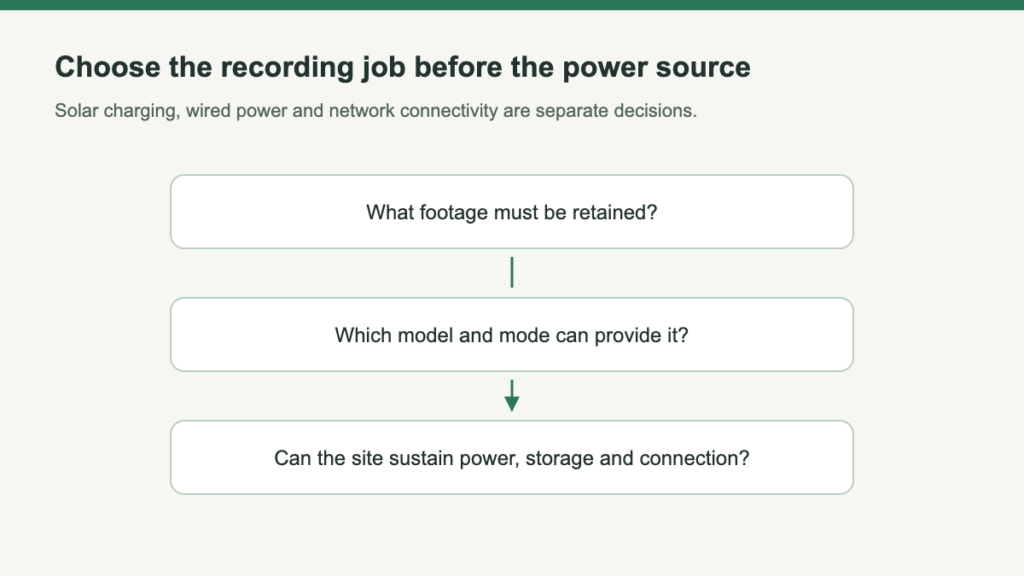
Three decisions shown vertically: required footage, supported recording mode, and sustainable power and connectivity.

Table of Contents

“Wireless” can describe the network connection, the power arrangement or both. A camera can use Wi-Fi while still needing a power cable. A solar camera can avoid permanent power wiring yet still depend on a router or cellular service. Start by unpacking the labels before comparing convenience.

Put power, communication and recording in separate columns

Decision What to establish
Energy How the camera is powered and what maintenance it needs
Communication How footage and alerts reach the intended viewer
Recording What is saved, where it is kept and how it is retrieved

This prevents a common mismatch: choosing a charging arrangement and assuming it also establishes a recording capability. The solar panel is not proof of continuous video, just as a cable is not proof that a recorder is included or correctly configured.

A nearby entrance and a distant gate are different purchases

Nearby entrance

If an approved power route is practical, compare installation work with battery access over time. Avoiding a cable does not eliminate panel, recording or maintenance tasks.

Distant gate

Solve communications alongside power. Sunlight cannot extend Wi-Fi coverage; a cellular choice adds compatibility and ongoing service requirements.

Specify continuous evidence precisely: Tapo C460 documentation describes interval images between events under Continuous Capture. That is not necessarily uninterrupted normal-speed footage. Assess every camera on its own documented mode.

Battery-only can be a legitimate third option

Worth considering

A reachable battery-only camera can fit when its supported charging routine is acceptable. Solar is not automatically necessary.

Not an assumed upgrade path

Buying a battery camera does not prove that any panel can later be attached. Verify approved accessories before relying on an upgrade.

Do not improvise permanent electrical connections to change product classes. Follow exact equipment and site requirements, using qualified help where needed.

Choose for the hardest requirement—not the fewest cables

  • Unbroken recorded evidence: establish the supported capture mode and a sustainable power path before comparing installation convenience.
  • No convenient camera outlet: assess a supported battery-and-solar arrangement, including panel exposure and access for service.
  • No usable home network: solve communications separately; sunlight does not turn Wi-Fi hardware into a cellular camera.

A reachable battery-only camera may also be sufficient if its approved charging routine fits the job. Do not buy a solar accessory merely to avoid considering that third option, or improvise electrical work to change one product class into another.

Use the complete installation and operating cost to compare only configurations that meet the evidence requirement. Visible cable count is a convenience detail; recording, communication and maintainability decide whether the system works for the site.
Frequently Asked Questions

Can a Wi-Fi camera still need a power cable?

Yes. Wireless networking and cable-free power describe different parts of the system; establish both.

Does having a solar panel establish a recording mode?

No. Check what the exact camera records independently of how it is charged.

Will a powered camera necessarily include a recorder?

No. Verify storage hardware, configuration and retrieval rather than inferring them from the power arrangement.

When should battery-only equipment remain in the comparison?

When the location is accessible and the supported charging routine is acceptable. Evaluate that routine rather than assuming every installation needs a panel.

Can I add an arbitrary panel to a battery camera later?

No. Establish supported compatibility and installation requirements for the exact equipment before purchasing accessories.

Which requirement should eliminate unsuitable camera systems first?

Start with the required saved evidence or another non-negotiable task, then confirm power and communications can support it at the site.

Share this article

Twitter Facebook LinkedIn Email

Leave a Reply Cancel reply

Your email address will not be published. Required fields are marked *

Related Articles

The solar maintainer lights up, but the battery still declines

Read More
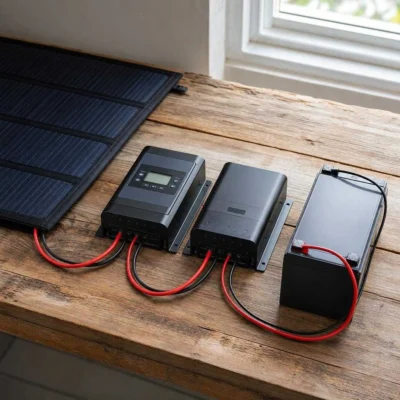
MPPT vs PWM charge controller wired between a solar panel and a 12V battery Filename: mppt-vs-pwm-charge-controller-featured

MPPT vs PWM Charge Controller: Which One Do You Need?

Read More
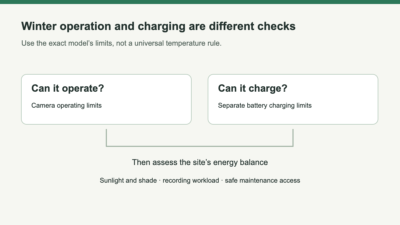
Operating conditions and charging conditions shown as separate lanes alongside sunlight, shade and workload checks.

Solar Security Cameras in Winter: Running Is Not the Same as Charging

Read More

About Solar Power Picks

Portable Solar Power, Backup Power, and Off-Grid Gear Guides

Your trusted source for honest, in-depth product reviews and comparisons.

Quick Links

  • Best Picks
  • Reviews
  • Guides
  • Comparisons
  • Calculator
  • Privacy policy
  • Favorites

Categories

  • Portable Power Stations
  • Solar Batteries
  • Solar Battery Maintainers
  • Solar Charge Controllers
  • Solar Generators
  • Solar Panels

© 2026 Solar Power Picks. All Rights Reserved.

We may earn a commission when you purchase through links on our site. Learn more