
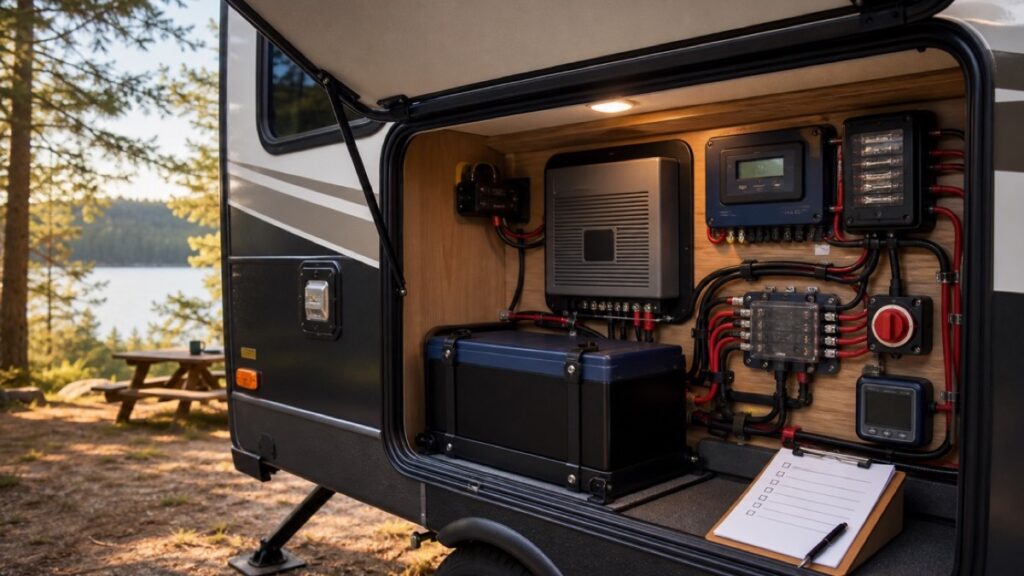
Are lithium batteries worth it for RV solar? Usually yes for frequent boondockers who repeatedly use the extra usable energy, want lower carried weight from an exact replacement design, and will upgrade charging and protection correctly. Often no for an RV that spends most nights on shore power or needs an expensive electrical rebuild for a few off-grid weekends. Price the whole conversion against your actual camping calendar—not one battery.
Value Starts with the Way You Camp
An RV solar system does not make lithium valuable by itself. Solar may reduce how deeply the bank is discharged on sunny days, while long cloudy stays, furnace use, compressor refrigeration, work equipment, or inverter loads make storage more important. Shore power can make both solar and a large bank nearly irrelevant for a particular owner.
Use a travel log before a product catalog. For each trip, record nights without hookups, energy used between full recharges, generator hours, low-voltage events, charging time available while driving, and trips limited by battery weight or compartment size. One season of imperfect measurements is more useful than a universal “lithium is worth it” claim.
More of the bank’s documented usable energy and recharge capability may be used on nearly every trip.
A premium bank can sit near full while the campground pedestal does the real work.
Cutoff, heating, placement, and charge-source control can add equipment and operating constraints.
Stored energy helps only when the exact BMS, conductors, protection, and inverter support the load.
Do not compare nominal amp-hours alone. Compare the present bank’s manufacturer-approved operating window with the exact proposed battery’s documented energy, discharge current, temperature behavior, and lifecycle conditions. If the old bank is already undersized or damaged, replacement benefit and chemistry benefit are two different entries in the ledger.
Put a price on the problem—not on a feature
Bluetooth has value when it replaces guesswork with usable state-of-charge and diagnostic information. Heating has value when the installation actually receives charge current below the battery’s normal charging range. A smaller case has value when it clears a real compartment obstruction. Features that do not change a trip are not savings.
The same rule applies to weight. Use the published weight of the exact old bank and exact proposed bank, including required brackets, boxes, cabling, heating, and protective equipment. A current Battle Born BB10012 manual, for example, documents 31 lb for that exact 100Ah battery; it is evidence for that model, not a weight promise for every 100Ah LiFePO4 product.
Audit What the RV Already Owns
A battery is one node in an RV charging system. Before pricing a conversion, identify what charges it from shore power, solar, and the engine; what disconnects loads; what measures state of charge; and what cable/protection path handles inverter current.
Progressive Dynamics currently sells converter families with selectable battery profiles, but that does not prove the converter already in your RV supports the proposed battery. Its lithium replacement guidance warns against increasing converter amperage without verifying the RV’s existing DC wiring. Record the label and manual for the installed unit before choosing a replacement.
The alternator side deserves the same discipline. Do not assume a battery can be connected directly because its charge-current rating is high. The alternator, engine-control strategy, cable run, isolation behavior, starting battery, DC-DC charger, and heat at low engine speed belong to one design. If those details are unknown, list alternator charging as unresolved—not free.
Solar-controller “lithium mode” is also not a complete compatibility statement. Progressive Dynamics notes that LiFePO4 manufacturers specify different charging requirements. The exact battery manual must be matched to the exact controller settings, including cold-charge control and any BMS communication.
State-of-charge monitoring can change during the conversion. Victron’s current GX documentation, as one system example, distinguishes batteries that report state of charge from systems that calculate it with a shunt or connected inverter/charger. An RV with solar, alternator, shore charging, and independent DC loads needs all bank current to be accounted for by the chosen monitoring architecture.
Price the Conversion in Layers
The battery-only price is the least reliable comparison. Build three scopes so an optional monitor or a required converter is not quietly hidden.
- Minimum compatible conversion: exact battery, approved hold-down/enclosure work, required cable and terminal changes, correctly rated protection, and verified settings on equipment that can remain.
- Sensible operating conversion: add the charging-source changes, low-temperature protection, disconnects, and state-of-charge monitoring needed for predictable use.
- Capability expansion: add a larger inverter, more solar, alternator charging, or additional battery capacity only when the load and travel log justify them.
Separate required costs from improvements you merely want. If replacing a failed converter would have been necessary with either chemistry, charge only the incremental lithium-related cost to the conversion decision. Conversely, do not credit the lithium bank for an inverter or solar upgrade that supplies a different benefit.
Ownership cost is not just purchase price divided by an advertised cycle number. Warranty terms, expected depth of discharge, calendar time, temperature, charge profile, standby drain, storage procedure, support, installation labor, and the chance of selling the RV can all change the realized value. A cycle-life number measured under specified laboratory conditions is not a promise of identical RV service.
Two RVs Can Reach Opposite Answers
These hypothetical cases show the decision method; they are not price forecasts.
The present bank regularly reaches its chosen discharge boundary, generator charging interrupts work, and the owner records meaningful daily energy use. A compatible converter and solar controller can remain, while a DC-DC charger and shunt are included in the quote. Over five years, 350 planned dry nights spread the incremental conversion cost across frequent use.
The battery mainly covers lights, pump, and one overnight stop. The old converter lacks an approved profile, the battery compartment needs rebuilding, and winter storage is below the proposed model’s instructions. Over five years, only 30 dry nights would use the upgrade. A smaller repair or replacement may have better value.
Suppose the first owner prices a complete, compatible conversion at a hypothetical $2,100 and a like-for-like conventional replacement at $700. The incremental $1,400 spread over 350 dry nights is $4 per dry night before considering generator fuel, maintenance, weight, or resale. The second owner facing the same incremental cost across 30 nights sees about $46.67 per dry night. Neither number proves payback, but the contrast exposes utilization.
The decision can still flip without a financial payback. Removing a documented amount of weight may restore payload margin. Quiet nights without a generator can matter at restricted campsites. Reliable medical-device power can justify redundancy. On the other hand, an owner who cannot keep charging within temperature limits or cannot safely modify the RV should count that constraint heavily.
Cold weather is a system question
Low-temperature charge cutoff protects against charging outside the product’s limit; it does not warm the battery or guarantee that the RV has usable charging. Self-heating consumes energy and follows model-specific activation rules. An interior installation, heated enclosure, controlled charge source, or different travel season can be the right answer, but each changes cost and operation.
Storage is separate from charging. Verify the exact model’s storage temperature, state-of-charge instruction, disconnection method, inspection interval, and recommissioning steps. Do not import a winter rule from another brand merely because both batteries use LiFePO4 cells.
Make a Go/No-Go Decision You Can Recheck
Complete this list with model numbers and quoted costs, not “lithium ready” labels.
- Document annual dry-camping nights, measured daily Wh, generator hours, and the failure or limitation the conversion should solve.
- Compare the exact old and proposed banks for nominal energy, allowed usable range, current limits, temperature behavior, weight, dimensions, warranty, and bank-growth rules.
- Verify shore converter, solar controller, alternator/DC-DC path, inverter, direct DC loads, monitoring, disconnects, conductors, terminals, and overcurrent protection.
- Price required compatibility work separately from optional inverter, solar, or capacity expansion.
- Write the cold-charging and seasonal-storage procedure for the actual parking location.
- Calculate an incremental cost per planned dry night or another use metric that reflects your travel pattern.
- Have high-current or code-sensitive work designed and checked by a qualified RV electrical professional.
Choose lithium when the log shows repeated use, the exact equipment can be made compatible, and the complete price buys outcomes you value. Delay it when hookups dominate, measurements are missing, or the quote depends on unverified converter, alternator, temperature, or protection assumptions.
For the next 12 months, keep a simple trip record: dry nights, daily Wh, lowest state of charge, generator time, and each battery-related limitation. Attach that record to a priced minimum/sensible/full conversion scope. At the end, “worth it” will be a decision about your RV rather than a slogan about a chemistry.
Leave a Reply