
Solar Power Picks logo with sun, solar panel, and green energy icon

  • Home
  • Reviews
  • Best
    • Best portable power stations
    • Best Solar Panels
    • Best Solar Generators
    • Best Solar Charge Controllers
    • Best Solar Batteries
  • Guides
    • Portable Power Stations Guides
    • Solar Panels Guides
    • Solar Generators Guides
    • Solar Charge Controllers Guides
    • Solar Batteries Guides
  • Comparisons
    • Portable Power Stations Comparisons
    • Solar Panels Comparisons
    • Solar Generators Comparisons
    • Solar Charge Controllers Comparisons
    • Solar Batteries Comparisons
  • Calculator

LiTime vs Vatrer 100Ah Self-Heating: Compact Proof or Group 31 Value?

COMPARED PRODUCTS

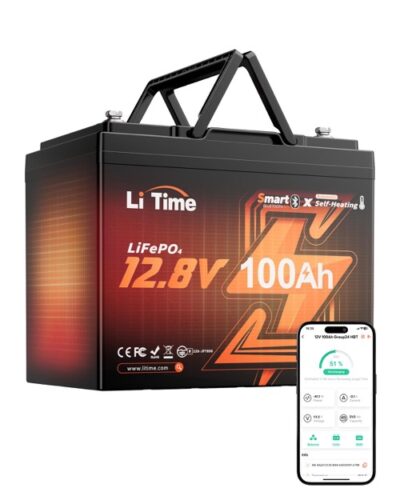
LiTime 12V 100Ah Self-Heating Review: Winter Logic Explained

Best Overall

LiTime 12V 100Ah Self-Heating Review: Winter Logic Explained

Check price at Amazon Jump to details
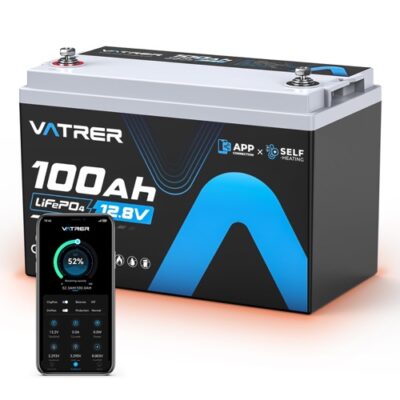
Vatrer 12V 100Ah Self-Heating Review: Group 31 Winter Value

Best Group 31 Value

Vatrer 12V 100Ah Self-Heating Review: Group 31 Winter Value

Check price at Amazon Jump to details

LiTime vs Vatrer 100Ah self-heating looks like a tie at 12.8V, 100Ah, 1,280Wh, 100A continuous, Bluetooth, IP65, and automatic heating around freezing. It is not. LiTime publishes the more complete sequence and fits Group 24; Vatrer occupies Group 31 and leaves surge and large-bank limits less resolved.

Choose LiTime

You want compact dimensions, warm-up estimates, a one-second pulse, and cleaner bank rules.

Choose Vatrer

You have a Group 31 tray, steady moderate loads, and a value advantage large enough to justify two confirmations.

The Heater Threshold Is Similar; Evidence Quality Is Not

LiTime heats from -20 to 5°C with at least 10A and publishes approximate 70–90-minute warm-up from -10°C and 100–150 minutes from -20°C. Vatrer starts below 0°C, stops at 5°C, and requires more than 10A, but its exact warm-up timing is not equally detailed.

Cold cellsBoth prevent direct unsafe charging.
Qualifying inputLiTime ≥10A; Vatrer >10A.
Warm-upLiTime publishes time estimates; Vatrer is less specific.
Normal chargingBoth remain within 100A maximum.

Case Length Is a 2.71-Inch Decision

LiTime is about 10.24 inches long; Vatrer about 12.95. Vatrer is also roughly 1.5 pounds heavier. A Group 31 tray can make Vatrer a convenient replacement, while a compact RV or boat compartment strongly favors LiTime.

Neither published case includes cable bends, terminal covers, fuse, disconnect, restraint, or service space. Heat function does not justify an unventilated, inaccessible, or wet compartment.

LiTime Owns the Published Startup Case

LiTime documents 500A for one second. Vatrer publishes 100A continuous but no attributable exact timed pulse. A pump or inverter whose startup is measured and shorter than one second can therefore be evaluated against LiTime; Vatrer needs an exact-model answer.

Load verdict:Tie below 100A continuous; LiTime wins any comparison that requires a published sharp-inrush boundary.

Vatrer’s Parallel Claim Needs Confirmation

LiTime clearly publishes 4S4P. Vatrer’s technical table says up to ten parallel, while other official copy says 4S4P. For one to four batteries the practical difference is small; for a larger parallel bank it is a purchasing blocker until the delivered revision is confirmed.

Planned bank LiTime Vatrer action
Single 12V battery Clear Clear
Up to 4P or 4S Documented Supported by both official statements
5–10P Outside published 4P Get exact-revision confirmation because official copy conflicts

Owner Evidence Favors LiTime Coverage, Not Necessarily Reliability

LiTime has 24 captured exact reviews including positive and critical cases; Vatrer has 14 that are almost entirely positive. LiTime’s sample exposes terminal-stack and low-input/parallel concerns. Vatrer’s sample offers less visibility into failure and remedy. We discount the positive skew rather than declaring Vatrer more reliable.

LiTime evidenceBroader, mixed coverage

More useful for identifying both successful use and specific failure modes, but still not a random reliability sample.

Vatrer evidenceSmaller, strongly positive coverage

Useful for application examples, but too one-sided to establish a reliability advantage.

Final Decision

LiTime earns the default win because it is smaller and closes more engineering questions. Vatrer remains rational when an existing Group 31 compartment and real price advantage dominate, continuous loads stay below 100A, and the buyer confirms surge and bank rules before relying on them.
Best Overall

LiTime 12V 100Ah Self-Heating Review: Winter Logic Explained

LiTime 12V 100Ah Self-Heating Review: Winter Logic Explained

Get it now:

Check latest price

What to know

  • Group 24
  • 10A heater minimum
  • 500A for one second
  • Bluetooth; IP65

Best if

  • Compactness and documentation lead
  • Sharp startup needs a pulse value
  • A conventional 4S4P boundary is enough

Skip if

  • Group 31 tray value leads
  • Winter input cannot reach 10A
  • A larger parallel bank is planned

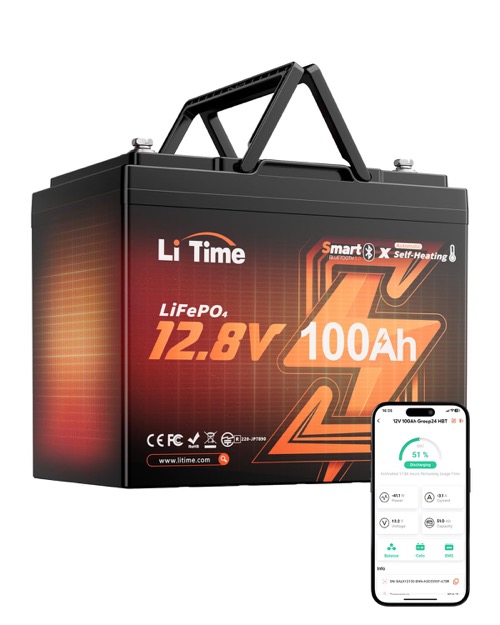
LiTime is easier to engineer: compact Group 24, 10A heater minimum, warm-up estimates, 500A/1s, and unambiguous 4S4P. Owner reports still flag terminal-stack and low-input parallel concerns.

BrandLiTime
Exact modelL12V100-100-GROUP24-HBT-4-A70
Battery chemistryLiFePO4 (LFP)
Nominal voltage12.8V
Rated capacity100Ah
Rated energy1,280Wh
Recommended depth of dischargeUp to 100% DoD; 80% DoD is paired with the 6,000-cycle figure
Recommended charge current20A
Maximum continuous charge current100A
Maximum continuous discharge current100A
Peak discharge current500A for 1 second
Recommended charge voltage14.4V ± 0.2V (CC/CV)
Low-temperature charge protectionCharging is blocked below 32°F (0°C) until the cells are warmed
Self-heatingYes; automatic heating from -4 to 41°F (-20 to 5°C), with at least 10A charging input
Charge / discharge temperatureCharge: -4–122°F (-20–50°C) with heating; discharge: -4–140°F (-20–60°C)
BMS protectionsOvervoltage, undervoltage, charge/discharge overcurrent, short-circuit, overload, and high/low-temperature protection
MonitoringBuilt-in Bluetooth with LiTime app
Series / parallel configurationUp to 4 in series and 4 in parallel (4S4P)
TerminalsM8 bolts
Dimensions10.24 × 6.61 × 8.27 in (Group 24)
Weight22.71 lb
Ingress ratingIP65
Cycle-life specification4,000 cycles at 100% DoD; 6,000 at 80%; 15,000 at 60%
Warranty5 years
Best Group 31 Value

Vatrer 12V 100Ah Self-Heating Review: Group 31 Winter Value

Vatrer 12V 100Ah Self-Heating Review: Group 31 Winter Value

Get it now:

Check latest price

What to know

  • Group 31
  • >10A heater input
  • 100A continuous
  • Bluetooth; IP65

Best if

  • The existing tray is Group 31
  • Loads remain inside 100A
  • Value outweighs documentation gaps

Skip if

  • A timed surge is essential
  • The case must be compact
  • Bank rules cannot remain ambiguous

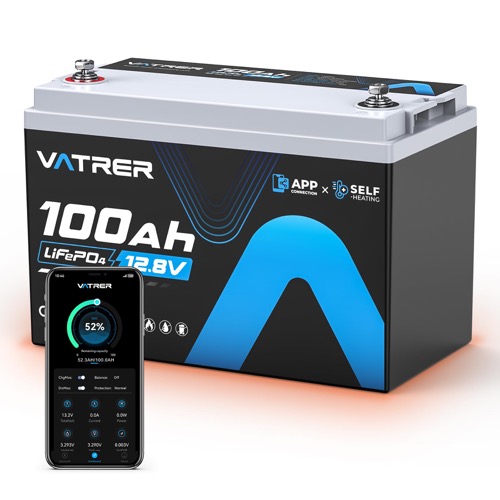
Vatrer offers the same nominal energy and 100A continuous current in a longer Group 31-style case. It can be compelling on price, but surge and maximum-parallel rules need clarification.

BrandVatrer Power
Exact modelD-12V-100AH-Black-H-10-KB
Battery chemistryLiFePO4 (LFP)
Nominal voltage12.8V
Rated capacity100Ah
Rated energy1,280Wh
Recommended depth of dischargeUp to 100% DoD; the manufacturer pairs the cycle figure with deep-cycle use but not one exact DoD condition
Recommended charge current20A
Maximum continuous charge current100A
Maximum continuous discharge current100A
Peak discharge currentNot published for the exact current model
Recommended charge voltage14.2–14.6V (CC/CV)
Low-temperature charge protectionHeating starts below 32°F (0°C) and stops at 41°F (5°C); charge input must exceed 10A
Self-heatingYes; automatic
Charge / discharge temperatureCharge: -4–122°F (-20–50°C) with heating; discharge: -4–140°F (-20–60°C)
BMS protectionsOvercharge, over-discharge, overcurrent, short-circuit, and temperature protection
MonitoringBuilt-in Bluetooth with Vatrer app
Series / parallel configurationCurrent technical table permits up to 4 in series and 10 in parallel; other page copy says 4S4P, so verify large banks
TerminalsM8 bolts
Dimensions12.95 × 6.77 × 8.42 in (Group 31)
Weight24.2 lb
Ingress ratingIP65
Cycle-life specificationAt least 5,000 cycles; exact test condition is not stated
Warranty5-year limited warranty; current policy changes remedy/shipping terms after year 3

Product Comparison

Feature LiTime 12V 100Ah Self-Heating Review: Winter Logic Explained Vatrer 12V 100Ah Self-Heating Review: Group 31 Winter Value
Product Image
LiTime 12V 100Ah Self-Heating Review: Winter Logic Explained
Vatrer 12V 100Ah Self-Heating Review: Group 31 Winter Value
Price $409.99 $279.98
Rating
4.7 / 5
4.9 / 5
Category Solar Batteries Solar Batteries
Brand LiTime Vatrer Power
Exact model L12V100-100-GROUP24-HBT-4-A70 D-12V-100AH-Black-H-10-KB
Battery chemistry LiFePO4 (LFP) LiFePO4 (LFP)
Nominal voltage 12.8V 12.8V
Rated capacity 100Ah 100Ah
Rated energy 1,280Wh 1,280Wh
Recommended depth of discharge Up to 100% DoD; 80% DoD is paired with the 6,000-cycle figure Up to 100% DoD; the manufacturer pairs the cycle figure with deep-cycle use but not one exact DoD condition
Recommended charge current 20A 20A
Maximum continuous charge current 100A 100A
Maximum continuous discharge current 100A 100A
Peak discharge current 500A for 1 second Not published for the exact current model
Recommended charge voltage 14.4V ± 0.2V (CC/CV) 14.2–14.6V (CC/CV)
Low-temperature charge protection Charging is blocked below 32°F (0°C) until the cells are warmed Heating starts below 32°F (0°C) and stops at 41°F (5°C); charge input must exceed 10A
Self-heating Yes; automatic heating from -4 to 41°F (-20 to 5°C), with at least 10A charging input Yes; automatic
Charge / discharge temperature Charge: -4–122°F (-20–50°C) with heating; discharge: -4–140°F (-20–60°C) Charge: -4–122°F (-20–50°C) with heating; discharge: -4–140°F (-20–60°C)
BMS protections Overvoltage, undervoltage, charge/discharge overcurrent, short-circuit, overload, and high/low-temperature protection Overcharge, over-discharge, overcurrent, short-circuit, and temperature protection
Monitoring Built-in Bluetooth with LiTime app Built-in Bluetooth with Vatrer app
Series / parallel configuration Up to 4 in series and 4 in parallel (4S4P) Current technical table permits up to 4 in series and 10 in parallel; other page copy says 4S4P, so verify large banks
Terminals M8 bolts M8 bolts
Dimensions 10.24 × 6.61 × 8.27 in (Group 24) 12.95 × 6.77 × 8.42 in (Group 31)
Weight 22.71 lb 24.2 lb
Ingress rating IP65 IP65
Cycle-life specification 4,000 cycles at 100% DoD; 6,000 at 80%; 15,000 at 60% At least 5,000 cycles; exact test condition is not stated
Warranty 5 years 5-year limited warranty; current policy changes remedy/shipping terms after year 3
Buy Now View Deal View Deal

LiTime Is Easier to Engineer; Vatrer Can Cost Less

LiTime wins for Group 24 fit, published warm-up timing, 500A/1s pulse, and cleaner 4S4P documentation. Vatrer is the Group 31 value choice with similar 100A continuous current and heater thresholds, but no exact timed surge and a bank-limit conflict.

Frequently Asked Questions

Which battery is smaller?

LiTime uses a Group 24 case around 10.24 inches long. Vatrer uses a Group 31-style case around 12.95 inches long. Both store 1,280Wh nominal.

Which heater needs less current?

LiTime states at least 10A; Vatrer states more than 10A. The practical difference may be small, but LiTime also publishes warm-up time estimates.

Which has the better surge rating?

LiTime publishes 500A for one second. No exact timed surge was found for Vatrer, so LiTime is easier to design around for a verified sharp inrush.

Do both have Bluetooth?

Yes. Both provide app monitoring. A shunt can still be preferable for total bank energy accounting.

Which allows the larger bank?

LiTime clearly publishes 4S4P. Vatrer's current technical table says 4S and up to 10P, while other official copy says 4S4P. Use 4P conservatively until Vatrer confirms the exact revision.

×

About Solar Power Picks

Portable Solar Power, Backup Power, and Off-Grid Gear Guides

Your trusted source for honest, in-depth product reviews and comparisons.

Quick Links

  • Best Picks
  • Reviews
  • Guides
  • Comparisons
  • Calculator
  • Privacy policy
  • Favorites

Categories

  • Portable Power Stations
  • Solar Batteries
  • Solar Charge Controllers
  • Solar Generators
  • Solar Panels

© 2026 Solar Power Picks. All Rights Reserved.

We may earn a commission when you purchase through links on our site. Learn more