ECO-WORTHY 12V 100Ah Bluetooth Review: Useful Data, Uneven Signals
At a Glance
KEY FEATURES
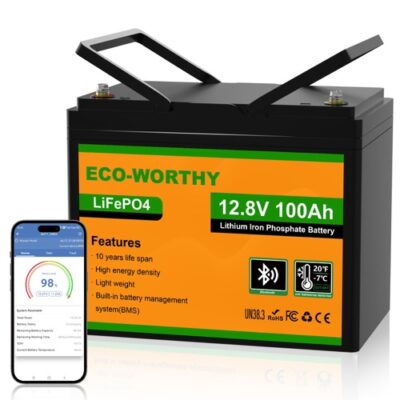
- 12.8V, 100Ah, 1,280Wh Group 24 battery.
- 100A continuous charge and discharge.
- Bluetooth plus -7°C cold-charge cutoff.
- Cold protection but no integrated heater.
- Best for buyers who value app visibility and can validate delivery condition.
PROS
- Group 24 dimensions are explicit
- Cold cutoff/recovery pair is published
- Bluetooth exposes cell and current data
- Large exact-ASIN evidence sample
CONS
- No exact timed surge rating found
- Some owners report low-current SOC blind spots
- Terminal/case failures appear in captured reports
- Warranty eligibility language needs confirmation
Feature-Rich Value
Based on exact documentation and exact-ASIN owner evidence
How Many ECO-WORTHY 12V 100Ah Bluetooth Batteries Do You Need?
Estimate how many ECO-WORTHY 12V 100Ah Bluetooth batteries your daily energy target may require.
Solar Battery Bank Size Calculator
How much solar battery storage do I need?
The ECO-WORTHY Bluetooth battery makes a stronger technical first impression than many budget 100Ah models: the case is explicitly Group 24, the BMS publishes 100A charge and discharge ceilings, and the manual gives both a low-temperature cutoff and recovery point. The uncertainty begins where monitoring meets real ownership—especially low-current SOC tracking, delivered variant identity, and several serious terminal or charging reports.
The App Can Miss the Quiet Part of the Day
Bluetooth lets an owner see voltage, current, temperature, cell spread, and protection state without opening a compartment. That is valuable for troubleshooting. Several exact-ASIN owners, however, describe SOC drifting when a small continuous load was not counted as expected. An app can show convincing precision while the underlying current threshold or SOC model misses part of a night.
App current is useful for checking direction and rough magnitude.
Verify with a shunt when overnight energy accounting matters.
The app may explain a disconnect, but it does not replace external fault protection.
100A Is Clear; Startup Current Is Not
The exact manual supports 100A maximum continuous charge and 100A maximum continuous discharge. It does not provide an attributable timed peak in the reviewed evidence. That omission matters for pumps, compressors, tongue jacks, and inverter loads: continuous current alone cannot approve startup.
| Known | Still needed | Decision |
|---|---|---|
| 100A continuous discharge | Load current at low battery voltage | Size sustained inverter/DC demand |
| 100A continuous charge | Combined current from every source | Check solar, alternator, and shore overlap |
| No timed surge found | Amperage and seconds from ECO-WORTHY | Do not approve surge-dependent loads by analogy |
The reviewed manual recommends 50A charge current, while the retail page also promotes a smaller charger in some contexts. Use the exact manual as the operating limit and treat bundle recommendations as charger-selection context, not a replacement specification.
The Cold Threshold Is Specific—and Unusual
Charging is documented to stop at 19.4°F (-7°C) and resume at 28.4°F (-2°C). That pair is lower than the 32°F cutoff common in competing manuals. We are reporting the manufacturer specification, not independently validating the cell-temperature strategy. If the installation routinely charges below freezing, obtain written confirmation for the delivered revision.
No heater is included. Protection can refuse solar energy; it cannot warm the battery to restart charging.
Terminal Evidence Deserves More Weight Than Star Average
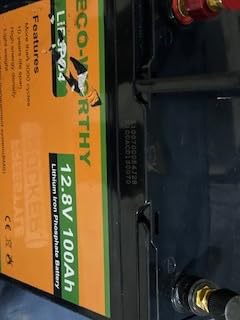
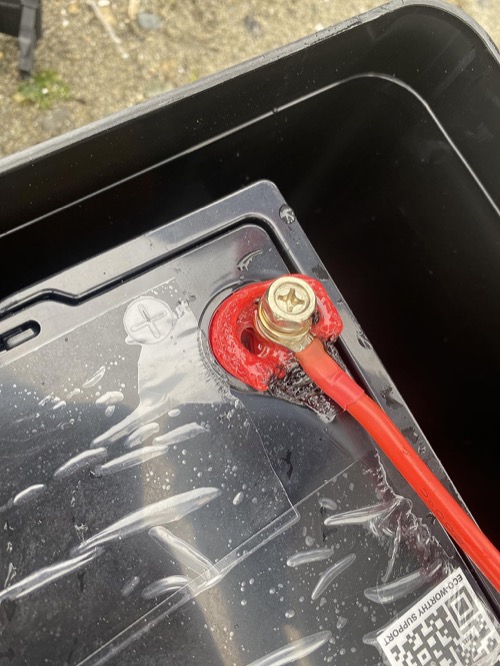
The 44-review merged exact-ASIN sample includes successful solar, RV, trolling, and backup use. It also includes reports of a melted terminal area, a cracked case or post region, a dead or non-charging battery, a delivered non-Bluetooth variant, and difficult support interactions. These are not a measured defect rate, but terminal damage is a high-consequence signal worth inspecting for.

- Confirm variant: pair the exact battery and compare its label with the manual.
- Inspect posts: look for movement, cracks, heat discoloration, or damaged threads.
- Torque correctly: use the manufacturer value if supplied for the delivered revision.
- Recheck under load: investigate voltage drop or warmth rather than tightening blindly.
Group 24 Fit Is Real, but Bank Language Needs Care
The case is 10.24 × 6.61 × 8.23 inches and 23.15 pounds. ECO-WORTHY describes expansion up to 48V and uses language that can be read more broadly than the practical 4S4P layout. We normalize the comparison row to 4S4P but advise confirmation before a large bank, especially if the current manual packaged with the product differs.
ECO-WORTHY 100Ah Bluetooth: Final Recommendation
Choose it when
- Group 24 fit and direct telemetry are priorities
- Loads remain inside a verified 100A continuous design
- You can add shunt-level monitoring for tiny parasitic loads
Pass when
- A documented timed surge is essential
- You need self-heating
- You cannot inspect, test, and preserve delivery evidence
It is a feature-rich budget battery with useful primary documentation. The right posture is monitored confidence, not blind confidence.
Pros & Cons Analysis
Based on documented specifications and owner feedback
Pros
- Group 24 dimensions are explicit
- Cold cutoff/recovery pair is published
- Bluetooth exposes cell and current data
- Large exact-ASIN evidence sample
Cons
- No exact timed surge rating found
- Some owners report low-current SOC blind spots
- Terminal/case failures appear in captured reports
- Warranty eligibility language needs confirmation
Bottom Line: Good Visibility, Conditional Confidence
ECO-WORTHY combines real Group 24 fit, 100A current limits, Bluetooth, and an unusually explicit cold cutoff/recovery pair. Its missing timed surge rating and captured terminal, charging, and support complaints keep it from an easy recommendation. It suits monitored moderate-load systems whose owners will inspect and baseline the battery promptly.
Frequently Asked Questions
Does the ECO-WORTHY 100Ah battery have Bluetooth?
Yes. The exact reviewed model has built-in Bluetooth for the ECO-WORTHY app. Use app readings as operating telemetry, not as an independent capacity test.
What is its low-temperature cutoff?
The reviewed manual states that charging stops at 19.4°F (-7°C) and resumes at 28.4°F (-2°C). The battery does not include self-heating.
Can it supply 100A continuously?
The exact manual publishes 100A maximum continuous charge and discharge. No attributable timed surge specification was found, so a surge-dependent inverter design needs manufacturer confirmation.
Why can the app SOC be inaccurate?
Some captured owners report that very small loads were not fully reflected in the state-of-charge calculation. Confirm overnight parasitic loads with an appropriate shunt or meter when precision matters.
How strong is the owner evidence?
The merged exact-ASIN set contains 44 reviews across positive and critical searches. It reveals applications and possible fault modes, but the targeted collection cannot establish population-wide rates.
Technical Specifications
| Brand | ECO-WORTHY |
|---|---|
| Exact model | 12V 100Ah Bluetooth and Low-Temperature Protection |
| Battery chemistry | LiFePO4 (LFP) |
| Nominal voltage | 12.8V |
| Rated capacity | 100Ah |
| Rated energy | 1,280Wh |
| Recommended depth of discharge | Up to 100% DoD; exact cycle-test DoD is not stated in the reviewed manual |
| Recommended charge current | 50A |
| Maximum continuous charge current | 100A |
| Maximum continuous discharge current | 100A |
| Peak discharge current | Not published in the exact manual |
| Recommended charge voltage | 14.4V absorption; 14.6V charge cutoff |
| Low-temperature charge protection | Charging stops at 19.4°F (-7°C) and resumes at 28.4°F (-2°C) |
| Self-heating | No |
| Charge / discharge temperature | Charge: 32–131°F (0–55°C); discharge: -4–131°F (-20–55°C) |
| BMS protections | Overcharge, over-discharge, overcurrent, short-circuit, and high/low-temperature protection |
| Monitoring | Built-in Bluetooth with ECO-WORTHY app |
| Series / parallel configuration | Manufacturer permits banks up to 48V and 4S4P; confirm the current manual before expansion |
| Terminals | M8 bolts |
| Dimensions | 10.24 × 6.61 × 8.23 in (260 × 168 × 209 mm) |
| Weight | 23.15 lb (10.5 kg) |
| Ingress rating | Not published in the exact manual |
| Cycle-life specification | 4,000 cycles; exact test condition is not stated |
| Warranty | Up to 10 years under the current policy; verify exact-model eligibility |