WattCycle 12V 100Ah Mini Bluetooth Review: Small Case, Real Tradeoffs
At a Glance
KEY FEATURES
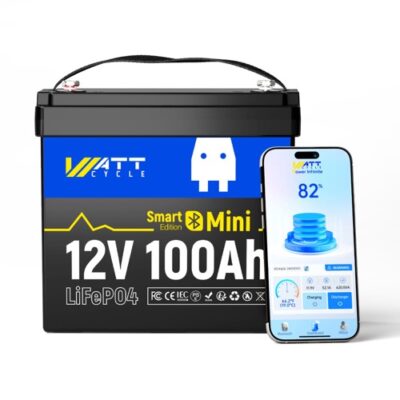
- Group 22NF-sized 9.0 × 5.6 × 8.2-inch case.
- 100A continuous current; 110A/10s and 150A/1s surge windows.
- Bluetooth monitoring and IP65 enclosure.
- Low-temperature charge cutoff without self-heating.
- Best for tight RV, boat, and electronics compartments.
PROS
- Unusually narrow 100Ah case
- Two timed surge specifications
- Clear cycle/DoD conditions
- Five-year warranty with registration extension
CONS
- Captured reviews include app range and login complaints
- Several BMS wake-up or lockout reports
- No self-heating
- 100A ceiling still limits large inverters
Compact Value Pick
Based on exact documentation and exact-ASIN owner evidence
How Many WattCycle 12V 100Ah Mini Bluetooth Batteries Do You Need?
Estimate how many WattCycle 12V 100Ah Mini Bluetooth batteries your daily energy target may require.
Solar Battery Bank Size Calculator
How much solar battery storage do I need?
WattCycle’s 12V 100Ah Mini Bluetooth has one defensible reason to exist: it puts 1,280Wh nominal into a 9.0 × 5.6-inch base. That makes it meaningfully narrower than a conventional Group 24 or Group 31 battery. The review therefore starts with the compartment, then asks whether app behavior and BMS recovery are acceptable—not with a generic list of LiFePO4 benefits.
Strongest reason to buy.
Typical 100Ah-class ceiling.
Not a large-inverter license.
Commission promptly.
A Mini Case Still Needs Full-Size Installation Space
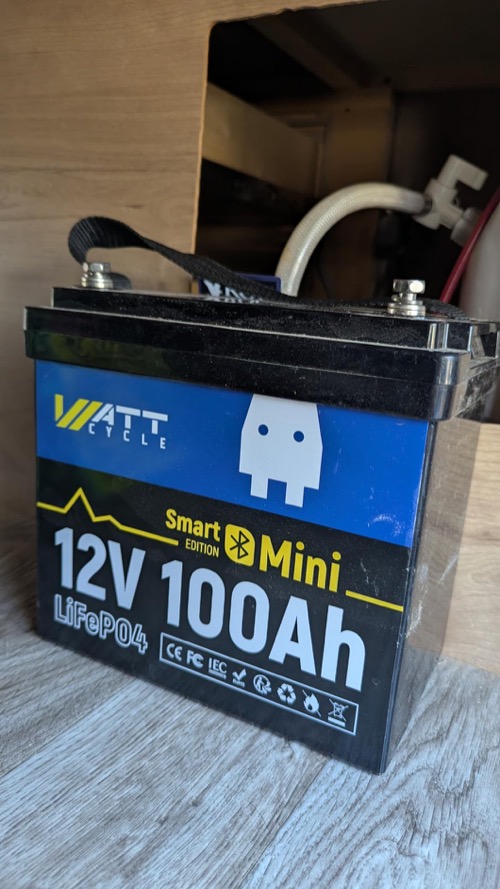
The 9.0 × 5.6 × 8.2-inch enclosure and 20.8-pound weight make seasonal removal and narrow-tray placement easier. They do not include the space consumed by terminal covers, lugs, cable bend radius, fuse, disconnect, and a restraint system. Measure those objects as an assembly.
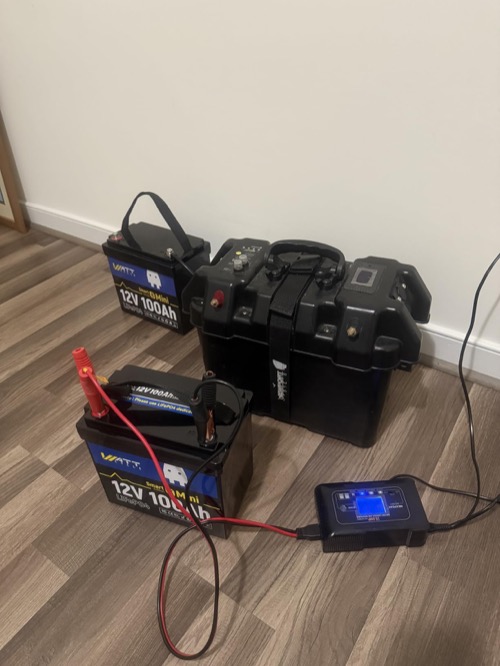
- Mock up the M8 lug stack before committing to enclosure height.
- Keep stiff inverter cable from side-loading the terminal.
- Place overcurrent protection near the positive source as required by the design.
- Retain access to the label and Bluetooth pairing path.
Two Surge Windows Are More Useful Than One Peak Number
WattCycle publishes 100A continuous charge and discharge, 110A for 10 seconds, and 150A for one second. That stepped envelope is better for design than a single dramatic pulse because a buyer can compare both magnitude and time with a compressor, pump, or inverter startup record.
The recommended 20A charge rate also deserves separation from the 100A maximum. At the idealized nameplate level, 20A is roughly a five-hour charge before taper and loss. Solar recovery must be calculated from harvest and load, not from the maximum current ceiling.
Bluetooth Convenience Meets Bluetooth Friction
In the 42-review merged sample, owners repeatedly mention the app as useful for seeing charge and load in hidden installations. Other reviews describe limited range, account/login friction, or difficulty connecting. A few said the battery itself continued working even when monitoring did not.
| App task | Useful for | Not proof of |
|---|---|---|
| Live current | Finding unexpected loads and checking charge direction | Independent current calibration |
| State of charge | Everyday planning after a known full cycle | 100Ah delivered capacity |
| Protection status | Diagnosing why charge or discharge opened | That the external fuse and charger are correct |
The More Important Complaint Pattern Is BMS Wake-Up
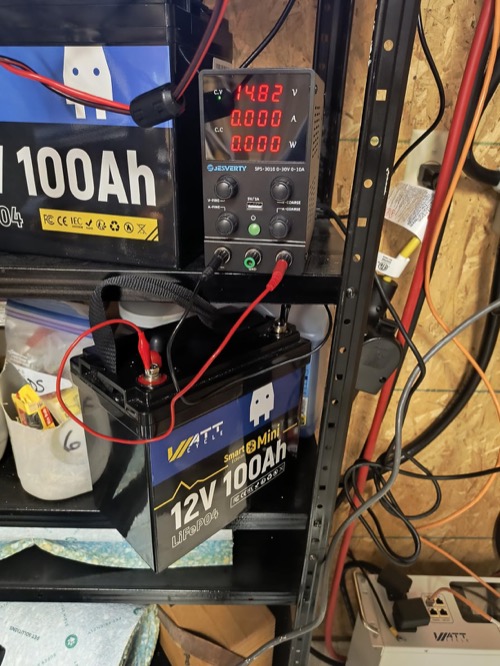
Several captured lower-star owners describe a battery that would not charge, appeared locked out, or required an unusual wake-up/recovery process. Some eventually received replacements or restored operation; others remained dissatisfied. These anecdotes cannot quantify prevalence, but they make the first week of ownership operationally important.
- On arrival: inspect damage, identify the exact Bluetooth Mini, and record open-circuit/app state.
- Before installation: use a LiFePO4-compatible charger and follow the documented recovery process if protection is active.
- Under moderate load: observe voltage, current, temperature, and connection behavior.
- Before the return window closes: resolve any repeat lockout, app failure, or capacity concern in writing.
Do not improvise with a high-voltage source or bypass the BMS to “wake” a battery. Follow the exact manual and support instructions, and isolate a suspect unit from a series or parallel bank during diagnosis.
Cold Cutoff Protects a Battery That Cannot Warm Itself
Charging stops below 32°F (0°C). The exact recovery point was not published in the reviewed evidence, so it should not be borrowed from another WattCycle model. Discharge can continue below freezing; consequently, working loads do not prove that solar charging is safe.
Winter distinction: low-temperature cutoff prevents unsafe charging. Self-heating raises cell temperature. This Mini provides the first function, not the second.
Owner Evidence: Strong Use-Case Breadth, Mixed Troubleshooting
The 42 unique exact-ASIN reviews include trolling motors, RV and camper service, solar storage, radios, refrigeration, and other compact installations. Seventeen are five-star, six four-star, two three-star, two two-star, and fifteen one-star in the rating-targeted merged set. Because the actor was deliberately asked for helpful and critical views, those counts are not a marketplace distribution.
The evidence supports the physical use case and exposes plausible app/BMS problems. It does not establish cycle life, defect rate, or a guaranteed replacement outcome.
WattCycle Mini: Final Recommendation
Choose it
The narrow Group 22NF footprint solves a real compartment problem, the 100A envelope fits the load, and you can test Bluetooth and BMS recovery immediately.
Skip it
You need self-heating, a larger continuous inverter envelope, or ownership evidence without a visible cluster of app and wake-up complaints.
This is a space specialist with respectable electrical documentation. Its miniaturization is valuable; it does not erase the need for a full commissioning plan.
Pros & Cons Analysis
Based on documented specifications and owner feedback
Pros
- Unusually narrow 100Ah case
- Two timed surge specifications
- Clear cycle/DoD conditions
- Five-year warranty with registration extension
Cons
- Captured reviews include app range and login complaints
- Several BMS wake-up or lockout reports
- No self-heating
- 100A ceiling still limits large inverters
Bottom Line: The Footprint Is the Feature
WattCycle's Mini is compelling when a normal 100Ah case simply will not fit. Its current limits and documentation are credible, but the 42-review sample includes enough app and BMS wake-up complaints to make commissioning important. Choose it for constrained space, not as a shortcut around a 100A system design.
Frequently Asked Questions
What size is the WattCycle 100Ah Mini?
The exact Bluetooth Mini is about 9.0 × 5.6 × 8.2 inches and 20.8 pounds, a Group 22NF-sized footprint. Measure terminal covers, cable bends, restraint, and service access in addition to the case.
Can it run a 1,000W inverter?
Its 100A continuous discharge rating is roughly a 1,280W nominal DC boundary. A 1,000W inverter may fit only after efficiency, low-voltage current, startup demand, cable loss, fuse, disconnect, and terminal limits are checked.
What are its surge ratings?
WattCycle publishes 110A for 10 seconds and 150A for one second. Use the load's actual startup current and duration; neither number is a continuous rating.
Does it have low-temperature protection?
Yes. Charging is blocked below 32°F (0°C), but the exact reviewed documentation does not state a recovery threshold and the battery does not heat itself.
How reliable is the Bluetooth app?
Many captured owners used the app successfully, while others reported short range, account friction, or connection problems. Treat Bluetooth as convenient telemetry and preserve an independent troubleshooting path.
Technical Specifications
| Brand | WattCycle |
|---|---|
| Exact model | 12V 100Ah Mini Bluetooth (Group 22NF) |
| Battery chemistry | LiFePO4 (LFP) |
| Nominal voltage | 12.8V |
| Rated capacity | 100Ah |
| Rated energy | 1,280Wh |
| Recommended depth of discharge | Up to 100% DoD; 80% DoD is paired with the 6,000-cycle figure |
| Recommended charge current | 20A |
| Maximum continuous charge current | 100A |
| Maximum continuous discharge current | 100A |
| Peak discharge current | 110A for 10 seconds; 150A for 1 second |
| Recommended charge voltage | 14.6V ± 0.2V (CC/CV) |
| Low-temperature charge protection | Charging stops below 32°F (0°C); exact recovery threshold is not published |
| Self-heating | No |
| Charge / discharge temperature | Charge: 32–149°F (0–65°C); discharge: -4–149°F (-20–65°C) |
| BMS protections | Overvoltage, undervoltage, charge/discharge overcurrent, short-circuit, and temperature protection |
| Monitoring | Built-in Bluetooth with WattCycle app |
| Series / parallel configuration | Up to 4 in series and 4 in parallel (4S4P) |
| Terminals | M8 bolts |
| Dimensions | 9.0 × 5.6 × 8.2 in (Group 22NF) |
| Weight | 20.8 lb |
| Ingress rating | IP65 |
| Cycle-life specification | 5,000 cycles at 100% DoD; 6,000 at 80%; 15,000 at 60% |
| Warranty | 5 years; registration may extend coverage to 7 years |