DC HOUSE 12V 100Ah Bluetooth Review: Value With Caveats
At a Glance
KEY FEATURES
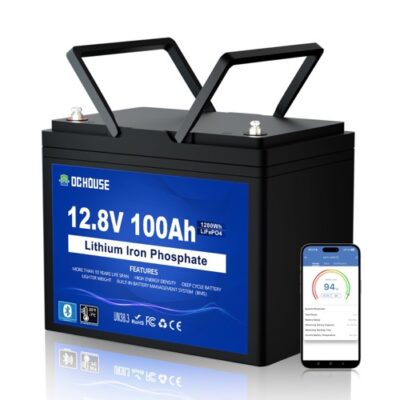
- 12.8V, 100Ah, and 1,280Wh nominal energy.
- 100A continuous charge and discharge; 130A for 10 seconds.
- Built-in Bluetooth plus low-temperature charge blocking.
- 10.2 × 6.6 × 9.2-inch case; this exact SKU is not treated as Group 24.
- Best for budget 12V systems where support and delivery checks are acceptable.
PROS
- 100A current limits are documented
- Bluetooth is useful in hidden installations
- Three-year warranty is explicit
- Broad exact-ASIN use-case sample
CONS
- 39-review sample includes failure and support complaints
- No published IP rating for this SKU
- Cold recovery threshold is not stated
- Short terminal hardware was reported in multi-lug banks
Conditional Value
Based on exact documentation and exact-ASIN owner evidence
How Many DC HOUSE 12V 100Ah Bluetooth Batteries Do You Need?
Estimate how many DC HOUSE 12V 100Ah Bluetooth batteries your daily energy target may require.
Solar Battery Bank Size Calculator
How much solar battery storage do I need?
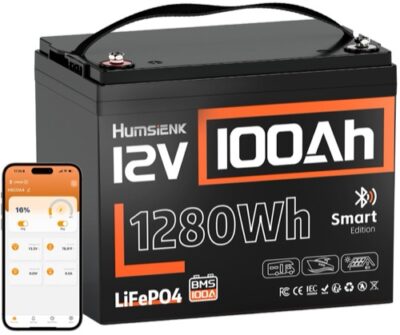
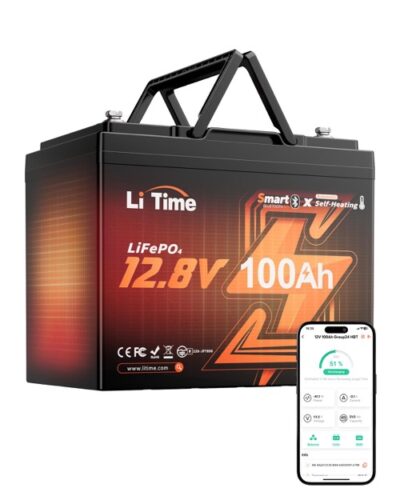
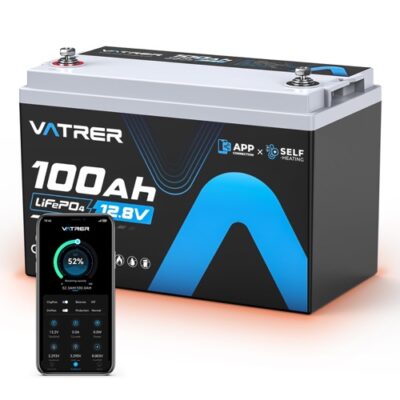
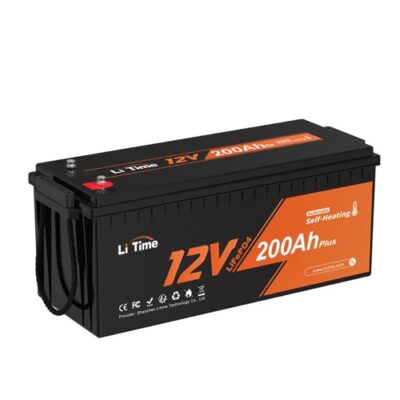
The exact DC HOUSE battery behind ASIN B0DBH2KJP3 is easy to misidentify. It is a 12.8V 100Ah Bluetooth model with a published 10.2 × 6.6 × 9.2-inch case—not a product we can responsibly call Group 24 just because marketplace copy and neighboring models use that language. That identity check changes the review: this is a value battery to measure and commission, not a generic 100Ah box.
Start With the Label, Not the Family Resemblance
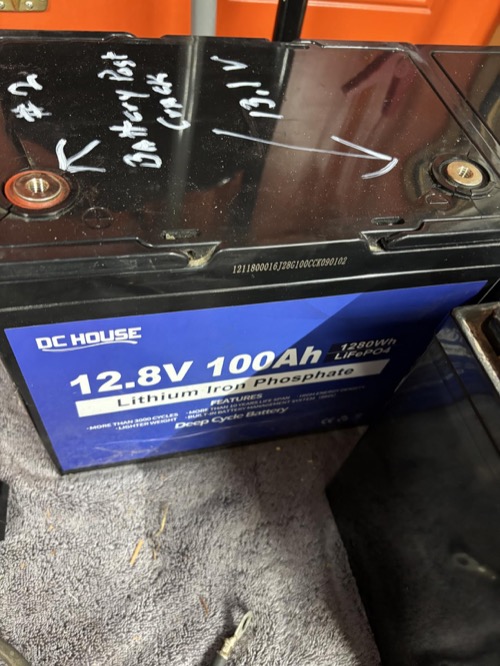
DC HOUSE identifies the exact unit as SKU L131211800062-1. The official page publishes 12.8V, 100Ah, and 1,280Wh alongside a 23.8-pound case. Those values belong together. A different DC HOUSE battery with a display, USB ports, heating, or another enclosure may share a listing family without sharing this manual or protection behavior.
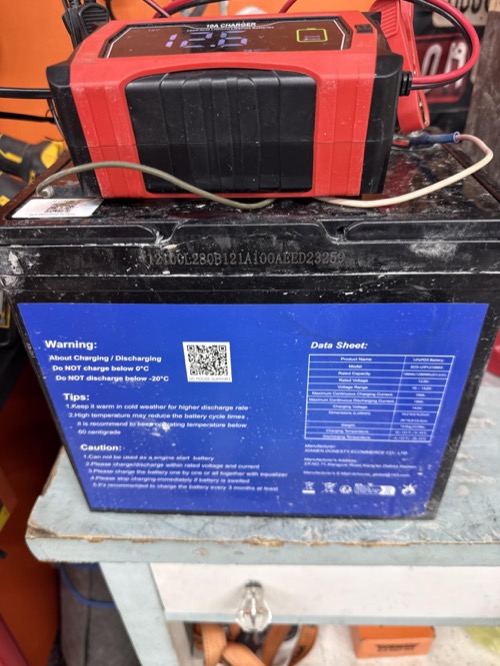
One detailed owner believed a delivered DC HOUSE unit resembled an ECO-WORTHY model and paired it with that app. That is an ownership observation, not proof of identical internals or permission to mix brands in a bank. Match the label, app, and current documentation on the unit you receive.
Bluetooth Is Useful—and Not Uniformly Reliable
Bluetooth is the everyday reason to consider this model. Owners describe checking charge state in a sailboat, equipment rack, radio station, RV, and trolling setup without exposing the battery. Several found pairing straightforward; others reported limited range or a connection that never worked. That spread is more informative than calling the app simply “good” or “bad.”
What should I record on delivery?
Save the exact label, app name, arrival voltage and state of charge, cell-voltage spread if shown, temperature, and a screenshot under a known charge and load. These records make a warranty conversation more concrete.
Does the app replace a shunt?
It can be enough for one battery’s operating view. A correctly placed shunt is still better when every charger and load in a multi-battery bank must be included in one energy balance.
The Current Envelope Is Better Defined Than the Case Class
The official limits are 100A continuous charge, 100A continuous discharge, and 130A for 10 seconds. At 12.8V nominal, 100A corresponds to 1,280W DC before sag and conversion loss. A 1,000W inverter may fit after its real low-voltage current and startup behavior are checked; a larger nameplate should not be justified with the 10-second number.
| Published boundary | Design use | Required follow-up |
|---|---|---|
| 50A standard charge | Everyday charging baseline | Add simultaneous solar, alternator, and shore current |
| 100A continuous | Sustained charge/discharge ceiling | Check hot terminals, cable drop, fuse, and inverter loss |
| 130A for 10 seconds | Moderate startup window | Compare with the load’s current-versus-time curve |
The M8 hardware also deserves attention. One owner building a larger bank said the supplied stud length was awkward for multiple heavy lugs. Do not stack conductors until thread engagement disappears; use an approved busbar layout and hardware that the manufacturer permits.
Cold Protection Stops Charge; It Does Not Create Heat
The exact page states that charging is blocked below 32°F (0°C). The reviewed material does not clearly state the recovery temperature, and the battery has no integrated heater. A freezing battery may continue supplying loads while refusing morning solar, leaving the controller energized but unable to put energy into the cells.
What the 39 Exact-ASIN Reviews Actually Change
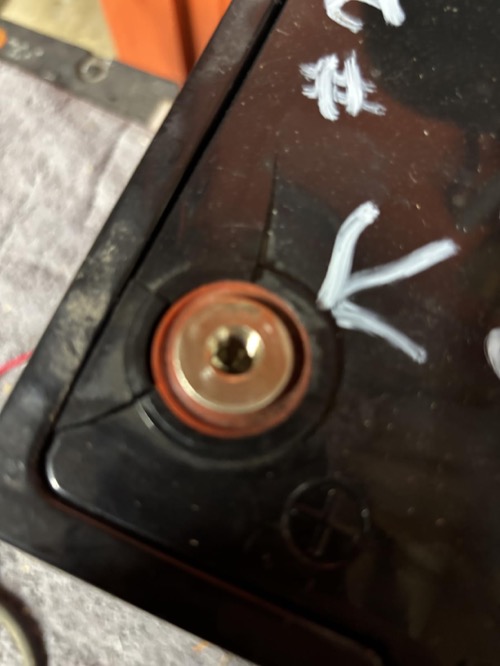
The merged evidence set contains 39 unique exact-ASIN reviews: 25 five-star, five four-star, and nine one-star. Positive reports cover trolling motors, CPAP, ham radio, RV conversion, backup power, series use, and app monitoring. The lower-star group contains several failed or non-charging units, Bluetooth problems, support dissatisfaction, and one report of cracking around battery posts.
That mix raises the importance of commissioning and remedy logistics. It does not permit a nine-in-39 failure-rate claim: the collection was rating-targeted, not a random census, and Amazon review availability is selective. The defensible conclusion is that serious failure modes appear in the captured evidence and should influence the buying process.
Who Should Choose It?
Good match
- Budget-sensitive 12V house systems
- Hidden batteries that benefit from phone visibility
- Loads that remain within 100A continuous and 130A/10s
- Buyers able to test promptly after delivery
Look elsewhere
- You need a published IP rating
- You require self-heating or an exact cold-recovery point
- Support certainty outweighs upfront price
- The compartment was selected by a Group 24 label alone
DC HOUSE 12V 100Ah Bluetooth: Final Recommendation
Buy it for a measured compartment, a moderate 100A-class system, and Bluetooth convenience—not for a guessed group size or an assumption that every battery in the listing family is interchangeable. The electrical case is reasonable; the ownership case is conditional. That difference is the whole review.
Pros & Cons Analysis
Based on documented specifications and owner feedback
Pros
- 100A current limits are documented
- Bluetooth is useful in hidden installations
- Three-year warranty is explicit
- Broad exact-ASIN use-case sample
Cons
- 39-review sample includes failure and support complaints
- No published IP rating for this SKU
- Cold recovery threshold is not stated
- Short terminal hardware was reported in multi-lug banks
Bottom Line: Buy for Value, Commission It Carefully
The DC HOUSE is a credible budget choice when Bluetooth, 100A continuous current, and a 10-second 130A allowance fit the system. It is not our low-friction recommendation: the exact owner sample contains recurring failure and support complaints, while IP rating and cold-recovery details remain incomplete. Photograph the delivered label, test it promptly, and keep the order record.
Frequently Asked Questions
Is the DC HOUSE 12V 100Ah battery Group 24?
No exact Group 24 identity was confirmed for ASIN B0DBH2KJP3. Its published case is 10.2 × 6.6 × 9.2 inches, so measure the compartment instead of selecting it by a borrowed group-size label.
How much current can it supply?
DC HOUSE publishes 100A maximum continuous discharge and 130A for 10 seconds. That supports a preliminary DC boundary, not an automatic inverter recommendation; low-voltage current, loss, surge, cables, protection, and terminals still decide the installation.
Does it stop charging below freezing?
The exact page states that low-temperature protection blocks charging below 32°F (0°C). It does not clearly publish the recovery threshold, and the battery is not self-heating.
What did Amazon owners report?
The retained exact-ASIN sample contains 39 reviews. Many describe trolling, radio, CPAP, RV, and backup use, while a meaningful minority report a failed unit, charging trouble, Bluetooth trouble, cracked terminal areas, or unsatisfactory support. The sample cannot establish a failure rate.
Can four batteries be connected in series?
The manufacturer permits up to 4S4P with compatible matched units. Verify revision compatibility, state of charge, conductor balance, protection, and the current manual before building a bank.
Technical Specifications
| Brand | DC HOUSE |
|---|---|
| Exact model | L131211800062-1 |
| Battery chemistry | LiFePO4 (LFP) |
| Nominal voltage | 12.8V |
| Rated capacity | 100Ah |
| Rated energy | 1,280Wh |
| Recommended depth of discharge | Up to 100% DoD; the manufacturer does not publish a cycle-test DoD for this exact SKU |
| Recommended charge current | 50A |
| Maximum continuous charge current | 100A |
| Maximum continuous discharge current | 100A |
| Peak discharge current | 130A for 10 seconds |
| Recommended charge voltage | 14.6V (CC/CV) |
| Low-temperature charge protection | Charging is blocked below 32°F (0°C); recovery threshold is not stated on the exact page |
| Self-heating | No |
| Charge / discharge temperature | Charge: 32–131°F (0–55°C); discharge: -4–131°F (-20–55°C) |
| BMS protections | Overcharge, over-discharge, overcurrent, short-circuit, high-temperature, and low-temperature protection |
| Monitoring | Built-in Bluetooth with DC HOUSE app |
| Series / parallel configuration | Up to 4 in series and 4 in parallel (4S4P) |
| Terminals | M8 bolts |
| Dimensions | 10.2 × 6.6 × 9.2 in (260 × 168 × 234 mm) |
| Weight | 23.8 lb (10.8 kg) |
| Ingress rating | Not published for this exact SKU |
| Cycle-life specification | Up to 15,000 cycles; exact test condition is not stated |
| Warranty | 3 years |