Renogy Core Mini Review: Strong Manual, External Monitoring
At a Glance
KEY FEATURES
- Battery: 12.8V, 100Ah, calculated 1,280Wh LiFePO4 in a compact case.
- Current: 100A continuous charge/discharge; 300A peak for five seconds.
- Temperature: Charging stops at 32°F and resumes at 37.4°F; no self-heating.
- Bank setup: Publishable limit is 4S4P pending clarification of one manual conflict.
- Best fit: Compact systems prioritizing documentation and a five-second surge window.
PROS
- Exact-model manual publishes conditioned capacity and detailed BMS limits.
- 300A peak lasts five seconds rather than a fraction of a second.
- Cold-charge cutoff and recovery thresholds are documented.
- Compact IP65 case with specified M8 hardware and torque.
- Useful exact-owner reports include a four-unit voltage check.
CONS
- The product page and manual disagree on maximum discharge temperature.
- Continuous discharge is still limited to 100A.
- No integrated heater is included.
- Battery-level app monitoring requires an optional external shunt.
- One exact owner reported failure plus a nearly two-month refund process.
Strong Alternative
Based on documentation and exact-model owner evidence
How Many Renogy Core Mini Batteries Do You Need?
Estimate how many Renogy Core Mini batteries your daily energy target may require.
Solar Battery Bank Size Calculator
How much solar battery storage do I need?
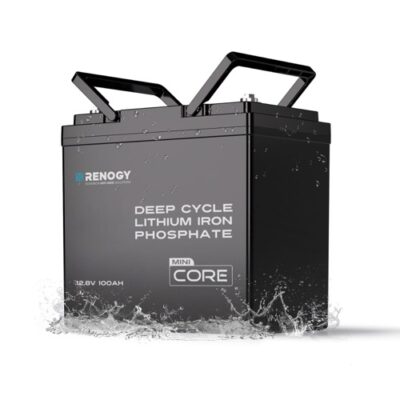
This Renogy Core Mini review begins with an advantage that is easy to overlook: the exact RBT12100LFP-M manual answers more important questions than the logo on the case does. It publishes conditioned capacity, continuous and surge current, cold-protection thresholds, terminal hardware, torque, and bank diagrams for the exact 12V 100Ah Mini sold under ASIN B0DJP772YP.
That documentation supports a compact battery with a useful five-second surge and automatic cold-charge cutoff. The tradeoffs are equally concrete. Bluetooth is not built in, the five-year warranty is prorated, two source conflicts need conservative treatment, and the small exact-owner sample includes one serious failure and refund complaint.
Start With the Manual, Not the Logo
Renogy specifies 12.8V and 100Ah at 0.5C and 77°F (25°C). Multiplying those published ratings gives 1,280Wh, but that energy figure remains a calculation rather than a Solar Power Picks discharge test. The conditioned capacity statement is valuable because it tells readers that a nameplate number depends on test rate and temperature.
The exact-model manual also resolves details that marketplace shorthand often hides. It calls for 14.4V ±0.2V CC/CV charging, lists 50A as the standard charge rate, and permits up to 100A continuous charge. Its BMS descriptions identify voltage, current, short-circuit, and temperature protections instead of asking a buyer to accept a generic “smart BMS” bullet.
This level of detail is valuable during component selection. A controller, converter, alternator charger, and inverter/charger can all contribute current, so the battery limit applies to their combined operating state. The manual gives a designer something concrete to coordinate rather than assuming that every device labeled LiFePO4-compatible will behave the same way.
Documentation is not perfect merely because it is long. Renogy’s product page and exact manual disagree about the top of the discharge-temperature range, and the manual contains tension over parallel count. The responsible approach is to use the more conservative exact-manual temperature and the clearly illustrated 4S4P bank while flagging both issues.
Source rule used in this review: Where Renogy’s current page and exact manual disagree, the recommendation keeps the more conservative exact-model boundary and names the conflict instead of blending the figures.
A Compact Battery With a Five-Second Current Story
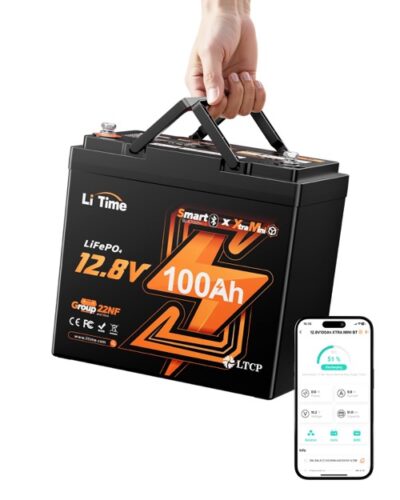
The enclosure measures 9.02 × 5.43 × 8.39 inches and weighs 21.8 pounds. That makes it close to the compact LiTime footprint rather than a conventional Group 31 case. Buyers still need to measure the tray, lid, hold-down, M8 lug stack, and cable bend — especially because the terminals sit on the top face.
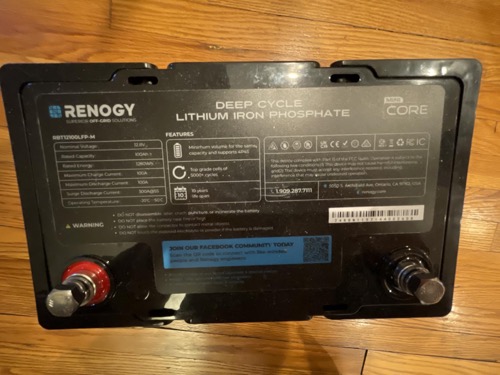
Continuous charging and discharging are both capped at 100A. The more distinctive number is 300A for five seconds. A timed five-second pulse is easier to evaluate against an inverter’s startup demand than a vague maximum or a 100-millisecond figure, but it still does not support a 300A continuous load.
At 12.8V nominal, 100A represents roughly 1,280W on the DC side before losses and voltage movement. An AC inverter plan must stay below the battery, inverter, conductor, fuse, disconnect, and terminal limits simultaneously. Check the inverter’s actual low-voltage DC current and surge curve rather than sizing from its AC badge alone.
12.8V × 100A = 1,280W preliminary DC boundary
This is not a 1,280W AC appliance recommendation. Recalculate current at the inverter’s low-voltage operating point, include conversion loss, and keep every conductor and protection device inside its own limit.
Where five seconds changes the answer
| Load behavior | Core Mini reading | Next check |
|---|---|---|
| Below 100A continuously | Inside the published BMS ceiling | Verify inverter loss, low-voltage current, cable, and fuse limits |
| 100–300A for no more than 5 seconds | Potentially inside the timed surge window | Compare the measured startup trace, not the appliance label |
| Above 300A or longer than 5 seconds | Outside the published surge envelope | Reduce the load or redesign the battery system |
Cold-Charge Protection: Trigger and Recovery
The BMS stops charging at or below 32°F (0°C) and resumes at 37.4°F (3°C). That small recovery gap helps avoid repeated switching at exactly the cutoff. Discharge is documented down to -4°F (-20°C), so the battery can be cold enough to run a load while refusing solar or charger current.
There is no self-heater in this exact Core Mini. If an unheated compartment remains below the recovery threshold, the BMS can protect the cells indefinitely without restoring charging. Winter design therefore involves compartment placement, insulation, or externally controlled heat as well as selecting a controller with a lithium profile.
For the upper discharge boundary, this review uses 131°F (55°C) from the exact manual rather than 140°F (60°C) from the current web page. A conservative primary-source choice is more useful than quietly merging the two figures, and neither number makes a hot, enclosed, high-current installation automatically acceptable.
What happens on a freezing morning
- The cells reach 32°F (0°C) or colder and the BMS blocks incoming charge.
- Loads may continue because the permitted discharge range extends below freezing.
- Solar production cannot resume charging until the cells warm to 37.4°F (3°C).
- The installation—not the BMS—must provide any heat needed to reach recovery temperature.
Monitoring Requires One More Box
The Core Mini does not accept Renogy’s direct Bluetooth battery modules. Renogy instead names its 300A Battery Shunt as the route to app monitoring. A shunt can be a capable system monitor because it counts current flowing into and out of the bank, but it adds hardware, cabling, setup, cost, and another component that needs correct placement.
One sampled owner used a Renogy ONE with a battery shunt, which supports the ecosystem case without turning the shunt into an included feature. The distinction matters in a value comparison: a battery with built-in Bluetooth and a battery requiring a monitor may deliver similar information only after their total installed costs differ.
External monitoring can also be an advantage for a multi-battery bank, since one correctly placed shunt observes the bank rather than a single internal Bluetooth module. Choose based on the system architecture, not the assumption that built-in is always better or that “Renogy app compatible” means this battery contains a radio.
A shunt is only as accurate as its installation and configuration. Every load and charging source must normally pass through the measured path, and the monitor needs the correct capacity plus a reliable full-charge synchronization point. A bypassed negative cable can make a polished app screen less trustworthy than no percentage at all.
What the shunt adds
One measurement point can track net current for a complete multi-battery bank and feed Renogy’s monitoring ecosystem.
What the shunt costs
Extra hardware, negative-bus rewiring, configuration, installation space, and another path that can be bypassed accidentally.
Four Batteries, One-Tenth-Volt Spread
One owner reports receiving four batteries within 0.1V of each other and says capacity matched the rating. The close arrival voltages are useful pre-bank evidence because parallel or series assembly starts more cleanly when units are at similar state of charge. The capacity comment remains an owner observation because the captured review does not provide an independently documented load, cutoff, temperature, instrument, or calculation method.
Other sampled owners describe the unit as compact, light, and easy to install compared with AGM. Those recurring handling observations fit the published 21.8-pound case. They do not demonstrate cell grade, internal fastening, or lifespan, which would require different evidence.
The eight-review sample is too small for fine-grained percentages. Seven five-star reviews suggest good early experiences among those captured, while the single one-star case shows that serious failure and service friction are present in the exact-model record. Both facts belong in the review without turning either into a universal outcome.
One four-battery report describes a 0.1V spread, which helps frame commissioning checks but is not a factory-wide result.
The reported match to capacity lacks the load, cutoff, temperature, instrument, and arithmetic needed for an independent measurement.
Compactness and lower weight recur across owners and align with the published case.
Eight reviews, including one serious negative, cannot establish a product or brand failure rate.
The Failure Report That Belongs in the Verdict
The negative exact-variant owner says the battery would not hold charge on a camping trip and that the refund took nearly two months. That is consequential because the failure affected the product’s core job and the remedy reportedly added delay. It should not be hidden behind an average rating.
It also remains one report. The evidence does not show whether the cause was an internal defect, charging problem, protection state, installation issue, or another factor, and it cannot support a brand-wide failure rate. A separate positive reviewer said support was available but left something to be desired, adding a softer ownership concern without establishing a consistent service pattern.
Renogy’s warranty is described as five-year prorated coverage for material and workmanship defects. “Five years” therefore does not mean a guaranteed full-price replacement throughout the term. Buyers for remote or seasonal systems should read the remedy schedule, documentation requirements, shipping responsibility, and exclusions before treating the warranty as downtime insurance.
Good commissioning records can make any later diagnosis clearer. Record serial number, arrival voltage, charger settings, terminal torque, bank balance, and current under a known load. Those details cannot guarantee a successful claim, but they help separate a protection event, installation problem, and suspected battery fault before a camping trip becomes the first serious test.
Bank Rules and the 4S4P Documentation Tension
The product page and the manual’s maximum illustrated arrangement support up to four in series and four in parallel. That creates a clear publishable 4S4P boundary. Another manual passage says “up to eight” parallel batteries, but it does not remove the competing maximum diagram.
This review will not choose the larger number. A design needing more than four in parallel should obtain model- and revision-specific confirmation from Renogy in writing. For the normal 4S4P case, use matched batteries at compatible state of charge and follow the manual’s balanced cabling and protection guidance.
What bank limit can be published today?
Use 4S4P because the product page and maximum illustrated arrangement support it. That boundary is clear enough for editorial use and avoids combining conflicting passages.
What if the design needs five to eight batteries in parallel?
Pause the design and obtain written confirmation tied to the exact Core Mini model and revision. One favorable sentence is not enough to override the competing maximum illustration.
Does 4S4P complete the wiring plan?
No. Matching, state of charge, conductor balance, branch protection, busbars, disconnect ratings, fault current, and charging capacity remain separate engineering checks.
The M8 × 1.25 × 12mm terminal hardware has a specified 10–12 N·m torque. That is valuable only when the correct bolt length, lug stack, conductor, fuse, and tool are used. Never solve an oversized lug stack by partially engaging threads or substitute finger-tight hardware in a high-current bank.
- Use 4S4P as the publishable limit unless Renogy confirms a larger bank in writing.
- Match battery model, revision, state of charge, and conductor paths before connection.
- Torque the M8 × 1.25 × 12mm hardware to the exact 10–12 N·m instruction.
- Record serials, resting voltage, shunt baseline, and current under a known commissioning load.
Renogy Core Mini: Bottom Line
The Renogy Core Mini review supports a conditional recommendation for buyers who value exact-model documentation, a compact enclosure, cold-charge protection, and a clearly timed 300A surge. It is especially defensible when an external shunt already belongs in the system plan and a five-second startup window matters more than the highest one-second headline.
Choose another battery if direct Bluetooth or a simple non-prorated warranty is a priority. Before ordering, accept 4S4P as the conservative bank limit, use the exact manual’s 55°C discharge ceiling, and budget for monitoring separately. The owner record is encouraging but small, and the failure and refund report prevents an unqualified reliability claim.
Pros & Cons Analysis
Based on documented specifications and owner feedback
Pros
- Unusually detailed exact manual — capacity conditions, temperature thresholds, current limits, terminal torque, and BMS behavior are all published for RBT12100LFP-M.
- Useful surge duration — the documented 300A pulse lasts five seconds, which is more informative than an untimed peak.
- Automatic cold-charge protection — charging stops at 0°C and recovers at 3°C.
- Ecosystem monitoring path — Renogy identifies its 300A Battery Shunt as an app-monitoring route.
- Compact and installation-specific — IP65, M8 × 1.25 × 12mm terminals, and 10–12 N·m torque are documented.
Cons
- Primary-source tensions remain — discharge temperature and parallel-count language are not completely consistent.
- Not a 300A continuous battery — sustained charging and discharging are each capped at 100A.
- No active warming — the battery must warm before it can accept charge again.
- One more component — Bluetooth is not built into this battery and the shunt is not presented as included.
- Mixed ownership evidence — the eight-review sample includes one serious failure/refund report and softer support criticism.
Renogy Core Mini Verdict: Documentation Leads, Monitoring Follows
Verdict: The Renogy Core Mini is a documentation-led compact choice with 100A continuous current, a useful 300A-for-five-second pulse, and clearly defined cold-charge protection.
Buy it if: You value an exact manual, a small case, and an external-shunt monitoring architecture. Its five-second surge window is easier to match to startup loads than a split-second peak.
Skip it if: You expect Bluetooth inside the battery or assume the five-year warranty is non-prorated. One exact owner also reported failure and a nearly two-month refund process, though that single case is not a failure rate.
Verify before checkout: Plan around 4S4P, the manual's -20–55°C discharge range, 100A continuous limits, and 10–12 N·m terminal torque. Get written Renogy confirmation before using the manual's competing eight-parallel statement.
Frequently Asked Questions
Does the Renogy Core Mini have Bluetooth built in?
No. Renogy's exact manual says direct Bluetooth modules are unsupported for this battery. The named app-monitoring path is an optional Renogy 300A Battery Shunt, which measures current externally. Treat the shunt as a separate system component unless a current bundle explicitly includes it.
What is the Renogy Core Mini's continuous discharge limit?
The RBT12100LFP-M manual lists 100A maximum continuous discharge and 100A maximum continuous charge. Its 300A figure lasts five seconds. Inverter sizing must use the continuous DC draw and surge duration together with voltage sag, efficiency, cables, overcurrent protection, and terminal limits.
Will the Core Mini stop charging below freezing?
Yes. The exact manual documents charge cutoff at or below 32°F (0°C) and recovery at 37.4°F (3°C). It does not document self-heating, so protection can stop unsafe charging but cannot warm the cells. A cold installation may need external thermal planning.
How many Renogy Core Mini batteries can be connected?
This review uses 4S4P because that is the maximum illustrated arrangement in the exact manual and matches the current product page. One manual passage also mentions up to eight parallel units. Confirm any design beyond 4P directly with Renogy in writing rather than choosing the larger number.
Is the Renogy Core Mini rated at 1,280Wh?
Its manual publishes 12.8V and 100Ah, with capacity conditioned at 0.5C and 77°F (25°C). The 1,280Wh value in this review is calculated from 12.8V × 100Ah; it is not a Solar Power Picks energy-delivery test.
What discharge temperature should I use for planning?
Use the exact manual's -4–131°F (-20–55°C) range. Renogy's current product page extends the upper value to 140°F (60°C), but the model-specific manual is the more conservative primary source. Temperature ratings still do not remove enclosure and current-derating considerations.
Is the five-year warranty fully non-prorated?
No. The reviewed Renogy wording describes five-year prorated coverage for materials and workmanship. Read the current terms for proof-of-purchase, remedies, exclusions, and the applicable prorated period before buying; a five-year headline alone does not describe the whole remedy.
What does the owner evidence say about reliability?
Seven of eight retained exact-variant reviews were five-star, and one was one-star. The negative owner reported a battery that would not hold charge and a refund process lasting nearly two months. That case belongs in the decision, but eight reviews cannot establish a product-wide failure or support rate.
Technical Specifications
| Brand | Renogy |
|---|---|
| Exact model | RBT12100LFP-M |
| Battery chemistry | LiFePO4 (LFP) |
| Nominal voltage | 12.8V |
| Rated capacity | 100Ah at 0.5C and 77°F (25°C) |
| Rated energy | 1,280Wh (calculated from 12.8V × 100Ah) |
| Recommended depth of discharge | Up to 100% DoD; cycle-life specification is measured at 80% DoD |
| Recommended charge current | 50A standard charge |
| Maximum continuous charge current | 100A |
| Maximum continuous discharge current | 100A |
| Peak discharge current | 300A for 5 seconds |
| Recommended charge voltage | 14.4V ± 0.2V (CC/CV) |
| Low-temperature charge protection | Charging stops at or below 32°F (0°C) and resumes at 37.4°F (3°C) |
| Self-heating | No |
| Charge / discharge temperature | Charge: 32–122°F (0–50°C); discharge: -4–131°F (-20–55°C) |
| BMS protections | Cell overvoltage/undervoltage, charge/discharge overcurrent, short circuit, and charge/discharge temperature protection |
| Monitoring | No direct Bluetooth port; optional Renogy 300A Battery Shunt adds app monitoring |
| Series / parallel configuration | Up to 4 in series and 4 in parallel (4S4P) |
| Terminals | M8 × 1.25 × 12 mm; 10–12 N·m specified torque |
| Dimensions | 9.02 × 5.43 × 8.39 in (229 × 138 × 213 mm) |
| Weight | 21.8 lb (9.9 kg) |
| Ingress rating | IP65 |
| Cycle-life specification | 5,000 cycles at 80% DoD to 80% remaining capacity (0.5C, 77°F/25°C) |
| Warranty | 5-year prorated material-and-workmanship warranty |