
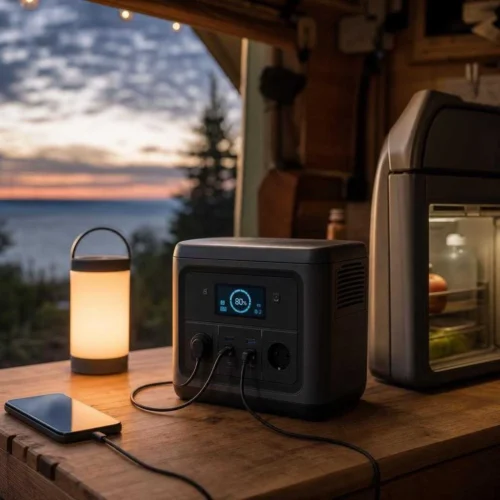
“How long will a solar generator last?” contains two different clocks. The first is runtime: minutes or hours on one charge. The second is service life: years and equivalent battery cycles before capacity falls to a published milestone. Mixing the clocks produces misleading answers.
Stored watt-hours move through DC converters or an inverter to the load.
Every discharge, charge, hot day, storage period, and calendar month contributes to aging.
Calculate One-Charge Runtime First
Start with rated battery capacity, then account for conversion loss, station overhead, and reserve. Divide usable watt-hours by total watts. A 1,024Wh station modeled at 85% usable with 20% reserve yields about 696Wh for the planned load. At 100W plus overhead, that is hours—not days.
Separate Runtime From Cycle-Limited Service
Estimate one-charge runtime and equivalent full cycles. The years result is not a warranty or calendar-life prediction.
Planning estimate only. Verify the exact load, manual limits, wiring, connectors, weather, and operating conditions.
The tool’s cycle-throughput years assume identical energy use every day and that cycle count is the only aging mechanism. Real batteries also age with time, temperature, state of charge, charging behavior, and manufacturing variation. Treat the result as a comparison of use intensity, never a predicted failure date.
Use Energy for Cycling Loads
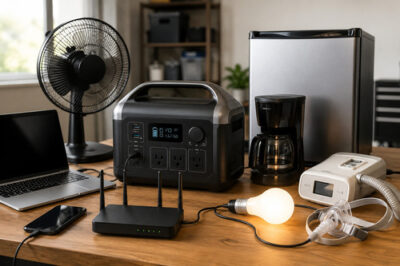
A refrigerator may draw 100W while its compressor runs and much less when it rests. Multiplying 100W by 24 hours can overstate the day, while using one low instant reading can understate it. Measure watt-hours across a representative 24-hour period, including startup, defrost, hot-room operation, and door opening where relevant.
| Load type | Best input | Common mistake |
|---|---|---|
| Steady router or light | Measured watts × time | Ignoring station idle overhead |
| Refrigerator or pump | Measured Wh over a full cycle | Using only running watts |
| CPAP | Actual setting and overnight Wh | Ignoring humidifier/heated hose |
| Cooking appliance | Measured watts and minutes per use | Confusing high watts with all-day energy |
Solar Can Pause the Runtime Clock
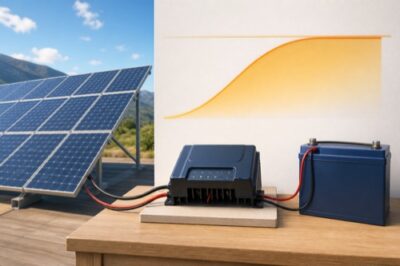
If the panel supplies more power than the load consumes, surplus can charge the battery and extend operation. If it supplies less, the battery still declines—just more slowly. Clouds, shade, angle, heat, and the station’s input ceiling make solar variable, so model energy collected across the day rather than assuming panel nameplate power continuously.
Positive means the battery gains energy over the interval. Negative means the battery is still being depleted.
DOE’s solar and storage overview emphasizes that storage decouples generation from consumption and that energy conversion is not perfectly efficient. That is the correct mental model: the panel changes the daily ledger, not the battery’s printed capacity.
Translate Partial Discharges Into Equivalent Cycles
One full equivalent cycle is roughly the throughput of 100% of rated capacity, even if accumulated through smaller discharges. Using 25% of capacity on four separate days is roughly one equivalent cycle in a simple model. Manufacturers may define and test cycle ratings differently, so preserve the exact capacity-retention threshold and test conditions whenever available.
A battery rated to 3,000 cycles at a stated threshold does not become unusable at cycle 3,001. It may retain less capacity and still serve a smaller job. Conversely, reaching far fewer cycles does not guarantee like-new capacity after many hot years.
Temperature and Storage Run a Third Clock
Battery aging continues while the station sits unused. Extreme heat can accelerate degradation; charging below permitted temperatures can be unsafe or blocked; long-term storage at an unsuitable state of charge can reduce health. Follow the exact manual rather than a universal percentage rule because battery-management systems and manufacturer recommendations differ.
- Store within the documented temperature range.
- Check and recharge at the manual’s stated interval.
- Keep vents clear and the station dry.
- Do not leave it in a hot vehicle for convenience.
- Record firmware, faults, unusual heat, and capacity changes.
Warranty Length Is Not Battery Lifespan
A five-year warranty defines contractual coverage under its terms, not a promise that every battery fails or remains perfect at five years. A cycle milestone is also not a warranty by itself. Read exclusions, registration rules, transferability, remedies, shipping responsibility, and separate panel coverage.
For a critical backup purchase, record the serial number, invoice, model revision, initial capacity test, and support contacts. Repeat a representative load test periodically so declining runtime appears during maintenance—not during the outage.
Use the Elite 200 V2 longevity-and-solar review as a concrete case: strong published cycle life does not remove the need to size panel recovery and fixed capacity separately.
Choose Capacity for the End of the Plan
Size a critical use so it still works after reasonable capacity loss. A system that barely passes when new has no aging margin. For convenience use, a smaller system may remain economically sensible even as runtime declines.
Create a Repeatable Health Check
Battery percentage is an estimate, so compare the station against the same controlled workload periodically. Begin at the same displayed charge, use the same output and load, keep temperature similar, record delivered time or watt-hours, and stop at the same reserve. A single short run can reflect calibration or conditions; a consistent trend across comparable tests is more informative.
- Baseline when new: record firmware, room temperature, load watts, start charge, stop charge, and elapsed time.
- Repeat on a schedule: quarterly or before seasonal risk, depending on use.
- Inspect the path: clean vents, check cables and connectors, review fault logs, and examine the panel.
- Escalate material change: follow calibration guidance or contact support while coverage applies.
Do not deliberately deep-cycle a battery more often than needed just to collect data. A shorter standardized interval can reveal change with less throughput. Follow manufacturer procedures if it recommends a full calibration cycle.
| Observed change | Possible explanations to check | Do not assume |
|---|---|---|
| Shorter runtime | Higher load, temperature, reserve setting, inverter overhead, aging, calibration | Immediate cell failure |
| Slower solar charge | Sun, shade, angle, heat, cable, panel, input limit, active loads | Battery aging alone |
| Unexpected shutdown | Overload, startup surge, temperature, low charge, fault, cable | Published capacity was false |
| Capacity-display jump | State-of-charge estimation or calibration | Energy physically appeared or vanished |
Calendar Aging Can Beat the Cycle Counter
A station used only during rare outages may accumulate few equivalent cycles and still age. Time spent hot, long storage at unsuitable charge, and years of calendar exposure continue whether the outlets are on or off. That is why dividing a cycle rating by annual use can produce an implausibly long “lifespan.”
Keep a dated readiness record rather than relying on memory. Log storage temperature, displayed charge, firmware changes, test-load runtime, recharge energy, and unusual shutdowns. Comparable records help distinguish ordinary seasonal variation from a persistent decline that deserves support attention before the next outage.
The published retention threshold also matters. “3,000 cycles” without “to 80%,” “to 70%,” or another condition is incomplete evidence. Two products with the same cycle count may use different thresholds and test procedures. Preserve the entire statement and avoid ranking chemistry solely on one number.
Plan retirement by mission, not by age alone
A battery that has fallen from 1,024Wh to 80% retains roughly 819Wh before conversion losses. It may no longer satisfy a 900Wh critical plan but can still support smaller communications or travel loads. Define the minimum acceptable delivered energy for each mission and reassign the station when it falls below that threshold.
For critical standby, choose a proactive replacement or secondary-source policy before the system fails a test. Warranty expiration, cycle milestone, and mission retirement are three separate dates; none automatically determines the others.
Bottom Line: Answer Both Clocks Explicitly
Runtime per charge comes from usable watt-hours divided by load. Service life comes from chemistry, throughput, environment, storage, calendar time, and care. Solar can improve the daily energy balance but does not stop aging. State which clock you mean, show the assumptions, and the answer becomes useful instead of falsely precise.
Leave a Reply