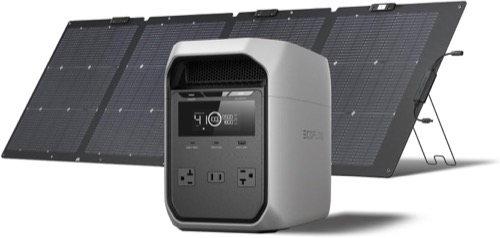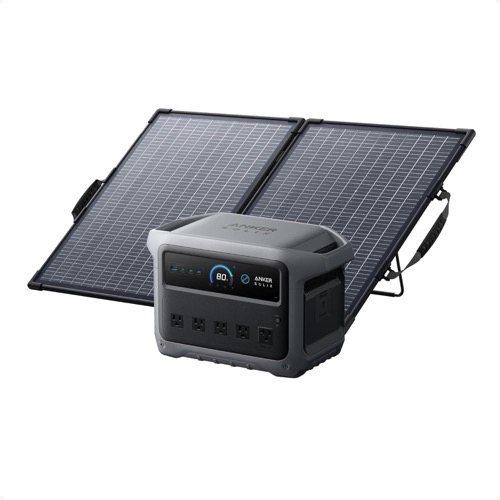
EcoFlow DELTA 3 Classic and Anker SOLIX C1000 Gen 2 tie at 1,024Wh, so this comparison starts where most spec races end. The decision is about energy flow: EcoFlow supplies a 220W panel and a 500W solar input; Anker supplies a 100W panel but leaves a 600W ceiling for a future array. EcoFlow emphasizes recovery and control. Anker emphasizes continuous output, DC utility, and a lighter total carry.
One Battery Number Removes a Distraction
Both stations store 1,024Wh and use LFP chemistry. Neither exact model has a published add-on battery port. Runtime differences caused by the battery label alone will therefore be small compared with load, inverter efficiency, reserve, idle draw, temperature, and power path. If one candidate appears to deliver dramatically longer runtime at the same load, inspect the assumptions before treating the result as a product advantage.
The equal battery also makes under-sizing easy to diagnose. If the worksheet says your essentials consume 1,400Wh between reliable recharges, neither station becomes a 1,400Wh system because it has the stronger inverter or the bigger panel. Reduce the load, recharge during the operating period, or select a larger documented platform.
Build the Solar-Deficit Budget
EcoFlow pairs its station with a 220W bifacial panel and estimates about 5.8 hours to refill under stated ideal conditions. Anker’s included 100W panel implies roughly 12–14 peak-sun hours from empty. These are not promises; clouds, heat, shading, angle, cable loss, battery state, and charge taper all reduce real collection. They are useful because they reveal the initial mismatch between battery and panel.
A negative result means the array can catch up under the entered conditions. A positive result means the battery declines each day until another charging source intervenes.
Continuous Power and Surge Split the Win
Anker publishes 2,000W continuous and 3,000W surge. EcoFlow publishes 1,800W continuous, 3,600W surge, and X-Boost support for selected resistive loads up to 2,600W. Ordinary continuous output is the first gate; startup behavior is the second. X-Boost can change voltage to keep certain compatible resistive appliances operating and should not be read as universal 2,600W rated output.
| Load condition | Question to ask | Likely edge |
|---|---|---|
| Steady load near 1,900W | Can the appliance operate within its specified voltage and waveform? | Anker’s 2,000W continuous ceiling |
| Brief motor startup | What are the measured startup watts and duration? | EcoFlow has the larger published surge, but test the exact load |
| Selected resistive load above 1,800W | Is it explicitly suitable for X-Boost behavior? | EcoFlow only if compatibility is documented |
| 240V circuit | Does the appliance require two hot legs? | Neither |
Ports Change What Efficiency Looks Like
EcoFlow provides six AC outlets and two USB-C ports but no 12V DC output on this exact station. Anker provides five AC outlets, three USB-C ports, one USB-A port, and a 12V car socket. For a DC compressor cooler, that socket is not just convenience: using DC can avoid the station’s AC inverter path. For an AC-heavy emergency board, EcoFlow’s sixth receptacle may be more useful. Outlet quantity never increases the shared watt ceiling.
- List plug types before appliances. Note AC, USB-C wattage, USB-A, and 12V separately.
- Mark continuous devices. A cooler or network stack makes idle and conversion losses more important.
- Mark simultaneous groups. Morning cooking loads may overlap even when daily energy is modest.
- Reject adapter assumptions. An adapter changes the plug, not the electrical limit.
Two Apps, Two Fast-Charge Policies
Both stations use Wi-Fi and Bluetooth apps. Anker’s 49-minute full-charge figure requires HyperFlash in the app. EcoFlow specifies about 45 minutes to 80% and 60 minutes to full in Fast mode. Fast charging is useful before a storm or departure, while slower scheduled charging may be preferable when noise and heat matter. Test whether critical settings persist without an internet connection and record the firmware version used in commissioning.
Both publish UPS transfer under 10ms. That is not equivalent to an online, zero-transfer UPS, and it does not prove compatibility with every sensitive device. Verify pass-through power limits, charging behavior, restoration behavior, and the tolerance of the protected load. A successful controlled test applies to that exact configuration, not the product family in general.
The Mobility Penalty Belongs to EcoFlow
Anker’s station is 24.9 lb and panel 7.7 lb, or about 32.6 lb combined. EcoFlow’s station is 26.7 lb and panel 15.4 lb, or about 42.1 lb combined. EcoFlow’s extra panel area helps recovery but must be carried, deployed, aimed, and stored. Buyers who move camp daily may value Anker’s roughly 9.5 lb total advantage more than a buyer who deploys once at a cabin.
Can one person move station, panel, cables, and loads without an awkward second trip?
Is there enough unshaded area to aim the full panel and secure it against wind?
Does collected energy replace the day’s use before evening loads begin?
Can the panel cool, dry, fold, and fit without damaging cells or cables?
Use Four Scenarios, Not One Overall Winner
Short outage with a 12V cooler
Anker. The car socket and higher continuous ceiling create the cleaner path.
Sunny base camp using the supplied box
EcoFlow. The included 220W panel starts with a smaller recovery deficit.
Frequent relocation
Anker. The published station-plus-panel package is materially lighter.
AC-heavy desk or appliance board
Depends. EcoFlow offers six receptacles and higher surge; Anker offers 2,000W continuous. Measure the actual overlap.
If a direct RV outlet and 2kWh reserve matter more than this 1kWh matchup, use the Anker C2000 Gen 2 + PS200 review to check TT-30R fit, receiver headroom, and the exact bundle limits.
Check Environmental and Warranty Boundaries
Both included panels publish IP68 protection, but the stations do not inherit that rating. EcoFlow lists the station as IP20 with potting protection; Anker publishes no station IP rating. Stage either battery box in a dry, ventilated location protected from rain, ground moisture, condensation, dust, and direct heat. A weather-rated panel connected to an unprotected station is not a weather-rated system.
Warranty documents are also component-specific. Anker publishes five years for the station, while the exact US bundle page does not state the panel term in the retained evidence. EcoFlow publishes three station years plus two with app registration, and twelve months for the panel. Confirm current terms on the checkout date and save them with the order; pages and regional policies can change.
This boundary can reverse the value decision. A buyer who expects frequent outdoor panel use may value the EcoFlow panel’s electrical documentation and supplied case but dislike its short coverage. A buyer choosing Anker should not assume the station’s five-year headline automatically covers the PS100 for the same term. The honest comparison marks unknown coverage as a question to resolve, not a tie.
- Save exact station and panel warranty PDFs or pages.
- Register within the required window and record confirmation.
- Photograph panel connectors before first deployment.
- Keep the station above wet ground and within charge/discharge temperatures.
- Dry and inspect panel and cables before packing.
Treat the Missing Expansion Port as a Design Limit
Neither exact station publishes a battery-expansion port. That makes a 1,024Wh capacity estimate a hard platform boundary rather than a starter configuration. Portable solar can replace energy during use, but it does not increase how much the system can carry through the night, a shaded period, or a trip when the panel remains packed.
If future needs are genuinely uncertain, write an upper-bound load scenario now. Price a larger or expandable platform beside the Anker and EcoFlow. A higher initial cost can be cheaper than replacing an otherwise good 1kWh station after discovering that the unchangeable storage limit—not solar input or inverter power—is the real constraint.
Close the Budget Before Choosing
EcoFlow is the stronger ready-made solar loop. Anker is the stronger station-first platform when the buyer accepts a small included panel and may build a larger array. Compare delivered price, the exact panel warranty, compatible cable cost, storage footprint, and the energy deficit across your hardest day. Whichever leaves fewer unresolved purchases and assumptions is the better solar generator.