
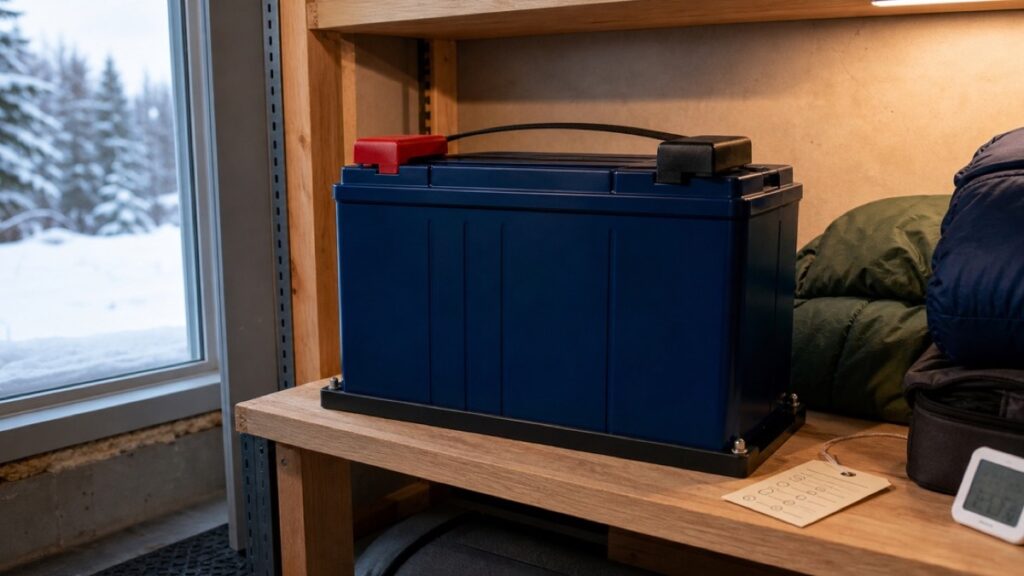
How to store LiFePO4 batteries for winter begins with the exact battery manual: set its specified storage state of charge, disconnect every unapproved charger and load, keep the battery within its documented storage environment, and record a baseline plus check dates. Do not use a universal “50%” or “fully charged” rule. Current manufacturer instructions conflict, and cold storage is not the same as charging a cold battery.
The manual conflict is real: one current Renogy manual for named 12V models specifies 30-50% state of charge and a recharge interval; the current Battle Born BB10012 family manual recommends bringing those models to 100% and disconnecting them completely. The safe public rule is to follow the exact model and revision you own.
Let the Exact Manual Set the Storage Target
Start with the label on the battery, not the brand name on a receipt. Record model/SKU, serial number, manufacture or purchase date, firmware/app version if relevant, and the URL or filename of the current manual. A product family can include standard, low-temperature cutoff, heated, Bluetooth, marine, and starting variants with different instructions.
The storage section should answer at least four questions: target state of charge, permitted storage temperature, maximum unattended interval, and reconnection/recharge procedure. If one is absent, ask the manufacturer in writing and keep the response with the battery record.
| Current documented example | Storage instruction shown | What it proves | What it does not prove |
|---|---|---|---|
| Renogy RNG-BATT-LFP-12-50/100/170 manual | 30-50% SoC, clean/dry/ventilated storage near the stated temperature, recharge at least every three months | Those covered models have an explicit partial-charge plan | That every Renogy or every LiFePO4 battery shares it |
| Battle Born BB10012/BB10012H manual | Bring the battery to 100%, disconnect completely, and observe the exact storage-temperature note | Those exact models use a different published plan | That full charge is a chemistry-wide storage target |
| Victron Lithium SuperPack NG operation manual | App “off” leaves Bluetooth active and is not suitable for long-term storage | A software-off state can retain a parasitic load | That every smart battery behaves the same way |
Storage temperature is also product-specific. A battery may tolerate a wider unpowered storage range than its charging range. That does not authorize charging immediately after a cold soak. The cell/BMS temperature, not just garage air at the moment you open the door, controls the restart decision.
Do not use terminal voltage alone to force the battery to a guessed state of charge. LiFePO4 voltage changes relatively little across much of its operating plateau, and an active charge, load, surface condition, BMS state, or temperature can distort the reading. Use the state-of-charge method and rest conditions supported by the exact documentation.
“Off” Must Mean the Loads Are Accounted For
An RV master switch may leave a propane detector, breakaway system, inverter standby circuit, solar controller, shunt, heater control, radio memory, Bluetooth module, or other device connected. Some connections may be safety-critical and require a separate winterization plan; do not remove them blindly. Map them.
Physically trace the positive and negative paths from the bank to every busbar and device. Note which conductors bypass the main disconnect. Confirm with an appropriate meter and the system documentation that the intended storage state actually removes or accounts for the residual current.
Amp-hours consumed = residual amps × 24 hours/day × storage days
A measured 0.025A (25mA) residual draw over 120 days equals 0.025 × 24 × 120 = 72Ah. Even a small unnoticed load can consume a large share of a 100Ah label across a winter. This example does not estimate internal self-discharge or authorize a minimum voltage.
The remedy is not always “remove both cables.” A permanently installed RV may need documented isolation, protected branch disconnects, alarm handling, solar shutdown order, or a manufacturer-approved storage mode. High-current banks can remain hazardous when disconnected, and terminals must be covered against tools, jewelry, or loose metal.
If the battery has an app-off or physical-off control, verify what it actually disables. Victron’s current SuperPack NG instructions explicitly note that switching that exact battery off in the app leaves Bluetooth active, making that state unsuitable for long-term storage. Treat this as a warning to check your product, not proof of another brand’s behavior.
Separate external drain from internal behavior
The manufacturer’s storage interval normally accounts for its own product design under stated conditions. Your RV adds external devices and environmental variation. Record both: the expected product self-discharge from exact documentation and the measured system-level residual current after your shutdown procedure.
If the bank is removed, use safe handling, lifting, terminal covers, and a stable location that meets the manual’s ventilation, moisture, orientation, impact, and temperature rules. Do not improvise a heater, blanket, or sealed box around a battery without an approved design.
The Last Operating Day Creates the Baseline
Do not park the RV and plan to remember the details in spring. Make the record while monitoring and chargers still work.
- Confirm exact model and current manual revision; copy the storage SoC, temperature, check interval, and restart instructions.
- Inspect for swelling, impact damage, liquid, odor, terminal heat marks, damaged insulation, loose hardware, or unresolved BMS alarms. Do not store a suspect battery as normal.
- Bring the bank to the manual’s storage state using approved equipment; let it reach any required rest condition before recording values.
- Save state of charge, rested terminal voltage, cell spread/app screenshots if available, battery temperature, and ambient location.
- Shut down solar, shore, alternator, inverter, and loads in the order required by their exact manuals; implement the approved isolation plan.
- Measure or otherwise verify residual draw. Identify every exception that must remain active and calculate its winter energy budget.
- Cover terminals, secure the bank, control moisture/condensation, and attach the next inspection date where it will be seen.
For a multi-battery bank, record each unit rather than only total bank voltage. A weak or mismatched unit can be hidden by the aggregate. Do not split, rebalance, charge, or reconnect a bank using a generic procedure; exact series/parallel and commissioning instructions control.
Photograph the final disconnect positions and label cables before removal. A spring photo is more reliable than memory, but it is not a substitute for a one-line diagram. Store terminal hardware so it cannot short a battery or disappear into the RV.
Winter Has Checkpoints, Not Guesswork
Use the exact manual’s maximum interval as the outer boundary. Shorten it when residual loads, temperature swings, an older bank, uncertain state-of-charge reporting, or prior imbalance justify closer observation.
- Storage day: save the baseline, implement complete approved isolation, cover terminals, and date the storage tag.
- First checkpoint: verify location conditions, case condition, terminal protection, and model-approved voltage/SoC evidence without casually reconnecting loads.
- Manual deadline: perform the exact inspection or recharge action before the manufacturer’s maximum unattended interval expires.
- After an extreme event: inspect after flooding, condensation, impact, unusually low/high temperature, building work, pest damage, or an unexpected alarm.
- Pre-season day: allow the battery to reach the required temperature, inspect and measure, then follow the exact recommissioning sequence.
An unheated garage is acceptable only when the exact storage range, enclosure conditions, moisture control, and local extremes are acceptable. Air-temperature averages are not enough. Check the coldest plausible battery location and whether sun, heaters, or building equipment can create high-temperature extremes.
Do not charge merely because the battery has been stored at a permitted cold temperature. The published charging range may be narrower. An internal heater also has exact activation, energy-source, and restart requirements; “heated” does not mean the battery can be ignored all winter.
Spring Restart Is a New Commissioning Event
Treat a months-long shutdown as recommissioning, especially if the bank was removed, reconfigured, or exposed to unusual conditions.
The battery is colder than its charging limit
Keep charging disabled. Move or warm the battery only by a method the manufacturer approves, and allow internal temperature—not merely room air—to meet the requirement. Confirm BMS and charger permissions before current flows.
Terminal voltage or app SoC changed more than expected
Do not compensate by forcing a generic wake-up charge. Verify the meter, rest condition, residual-load history, individual units, BMS state, and the exact recovery instructions. Save evidence for manufacturer support.
The case, terminal, cable, or fuse shows damage
Keep the bank isolated. Heat marks, swelling, cracks, moisture intrusion, looseness, corrosion, odor, or damaged insulation require evaluation before energizing. Do not open a sealed battery case.
The system was changed during storage
Update the one-line diagram and redo compatibility, protection, torque, polarity, settings, and commissioning checks. A replaced controller or inverter can change charge voltage, idle draw, low-voltage behavior, and current demand.
When all checks pass, use the manual’s connection order, torque, precharge, charge profile, and state-of-charge synchronization procedure. Re-enable one source or load stage at a time while watching voltage, current, temperature, alarms, and connection heating. Stop on unexpected behavior.
Attach a durable tag to the stored bank or its service record with model, manual revision, storage SoC method, baseline values, residual current, storage date, permitted temperature, check deadline, and restart rule. That dated record—not a universal winter percentage—is the control that gets the battery safely from autumn shutdown to spring service.
Leave a Reply