LiTime 12V 100Ah Group 24 Bluetooth Review: The Smart Baseline
At a Glance
KEY FEATURES
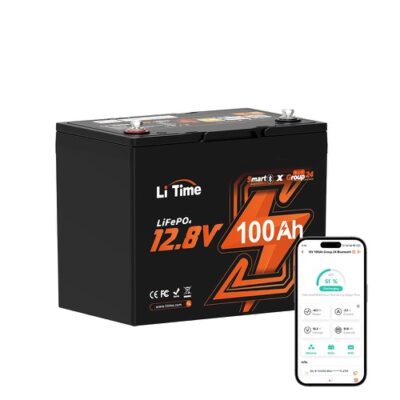
- 12.8V, 100Ah, 1,280Wh in a Group 24 case.
- 100A continuous; 500A for one second.
- Bluetooth with LiTime app.
- 0°C cutoff and 5°C recovery; no heater.
- Best for monitored RV, marine, and compact solar storage.
PROS
- Complete 24-row documentation
- Built-in app visibility
- Strong one-second pulse specification
- Broad positive use-case evidence
CONS
- One-second pulse may not fit multi-second motors
- No self-heating
- App and wake-up complaints appear
- One cracked-case/water report raises installation caution
Smart Group 24 Pick
Based on exact documentation and exact-ASIN owner evidence
How Many LiTime 12V 100Ah Group 24 Bluetooth Batteries Do You Need?
Estimate how many LiTime 12V 100Ah Group 24 Bluetooth batteries your daily energy target may require.
Solar Battery Bank Size Calculator
How much solar battery storage do I need?
LiTime’s smart Group 24 is the reference battery in this Bluetooth group because its identity and operating boundaries are unusually complete. That does not make it universally best. The decisive limitation is time: the BMS supports 100A continuously and 500A for one second, so a brief electronic inrush and a slow mechanical startup are different buying problems.
One Second Separates “Big Number” From Useful Surge
The 500A specification is attractive until its duration is removed. It can support an event that settles in less than a second; it cannot approve a tongue jack, compressor, or pump that stays above 100A for several seconds. One captured owner specifically reported trouble with an RV tongue jack, a valuable counterweight to headline-current marketing.
Bluetooth Is Most Valuable After a Baseline
The app can reveal current direction, cell spread, temperature, SOC, and protection states. Owners report long-term refrigerator, RV, trolling, and backup use with the app, while others mention pairing glitches, wake-up trouble, or support dissatisfaction. Save a known-good baseline after the first complete charge rather than interpreting every later percentage without context.
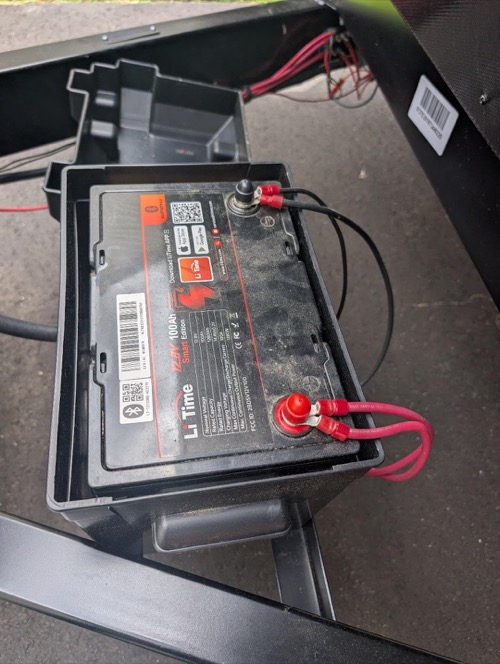
Monitoring rule: use the internal app to diagnose one battery; use an external shunt when the question is net energy entering and leaving a complete bank.
The Group 24 Enclosure Is Predictable
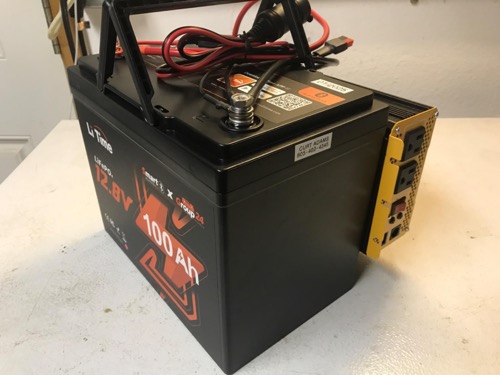
The case measures 10.24 × 6.61 × 8.27 inches and weighs 21.87 pounds. That makes tray comparison easier than with an unlabeled “compact” battery. Add M8 lug height, insulated covers, conductor bends, restraint, fuse and disconnect space before treating it as a drop-in replacement.
Cold Cutoff Has a 9°F Recovery Gap
Charging stops below 32°F (0°C) and resumes at 41°F (5°C). That hysteresis avoids rapid switching near freezing. The battery still has no heater, so a cold morning can leave solar available while the battery waits for ambient or externally supplied warmth.
Owner Evidence Supports the Use Case, Not the Cycle Claim
The merged 45-review sample contains successful RV refrigeration, trolling, solar, and backup reports. It also captures a non-charging unit, app trouble, a cracked-case/water anecdote, support disputes, and the surge-sensitive tongue-jack problem. These are plausible outcomes, not percentages for all purchasers.
| Evidence layer | What it supports | What remains unproved |
|---|---|---|
| Exact manual | 100A, 500A/1s, 4S4P, temperatures | Every delivered revision is identical |
| 45 captured reviews | Applications and possible fault modes | Population failure rate |
| Cycle specification | Manufacturer planning condition | Your achieved service life |
Charging and Bank Expansion
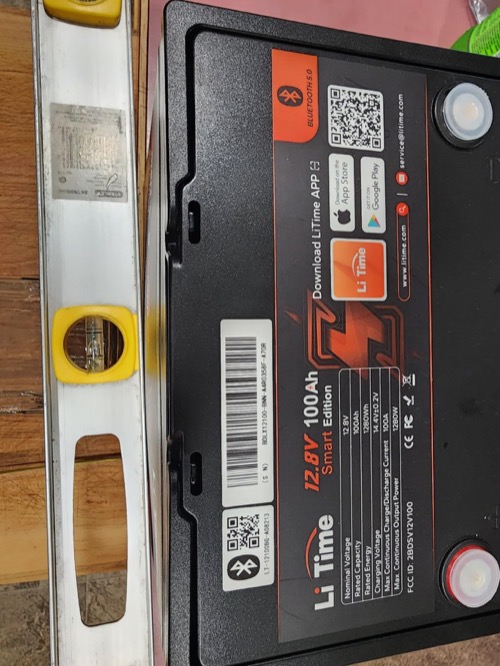
LiTime recommends 20A and permits 100A maximum continuous charge. Add every simultaneous source. The 4S4P boundary applies only to compatible matched units; it is not permission to mix ages, SOC, capacities, or internal revisions. Commission one unit before multiplying complexity.
- Disable incompatible lead-acid equalization behavior.
- Use the 14.4V ±0.2V CC/CV guidance across every charger.
- Balance parallel conductors and protect branches as required.
- Preserve an individual-battery diagnostic path in larger banks.
LiTime Group 24 Bluetooth: Final Recommendation
Choose it when direct monitoring, clear documentation, Group 24 fit, and a 100A-class load profile align. The strongest reason to pass is equally clear: your installation needs heat or a startup event that remains elevated longer than one second.
Pros & Cons Analysis
Based on documented specifications and owner feedback
Pros
- Complete 24-row documentation
- Built-in app visibility
- Strong one-second pulse specification
- Broad positive use-case evidence
Cons
- One-second pulse may not fit multi-second motors
- No self-heating
- App and wake-up complaints appear
- One cracked-case/water report raises installation caution
Bottom Line: A Strong Default Within a 100A Envelope
LiTime's smart Group 24 is the Bluetooth shortlist's best-documented default. The case, app, current, temperature, cycle, and bank limits are all attributable. Buy it when 100A continuous and a one-second pulse fit the real loads; skip it for self-heating or multi-second startup demands.
Frequently Asked Questions
Is this LiTime battery self-heating?
No. The exact Group 24 Smart Bluetooth model blocks charging below 32°F (0°C) and resumes at 41°F (5°C), but it does not heat itself.
What does 500A for one second mean?
It is a very short pulse allowance, not a continuous output rating. A load that remains above 100A for longer than one second needs a different battery or bank design.
Can it run an RV tongue jack?
It depends on the jack's measured startup current and duration. One captured owner reported incompatibility with a surge-heavy tongue jack, illustrating why the one-second BMS window must be checked.
How many can be connected?
LiTime documents up to 4S4P with compatible matched batteries. Follow state-of-charge, revision, wiring, and protection rules from the current exact manual.
What is the owner-evidence sample?
The merged exact-ASIN set contains 45 reviews, including 26 five-star and 15 one-star items from targeted positive and critical passes. It exposes use cases and fault modes but is not a random rating distribution.
Technical Specifications
| Brand | LiTime |
|---|---|
| Exact model | L12V100-100-GROUP24-BT-4-A70 |
| Battery chemistry | LiFePO4 (LFP) |
| Nominal voltage | 12.8V |
| Rated capacity | 100Ah |
| Rated energy | 1,280Wh |
| Recommended depth of discharge | Up to 100% DoD; 80% DoD is paired with the 6,000-cycle figure |
| Recommended charge current | 20A |
| Maximum continuous charge current | 100A |
| Maximum continuous discharge current | 100A |
| Peak discharge current | 500A for 1 second |
| Recommended charge voltage | 14.4V ± 0.2V (CC/CV) |
| Low-temperature charge protection | Charging stops below 32°F (0°C) and resumes at 41°F (5°C) |
| Self-heating | No |
| Charge / discharge temperature | Charge: 32–122°F (0–50°C); discharge: -4–140°F (-20–60°C) |
| BMS protections | Overvoltage, undervoltage, charge/discharge overcurrent, short-circuit, overload, and high/low-temperature protection |
| Monitoring | Built-in Bluetooth with LiTime app |
| Series / parallel configuration | Up to 4 in series and 4 in parallel (4S4P) |
| Terminals | M8 bolts |
| Dimensions | 10.24 × 6.61 × 8.27 in (Group 24) |
| Weight | 21.87 lb |
| Ingress rating | IP65 |
| Cycle-life specification | 4,000 cycles at 100% DoD; 6,000 at 80%; 15,000 at 60% |
| Warranty | 5 years |