
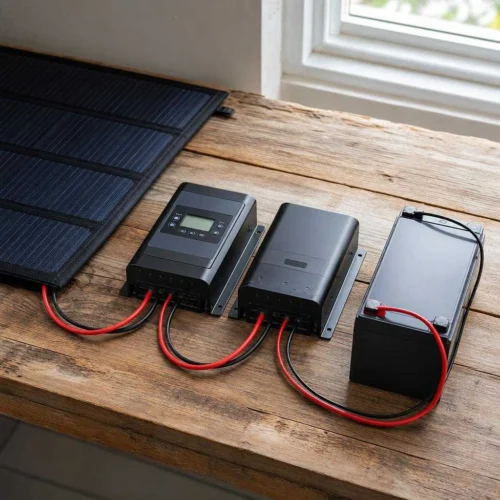
MPPT vs PWM Charge Controller: The Short Answer
For most setups worth spending money on, an MPPT charge controller beats a PWM one — it pulls 15-30% more usable energy out of the same solar panel, especially in cold, cloudy conditions or when the panel’s voltage sits well above the battery’s. A PWM charge controller is cheaper and perfectly fine in one specific case: a small 12V-nominal panel matched to a 12V battery. Everywhere else — bigger panels, higher-voltage panels, series strings, LiFePO4 batteries — MPPT earns its higher price.
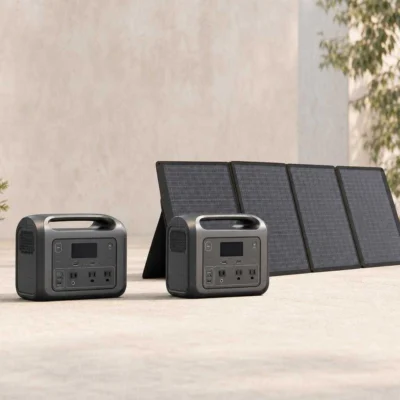
One important note before you buy anything: if you’re charging a portable power station, the MPPT controller is already built into the station. You don’t add a separate controller at all. This whole guide really applies to charging a raw 12V or 24V battery, not a power station.
Key Takeaways
- MPPT harvests more — expect roughly 15-30% more energy from the same panel, with the biggest gains in cold weather, low light, and when panel voltage far exceeds battery voltage.
- PWM is fine only when voltages match — a 12V-nominal panel (Vmp around 17-18V) on a 12V battery, usually under about 20W.
- Size an MPPT by output amps — panel watts ÷ battery volts, then add about 25% headroom.
- Power stations don’t need one — they have a built-in MPPT, so you just plug the panel in.
What a Charge Controller Actually Does
A solar panel is a variable, uncontrolled power source. Point it at strong sun and its voltage climbs; shade it or cool it down and the numbers move again. A raw battery can’t take that safely — connect a panel straight to it and you risk overcharging and damaging the cells.
The charge controller sits between the panel and the battery. Its job is to regulate voltage and current so the battery charges safely and stops at the right point. Both PWM and MPPT controllers do that core job. Where they differ is how much of the panel’s power they manage to keep on the way through.
How a PWM Charge Controller Works
PWM stands for Pulse Width Modulation. Here’s the simple version: a PWM controller acts almost like a fast on-off switch that connects the panel directly to the battery. When it’s connected, the panel is effectively pulled down to whatever voltage the battery is sitting at.
That last part is the catch. A typical “12V” solar panel doesn’t actually output 12V — its maximum-power voltage (Vmp) is usually around 17-18V. A PWM controller drags that panel down to, say, 13V to match a charging battery. The current stays about the same, but all that extra voltage above the battery is simply lost. Watts equal volts times amps, so losing voltage means losing power.
PWM works best when the gap is small — a panel built to sit close to battery voltage, in warm weather where panel voltage is already lower. It’s cheap, simple, and reliable, which is why it still ships in budget 12V kits.
How an MPPT Charge Controller Works
MPPT stands for Maximum Power Point Tracking. Instead of dragging the panel down to battery voltage, an MPPT controller is a smart DC-to-DC converter. It lets the panel run at its ideal voltage — its maximum power point — and then converts the surplus voltage into extra charging current.
Think of it as a trade: the panel puts out 18V at 5A, and the MPPT converts that into roughly 13V at about 6.5A for the battery. Same power in, but almost none of it wasted. On top of that, the controller constantly “tracks” the panel’s best operating point as sun, temperature, and shade change through the day.
That’s where the 15-30% harvest advantage comes from. MPPT controllers convert at around 93-97% efficiency, versus an effective 70-80% for PWM once you count the voltage that PWM throws away.
The Real Efficiency Gap: MPPT vs PWM Charge Controller Harvest
The 15-30% figure isn’t fixed — it depends on how big the gap is between panel voltage and battery voltage. Three things widen that gap, and every one of them favors MPPT.
- Cold weather — solar panels produce higher voltage when they’re cold. A PWM controller just wastes that extra voltage; an MPPT converts it into more amps. Winter is where MPPT pulls furthest ahead.
- Cloudy and low light — in weak light, panel voltage holds up better than current. MPPT keeps working the panel at its best point, so it claws back energy PWM would lose.
- Panel Vmp much higher than battery — a 20V+ panel on a 12V battery wastes a huge chunk of voltage through PWM. That’s exactly the situation MPPT is built for.
In warm, sunny weather with a perfectly voltage-matched 12V panel, the gap shrinks and PWM does nearly as well. So the honest answer is: the worse your conditions, the more MPPT is worth it.
Side-by-Side: MPPT vs PWM Charge Controller
| Factor | MPPT Controller | PWM Controller |
|---|---|---|
| Efficiency | 93-97% conversion; 15-30% more harvest | Effectively 70-80%; wastes excess panel voltage |
| Cost | Higher — roughly $20-80+ for small units | Lower — roughly $5-25 |
| Best for | Bigger panels, series strings, LiFePO4, cold or cloudy climates | Small trickle panels matched to a 12V battery |
| Panel-to-battery voltage | Handles high panel voltage well (e.g. 20V+ panel on 12V battery) | Needs panel voltage close to battery voltage |
| Wiring | Series or parallel; higher-voltage strings OK | Parallel, low-voltage only; series strings waste power |
When PWM Is Perfectly Fine
Don’t overspend where you don’t need to. A PWM controller does the job when all of these are true:
- You’re using a single small panel, usually under about 20W.
- The panel is “12V-nominal” — its Vmp sits around 17-18V.
- You’re charging a standard 12V lead-acid, AGM, or gel battery.
- You live somewhere warm and sunny more often than not.
A classic example is a bundled kit like the ECO-WORTHY 260W flexible solar panel kit, which ships with a 30A PWM controller. Owners charging simple 12V battery banks report it works fine — but several also note the PWM controller is the limiting part and say they plan to swap in an MPPT to get the full benefit of the panels. That’s the pattern to expect: PWM gets you running, MPPT gets you the most out of what you paid for. If flexible panels are your thing, our best flexible solar panels roundup covers more options.
When You Really Need MPPT
MPPT stops being optional and starts being the right call once any of these apply:
- Higher-voltage panels — 20V, 24V, or larger residential-style panels whose Vmp sits far above battery voltage.
- Series strings — wiring panels in series stacks their voltage, which only MPPT converts efficiently.
- LiFePO4 batteries — lithium wants precise voltage limits and a proper charge profile, which MPPT controllers offer and many cheap PWM units don’t.
- Cold or cloudy climates — the conditions where MPPT’s harvest advantage is largest.
- Bigger systems — once you’re past ~100W, the extra energy MPPT recovers adds up fast.
A good example is the Renogy 400W 4x100W kit, which pairs four 100W panels with a 40A MPPT controller. Owners wire the panels in series, and several specifically say the MPPT controller is “worth the extra money” and note it outperforms the cheap PWM controllers they started with. At 400W across a series string, PWM would leave a lot of energy on the table. For more panels in that class, see our best 400W solar panels guide.
How to Size a Charge Controller
Sizing is about amps, not watts. The controller has to handle the current flowing to the battery, so use this simple formula:
- Controller amps = panel watts ÷ battery voltage
- Then add about 25% headroom for cold-weather voltage spikes and round up to the next standard size.
The battery voltage matters a lot here. The same panel needs a smaller controller on a 24V battery than on a 12V one, because higher battery voltage means lower current for the same power. For an MPPT controller, this current is the output side — the amps going into the battery.
Worked Example: What MPPT Do I Need for a 200W Solar Panel?
Say you’ve got a single 200W panel and you want to charge a 12V battery bank.
- Output amps = 200W ÷ 12V = 16.7A
- Add 25% headroom: 16.7 × 1.25 ≈ 21A
- Round up to the next standard size: a 20A MPPT controller (or 30A if you plan to add more panels later)
On a 24V battery, the same 200W panel only pushes 200 ÷ 24 = 8.3A, so a 10A MPPT is plenty. Bump up to 24V and you can use a smaller, cheaper controller for the same panel — one reason larger systems often run at 24V or 48V.
Can You Mix PWM and MPPT Controllers?
Yes, with one firm rule: each controller needs its own dedicated panel or panel group. Never wire a single panel array into two controllers at the same time. If you have two separate panels or arrays, you can run one on a PWM controller and one on an MPPT controller, and both can feed the same battery bank in parallel — as long as they’re set to the same charge voltages and battery type.
In practice, most people who start with a bundled PWM controller don’t run both. They swap the PWM out for an MPPT once they want the extra harvest, rather than juggle two controllers with different efficiencies.
A Reminder About Portable Power Stations
If your plan is to charge a portable power station (a Jackery, EcoFlow, Anker, Bluetti, and so on) rather than a bare battery, you don’t need to buy any controller. These stations have an MPPT charge controller built into the solar input. You just connect a compatible panel and the station handles the rest — voltage regulation, tracking, battery protection, all of it.
So the MPPT vs PWM question only really matters when you’re charging a standalone 12V or 24V battery. For power stations, focus on matching the panel’s connector and voltage window to the station instead.
Which Should You Buy?
Here’s the honest bottom line on the MPPT vs PWM charge controller decision. If you’re maintaining a single small 12V battery with a matched trickle panel in a sunny spot, a PWM controller is cheap and does the job — don’t overthink it. For nearly everything else, buy MPPT.
The moment you move to bigger panels, higher-voltage or series-wired panels, LiFePO4 batteries, or cold and cloudy weather, the 15-30% extra energy MPPT recovers is worth far more than the price difference. And if you’re charging a portable power station, skip the decision entirely — the MPPT is already inside. Not sure how much panel and controller you actually need? Try our solar panel output calculator to size your setup in a couple of clicks.
Leave a Reply