
Solar Power Picks logo with sun, solar panel, and green energy icon

  • Home
  • Reviews
  • Best
    • Best portable power stations
    • Best Solar Panels
    • Best Solar Generators
    • Best Solar Charge Controllers
    • Best Solar Batteries
  • Guides
    • Portable Power Stations Guides
    • Solar Panels Guides
    • Solar Generators Guides
    • Solar Charge Controllers Guides
    • Solar Batteries Guides
  • Comparisons
    • Portable Power Stations Comparisons
    • Solar Panels Comparisons
    • Solar Generators Comparisons
    • Solar Charge Controllers Comparisons
    • Solar Batteries Comparisons
  • Calculator

WattCycle Mini vs LiTime Group 24 Bluetooth: Space or Surge?

COMPARED PRODUCTS

WattCycle 12V 100Ah Mini Bluetooth Review: Small Case, Real Tradeoffs

Best for Narrow Compartments

WattCycle 12V 100Ah Mini Bluetooth Review: Small Case, Real Tradeoffs

Check price at Amazon Jump to details
LiTime 12V 100Ah Group 24 Bluetooth Review: The Smart Baseline

Best All-Round Choice

LiTime 12V 100Ah Group 24 Bluetooth Review: The Smart Baseline

Check price at Amazon Jump to details

WattCycle Mini vs LiTime Group 24 is not a quality ladder. It is a geometry-and-time decision. Both store 1,280Wh, both publish 100A continuous charge/discharge, both have Bluetooth and IP65, and neither heats itself. WattCycle is narrower; LiTime publishes the larger brief pulse and the clearer cold recovery point.

Choose WattCycle

The battery tray is the hard constraint or the load needs up to 110A for several seconds.

Choose LiTime

A Group 24 case fits and a sharp high-current event settles within one second.

Begin With a Cardboard Footprint

WattCycle’s base is roughly 9.0 × 5.6 inches; LiTime’s is 10.24 × 6.61. That difference is large enough to change a boat seat, radio cabinet, or RV tray. Height and weight are close enough that the base usually decides first.

  1. Cut each base footprint from cardboard.
  2. Add the published case height plus complete lug/cover stack.
  3. Model cable bends, fuse, disconnect, restraint, and service access.
  4. Reject any layout that side-loads a terminal or hides protection.

Now Draw the Startup Curve

LiTime’s 500A figure ends after one second. WattCycle allows 150A for one second and 110A for ten seconds. A 130A event lasting half a second fits both published windows; a 105A event lasting six seconds fits WattCycle’s timing but not LiTime’s stated one-second pulse; a 300A half-second event points to LiTime.

≤100A sustainedBoth remain candidates.
100–110A for ≤10sWattCycle has the clearer duration.
150–500A for ≤1sOnly LiTime publishes that magnitude.
Outside bothRedesign the battery/load path.

Cold Protection Breaks the Tie on Documentation

Both stop charging below 32°F (0°C). LiTime publishes recovery at 41°F (5°C); WattCycle’s exact recovery threshold was not found. Neither heater can warm itself. For a controlled indoor compartment the gap may be minor; for an autonomous winter array, LiTime’s explicit recovery state is valuable.

App Ownership Favors Neither Unconditionally

Both exact samples contain successful hidden-battery monitoring and connection complaints. WattCycle’s 42-review merged sample also exposes several BMS lockout/wake-up experiences. LiTime’s 45-review set includes app/wake issues plus a surge-sensitive tongue-jack case. The samples were targeted and cannot establish comparative defect rates.

Physical/electrical comparisonHigh confidence

Dimensions and current windows are attributable.

Ownership comparisonModerate confidence

Useful fault patterns, not random populations.

Final Decision

LiTime is the safer default because its documentation closes more loops and its pulse handles a broader sharp-inrush class. WattCycle is the better design when its smaller base is the difference between a clean installation and an impossible one, or when a small overload needs several seconds rather than a much larger one-second pulse.
Best for Narrow Compartments

WattCycle 12V 100Ah Mini Bluetooth Review: Small Case, Real Tradeoffs

WattCycle 12V 100Ah Mini Bluetooth Review: Small Case, Real Tradeoffs

Get it now:

Check latest price

What to know

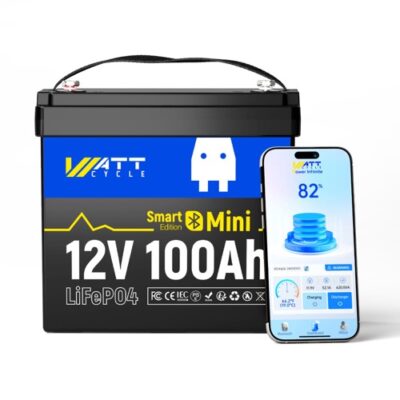
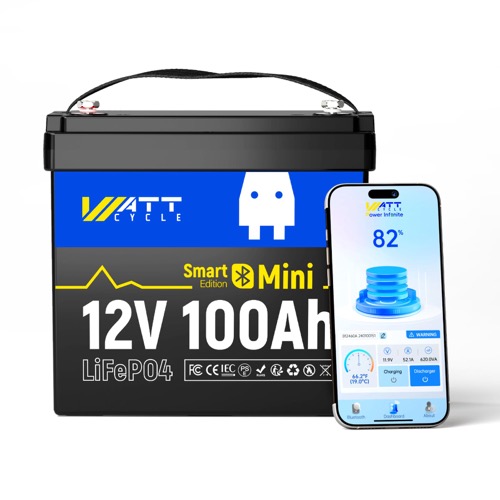
  • 9.0 × 5.6-inch base
  • 20.8 lb
  • 110A/10s; 150A/1s
  • Bluetooth; IP65

Best if

  • Group 24 cannot fit
  • A modest overload lasts several seconds
  • You will test BMS recovery

Skip if

  • A very sharp high-current pulse matters
  • Exact cold recovery is required
  • Owner-friction coverage worries you

WattCycle saves more than an inch of case width and gives a 10-second 110A allowance. It is the physical-fit winner, with more captured BMS wake-up/app friction to commission.

BrandWattCycle
Exact model12V 100Ah Mini Bluetooth (Group 22NF)
Battery chemistryLiFePO4 (LFP)
Nominal voltage12.8V
Rated capacity100Ah
Rated energy1,280Wh
Recommended depth of dischargeUp to 100% DoD; 80% DoD is paired with the 6,000-cycle figure
Recommended charge current20A
Maximum continuous charge current100A
Maximum continuous discharge current100A
Peak discharge current110A for 10 seconds; 150A for 1 second
Recommended charge voltage14.6V ± 0.2V (CC/CV)
Low-temperature charge protectionCharging stops below 32°F (0°C); exact recovery threshold is not published
Self-heatingNo
Charge / discharge temperatureCharge: 32–149°F (0–65°C); discharge: -4–149°F (-20–65°C)
BMS protectionsOvervoltage, undervoltage, charge/discharge overcurrent, short-circuit, and temperature protection
MonitoringBuilt-in Bluetooth with WattCycle app
Series / parallel configurationUp to 4 in series and 4 in parallel (4S4P)
TerminalsM8 bolts
Dimensions9.0 × 5.6 × 8.2 in (Group 22NF)
Weight20.8 lb
Ingress ratingIP65
Cycle-life specification5,000 cycles at 100% DoD; 6,000 at 80%; 15,000 at 60%
Warranty5 years; registration may extend coverage to 7 years
Best All-Round Choice

LiTime 12V 100Ah Group 24 Bluetooth Review: The Smart Baseline

LiTime 12V 100Ah Group 24 Bluetooth Review: The Smart Baseline

Get it now:

Check latest price

What to know

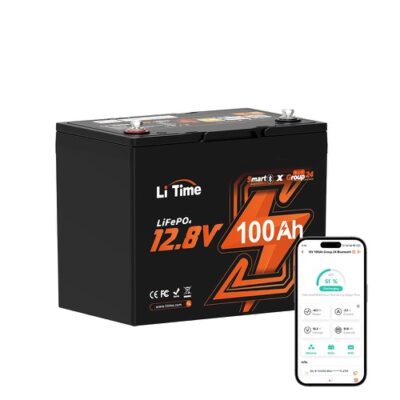
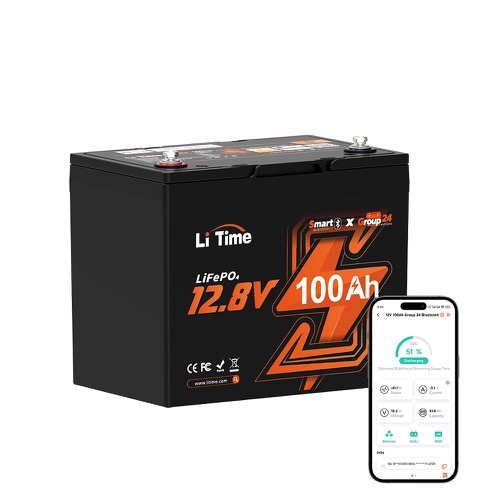
  • Group 24 base
  • 21.87 lb
  • 500A for one second
  • Bluetooth; IP65

Best if

  • A Group 24 case fits
  • The startup settles inside one second
  • Documentation leads

Skip if

  • Every inch of width matters
  • The event stays above 100A for several seconds
  • Self-heating is required

LiTime is slightly heavier and wider but publishes a much larger one-second pulse, a clear cold recovery point, and more complete exact documentation.

BrandLiTime
Exact modelL12V100-100-GROUP24-BT-4-A70
Battery chemistryLiFePO4 (LFP)
Nominal voltage12.8V
Rated capacity100Ah
Rated energy1,280Wh
Recommended depth of dischargeUp to 100% DoD; 80% DoD is paired with the 6,000-cycle figure
Recommended charge current20A
Maximum continuous charge current100A
Maximum continuous discharge current100A
Peak discharge current500A for 1 second
Recommended charge voltage14.4V ± 0.2V (CC/CV)
Low-temperature charge protectionCharging stops below 32°F (0°C) and resumes at 41°F (5°C)
Self-heatingNo
Charge / discharge temperatureCharge: 32–122°F (0–50°C); discharge: -4–140°F (-20–60°C)
BMS protectionsOvervoltage, undervoltage, charge/discharge overcurrent, short-circuit, overload, and high/low-temperature protection
MonitoringBuilt-in Bluetooth with LiTime app
Series / parallel configurationUp to 4 in series and 4 in parallel (4S4P)
TerminalsM8 bolts
Dimensions10.24 × 6.61 × 8.27 in (Group 24)
Weight21.87 lb
Ingress ratingIP65
Cycle-life specification4,000 cycles at 100% DoD; 6,000 at 80%; 15,000 at 60%
Warranty5 years

Product Comparison

Feature WattCycle 12V 100Ah Mini Bluetooth Review: Small Case, Real Tradeoffs LiTime 12V 100Ah Group 24 Bluetooth Review: The Smart Baseline
Product Image
WattCycle 12V 100Ah Mini Bluetooth Review: Small Case, Real Tradeoffs
LiTime 12V 100Ah Group 24 Bluetooth Review: The Smart Baseline
Price $209.99 $365.99
Rating
4.0 / 5
4.6 / 5
Category Solar Batteries Solar Batteries
Brand WattCycle LiTime
Exact model 12V 100Ah Mini Bluetooth (Group 22NF) L12V100-100-GROUP24-BT-4-A70
Battery chemistry LiFePO4 (LFP) LiFePO4 (LFP)
Nominal voltage 12.8V 12.8V
Rated capacity 100Ah 100Ah
Rated energy 1,280Wh 1,280Wh
Recommended depth of discharge Up to 100% DoD; 80% DoD is paired with the 6,000-cycle figure Up to 100% DoD; 80% DoD is paired with the 6,000-cycle figure
Recommended charge current 20A 20A
Maximum continuous charge current 100A 100A
Maximum continuous discharge current 100A 100A
Peak discharge current 110A for 10 seconds; 150A for 1 second 500A for 1 second
Recommended charge voltage 14.6V ± 0.2V (CC/CV) 14.4V ± 0.2V (CC/CV)
Low-temperature charge protection Charging stops below 32°F (0°C); exact recovery threshold is not published Charging stops below 32°F (0°C) and resumes at 41°F (5°C)
Self-heating No No
Charge / discharge temperature Charge: 32–149°F (0–65°C); discharge: -4–149°F (-20–65°C) Charge: 32–122°F (0–50°C); discharge: -4–140°F (-20–60°C)
BMS protections Overvoltage, undervoltage, charge/discharge overcurrent, short-circuit, and temperature protection Overvoltage, undervoltage, charge/discharge overcurrent, short-circuit, overload, and high/low-temperature protection
Monitoring Built-in Bluetooth with WattCycle app Built-in Bluetooth with LiTime app
Series / parallel configuration Up to 4 in series and 4 in parallel (4S4P) Up to 4 in series and 4 in parallel (4S4P)
Terminals M8 bolts M8 bolts
Dimensions 9.0 × 5.6 × 8.2 in (Group 22NF) 10.24 × 6.61 × 8.27 in (Group 24)
Weight 20.8 lb 21.87 lb
Ingress rating IP65 IP65
Cycle-life specification 5,000 cycles at 100% DoD; 6,000 at 80%; 15,000 at 60% 4,000 cycles at 100% DoD; 6,000 at 80%; 15,000 at 60%
Warranty 5 years; registration may extend coverage to 7 years 5 years
Buy Now View Deal View Deal

LiTime Wins the Default; WattCycle Wins the Compartment

Choose LiTime when a standard Group 24 case fits and its 500A one-second pulse matches the load. Choose WattCycle when the 5.6-inch width solves a real installation constraint or a modest 110A event needs ten seconds. Both require app and BMS commissioning.

Frequently Asked Questions

Which battery is smaller?

WattCycle is the narrow-case winner at about 9.0 × 5.6 × 8.2 inches. LiTime is a standard Group 24 at 10.24 × 6.61 × 8.27 inches.

Which has the better surge rating?

It depends on the load curve. LiTime publishes 500A for one second. WattCycle publishes 110A for ten seconds and 150A for one second. Magnitude and time cannot be ranked separately.

Do both have Bluetooth?

Yes. Both use built-in Bluetooth, though the exact captured owner samples include app or connection complaints. Test range from the finished compartment.

Do either batteries self-heat?

No. Both block cold charging but do not include heaters. LiTime publishes a 5°C recovery point; WattCycle's exact recovery point was not found.

Which is better for a 1,000W inverter?

Both publish 100A continuous current. Either can be considered only after actual low-voltage current, inverter efficiency, startup, cables, fuse, disconnect, and terminals are checked.

×

About Solar Power Picks

Portable Solar Power, Backup Power, and Off-Grid Gear Guides

Your trusted source for honest, in-depth product reviews and comparisons.

Quick Links

  • Best Picks
  • Reviews
  • Guides
  • Comparisons
  • Calculator
  • Privacy policy
  • Favorites

Categories

  • Portable Power Stations
  • Solar Batteries
  • Solar Charge Controllers
  • Solar Generators
  • Solar Panels

© 2026 Solar Power Picks. All Rights Reserved.

We may earn a commission when you purchase through links on our site. Learn more