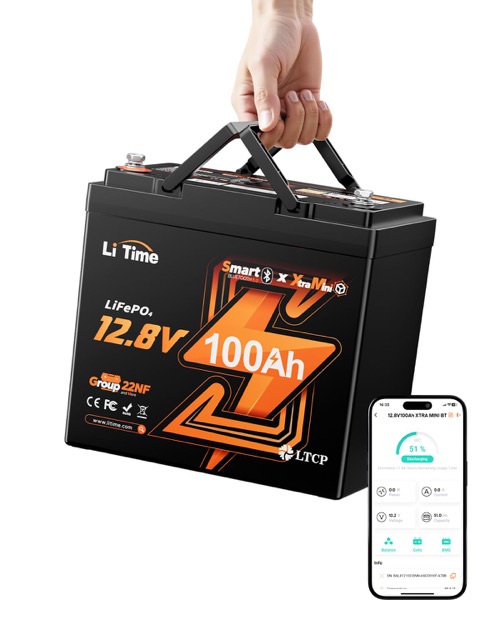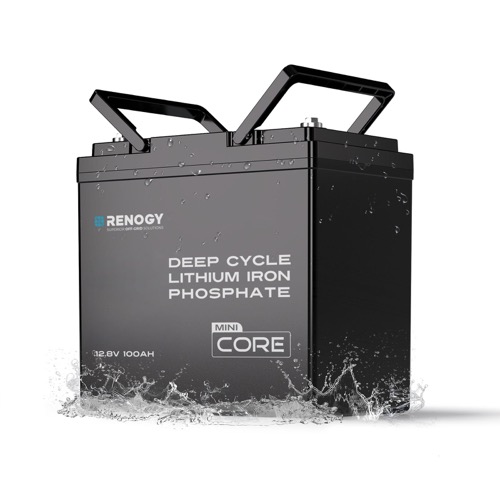
LiTime Xtra-Mini vs Renogy Core Mini is a closer decision than their marketing pages suggest. Both exact batteries provide 12.8V, 100Ah, calculated 1,280Wh, 100A continuous charge and discharge, IP65 cases with the same 9.02 × 5.43-inch base, automatic cold-charge cutoff, and a 4S4P planning limit.
The deciding differences sit around those shared numbers. LiTime is lighter, slightly shorter, and puts Bluetooth inside the battery. Renogy requires an external shunt for app monitoring but publishes a 300A surge lasting five seconds, compared with LiTime’s larger 500A pulse lasting one second. Renogy also recovers from cold-charge protection at a lower temperature and states a higher standard charge rate.
LiTime is the default winner for a compact single-battery system because direct visibility and lower weight improve everyday ownership without sacrificing continuous current. Renogy reverses the choice when a startup load needs several seconds, an external bank shunt is already part of the design, or its exact manual better fits the documentation standard of the project.
The Decision in Thirty Seconds
Choose LiTime when the battery will be hidden in an RV, boat, radio box, or off-grid compartment and you want status on a phone without wiring another monitor. Its 19.13-pound case is 2.67 pounds lighter, it stands 0.2 inch shorter, and its five-year warranty is described more simply in the reviewed sources. The captured exact reviews also repeatedly praise the app and compact form.
Choose Renogy when the inverter or DC load has a startup demand that remains elevated beyond one second. Its 300A five-second specification can be more useful than 500A for one second even though the headline current is smaller. The optional shunt route also has a system-level advantage: one properly installed shunt can observe the current of a complete bank rather than one battery’s internal electronics.
Neither battery is self-heating or intended for engine starting. Both need exact charger settings, proper terminals, conductors, overcurrent protection, restraint, and a bank configuration that follows the current manual. This comparison is based on primary specifications and sampled exact owner evidence, not Solar Power Picks capacity testing.
Choose LiTime when
You want the lighter, slightly shorter case and direct phone visibility for one compact battery.
- Bluetooth is built in
- 19.13-pound case
- 500A for a one-second pulse
Choose Renogy when
Your load has a longer startup event or one external shunt will monitor the complete bank.
- 300A for five seconds
- 50A standard charge rate
- Lower cold-charge recovery temperature
Direct battery data without another device.
The published surge window lasts five seconds.
Both publish a 100A continuous ceiling.
Cold cutoff is protection, not a heat source.
Same Footprint, Different Installation Priorities
The base dimensions are identical at 9.02 × 5.43 inches. LiTime is 8.19 inches tall and Renogy 8.39 inches, a small difference that can matter under a low compartment cover once lugs and insulated terminal protection are added. LiTime weighs 19.13 pounds versus Renogy’s 21.8 pounds.
Neither wins simply because it is compact. Measure the actual tray, hold-down, cable bend radius, fuse and disconnect clearance, access to the terminal hardware, and the environmental conditions. A two-pound saving helps seasonal removal; it does not compensate for a cable that side-loads a terminal or a lid that can contact an energized lug.
LiTime specifies M8 terminals torqued to 12–14 N·m. Renogy identifies M8 × 1.25 × 12mm hardware and 10–12 N·m. The ranges must not be averaged. Use the exact battery’s hardware, correct lug stack and thread engagement, and a torque tool set to that model’s instruction.
Both enclosures carry IP65. That supports dust and water-jet resistance under the rating conditions, not submersion. A boat installation still needs a dry suitable enclosure, secure restraint, protected conductors, and terminal corrosion management.
Installation checks shared by both
- Measure lid clearance with the complete M8 lug stack installed.
- Use each battery’s own torque range; do not average 12–14 N·m and 10–12 N·m.
- Leave room for the fuse, disconnect, hold-down, and cable bend radius.
- Treat IP65 as water-jet resistance, not permission for submersion.
One Second at 500A or Five at 300A?
Continuous operation is a tie: each exact BMS allows 100A maximum continuous discharge. At 12.8V nominal, that is roughly a 1,280W preliminary DC boundary before voltage sag and conversion loss. An inverter’s 1,000W AC nameplate may approach that boundary at low battery voltage, and startup can push well beyond it.
LiTime publishes 500A for one second. Renogy publishes 300A for five seconds. A very brief inrush that falls quickly can favor LiTime’s larger pulse, while a compressor or motor that remains above 100A for several seconds may fit Renogy’s longer window better. The load’s actual current-versus- time curve decides the winner, not peak amperage alone.
Charging introduces another difference. Both list 100A maximum continuous charge, but LiTime recommends 20A and Renogy defines 50A as standard. That makes Renogy the clearer choice for a buyer who wants the manufacturer’s stated everyday profile to accept more solar or alternator current. Maximum current is still the combined total from every active source, not a separate allowance for each charger.
Both specify 14.4V ±0.2V CC/CV. Confirm that solar, alternator, converter, and inverter/charger profiles align and that lead-acid equalization behavior is disabled where required. A correct voltage setting does not excuse excessive current or cold charging.
Consider a hypothetical compressor whose startup record shows 240A for three seconds before settling to 65A. On published current and duration alone, that event sits inside Renogy’s 300A/ five-second window but outside LiTime’s one-second 500A duration after the first second. A different load drawing 380A for half a second before settling could favor LiTime. These examples are not test results for either battery; they show why the appliance’s time curve must be compared with both axes of the battery specification.
The 20A-versus-50A recommended charge difference affects recovery time as well. From an idealized empty 100Ah nameplate, 20A corresponds to roughly five hours and 50A to roughly two hours before absorption behavior and losses. Real charging is not that linear, but the comparison explains why a high-input system may prefer Renogy’s stated standard rate even though both products share a 100A maximum ceiling.
Do not rank surge by amperage alone: LiTime’s 500A for one second and Renogy’s 300A for five seconds cannot be ordered without the actual load’s current-versus-time curve.
The Cold Morning: 5°C vs 3°C Recovery
Each battery stops charging at the freezing boundary. LiTime resumes at 41°F (5°C); Renogy resumes at 37.4°F (3°C). Renogy can therefore return to charging two Celsius degrees sooner as the cells warm, while both maintain a recovery gap that helps avoid switching repeatedly at 0°C.
That is a modest but real Renogy advantage in a cool compartment. It does not make either model self-heating. If the cells remain below their recovery threshold, the BMS can protect them while the solar array produces energy the bank cannot accept.
System design still determines whether the cutoff is enough. A heater needs a controlled power source and appropriate sensing; conditioned placement needs adequate thermal behavior; every charger needs to respect a battery BMS that may be disconnected. Discharge remains possible to -4°F (-20°C), so working loads are not proof that charging should proceed.
What happens to incoming solar while the battery is below cutoff?
The array may still produce power, but the BMS can refuse battery charging. The controller and any other charging source must tolerate that state without treating available sunlight as permission to force current into cold cells.
Does the lower Renogy recovery point replace a heater?
No. Renogy may reconnect two Celsius degrees sooner, but neither battery creates heat. The installation still determines whether the cells ever reach the recovery threshold.
Why can the loads work while charging remains blocked?
The documented discharge range extends below the charging boundary. A working light, radio, or refrigerator therefore confirms only that discharge is available—not that charging is safe.
Bluetooth Inside or a Shunt Around the Bank?
LiTime’s Bluetooth 5.0 is the simpler arrangement for one battery. Sampled owners specifically value seeing status in the app, and one reports using it without account creation. No extra current sensor, communication cable, or negative-bus rework is required to access the battery’s own data.
Renogy does not support direct Bluetooth modules on this Core Mini. Its named path is the optional 300A Battery Shunt, which adds hardware and installed cost. In exchange, a shunt placed so every load and charging source crosses it can track the entire bank rather than one case.
Both approaches need correct interpretation. Internal app state of charge is not an independent capacity test, and a shunt can become inaccurate if a load bypasses it, its capacity is configured wrong, or it never receives a reliable full-charge synchronization. The single-battery convenience winner is LiTime; the planned multi-battery system may reasonably prefer Renogy’s external method.
Monitoring can also affect fault diagnosis. LiTime’s internal view may expose the state and protection behavior of one case directly, which is helpful when a single hidden battery disconnects. A common shunt shows total bank current but may not reveal that one parallel battery stopped contributing. Larger banks often benefit from bank-level energy accounting plus a separate method for checking individual batteries rather than treating either approach as complete by itself.
Do not compare value using battery checkout prices alone. Renogy’s shunt, communication hardware, cabling, and installation time belong in its monitored-system cost. LiTime avoids those additions for basic direct status, while a buyer already installing a central shunt may receive little extra value from another internal phone view.
| Monitoring job | LiTime internal Bluetooth | Renogy external shunt |
|---|---|---|
| Single hidden battery | Simple direct visibility | More installation than the job may need |
| Whole-bank net current | Shows one battery’s internal view | Can measure every load and charger when wired correctly |
| Detect one disconnected battery | May expose that battery’s own protection state | Total bank current may not identify which unit dropped out |
| Installed cost | No separate monitor required for basic data | Hardware, cable, setup, and space must be added |
Bank Expansion and Documentation Friction
LiTime cleanly publishes up to four in series and four in parallel. Renogy’s current product page and maximum illustrated manual arrangement also support 4S4P, but one passage mentions up to eight parallel batteries. This comparison uses 4S4P because it is the shared conservative limit.
A Renogy design needing more than four in parallel should obtain exact-model confirmation in writing. Selecting 8P from one favorable sentence while ignoring the competing maximum would make the source conflict disappear on paper, not in the system.
For either brand, 4S4P is not a complete wiring plan. Use matched compatible batteries at the manufacturer-required state of charge, balanced conductor paths, branch protection, suitable busbars and disconnects, and charging sized for the bank. Available fault current and diagnostic difficulty grow as batteries are added.
Renogy’s manual is otherwise the more detailed BMS document, including exact test condition, temperature thresholds, and protection behavior. LiTime’s source set is sufficiently complete for the shared table and has the cleaner bank-limit statement. Which documentation advantage matters depends on whether the project prioritizes protection detail or absence of one consequential configuration conflict.
Owner Evidence Does Not Break the Tie Cleanly
LiTime’s retained set contains ten exact-variant verified reviews: nine five-star and one four-star, dated from January 2025 through March 2026. Owners repeatedly mention compactness and app usefulness across radio, refrigeration, trolling, boat-electronics, and heater use. The sample is too recent and positive-skewed to establish long-term reliability.
Renogy’s set contains eight exact-variant verified reviews: seven five-star and one one-star, dated from December 2024 through December 2025. A four-battery owner reports units arriving within 0.1V and says capacity matched, but without an independently documented test method. Another owner uses a Renogy ONE and shunt, supporting the external-monitoring path.
The negative Renogy owner reports a battery that would not hold charge during a camping trip and a refund taking nearly two months. That serious exact-model anecdote belongs in the decision but does not establish a failure or support rate from eight reviews. LiTime’s lack of an equivalent captured complaint is an evidence limitation, not proof the product has none.
Owner evidence therefore reinforces the use-case differences rather than declaring a reliability winner. LiTime has encouraging early feedback for its app and size; Renogy has a smaller, more mixed sample that exposes both multi-unit success and a difficult failure/remedy experience.
Ten recent exact-variant reviews support app and compactness themes, but the positive skew and short history limit reliability conclusions.
Eight exact reviews show both multi-unit success and one serious failure/refund account; neither outcome can be converted into a rate.
Warranty wording tilts the administrative comparison toward LiTime, though it cannot settle product reliability. Both carry five-year headlines, but Renogy describes prorated material-and-workmanship coverage in the reviewed evidence. The practical remedy still depends on each active policy, purchase record, exclusions, diagnosis, shipping, and timing, so neither should be presented as an automatic five-year replacement promise.
Commissioning records are especially useful with either compact battery. Save the exact ASIN/SKU, serial, arrival voltage, charger settings, terminal torque, app or shunt baseline, and current under a known load. Those records cannot prevent a defect, but they give the owner and support team a better way to distinguish installation, protection, monitoring, and suspected hardware problems.
Resolve the tie in this order
- Plot the startup: record amperage and duration for the largest load.
- Choose monitoring: decide between one battery’s internal data and a bank-level shunt.
- Measure fit: include terminal covers, cable bends, protection, and service space.
- Check winter recovery: decide how the battery reaches its reconnect temperature.
- Confirm the bank: use the conservative documented arrangement and matched units.
Which Compact Battery Wins?
LiTime wins for the typical one-battery compact solar system. It is lighter, slightly shorter, provides direct Bluetooth, maintains the same 100A continuous limits, and has clearly documented cold-charge protection. Those advantages affect installation and daily use without requiring a buyer to rely on the one-second 500A headline.
Renogy is the better specialist when a verified startup load needs up to five seconds, a 50A standard charge rate is desirable, or one external shunt should monitor a complete bank. Its exact manual is excellent, but the prorated warranty, monitoring add-on, and parallel-count conflict are real concessions.
The tie-breaker is the system’s transient and monitoring architecture. Plot the inverter or load’s startup current against time. Then decide whether one battery’s internal app or a properly wired bank shunt is the better source of state-of-charge information. If the startup settles within one second and direct visibility matters, choose LiTime. If it remains elevated for several seconds and the shunt is already planned, choose Renogy.