Solar Power Picks logo with sun, solar panel, and green energy icon

  • Home
  • Reviews
  • Best
    • Best portable power stations
    • Best Solar Panels
    • Best Solar Generators
  • Guides
    • Portable Power Stations Guides
    • Solar Panels Guides
    • Solar Generators Guides
  • Comparisons
    • Portable Power Stations Comparisons
    • Solar Panels Comparisons
    • Solar Generators Comparisons
  • Calculator

100W vs 200W Solar Panel: Which Size Do You Need?

COMPARED PRODUCTS

ZOUPW 100W Solar Panel Review: Five Connectors, Zero Adapter Hassle

Best 100W Example

ZOUPW 100W Solar Panel Review: Five Connectors, Zero Adapter Hassle

Check price at Amazon Jump to details
Renogy RPP200EF-SE Review: A Lightweight 200W Portable Panel for Camping, RVs, and Power Stations

Best 200W Example

Renogy RPP200EF-SE Review: A Lightweight 200W Portable Panel for Camping, RVs, and Power Stations

Check price at Amazon Jump to details

The 100W vs 200W solar panel question isn’t really a fight between two products — it’s a sizing decision. Both wattages use the same kind of monocrystalline cells and charge the same power stations and batteries. The only thing that changes is how much energy you harvest in a day, how much the panel weighs, and how much it costs. Get your daily energy need straight and the right size becomes obvious.

To keep this grounded instead of theoretical, we’re using two real portable panels with published owner feedback as our examples: the ZOUPW 100W portable panel for the 100W class, and the Renogy RPP200EF-SE 200W portable panel for the 200W class. Their real-world numbers do the arguing.

Fast Answer: Which Size Should You Buy?

Buy a 100W panel if your loads are small — phones, tablets, camp lights, a fan, and a small-to-mid power station you top up over a weekend. It’s lighter, cheaper, and easy to carry, and for that job it’s plenty. Buy a 200W panel if you run a 12V fridge, want to recharge a 1,000Wh-class power station in a single sunny day, or power an RV, van, or boat setup. It roughly doubles your daily energy for a modest weight and price penalty, and the price per watt usually comes out better.

The Real Difference: Watt-Hours Per Day

Rated watts get all the attention, but the number that actually matters is watt-hours per day — how much energy the panel banks between sunrise and sunset. That’s rated wattage multiplied by a real-world factor (panels rarely hit their rating outdoors) multiplied by peak sun hours. Using a conservative 0.72 factor and 4 peak sun hours:

  • 100W panel: 100 × 0.72 × 4 ≈ 288 Wh per day
  • 200W panel: 200 × 0.72 × 4 ≈ 576 Wh per day

Our two example panels back this up. The ZOUPW 100W, with owners commonly reporting 60-80W in good sun, is rated by our team at a 0.75 factor for about 300 Wh a day. The Renogy RPP200EF-SE 200W, where owners see roughly 150-190W, lands at a 0.76 factor for about 608 Wh a day. Same cell technology, same conditions — the 200W simply banks roughly twice the energy. Want to run these numbers for your own location? Our solar panel calculator estimates real daily output before you buy, and our guide on how much power a solar panel produces walks through the math.

100W vs 200W Solar Panel: Side-by-Side

Dimension 100W panel (ZOUPW example) 200W panel (Renogy example)
Energy per day (4 PSH) ~288 Wh class; ~300 Wh real (ZOUPW) ~576 Wh class; ~608 Wh real (Renogy)
Real-world output ~60-80W in good sun ~150-190W in good sun
Weight Lighter — ~9.5 lb (ZOUPW) Heavier — ~13.9 lb (Renogy)
Folded size Smaller — ~24 × 21 × 1.8 in Larger — ~24 × 23 × 2 in
Price / value Lower up-front cost; the cheapest way in Higher cost, usually better price per watt
Best use Phones, small stations, weekend camping, backup Fridges, faster station recharge, RV and van power

What Each Size Actually Powers

The cleanest way to choose is to match daily watt-hours to your loads rather than guess from the sticker wattage.

A 100W panel and its ~288 Wh a day covers the small stuff well: several phone and tablet charges, camp or tent lights, a portable fan, a GPS or camera, and a light cycle on a small 12V cooler. It’s a natural fit for a 300-500Wh power station — the ZOUPW’s owners are happiest pairing it with a Jackery Explorer 300 or an EcoFlow River, where it can feed the station near its solar input limit. Where 100W runs out of room is anything with a compressor or a heating element: a full-time fridge, a microwave, a kettle, or an air conditioner will out-draw it. If a lightweight, single-panel setup is your goal, our roundup of the best 100W portable solar panels compares the field.

A 200W panel and its ~576 Wh a day changes what’s realistic. That’s enough to keep a 12V camping fridge running through the day, recover an overnight CPAP draw with room to spare, top up laptops and fans, and still bank energy for the evening. Renogy owners lean on the RPP200EF-SE exactly this way — steady RV, van, and CPAP support rather than trickle charging. It still won’t run a rooftop AC on its own, but for a mid-size steady load it’s the honest floor. Stepping up? Compare options in our best 200W portable solar panels guide.

Charge-Time Math: Power Stations and a 100Ah Battery

This is where the size gap gets concrete. Take a common target — a 100Ah 12V battery, which holds about 1,280 Wh when full — and a 1,000Wh power station.

Charging a 100Ah battery. A 200W panel making a real ~150W needs roughly 8-9 hours of strong sun to refill a fully drained LiFePO4 100Ah battery — realistically two good solar days at 4 peak sun hours each. A 100W panel making ~75W takes about twice as long, so budget three to four sunny days for the same job. If it’s a lead-acid or AGM battery you only draw to 50%, halve those times: the 200W often tops it back in a single sunny day. An MPPT controller pushes more of that harvest into the battery than a basic PWM unit, which matters more the bigger the battery gets.

Recharging a power station. A 200W panel’s ~608 Wh a day recovers a meaningful chunk of a 1,000Wh station in one sunny day, or fully refills a 500Wh station with margin. A 100W panel’s ~300 Wh gives a small 300Wh station a useful partial-to-full recharge in a day, but a 1,000Wh station will test your patience — this is the moment ZOUPW owners often add a second panel or wish they’d bought the 200W. The rule of thumb: if the battery you want to refill in a single day is bigger than about 500-600Wh, start at 200W.

Weight and Portability: The Trade-Off

Doubling the watts costs you some back, weight and bulk. The 100W ZOUPW is about 9.5 lb and folds to a slim briefcase you can move one-handed — genuinely easy from the car to the campsite or patio. The 200W Renogy is about 13.9 lb, still light for its class but noticeably more to carry and a little larger folded. Neither is a backpacking panel; both are better described as vehicle-based gear for car camping, RVs, vans, and boats.

So the portability question is really about your carry, not the wattage in the abstract. If you’re hauling gear across a campsite or storing it in a small van nook, the 100W’s lighter, slimmer body is a daily convenience. If the panel lives near the vehicle and gets set up once, the 200W’s extra few pounds barely register against the energy you gain. For most people the weight difference is smaller than the output difference — which is why buyers who are on the fence usually regret going too small more than too big.

Price and Value: The Per-Watt Story

A 100W panel almost always has the lower sticker price, and that’s a real advantage if the budget is tight or the loads are genuinely small — you’re not paying for capacity you’ll never use. But watch the per-watt math: a 200W panel usually costs less than two 100W panels for the same 200W of capacity, and you carry one panel and run one cable instead of two. If there’s any chance you’ll want more power later, buying 200W once is often cheaper and tidier than buying 100W now and a second panel in a few months. The classic ZOUPW pattern — owners adding a second panel to keep up with a bigger station — is exactly the situation a single 200W avoids.

Which Should You Buy?

There’s no universal winner in the 100W vs 200W solar panel choice — there’s a winner for your setup. Here’s the honest breakdown by who you are.

  • Weekend camper with a small power station: 100W. The ZOUPW-class panel is lighter, cheaper, and enough for phones, lights, a fan, and a 300-500Wh station.
  • Emergency backup for phones and small gear: 100W. Modest daily output covers the essentials, and the lower cost makes it easy to justify sitting in a closet.
  • Running a 12V fridge or CPAP: 200W. The Renogy-class panel’s ~576 Wh a day keeps a compressor load fed through daylight.
  • RV, van, or boat power: 200W. Faster charging and more daily harvest suit a lived-in setup where energy adds up.
  • Recharging a 1,000Wh-plus power station in one day: 200W, or plan to run two 100W panels — a single 100W simply won’t keep pace.
  • Unsure and want room to grow: 200W. Buying the bigger size once is usually cheaper per watt than adding a second panel later.

The Verdict: Size to Your Load, Not the Sticker

Line the two up and the difference is clean: a 100W panel banks about 288 Wh on a good day, a 200W panel about 576 Wh — the same cells, roughly double the energy. The 100W wins on weight, folded size, and up-front cost, and it’s genuinely enough for phones, small power stations, and weekend trips. The 200W wins on daily harvest, charge speed, and price per watt, and it’s the size that actually keeps a fridge, an RV, or a big power station happy.

Bottom line: figure out your daily watt-hours first, then buy the size that covers them with a little headroom. Choose 100W when your loads are small and portability matters most; choose 200W when you run a fridge, want faster recharges, or power an RV, van, or boat. Both are honest picks — they’re just built for different jobs.

Best 100W Example

ZOUPW 100W Solar Panel Review: Five Connectors, Zero Adapter Hassle

ZOUPW 100W Solar Panel Review: Five Connectors, Zero Adapter Hassle

Get it now:

Check latest price

What to know

  • Real output around 60-80W in good sun — about 300 Wh/day at a 0.75 factor over 4 peak sun hours
  • Broad connector coverage — a 5-in-1 cable fits XT60, Anderson, DC5521, DC7909, and DC8020 stations plus USB-C and USB-A devices
  • Light and packable — ~9.5 lb folding briefcase that's easy to carry and store
  • Best paired with small stations — happiest feeding a 300-500Wh power station near its input limit
  • Not for big loads — one panel won't run a fridge or fast-charge a 1,000Wh station on its own

Best if

  • Your loads are small — phones, lights, a fan, and a mid-size power station
  • You want the lightest, cheapest way to add solar for weekends and backup
  • You value wide power-station compatibility straight out of the box

Skip if

  • You need to run a 12V fridge or CPAP through the day
  • You want to recharge a 1,000Wh-plus station in a single sunny day
  • You expect a steady 100W — real output lands lower in anything but ideal sun
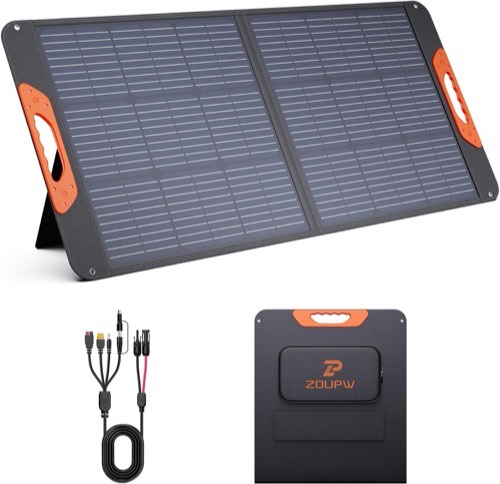
If you want to see what a 100W panel realistically does, this foldable ZOUPW is a clean example — light, cheap, and built for weekend energy rather than heavy loads. It's aimed at car campers and emergency-prep buyers, and owners keep praising the same thing: a 5-in-1 cable that plugs into Jackery, EcoFlow, Anker, Bluetti, and most other power stations without an adapter hunt. What makes it work as a 100W: at about 9.5 pounds it moves one-handed, the ETFE surface carries an IP67 body rating, and in good sun it commonly delivers 60-80W — roughly 300 Wh across a solar day. That's enough to keep a 300-500Wh station, phones, lights, and a fan going through a trip. The catch is the ceiling. Clouds, shade, and a full battery pull output well below the rating, one 100W panel is slow to refill anything large, and owners with bigger stations often end up adding a second panel or stepping up to 200W.
Power output100 W monocrystalline (foldable)
Cell efficiency23.5% monocrystalline
Real-world output~60-80W in good sun (~300 Wh/day at 0.75)
Charge controllerBuilt-in USB regulation only; MPPT/PWM not specified
Connector5-in-1: XT60, Anderson, DC5521, DC7909, DC8020, USB-C, USB-A
WeatherproofingIP67 panel body; ETFE surface (keep USB hub dry)
Weight9.5 lb; folds to ~24 × 21 × 1.8 in
Warranty12 months + lifetime technical support
Best forWeekend camping, small power stations, phones, and emergency backup
Best 200W Example

Renogy RPP200EF-SE Review: A Lightweight 200W Portable Panel for Camping, RVs, and Power Stations

Renogy RPP200EF-SE Review: A Lightweight 200W Portable Panel for Camping, RVs, and Power Stations

Get it now:

Check latest price

What to know

  • Real output 150-190W in strong sun — about 608 Wh/day at a 0.76 factor over 4 peak sun hours
  • Roughly double a 100W panel — enough for a fridge, faster station recharge, or two solar days to a 100Ah battery
  • Bring the right adapter — MC4 output needs an MC4-to-XT60, 8mm, or brand-specific cable for most stations
  • Light for a 200W — ~13.9 lb quad-fold with 40°/50°/60° kickstand angles
  • Output varies by unit — most see 150W-plus, but a minority report 120-140W in good sun

Best if

  • You run a 12V fridge, CPAP, or RV/van setup that needs steady daily energy
  • You want to recover a 1,000Wh-class power station in one sunny day
  • You value better price per watt and one panel instead of two

Skip if

  • Your loads are tiny and a lighter, cheaper 100W would cover them
  • You need a backpack-friendly panel for foot travel
  • You expect a guaranteed 200W and every adapter included in the box
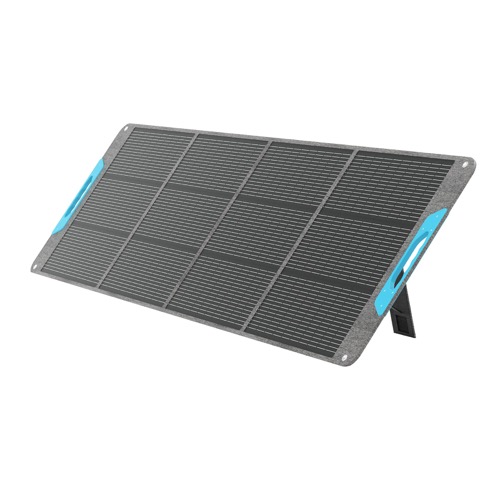
When 100W stops keeping up, this Renogy shows what doubling the wattage buys you — roughly twice the daily energy for a modest weight penalty. It's built for power-station charging and vehicle-based off-grid use, and owners reach for it to keep EcoFlow, Bluetti, Anker, and RV batteries fed without generator noise. What makes it work as a 200W: 25%-efficiency N-Type cells, a 21.6V operating voltage, and real output of roughly 150-190W in strong sun — about 608 Wh across a solar day. That's enough to run a 12V fridge through daylight, recover an overnight CPAP draw, or refill a big chunk of a 1,000Wh station in a single sunny day. At 13.9 pounds it's still light for its class and folds compactly for a van or RV nook. The catch is that it ships with MC4 output and usually no brand adapter, the built-in leads are short, the kickstands can be fiddly in wind, and unit-to-unit output varies — a few owners see only 120-140W.
Power output200 W monocrystalline (16BB N-Type, foldable)
Cell efficiency25% N-Type
Real-world output150-190W in good sun (~608 Wh/day at 0.76)
Charge controllerNone — use a power station input or separate controller
ConnectorMC4, USB-C PD (45W), USB-A (18W/15W); adapter usually needed
WeatherproofingIP65; UL 61730, CE, FCC, RoHS, PSE certified
Weight13.9 lb; folds to ~24 × 23 × 2 in
Warranty2 years material and workmanship
Best forFridges, CPAP backup, RV/van power, and 1,000Wh-class station recharge

Product Comparison

Feature ZOUPW 100W Solar Panel Review: Five Connectors, Zero Adapter Hassle Renogy RPP200EF-SE Review: A Lightweight 200W Portable Panel for Camping, RVs, and Power Stations
Product Image
ZOUPW 100W Solar Panel Review: Five Connectors, Zero Adapter Hassle
Renogy RPP200EF-SE Review: A Lightweight 200W Portable Panel for Camping, RVs, and Power Stations
Price $105.99 $220.49
Rating
4.6 / 5
4.5 / 5
Category Solar Panels Solar Panels
Brand ZOUPW Renogy
Model / SKU ZOUPW-F100W (ASIN: B0CR42CFJ9) RPP200EF-SE (ASIN: B0CNPHD4VY)
Product type Portable solar panel Portable solar panel
Solar cell type Monocrystalline silicon (A+ grade claimed) Monocrystalline silicon, 16BB N-Type cells
Maximum power output 100 W 200 W
Open-circuit voltage (Voc) 24.3 V Not specified (owners commonly measure around 21-23V open circuit, but official Voc is not listed in supplied specs)
Maximum operating voltage (Vmp) 20.16 V 21.6 V
Output voltage 20.16 V DC (solar operating voltage); USB-C and USB-A regulated device outputs also included</span > 21.6 V DC maximum operating voltage; USB-C and USB-A device outputs also included
Maximum current (Imp) 4.96 A 9.26 A (calculated: 200W ÷ 21.6V)
Short-circuit current (Isc) 5.25 A 11.3 A (listed as amperage capacity)
Cell efficiency 23.5% 25%
Charge controller included Yes — built-in intelligent controller for USB/direct charging (MPPT/PWM type not specified) No (designed for power stations or a separate solar charge controller)
Controller features USB-C and USB-A charging, overcurrent protection, short-circuit protection (other controller details not specified) N/A
Connector type XT60, Anderson, DC5521, DC7909/8mm, DC8020, USB-C, USB-A MC4, USB-C PD, USB-A
Cable length 10 ft adapter cable (plus short panel lead) Not specified (customers describe the built-in MC4 leads as short and often buy extensions)
Waterproof rating IP67 (panel body; USB hub and connected cables should be kept dry)</span > IP65
Operating temperature range 14°F to 158°F Not specified
Dimensions (L × W × H) 48.43" × 21.06" × 0.98" unfolded; 24.13" × 21.06" × 1.77" folded 23.72" × 1.97" × 22.99" (folded size)
Weight 9.48 lb 13.9 lb
Frame material Fabric-backed foldable construction (rigid frame material not specified) Not specified (portable foldable panel construction)
Surface / glass material ETFE coating material over monocrystalline solar cells Monocrystalline silicon; surface material not specified
Mounting type Fold-out kickstands (portable ground/patio/campsite setup) Built-in kickstands with 40° / 50° / 60° angle adjustment; reinforced grommets for mounting; optional ground studs not included
Compatible devices / batteries Portable power stations using XT60, Anderson, DC5521, DC7909, or DC8020 inputs; direct USB charging for phones, tablets, GPS units, cameras, and small accessories Portable power stations, smartphones, tablets, laptops, cameras, AGM batteries, LiFePO4 batteries, and deep-cycle 12V systems when used with proper controller/adapters
Required sunlight hours Varies by battery capacity (4 peak sun hours can deliver roughly 300 Wh/day in good conditions)</span > Varies by battery capacity and load (typical owners see useful charging with 3-5 peak sun hours)
Wind / snow load rating Not specified Not specified
Safety certifications Not specified UL 61730, CE, RoHS, FCC, ISO 9001 facility, CA65, PSE
Special features 23.5% efficiency, foldable design, magnetic handle, zippered cable pouch, 5-in-1 adapter cable, direct USB charging, ETFE surface, IP67 panel body 25% efficiency, foldable quad design, magnetic handle closure, rear accessory pouch, USB-C PD 45W max, USB-A 18W and 15W, MC4 output, IP65 rating
Included in the box 1× ZOUPW 100W solar panel, 1× 10 ft 5-in-1 solar connector cable, user manual 1× 200W EFLEX portable solar panel
Warranty 12-month manufacturer warranty plus lifetime technical support 2-year material and workmanship warranty
Expected lifespan Not specified Not specified
Unit count 1 1
Best for Car camping, RV trips, power outage backup, Jackery/EcoFlow/Anker/Bluetti charging, phones and small electronics, off-grid weekend use, and moderate emergency power station top-ups Power station charging, RV and van camping, CPAP backup, sailboat battery support, LiFePO4/AGM battery charging with a controller, blackout prep, and portable off-grid use
Buy Now View Deal View Deal

Final Verdict

The 100W vs 200W solar panel choice isn't about which is better — it's about matching wattage to your load. A 100W panel delivers roughly 288 Wh on a good day (real-world example: the ZOUPW 100W lands near 300 Wh), which is plenty for phones, a small power station, camp lights, and weekend top-ups. It's lighter, cheaper, and easier to carry, but slow to refill anything large and quick to disappoint if you expect it to run a fridge. A 200W panel roughly doubles that to about 576 Wh a day (the Renogy RPP200EF-SE lands near 608 Wh) — enough to keep a 12V fridge going, recover a 1,000Wh power station in one sunny day, or push real amps into a 100Ah battery in about two days of sun. The cost is more weight, more folded bulk, and a higher price, though the price per watt is usually better. Buy 100W if your loads are small and portability matters most; buy 200W if you run a fridge, want faster station recharges, or power an RV or van.

Frequently Asked Questions

What are the disadvantages of a 100W solar panel?

The main disadvantage is that a 100W panel produces modest energy — realistically about 288 Wh on a good day, since real output lands closer to 60-80W than the rated 100W once you account for angle, heat, and clouds. That's slow for recharging a large power station, and it won't run high-draw loads like a fridge, microwave, or air conditioner on its own. You also often need a second panel later, and cloudy or shaded conditions cut an already-modest output down further. For phones, lights, small power stations, and weekend camping it's fine; for anything hungrier it falls short.

What will a 200W solar panel run?

A 200W panel delivers roughly 576 Wh on a good day — enough to keep a 12V camping fridge running during daylight, recover an overnight CPAP draw, recharge a meaningful chunk of a 1,000Wh power station, and top up laptops, phones, fans, and lights. It won't run a rooftop air conditioner or an electric kettle for long on its own, because those loads draw more than the panel makes. Think of 200W as enough to cover a steady mid-size daily load or refill a battery bank over a day or two, not as a whole-house supply.

How long does it take to charge a 100Ah battery with a 200W panel?

A 100Ah 12V battery holds about 1,280 Wh when full. A 200W panel makes roughly 150W in good sun, so refilling a fully drained LiFePO4 100Ah battery takes about 8-9 hours of strong sunlight — realistically spread across two good solar days at 4 peak sun hours each. A lead-acid or AGM battery you only draw to 50% needs about half that, so one solid sunny day often tops it back up. Add a smaller charge on cloudy days. An MPPT controller squeezes more of the panel's output into the battery than a basic PWM unit.

How many batteries can a 100W solar panel charge?

A single 100W panel comfortably maintains one 50-100Ah 12V battery, or keeps a small power station topped up. On a good day it delivers about 288 Wh, which is enough to replace the daily draw of a modest setup — a few phone charges, camp lights, a fan, and a small fridge cycling lightly. It's not enough to fast-charge a big bank or keep several depleted batteries happy at once; for that you'd step up to 200W or add a second 100W panel in parallel. Match the panel to your daily energy use, not just the number of batteries.

Is 100W or 200W better for camping or a power station?

It depends on the size of your setup. For weekend camping with a small-to-mid power station (roughly 300-500Wh), phones, lights, and a fan, a 100W panel like the ZOUPW is lighter, cheaper, and enough. For longer trips, a 12V fridge, an RV or van, or a 1,000Wh-plus power station you want to recover in a single sunny day, a 200W panel like the Renogy RPP200EF-SE is the better match — it roughly doubles daily output for a modest weight penalty. Pick 100W for small and light; pick 200W for faster charging and bigger loads.

×

About Solar Power Picks

Portable Solar Power, Backup Power, and Off-Grid Gear Guides

Your trusted source for honest, in-depth product reviews and comparisons.

Quick Links

  • Best Picks
  • Reviews
  • Guides
  • Comparisons
  • Calculator
  • Privacy policy
  • Favorites

Categories

  • Portable Power Stations
  • Solar Generators
  • Solar Panels

© 2026 Solar Power Picks. All Rights Reserved.

We may earn a commission when you purchase through links on our site. Learn more