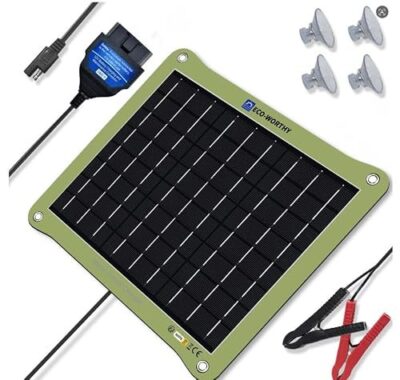
ECO-WORTHY 10W OBD review: convenience depends on the vehicle
At a Glance
KEY FEATURES
- 10W offer with an OBD connection option
- Alternative clips described in owner feedback
- Vehicle permission and cable reach decide convenience
- Keep separate from the standard ECO-WORTHY 10W offer
PROS
- OBD connection may reduce repeated hood access
- Owner confirms an alternative clip arrangement
CONS
- Vehicle-specific charging permission unresolved
- Lead reach restricted one intended installation
- Indicator activity did not guarantee a successful storage outcome
Price and availability subject to change
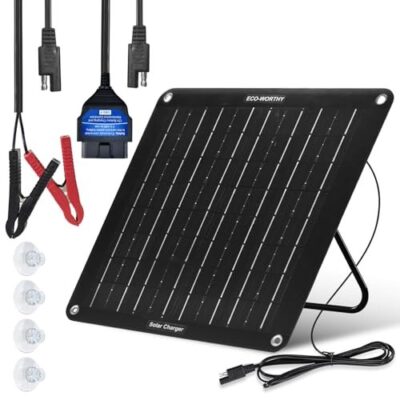
The OBD connection is the reason to investigate this ECO-WORTHY 10W offer. Avoiding the hood can make a maintenance routine easier to follow, but an included diagnostic-port cable is not proof of compatibility with every vehicle.
Research-based analysis of the selected offer and customer accounts; not our hands-on test.
Start with the port, not the promise
| Buying question | Why it matters |
|---|---|
| Is this charging route supported for my vehicle? | The cable must be appropriate electrically, not merely fit the port. |
| Can the panel reach useful light? | A van owner found the included reach limited their intended position. |
| Can I check the battery during storage? | A later no-start report shows why the indicator alone is insufficient. |
Useful convenience, uncertain charging evidence
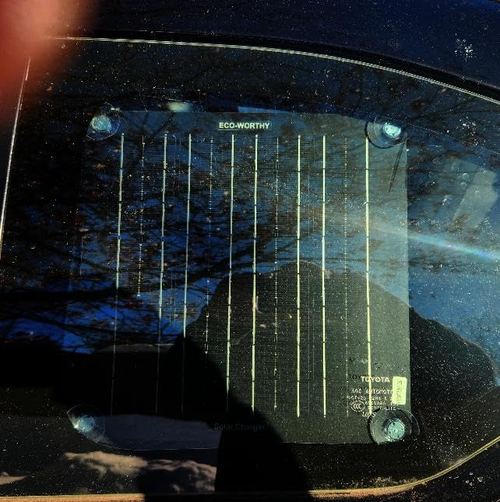
A van owner liked having both the OBD route and clips, but could not confirm charge reaching a separate battery bank in their intended placement. Their report distinguishes a light turning on from a measured charging result. It also highlights the cable-length problem before anyone assumes that every sunny position is reachable.
The panel does not repair an electrical drain
Another owner explicitly acknowledges an unresolved vehicle drain and plans to address that separately. A different account describes a no-start after a trip despite an apparently active indicator. Neither establishes a universal product defect; together they undermine the idea that buying a maintainer removes the need to check battery condition and parking loads.
Documentation still needed for the convenient route
Pros & Cons Analysis
Based on documented specifications and owner feedback
Pros
- Potentially less hood access. The OBD route can simplify a supported installation for an infrequently used vehicle.
- Another connection may be available. The van account describes clips as an alternative, though its intended remote placement remained constrained.
Cons
- An OBD socket is not universal approval. Verify the vehicle’s permitted charging route rather than assuming every diagnostic port accepts this accessory.
- Indicator activity is insufficient. The owner’s uncertainty about delivered charging and a separate no-start report make checking the battery result important.
- Cable reach is part of the kit choice. A convenient connector does not help if the panel cannot reach useful exposure.
The OBD lead must save effort without adding uncertainty
Choose this version over a conventional connection only when your vehicle supports it and the included reach works for a useful panel position. Otherwise the OBD accessory adds little practical value; compare a supported direct-connection arrangement instead.
Frequently Asked Questions
Does the OBD cable work with every car?
This review does not establish universal compatibility. Confirm the vehicle and charger instructions.
Is this the same as the standard 10W kit?
No. The OBD accessory is an offer-specific distinction; do not transfer it or its compatibility assumptions to the standard version.