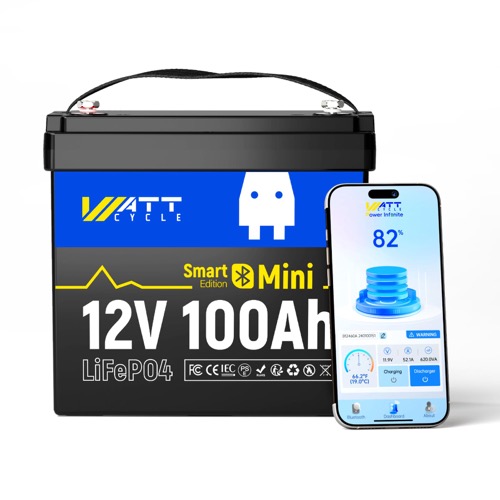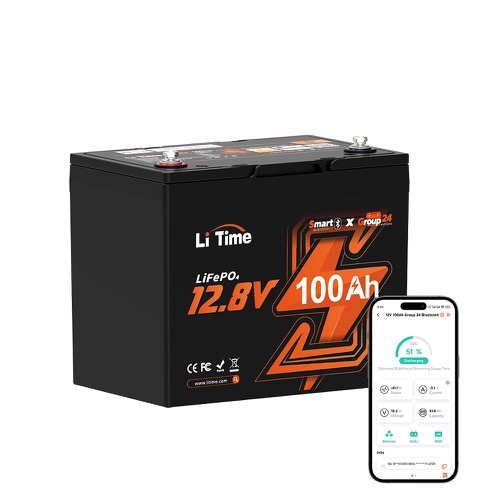
WattCycle Mini vs LiTime Group 24 is not a quality ladder. It is a geometry-and-time decision. Both store 1,280Wh, both publish 100A continuous charge/discharge, both have Bluetooth and IP65, and neither heats itself. WattCycle is narrower; LiTime publishes the larger brief pulse and the clearer cold recovery point.
Choose WattCycle
The battery tray is the hard constraint or the load needs up to 110A for several seconds.
Choose LiTime
A Group 24 case fits and a sharp high-current event settles within one second.
Begin With a Cardboard Footprint
WattCycle’s base is roughly 9.0 × 5.6 inches; LiTime’s is 10.24 × 6.61. That difference is large enough to change a boat seat, radio cabinet, or RV tray. Height and weight are close enough that the base usually decides first.
- Cut each base footprint from cardboard.
- Add the published case height plus complete lug/cover stack.
- Model cable bends, fuse, disconnect, restraint, and service access.
- Reject any layout that side-loads a terminal or hides protection.
Now Draw the Startup Curve
LiTime’s 500A figure ends after one second. WattCycle allows 150A for one second and 110A for ten seconds. A 130A event lasting half a second fits both published windows; a 105A event lasting six seconds fits WattCycle’s timing but not LiTime’s stated one-second pulse; a 300A half-second event points to LiTime.
Cold Protection Breaks the Tie on Documentation
Both stop charging below 32°F (0°C). LiTime publishes recovery at 41°F (5°C); WattCycle’s exact recovery threshold was not found. Neither heater can warm itself. For a controlled indoor compartment the gap may be minor; for an autonomous winter array, LiTime’s explicit recovery state is valuable.
App Ownership Favors Neither Unconditionally
Both exact samples contain successful hidden-battery monitoring and connection complaints. WattCycle’s 42-review merged sample also exposes several BMS lockout/wake-up experiences. LiTime’s 45-review set includes app/wake issues plus a surge-sensitive tongue-jack case. The samples were targeted and cannot establish comparative defect rates.
Dimensions and current windows are attributable.
Useful fault patterns, not random populations.
Final Decision
LiTime is the safer default because its documentation closes more loops and its pulse handles a broader sharp-inrush class. WattCycle is the better design when its smaller base is the difference between a clean installation and an impossible one, or when a small overload needs several seconds rather than a much larger one-second pulse.