LiTime 12V 200Ah Plus Self-Heating Review: Current Before Apps
At a Glance
KEY FEATURES
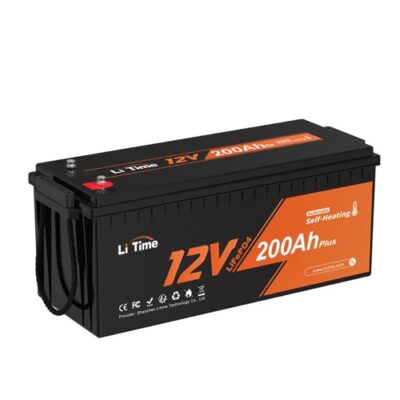
- 12.8V, 200Ah, 2,560Wh nominal energy.
- 200A continuous charge/discharge; 800A for one second.
- Automatic heating needs at least 20A input.
- IP65 enclosure without built-in Bluetooth.
- Best for high-current cold systems using a separate shunt.
PROS
- 200A continuous envelope
- 2.56kWh in one battery
- Exact heater minimum and temperature band
- 800A one-second pulse
CONS
- No Bluetooth
- Only nine exact reviews captured
- 20A heater minimum is demanding for small winter arrays
- Large 44.1-pound case
High-Current Heated Pick
Based on exact documentation and exact-ASIN owner evidence
How Many LiTime 12V 200Ah Plus Self-Heating Batteries Do You Need?
Estimate how many LiTime 12V 200Ah Plus Self-Heating batteries your daily energy target may require.
Solar Battery Bank Size Calculator
How much solar battery storage do I need?
The LiTime 200Ah Plus trades smart-battery convenience for a larger electrical envelope. It stores 2,560Wh, supports 200A continuously, and heats automatically in the cold—but has no Bluetooth. That combination is coherent for a serious bank already using a system shunt.
Current Capability Is the Reason to Buy
A 200A ceiling at 12.8V is about 2,560W nominal DC before low-voltage and inverter losses. The 800A pulse lasts one second. This can fit more demanding 12V inverters than the 100A batteries, but it does not make a 3,000W AC load automatically safe.
| Load period | Battery boundary | Planning implication |
|---|---|---|
| Sustained | 200A | Account for lowest operating voltage and conversion loss |
| First second | Up to 800A | Check inverter, fuse, cable, terminal, and BMS together |
| After one second | Return to continuous envelope | Multi-second startup needs another design |
A 20A Heater Minimum Changes Array Sizing
The heater works from -4 to 41°F (-20 to 5°C) and requires at least 20A charging input—twice the 100Ah heated models in this batch. At roughly 14V, that is on the order of 280W reaching the battery before controller and wire losses. Weak winter sun can delay heating even when the array’s summer nameplate looks generous.
20A × 14V ≈ 280W reaching the battery
This is a heater-start planning floor, not a recommended array nameplate. Controller loss, wiring loss, poor irradiance, and concurrent loads require additional margin.
No Bluetooth Can Be an Architecture Advantage
A bank-level shunt sees every charger and load, while an internal app sees one battery. In a multi-battery 200A installation, a quality shunt is often the better accounting tool. The drawback is extra equipment and no direct cell/protection view when one battery opens.
Internal app
Convenient individual-battery diagnostics, absent here.
External shunt
Better complete-bank energy accounting, but it cannot expose every internal BMS detail.
Nine Reviews Require Restraint
The exact sample contains nine reviews: three five-star, three four-star, one three-star, and two one-star in the merged targeted capture. Critical reports include an early BMS cutoff/solar-load problem and disappointment about missing Bluetooth. The latter is a selection mismatch, not necessarily a defect.
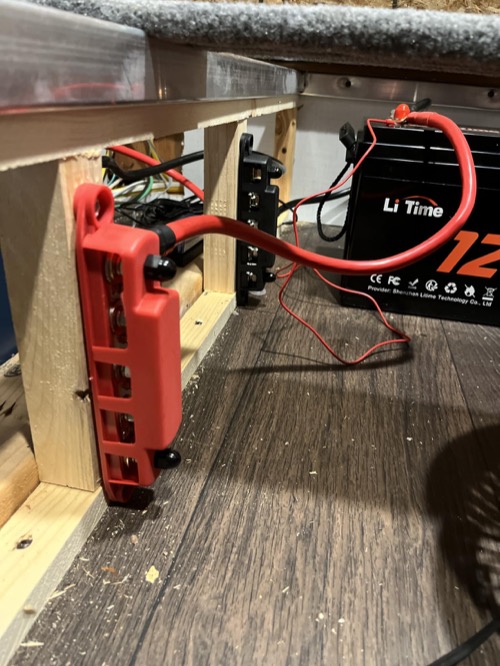
The sample is sufficient to identify questions, not to score reliability with confidence. Our stronger electrical rating comes from exact documentation; the Build & Ownership rating is discounted for coverage.
Installation Scales Faster Than Capacity
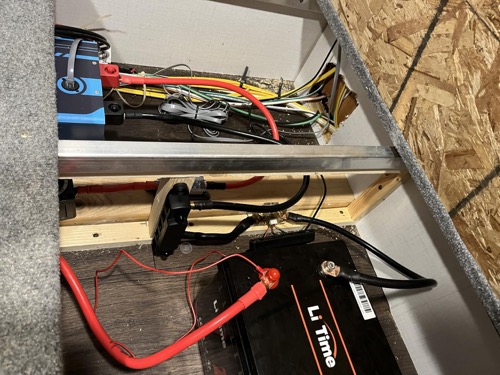
A 44.1-pound battery and a 200A path need secure handling, restrained mounting, appropriately rated protection, and a terminal layout that avoids stacked high-current lugs. A 4S4P theoretical boundary implies enormous stored energy and fault current; it is not a casual DIY target.
- Plan handling: tray, lifting path, restraint, and service clearance.
- Design fault protection: available current, conductor ampacity, interrupt rating, and disconnect.
- Verify monitoring: locate a shunt so every charge source and load crosses it.
- Prove winter recovery: test heater startup at the weakest expected solar condition.
LiTime 200Ah Plus: Final Recommendation
Choose it when the system genuinely needs 200A continuous current and 2.56kWh in one heated case, already has bank-level monitoring, and can deliver more than 20A in the cold. Choose a smart 100Ah unit when app diagnostics and easier handling matter more than current density.
Pros & Cons Analysis
Based on documented specifications and owner feedback
Pros
- 200A continuous envelope
- 2.56kWh in one battery
- Exact heater minimum and temperature band
- 800A one-second pulse
Cons
- No Bluetooth
- Only nine exact reviews captured
- 20A heater minimum is demanding for small winter arrays
- Large 44.1-pound case
Bottom Line: Strong Hardware, Thin Ownership History
The LiTime 200Ah Plus is the heated batch's current specialist: 2,560Wh, 200A continuous, and an 800A one-second pulse. It makes sense with a separate shunt and a winter source capable of exceeding 20A. The nine-review evidence set is too small to support a confident long-term ownership verdict.
Frequently Asked Questions
Does the LiTime 200Ah Plus have Bluetooth?
No. This exact self-heating Plus model has no built-in Bluetooth. Plan a compatible shunt or other bank monitor if energy accounting is required.
How much current can it supply?
The exact manual publishes 200A continuous charge and discharge plus 800A for one second. Check the complete DC path and startup duration.
What does the heater require?
Automatic heating operates from -4°F to 41°F (-20°C to 5°C) and needs at least 20A charging input. Small or shaded winter arrays may not start it.
How large is the owner sample?
Only nine exact-ASIN reviews were retained. They include positive and critical evidence plus four customer images, but the sample is too small for strong reliability conclusions.
Can it be used in a 48V bank?
LiTime permits up to four in series and four in parallel with compatible matched units. A 200A-class bank has substantial fault energy and needs appropriate design and protection.
Technical Specifications
| Brand | LiTime |
|---|---|
| Exact model | 12.8V 200Ah Plus Self-Heating |
| Battery chemistry | LiFePO4 (LFP) |
| Nominal voltage | 12.8V |
| Rated capacity | 200Ah |
| Rated energy | 2,560Wh |
| Recommended depth of discharge | Up to 100% DoD; 80% DoD is paired with the 6,000-cycle figure |
| Recommended charge current | 40A |
| Maximum continuous charge current | 200A |
| Maximum continuous discharge current | 200A |
| Peak discharge current | 800A for 1 second |
| Recommended charge voltage | 14.4V ± 0.2V (CC/CV) |
| Low-temperature charge protection | Charging is blocked below 32°F (0°C) until the cells are warmed |
| Self-heating | Yes; automatic heating from -4 to 41°F (-20 to 5°C), with at least 20A charging input |
| Charge / discharge temperature | Charge: -4–122°F (-20–50°C) with heating; discharge: -4–140°F (-20–60°C) |
| BMS protections | Overvoltage, undervoltage, charge/discharge overcurrent, short-circuit, overload, and high/low-temperature protection |
| Monitoring | No built-in Bluetooth |
| Series / parallel configuration | Up to 4 in series and 4 in parallel (4S4P) |
| Terminals | M8 bolts |
| Dimensions | 21.0 × 8.2 × 8.5 in |
| Weight | 44.1 lb |
| Ingress rating | IP65 |
| Cycle-life specification | 4,000 cycles at 100% DoD; 6,000 at 80%; 15,000 at 60% |
| Warranty | 5 years |