Solar Power Picks logo with sun, solar panel, and green energy icon

  • Home
  • Reviews
  • Best
    • Best portable power stations
    • Best Solar Panels
  • Guides
    • Portable Power Stations Guides
  • Comparisons
    • Portable Power Stations Comparisons
  • Calculator
Home / Solar Panels / Best / Best 100W Portable Solar Panels: 8 Picks Ranked by Real Daily Output

Best 100W Portable Solar Panels: 8 Picks Ranked by Real Daily Output

OUR PICKS

ZOUPW 100W Solar Panel Review: Five Connectors, Zero Adapter Hassle

Best Overall

ZOUPW 100W Solar Panel Review: Five Connectors, Zero Adapter Hassle

Check price at Amazon Jump to details
FlexSolar 100W Solar Panel Review: The 4-Pound Panel Hikers and Backpackers Actually Want

Best Budget Foldable 100W

FlexSolar 100W Solar Panel Review: The 4-Pound Panel Hikers and Backpackers Actually Want

Check price at Amazon Jump to details
DOKIO 100W Solar Panel Kit Review: The Complete Beginner Setup That Works Straight Out of the Box

Best Cheap 100W Kit

DOKIO 100W Solar Panel Kit Review: The Complete Beginner Setup That Works Straight Out of the Box

Check price at Amazon Jump to details
GRECELL SP-100 Review: A Budget 100W Folding Panel That Punches Above Its Price

Best Premium 100W Panel

GRECELL SP-100 Review: A Budget 100W Folding Panel That Punches Above Its Price

Check price at Amazon Jump to details
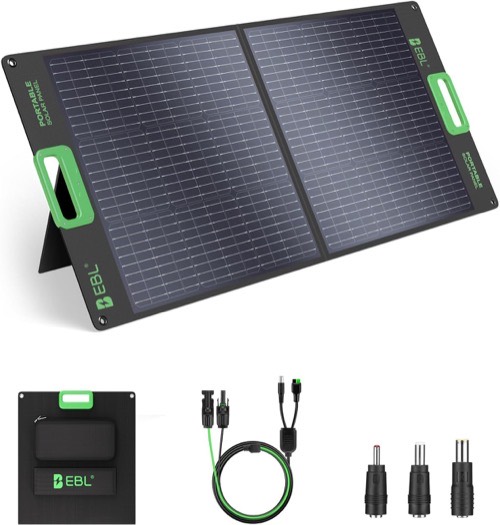
EBL 100W Portable Solar Panel Review: The Budget 100W That Punches Above Its Price Tag — Sometimes

Best for Power Stations

EBL 100W Portable Solar Panel Review: The Budget 100W That Punches Above Its Price Tag — Sometimes

Check price at Amazon Jump to details
Renogy 100W 12V Solar Panel Review: The Industry Standard That Earned Its Reputation Over a Decade

Best Rigid 100W Panel

Renogy 100W 12V Solar Panel Review: The Industry Standard That Earned Its Reputation Over a Decade

Check price at Amazon Jump to details
HQST Bifacial 100W Solar Panel Review: The 12V Panel That Pulls Extra Power From Reflected Light

Best Bifacial 100W Panel

HQST Bifacial 100W Solar Panel Review: The 12V Panel That Pulls Extra Power From Reflected Light

Check price at Amazon Jump to details
100W Portable Solar Panel Review: What You’re Actually Getting From an Unbranded Panel at a Budget Price

Best Low-Cost Amazon Pick

100W Portable Solar Panel Review: What You’re Actually Getting From an Unbranded Panel at a Budget Price

Check price at Amazon Jump to details

A 100W panel delivers roughly 328 Wh on a clear 4-peak-sun-hour day — enough to put about two-thirds of a 500Wh power station back in the tank — and that one number is the lens we used to rank the best 100w portable solar panels here. It’s not a spec-sheet abstraction. It’s the energy you actually carry back to camp or feed into a 12V battery, and it’s where the real differences start.

Since every panel on this list is rated the same 100W, the spec sheet stops being useful fast. What actually separates them is real-world output — a foldable panel feeding a station’s MPPT delivers more than a rigid one wired through a cheap PWM controller — plus format (a 4 lb foldable versus a 13 lb rigid frame), the connector match for your power station, and whether the panel has any certified weatherproofing at all. Two “100W” panels can hand you very different days.

This guide ranks eight 100W panels by what they realistically put back in a day, then sorts them by who they’re for: foldable for power-station campers, rigid for a fixed 12V install, kit-with-controller for first-time 12V buyers, and budget for cost-first shoppers. Weight here spans about 4 lb to 13 lb, and connectors run from USB-rich foldables to MC4-only rigid frames. Honestly, that range is the whole story at this tier.

Not Sure 100W Is Enough?

Our Solar Panel Output Calculator estimates how much energy a 100W panel produces per day based on your location’s sun hours — so you can see whether 328 Wh covers your power station, a 12V battery, or a day of devices before you buy.

Use the Solar Calculator — Jump to What 100W Powers

How We Chose the Best 100W Portable Solar Panels

We didn’t run these in a lab, and we won’t pretend otherwise — our rankings lean on manufacturer specs, the connector and IP details printed on each panel, and what owners report in real sun conditions. Because every panel is 100W, we ranked on what actually varies at this tier: real-world daily output (cell quality, efficiency, and the controller path the power flows through), format (foldable portability versus rigid efficiency at a fixed angle), connector match for the most common power stations, certified weatherproofing, and what’s in the box — a kit with a controller versus a bare panel. That’s how we sorted the best 100W portable solar panels into clear buyer types rather than a single “winner.”

Criterion Why It Matters at the 100W Tier Weight
Real-world output (vs rated 100W) Every panel claims 100W; what reaches the battery depends on cell quality and controller path High
Format (foldable vs rigid) 4 lb foldable for power stations vs 13 lb rigid frame for a fixed 12V mount — two different buyers High
Connector compatibility XT60, Anderson, DC, MC4 — the right plug is what lets a 100W panel actually charge your station High
IP weatherproofing rating Several budget 100W panels carry no certified IP rating — that matters for anything left outside Medium
What’s in the box A kit with a PWM controller and cables vs a bare panel changes the real cost of getting started Medium
USB outputs Foldables with USB-C/USB-A charge phones without occupying the power station’s ports Low
Warranty and brand support Longer warranty = more confidence for a panel that lives outdoors Low

Selection criteria:

  • Real-world output — N-Type/high-efficiency mono into a station’s MPPT (~0.82 factor) vs PWM/direct (~0.68); rated watts are not delivered watts
  • Format — foldable for portability and power stations; rigid for a fixed-angle 12V install
  • Connector compatibility — native or included cables for EcoFlow (XT60), Jackery (DC8020/DC7909), Bluetti, plus MC4 for controllers
  • IP rating — certified IP65/IP67 preferred; flag any panel with no certified rating
  • What’s in the box — bare panel vs full kit (controller, cables, bag)
  • USB outputs — direct device charging without occupying the power station
  • Weight — roughly 4 lb (FlexSolar) to 13 lb (Renogy rigid) across this lineup
  • Warranty — longer coverage preferred for an always-outdoors product

What One 100W Panel Actually Powers Per Day

Let’s turn the abstract “100W” into one honest daily number, then into devices you recognize. At 4 peak sun hours with a 0.82 real-world factor — a good foldable feeding a station’s built-in MPPT — a 100W panel delivers roughly 328 Wh per day. Run that same panel through a basic PWM controller into a 12V battery and you land closer to 272 Wh. Here’s what that energy realistically recovers.

Device / Power Station Typical Capacity or Daily Draw What ~328 Wh/Day Does
EcoFlow RIVER 2 (256Wh) 256 Wh Full recharge with headroom on one good sun day
Jackery Explorer 500 / EcoFlow RIVER (~500Wh) ~500 Wh About 65% recovered per day — roughly 1.5 sunny days to full
Power station ~1000Wh ~1000 Wh About a third per day — pair two 100W panels to keep up
12V fridge / cooler ~300-450 Wh/day Covers a small efficient fridge on a clear day; tight in heat
Phone charges ~12-15 Wh each Roughly 20+ full phone charges of energy
Laptop charges ~50-60 Wh each About 5-6 laptop charges, or one laptop plus lights and a fan

Real-World Math — That 328 Wh comes from 100W × 4 PSH × 0.82. Drop to a cloudy day at 2 effective sun hours and you’re closer to 160 Wh — half a phone-heavy day, not a full station recharge. Push to a sunny 5-PSH afternoon and a clean foldable can clear 400 Wh.

How to Choose a 100W Portable Solar Panel

What to prioritize when buying a 100W panel:

  • Real daily output, not just the “100W” label — check cell efficiency and the controller path
  • The right format for the job — foldable for power stations, rigid for a fixed 12V mount
  • A connector that matches your station — XT60 (EcoFlow), DC8020 (Jackery), MC4 for controllers
  • Certified IP65/IP67 if the panel lives outside — several budget 100W panels have none
  • USB-C/USB-A output if you also want to charge phones without the station

Common buyer mistakes at the 100W tier:

  • Treating all “100W” panels as equal — output varies by cell quality and controller
  • Buying a rigid 13 lb frame when you wanted a foldable for camping (or vice versa)
  • Wiring a bare 100W panel straight to a 12V battery with no charge controller
  • Ignoring whether the panel has any certified IP rating before leaving it in the rain

Why 100W Is the Sweet Spot

For one-person setups, 100W is the most popular portable tier for a reason. It’s enough to meaningfully recover a small-to-midsize power station in a day, light and compact enough to actually carry, and far cheaper per usable day than a single 200W slab. A 60W panel often charges a station too slowly to keep up with real loads, while a 200W panel is heavy and frequently overkill unless you’re running a 12V fridge full-time. In practice, 100W is the line where portability and useful output meet. If you want the head-to-head, see our 100W vs 200W portable solar panel comparison. The takeaway: for most campers and power-station owners, one or two 100W panels is the right call.

Worth Knowing — Two 100W foldables often beat one 200W panel for flexibility: you can split them across two stations, angle them separately, and carry them in two lighter loads. The catch is two sets of cables and connectors to manage.

Real-World Output From a 100W Panel

The label says 100W at Standard Test Conditions — real output is always lower. Here’s how the factors play out across this lineup:

  • High-efficiency / N-Type mono feeding a station’s built-in MPPT: ~0.82 factor (~328 Wh/day at 4 PSH)
  • Standard mono through direct/IC output: ~0.78 factor
  • Through a basic PWM controller into a 12V battery (DOKIO kit): ~0.68 factor (~272 Wh/day)
  • Bifacial (HQST): front-side comparable to mono, plus a rear-side gain on bright or reflective ground

Notice the spread. The same nominal panel can hand you anywhere from 272 to 328 Wh on the same day depending on how the power flows. For the full breakdown, our guide on how much power a solar panel produces walks through the math. The takeaway: at this tier, the controller path and cell quality move the number more than the brand name does.

Foldable vs Rigid 100W Panels

This is the core format split in the lineup. Foldables — the ZOUPW, FlexSolar, DOKIO kit, GRECELL, EBL, plus the unbranded pick — pack down, carry easily, and deploy on kickstands or carabiners, which makes them ideal for power-station charging and camping. Rigid framed panels like the Renogy 100W and HQST bifacial are heavier at 12-13 lb, but they’re cheaper per watt and built for a fixed-angle 12V install on a roof, shed, or ground mount. As a rough rule, anything under about 6 lb is genuinely backpack-friendly, while a 13 lb rigid frame wants a permanent home. Pick the one that matches how you’ll actually use it.

Best Practice — Pick the format from the use case, not the price. If you’re charging a power station and moving around, a foldable like the ZOUPW or FlexSolar is worth the small premium. If the panel will live bolted to a van roof or a cabin wall, the rigid Renogy or HQST gives you more output per dollar.

Connectors & Power Station Compatibility

The plug decides whether your 100W panel charges anything at all. Here’s how the lineup maps to real stations:

  • USB-rich foldables with many adapters: ZOUPW (XT60 + Anderson + DC5521/7909/8020 + USB-C + 2× USB-A) and FlexSolar (USB-A/C + XT60 + Anderson + DC5521 + DC8MM)
  • MC4-based panels that need an adapter for most stations: GRECELL, EBL, Renogy, HQST, and the unbranded pick
  • The major station inputs: EcoFlow (XT60), Jackery (DC8020/DC7909), Bluetti (T500/aviation), Anker SOLIX (XT60)

These 100W panels output roughly 18-20V, which sits inside the input range of most portable stations — but confirm your station’s solar input ceiling and connector before you buy. Our portable solar panel for power station guide and the EcoFlow vs Jackery solar panel comparison cover the connector details. The takeaway: connector matters as much as wattage here.

Weatherproofing

The IP rating tells you what a 100W panel can survive outside. In this lineup it breaks down cleanly:

  • IP67 panel body: ZOUPW and FlexSolar — handle rain and brief splashing confidently, though connectors and pockets still need care
  • IP65: EBL and Renogy (junction box) — fine for rain and spray
  • No certified rating: the DOKIO kit, GRECELL, and the unbranded pick — manufacturers imply weather resistance but cite no standard, so treat them as fair-weather or sheltered panels

To be fair, “no certified IP rating” is a real limitation for anything left out overnight, not a marketing nitpick. The takeaway: if your panel will face weather unattended, buy a certified rating.

Buying Note — A panel rated IP67 protects the laminate, not always the connector pocket or USB hub. Even on the ZOUPW and FlexSolar, owners should keep the connector pocket zipped and out of standing water. For panels with no certified rating at all, plan to bring them in if rain is coming.

Do You Need a Charge Controller (12V batteries)?

This is the split that trips up first-time 100W buyers. Charging a power station? No separate controller needed — the station’s built-in MPPT handles it, so you just match the connector. Charging a bare 12V battery — AGM, lead-acid, or LiFePO4 — is different: you need a charge controller, because a bare 100W panel wired straight to a battery can overcharge it and backfeed at night. The DOKIO kit ships with a PWM controller, while the Renogy, EBL, GRECELL, HQST, and unbranded panels are bare and need you to supply one. Our MPPT vs PWM charge controller guide explains the difference. The takeaway: LiFePO4 owners should choose an MPPT controller with an LFP profile.

What Can a 100W Panel Do Across Conditions?

The 328 Wh figure assumes a clean 4-PSH day. Real days vary — here’s how a single 100W panel’s output and best use shift from bright sun to heavy overcast, so you can size expectations before a trip.

Conditions Effective Sun Hours Est. Daily Output (100W) What It Realistically Covers
Bright, clear sky, panel angled to sun 5 PSH ~400 Wh/day Full ~500Wh station recovery in a day with room to spare
Average sunny day, flat or fixed mount 4 PSH ~328 Wh/day About two-thirds of a 500Wh station; a small 12V fridge
Hazy or partly cloudy 3 PSH ~245 Wh/day Phones, lights, a laptop; slows station drain rather than reversing it
Through a basic PWM controller into 12V 4 PSH ~272 Wh/day 12V battery maintenance and modest daily 12V loads
Heavy overcast ~2 effective ~160 Wh/day Topping phones and lights only; not a station recharge

Cloudy stretches hurt a 100W panel more than buyers expect. Two grey days in a row can leave a power station well behind, so on multi-day off-grid trips, plan for a second panel, a flexible departure, or a wall-outlet top-off — don’t assume one 100W panel keeps up through a storm.

Will Your 100W Panel Work With Your Setup?

Most 100W portable panels output around 18-20V DC, which falls inside the input range of nearly every EcoFlow, Jackery, and Bluetti portable power station — the station’s built-in MPPT does the work, so you only need the right cable. The picture changes when you charge a bare 12V battery: then a separate controller is mandatory. Here’s the quick decision table for the most common 100W setups.

100W Charging Scenario Separate Controller Needed? Why
100W panel to EcoFlow / Jackery / Bluetti power station No Station has built-in MPPT; just connect the right cable (XT60 / DC8020)
100W panel to a standalone 12V AGM or lead-acid battery Yes — PWM or MPPT No overcharge or backfeed protection without a controller
100W panel to a LiFePO4 battery (van, RV, DIY bank) Yes — MPPT with LFP mode LiFePO4 needs a specific charge profile; the wrong one shortens battery life
100W kit with included PWM controller (DOKIO) to 12V Included (PWM) Kit ships with a controller; fine for lead-acid maintenance
100W panel to phone / tablet via onboard USB No USB output is already regulated; plug your cable directly

Best Practice — If you ever wire a 100W panel straight to a 12V battery without a controller, the panel can backfeed current at night and slowly drain the battery you meant to charge. Power stations handle this automatically; bare batteries never do. When in doubt, add an MPPT controller with anti-drain protection.

Best Overall

ZOUPW 100W Solar Panel Review: Five Connectors, Zero Adapter Hassle

ZOUPW 100W Solar Panel Review: Five Connectors, Zero Adapter Hassle

Get it now:

Check latest price

What to know

  • 23.5% mono cells turn in a typical 60-80W, landing near 300 Wh on a 4-PSH day — a solid real return for a 100W panel
  • That 300 Wh tops a 300Wh station or keeps phones, lights, and a fan going across a day off-grid
  • The five bundled DC tips are the value angle — most 100W rivals charge extra for that connector spread
  • Fold-out kickstands at a fixed tilt set the angle that drives the daily number — square it to the sun for the full 80W
  • Folds with a magnetic handle and cable pouch to about briefcase size for the daily harvest it delivers

Best if

  • You want a 100W panel that reliably returns 60-80W and ~300 Wh on a clear day for the money
  • You want the widest connector kit in the 100W class without paying for adapters separately
  • You like a briefcase-fold form factor with a handle for the daily output it puts out

Skip if

  • You expect a steady rated 100W on the readout through cloud, haze, or a near-full station
  • You're charging a bare 12V battery — there's no dedicated battery controller for that
  • You need a panel light enough to backpack — at 9.5 lb it stays with the vehicle

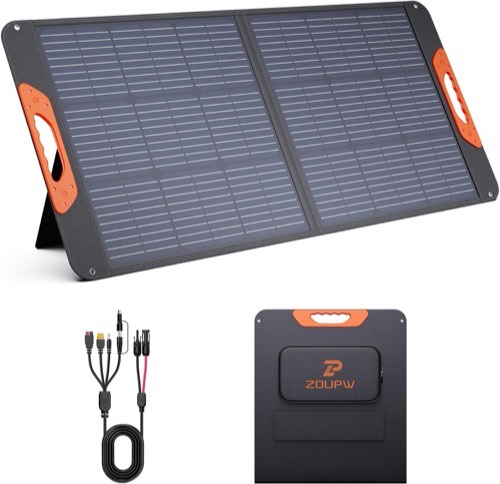
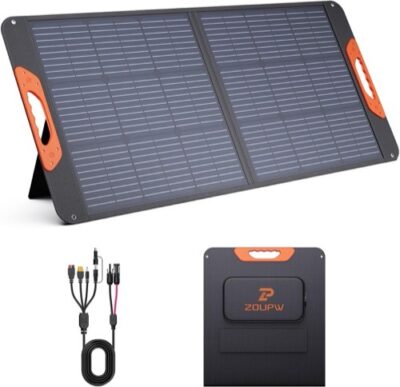
If you want one 100W foldable panel that talks to almost any power station you already own, the ZOUPW 100W earns Best Overall on connector coverage alone. It's the panel campers and emergency-prep buyers keep reaching for, and the reason is the 5-in-1 cable — XT60, Anderson, DC5521, DC7909, and DC8020 all in the box, plus USB-C and USB-A for phones.

Owners commonly pull 60-80W in good sun from the 23.5% mono cells, enough for roughly 300 Wh on a 4-hour peak-sun day. The IP67 panel body shrugs off rain better than most budget foldables, and the 10 ft cable lets you park the panel in sun while the station stays shaded.

Just know the controller type isn't listed as MPPT or PWM — treat it as a power-station panel, not a bare-battery charger.

Wattage100W monocrystalline, 23.5% efficiency (~300 Wh/day at 4 PSH, 0.75 factor)
IP RatingIP67 (panel body; USB hub and connectors should be kept dry)
ConnectorXT60, Anderson, DC5521, DC7909, DC8020, USB-C, USB-A (all included)
ControllerBuilt-in USB/device regulation; MPPT/PWM type not specified — use a separate controller for bare 12V batteries
Cable & Mount10 ft adapter cable; fold-out kickstands (fixed-angle)
Best Budget Foldable 100W

FlexSolar 100W Solar Panel Review: The 4-Pound Panel Hikers and Backpackers Actually Want

FlexSolar 100W Solar Panel Review: The 4-Pound Panel Hikers and Backpackers Actually Want

Get it now:

Check latest price

What to know

  • 24% cells return 77-92W when aimed well — about 304 Wh a day, strong output for the lightest body in this class
  • That daily figure rivals heavier briefcase 100W panels while folding down near laptop dimensions at 4.1 lb
  • Output slides toward 60W in weak sun or high latitudes, so the 304 Wh assumes a clear day and a good angle
  • USB-C PD to 45W and USB-A QC3.0 to 18W let it earn watts as a standalone charger, not just a station feeder
  • The value is watts-per-pound — you pay less per usable watt carried than the briefcase panels here

Best if

  • You want near-top 100W daily output from the lightest, most packable body in the class
  • You value strong watts-per-pound and watts-per-dollar over a heavier rigid build
  • You'll use the USB ports to charge devices straight off the panel without a station

Skip if

  • You want the steadiest output in poor light — yield drops toward 60W in weak or high-latitude sun
  • You're charging a 12V battery directly — no MPPT or PWM controller is included
  • You need a self-standing panel that aims itself — it only hangs or leans, no kickstand

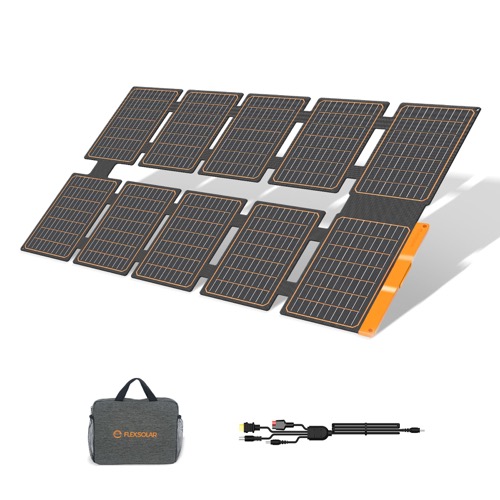
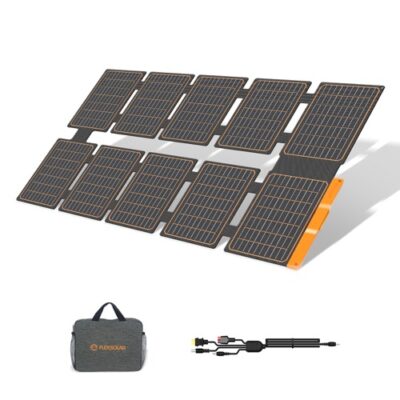
A blanket-style 100W that folds close to laptop size changes what the form factor can do — the FlexSolar slips into a pack where briefcase panels won't, which is why it takes Best Budget Foldable. Most folding 100W panels land in the 6-to-10-pound range, so this one is a genuinely different animal for backpackers, overlanders, and small-power-station owners.

Here's the mix that works: 24% mono cells, an IP67 rating with a tough ETFE laminate, USB-A QC3.0 and USB-C PD outputs, and a 4-in-1 DC cable with XT60, Anderson, DC5521, and DC8MM tips. Owners report 77-92W when they aim it well, dropping toward 60W in weaker sun or high latitudes.

The catch: there's no kickstand and no controller, so you'll lean it on a tent or ladder and pair it with a power station rather than a raw battery.

Wattage100W monocrystalline, 24% efficiency (~304 Wh/day at 4 PSH, 0.76 factor)
IP RatingIP67
ConnectorUSB-A QC3.0, USB-C PD (45W), DC with XT60, Anderson, DC5521, DC8MM tips
ControllerNone — built-in IC protection only; pair with a power station or separate controller
Cable & Mount6.6 ft (2 m) cable; no kickstand — eye holes and carabiners for hanging
Best Cheap 100W Kit

DOKIO 100W Solar Panel Kit Review: The Complete Beginner Setup That Works Straight Out of the Box

DOKIO 100W Solar Panel Kit Review: The Complete Beginner Setup That Works Straight Out of the Box

Get it now:

Check latest price

What to know

  • The PWM controller caps this 100W panel at a real 65-80W, so plan around roughly 272 Wh on a 4-PSH day
  • That's the lowest realistic daily yield among the 100W panels here — the trade for bundling a whole system cheaply
  • For the price of a bare 100W elsewhere you get the panel plus a controller, four cables, and a bag
  • Folds flat to about 19×26 in at 5.3 lb — one of the lighter, slimmer bodies in the 100W class
  • No kickstand and no IP cert — you prop it to aim it, and the daily figure assumes you angle it well

Best if

  • You want a complete working 100W system for the price others charge for the bare panel
  • You value a slim, light fold-flat body that stows easily for the watts it returns
  • You're maintaining a 12V lead-acid, AGM, or flooded battery and don't need every last watt

Skip if

  • You want the strongest daily harvest in the 100W class — the PWM cap puts it near the bottom
  • You want maximum output in variable light — a PWM controller trails an MPPT setup
  • You run LiFePO4 and want a full charge — the controller tops out short of lithium voltage

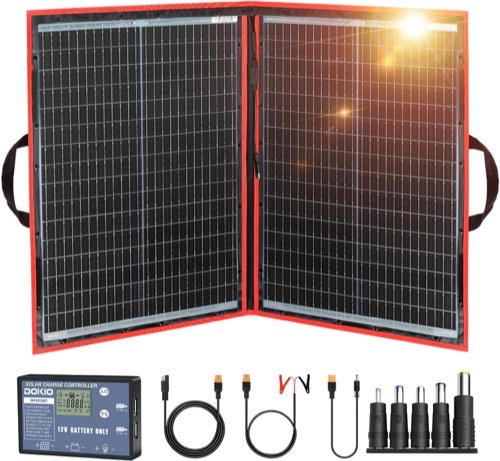
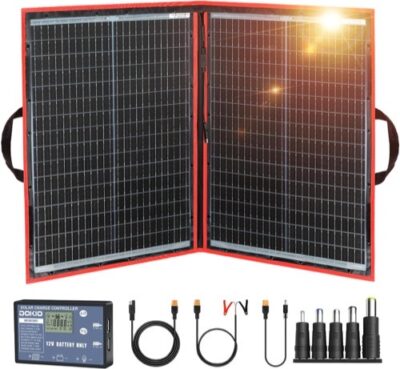
Most 100W panels at this price are just the panel — the DOKIO 100W earns Best Cheap 100W Kit by putting the whole system in one box for about the same money. Panel, a standalone PWM controller, four connector cables (SAE, XT60, DC barrel, alligator clips), and a carry bag, nothing else to source before your first charge. For a first-time 12V buyer, that completeness is the appeal in a sentence.

In full sun, owners consistently see 65-80W — normal for a PWM setup, and roughly 272 Wh across a 4-hour peak-sun day. The dual USB ports on the controller charge phones once a 12V battery is connected, and the 9.84 ft cable lets you shade the battery while the panel works.

Worth knowing: there's no certified IP rating, and the controller charges to a lead-acid profile — fine for AGM and flooded, less ideal for LiFePO4.

Wattage100W monocrystalline (~272 Wh/day at 4 PSH, 0.68 factor)
IP RatingNo certified IP rating — manufacturer implies weather resistance
ConnectorSAE plug, XT60, DC barrel (5.5mm), alligator clips (all included)
ControllerPWM (included); reverse-polarity, overcharge, overload, short-circuit protection; supports AGM, SLA, gel, flooded (LiFePO4 non-optimal)
Cable & Mount9.84 ft (3 m) cable; no bracket — folds flat, grommets for hanging
Best Premium 100W Panel

GRECELL SP-100 Review: A Budget 100W Folding Panel That Punches Above Its Price

GRECELL SP-100 Review: A Budget 100W Folding Panel That Punches Above Its Price

Get it now:

Check latest price

What to know

  • Owners pull 80-90W in good sun — roughly 328 Wh a day, among the higher real returns in the 100W class
  • One side-by-side test clocked it at 84W against a Jackery SolarSaga 100's 72W in the same light
  • That's about 80-90% of nameplate, the kind of real-world number panels costing twice as much deliver
  • Series/parallel ready — pair two through an MPPT to roughly double the charge rate as needs grow
  • The premium output comes without a certified IP rating, so it trades sealing for watts and price

Best if

  • You want top-of-class 100W output and ~328 Wh a day for well under premium-brand pricing
  • You plan to scale up by wiring a second panel in series or parallel through an MPPT
  • You want a verified high yield rather than an optimistic nameplate that fades in the field

Skip if

  • You need a sealed panel to leave mounted outdoors year-round — it's water-resistant only
  • You charge phones directly with no station — there's no onboard USB port
  • You can't tolerate finicky kickstands that fold back in when you lift the panel

Strong output at a budget price is what pushes the GRECELL SP-100 into the Best Premium 100W slot — owners report 80-90W in good sun, with one side-by-side test putting it at 84W against a Jackery SolarSaga 100's 72W in the same light. That's roughly 80-90% of the nameplate, which is the kind of real-world number you'd expect from a panel costing twice as much.

The spec-to-benefit story is simple: 23.5% mono cells under ETFE lamination feed a clean 20V output, the briefcase fold packs a zippered cable pouch, and a built-in MC4 cable plus DC and Anderson adapters plug into Jackery, Anker, Bluetti, Goal Zero, and EcoFlow. Two panels wire in series or parallel to roughly double the charge rate.

The catch is no certified IP rating, and the kickstands feel flimsy — bring it in when it rains and expect to fiddle with the legs.

Wattage100W monocrystalline, up to 23.5% (~328 Wh/day at 4 PSH, 0.82 factor)
IP RatingNo certified rating — Oxford cloth + ETFE lamination, water-resistant only
ConnectorMC4 (built-in); 2-in-1 DC 5.5*2.1mm/Anderson plus 3.5*1.35mm, 5.5*2.5mm, 8mm adapters
ControllerNone — direct DC output; feeds a power station input or external MPPT
Cable & MountCable length not specified (owners add 20-50 ft); built-in kickstands + grommets
Best for Power Stations

EBL 100W Portable Solar Panel Review: The Budget 100W That Punches Above Its Price Tag — Sometimes

EBL 100W Portable Solar Panel Review: The Budget 100W That Punches Above Its Price Tag — Sometimes

Get it now:

Check latest price

What to know

  • 100W A+ mono cells — 70-90W in good sun, one verified 99W reading, about 312 Wh/day
  • MC4 with Anderson and DC barrel adapters fits Jackery, EcoFlow River 2, Bluetti, GRECELL
  • IP65 with aluminum frame and ETFE laminate — handles dew, light rain, and snow glare
  • Still charges 26-60W under heavy cloud — keeps essentials topped through a grey day
  • No XT60 adapter and no onboard USB port — short kickstand legs for steep angles

Best if

  • You're topping up a 300-600Wh power station while camping or off-grid
  • You own a Jackery, EcoFlow, or Bluetti station and want a wide adapter kit out of the box
  • You want an IP65 aluminum-framed panel for dew and light rain

Skip if

  • You need to fully refill a large station from empty in one day — 100W tops up, won't fast-fill
  • Your station uses an XT60 input — no XT60 adapter is included, buy one separately
  • You're chasing low winter sun without props — the kickstand legs are too short to angle steeply

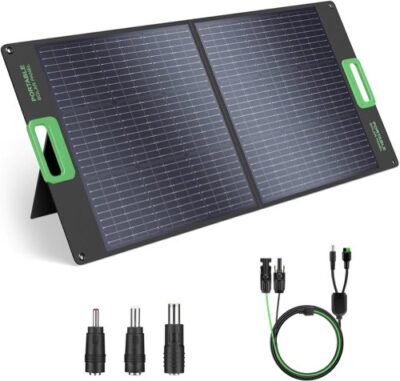
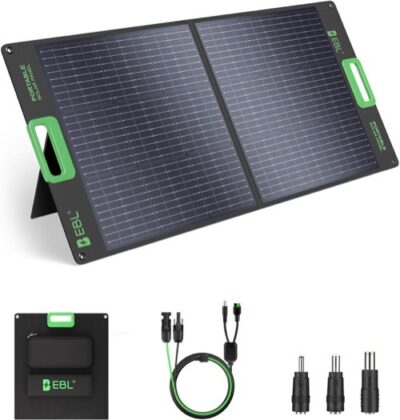
Pairs naturally with a portable power station — and that's where the EBL 100W earns its badge. The 18V output and a generous adapter kit (MC4 with Anderson and DC barrel pigtails, plus three barrel sizes) drop straight into Jackery, EcoFlow River 2, Bluetti, and GRECELL stations without an extra purchase, and one tester even clocked a verified 99W on a clear day.

In everyday use, the EBL feels like a dependable midsize charger: owners pull a steady 70-90W in good sun, roughly 312 Wh over a 4-hour peak-sun day, with 26-60W still trickling through heavy cloud. The aluminum frame and ETFE laminate carry an IP65 rating that handles dew, snow glare, and light rain.

One thing: the kickstand legs are too short for low winter sun, and there's no XT60 adapter in the box — budget a couple of 2x4s and a cheap adapter.

Wattage100W A+ monocrystalline, up to 23% (~312 Wh/day at 4 PSH, 0.78 factor)
IP RatingIP65 (splash and rain-jet resistant; not for soaking)
ConnectorMC4 with MC4-to-Anderson and MC4-to-DC5521 cables plus 3 barrel adapters (no XT60)
ControllerNone — direct to a power station, or pair your own MPPT/PWM for a 12V battery
Cable & MountCable runs short (extension often needed); fold-out kickstands + 4 corner grommets
Best Rigid 100W Panel

Renogy 100W 12V Solar Panel Review: The Industry Standard That Earned Its Reputation Over a Decade

Renogy 100W 12V Solar Panel Review: The Industry Standard That Earned Its Reputation Over a Decade

Get it now:

Check latest price

What to know

  • N-Type 16BB mono cells, 25% cell efficiency — often hits or beats 100W with MPPT, ~328 Wh/day
  • Aluminum frame and low-iron tempered glass — owners report 8-9+ years outdoors
  • Voc 22.79V (under 25V) works with most MPPT and PWM controllers
  • MC4 leads charge Jackery, EcoFlow, Bluetti, and Anker stations with the right adapter
  • Ships bare — no brackets, extension cable, or power-station adapter included

Best if

  • You're building a 12V RV, marine, or cabin system you'll mount once and trust for years
  • You already own an MPPT controller and want real at-or-above-rated output
  • You value a 5-year warranty and a decade-long durability record

Skip if

  • You want a foldable panel to grab and carry — this is a rigid 13 lb glass module
  • You expect everything in the box — no brackets, extension, or adapter ship with it
  • You're mounting in partial shade — output collapses where any cells sit in shadow

The rigid panel that keeps showing up on RV, marine, and cabin builds, the Renogy 100W 12V takes Best Rigid 100W on a decade of track record. Unlike the foldables here, this is an aluminum-framed, tempered-glass module owners report still running after 8 to 9 years outdoors — through tornadoes, snow, and 100-degree summers.

With an MPPT controller in good sun, the N-Type cells routinely hit or beat the nameplate — reports of 105W, 109W, even 118W on cold, clear days are common, and a realistic plan is around 328 Wh per peak-sun day. The Voc stays under 25V, so it pairs with most MPPT and PWM controllers, and an adapter feeds Jackery, EcoFlow, and Bluetti stations.

Not ideal if you want everything in one box — it ships bare, with no brackets, extension, or adapter, and shipping damage is the most common complaint.

Wattage100W N-Type monocrystalline, 25% cell / 20% module (~328 Wh/day at 4 PSH, 0.82 factor)
IP RatingIP65 (junction box; aluminum frame, low-iron tempered glass front)
ConnectorMC4-style leads (adapter needed for power stations)
ControllerNone — pair with your own MPPT (recommended) or PWM; supports lead-acid, AGM, gel, LiFePO4
Cable & MountShort factory leads (add 10-15 ft); pre-drilled frame holes, no brackets included
Best Bifacial 100W Panel

HQST Bifacial 100W Solar Panel Review: The 12V Panel That Pulls Extra Power From Reflected Light

HQST Bifacial 100W Solar Panel Review: The 12V Panel That Pulls Extra Power From Reflected Light

Get it now:

Check latest price

What to know

  • Bifacial PERC cells add real rear-side output over a reflective surface with an air gap
  • Typical 80-90W front output, ~328 Wh/day with MPPT — 100W+ when the rear side is active
  • IP68 junction box, aluminum frame, 2400 Pa wind and 5400 Pa snow load ratings
  • Scales cleanly into 400W+ series/parallel arrays for sheds, cabins, and golf carts
  • Short MC4 leads; bare panel with no brackets, wiring, controller, or adapters

Best if

  • You can pole- or ground-mount over gravel, sand, or snow where the rear side catches light
  • You want a tough panel for an off-grid shed or 12V/24V bank that scales into a big array
  • You're buying on durability for a permanent install

Skip if

  • You'll bolt it flat to a dark roof with no air gap — the bifacial bonus mostly disappears
  • You want an all-in-one kit — no brackets, controller, wiring, or adapters are included
  • You're counting on the 30-year claim — defect coverage is far shorter than the output marketing

Rear-side gain is what sets the HQST Bifacial 100W apart, so it lands the Best Bifacial 100W badge — but only when you mount it right. Give the back of the panel reflected light over gravel, sand, snow, or a silver tarp with an air gap, and owners report real extra output; one cloudy-region buyer measured up to 25% more than his non-bifacial panels on overcast days.

Common problem with bifacial at this size is that the bonus vanishes flat on a dark roof — which is exactly why the air-gap detail matters. Mount it on a pole or tilt bracket and the 9-busbar PERC cells deliver a typical 80-90W front output (around 328 Wh/day with MPPT) plus a rear-side bonus on top. The IP68 junction box, aluminum frame, and 2400 Pa wind / 5400 Pa snow ratings handle permanent outdoor duty, and owners run big series/parallel arrays.

To be fair, the HQST isn't perfect: the MC4 leads run short, it ships bare, and the defect warranty is far shorter than the "up to 30 years" output claim.

Wattage100W bifacial monocrystalline, up to 25% (~328 Wh/day at 4 PSH, 0.82 factor; rear-side gain on top)
IP RatingIP68 (junction box; dust-tight and water resistant)
ConnectorMC4 (leads run short — plan on extensions for roof routing)
ControllerNone — pair with your own PWM or MPPT (recommended); supports lead-acid, AGM, LiFePO4
Cable & MountShort MC4 leads; pre-drilled long-side holes, no brackets — tilt brackets recommended
Best Low-Cost Amazon Pick

100W Portable Solar Panel Review: What You’re Actually Getting From an Unbranded Panel at a Budget Price

100W Portable Solar Panel Review: What You’re Actually Getting From an Unbranded Panel at a Budget Price

Get it now:

Check latest price

What to know

  • 20V mono cells — owners report a real 65-86W in good sun, about 288 Wh/day at 4 PSH
  • MC4, Anderson, and a pouch of DC adapters fit Jackery, EcoFlow, Bluetti, Anker, Goal Zero, Rockpals
  • No certified IP rating — ports aren't sealed, keep it out of heavy rain
  • Series/parallel ready, with reinforced grommets and a zippered cable pouch (~10.3 lb)
  • Unbranded QC varies batch to batch — no onboard USB, warranty depends on the seller

Best if

  • You want a cheap, capable panel to keep a power station charged on weekend trips
  • You already own a Jackery, EcoFlow, Bluetti, or Goal Zero station to plug into
  • You'll test the panel the day it lands and buy from a seller with a clear return window

Skip if

  • You'd leave it staked out through heavy rain — there's no IP rating and the ports aren't sealed
  • You want to charge a phone directly — there's no onboard USB port
  • You need rock-solid, certified specs and a brand-backed warranty for a permanent install

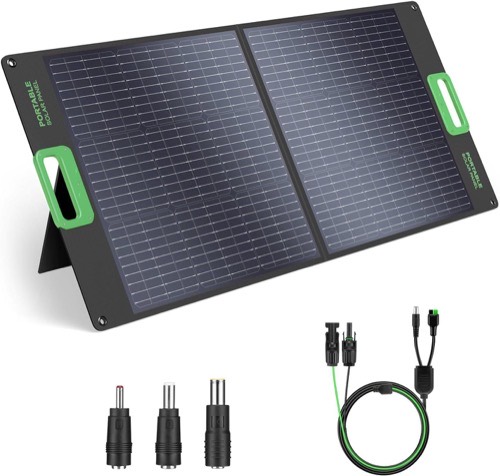
This proves a capable 100W foldable can land at roughly half the name-brand price — which is the whole case for the Best Low-Cost Amazon Pick. It's an unbranded briefcase-style panel built for power-station charging on camping, RV, and outage-backup duty, and in good sun owners report a genuine 65-86W from the 20V mono cells, around 288 Wh on a 4-hour peak-sun day.

Compatibility is the strong suit: an MC4 cable plus an Anderson lead and a pouch of DC adapters (8mm, 5.5×2.1mm, and more) connect to Jackery, EcoFlow, Bluetti, Anker, Goal Zero, and Rockpals. The metal-backed cells feel sturdier than the price suggests, and the panel wires in series or parallel to grow later.

The catch is the unbranded trade-off: there's no certified IP rating, the ports aren't sealed, and quality control wanders batch to batch — so test it the day it arrives, because the seller is your only safety net.

Wattage100W monocrystalline, up to 23.5% claimed (~288 Wh/day at 4 PSH, 0.72 factor)
IP RatingNo certified rating — Oxford cloth + ETFE lamination, owners report not rainproof
ConnectorMC4; 2-in-1 Anderson cable; DC adapters (5.5×2.1mm, 3.5×1.35mm, 5.5×2.5mm, 8mm) — no USB
ControllerNone — direct output; pair with a power station or separate MPPT/PWM for 12V batteries
Cable & MountCable runs short (owners add 20-50 ft); two built-in kickstands + hanging grommets

Product Comparison

Feature ZOUPW 100W Solar Panel Review: Five Connectors, Zero Adapter Hassle FlexSolar 100W Solar Panel Review: The 4-Pound Panel Hikers and Backpackers Actually Want DOKIO 100W Solar Panel Kit Review: The Complete Beginner Setup That Works Straight Out of the Box GRECELL SP-100 Review: A Budget 100W Folding Panel That Punches Above Its Price EBL 100W Portable Solar Panel Review: The Budget 100W That Punches Above Its Price Tag — Sometimes Renogy 100W 12V Solar Panel Review: The Industry Standard That Earned Its Reputation Over a Decade HQST Bifacial 100W Solar Panel Review: The 12V Panel That Pulls Extra Power From Reflected Light 100W Portable Solar Panel Review: What You're Actually Getting From an Unbranded Panel at a Budget Price
Product Image
ZOUPW 100W Solar Panel Review: Five Connectors, Zero Adapter Hassle
FlexSolar 100W Solar Panel Review: The 4-Pound Panel Hikers and Backpackers Actually Want
DOKIO 100W Solar Panel Kit Review: The Complete Beginner Setup That Works Straight Out of the Box
GRECELL SP-100 Review: A Budget 100W Folding Panel That Punches Above Its Price
EBL 100W Portable Solar Panel Review: The Budget 100W That Punches Above Its Price Tag — Sometimes
Renogy 100W 12V Solar Panel Review: The Industry Standard That Earned Its Reputation Over a Decade
HQST Bifacial 100W Solar Panel Review: The 12V Panel That Pulls Extra Power From Reflected Light
100W Portable Solar Panel Review: What You're Actually Getting From an Unbranded Panel at a Budget Price
Price $105.99 $89.99 $84.99 $68.77 $129.99 $85.99 $139.99 $89.99 $87.99 $74.79 $59.99 $49.99 $129.99 $85.99
Rating
4.6 / 5
4.6 / 5
4.2 / 5
4.5 / 5
4.6 / 5
4.6 / 5
4.5 / 5
4.5 / 5
Category Solar Panels Solar Panels Solar Panels Solar Panels Solar Panels Solar Panels Solar Panels Solar Panels
Brand ZOUPW FlexSolar DOKIO GRECELL EBL Renogy HQST Unbranded / generic (sold under rotating house-brand labels)
Model / SKU ZOUPW-F100W (ASIN: B0CR42CFJ9) lx-S100 (ASIN: B0DX6W8HM4) FFSP110M (ASIN: B0748FYFSK) SP-100 (ASIN: B0B5H1BC51) ESP-100 (ASIN: B0G64S2WTV) RNG-100D-SS (ASIN: B07GF5JY35) HSP100D-30AT (ASIN: B08SVXMK3V) SP-100 (ASIN: B0B5H1BC51)
Product type Portable solar panel Portable solar panel Portable foldable solar panel kit (panel + PWM controller + cables + bag) Portable foldable monocrystalline solar panel — for charging portable power stations and solar generators Portable foldable solar panel — for power stations and 12V battery charging Rigid monocrystalline solar panel for RV, marine, rooftop, farm, and off-grid 12V systems Rigid bifacial monocrystalline solar panel — 12V battery charging for off-grid, RV, boat, and ground/pole arrays Portable foldable solar panel — for charging portable power stations and solar generators
Solar cell type Monocrystalline silicon (A+ grade claimed) Monocrystalline Monocrystalline silicon Monocrystalline silicon with ETFE lamination Monocrystalline silicon (A+ grade) Monocrystalline silicon — A+ grade N-Type 16BB cells Monocrystalline silicon — Grade A+ 9-busbar PERC cells, bifacial Monocrystalline silicon
Maximum power output 100 W 100 W 100 W (marketed); productDetails list 110W Pmax under STC 100 W (rated); 80-90W typical real-world based on customer reports 100 W (rated); 70-90W typical real-world based on customer testing 100 W (at STC; owners commonly measure 95-118W with MPPT in good sun) 100 W (rated; manufacturer claims up to ~115W with bifacial gain; 80-90W typical real-world based on customer reports) 100 W (rated); 65-86W typical real-world in good sun based on customer testing
Open-circuit voltage (Voc) 24.3 V Not specified Not specified (estimated ~22 V typical for 18V Vmp monocrystalline) Not specified Not specified (one owner measured ~19.7 Voc in the field) 22.79 V Not specified (owners measure roughly 19-22V in sun; one report of ~19.25V under load) Not specified
Maximum operating voltage (Vmp) 20.16 V Not specified 18 V 20 V (stated maximum voltage / output voltage) 18 V 19.97 V Not specified (owner multimeter reading ~17.75V at the maximum power point) 20 V
Output voltage 20.16 V DC (solar operating voltage); USB-C and USB-A regulated device outputs also included</span > 20 V DC (USB output also available) 12 V DC (after PWM controller regulation) 20 V DC 18 V (DC) 12 V (designed for 12V battery systems via charge controller) 12 V nominal 20 V DC
Maximum current (Imp) 4.96 A 5 A (calculated: 100W ÷ 20V output voltage) 6.1 A 5 A (amperage capacity; connector rated to 25A max) 5.56 A (calculated: 100W ÷ 18V; one owner measured 5.5A) 5.01 A Not specified (owner reading ~5.4A at the maximum power point) 5 A (listed amperage capacity)
Short-circuit current (Isc) 5.25 A Not specified Not specified Not specified Not specified 5.31 A Not specified (one owner measured ~6.2A; another cited ~6A range) Not specified (connector rated to 25A max)
Cell efficiency 23.5% 24% Not specified (standard monocrystalline tier — typically 18-20%) Up to 23.5% (manufacturer-stated monocrystalline) Up to 23% (manufacturer claim, monocrystalline A+) 25% cell efficiency (20.0% module efficiency) Up to 25% (manufacturer rating) Up to 23.5% claimed (monocrystalline — not independently verified)
Charge controller included Yes — built-in intelligent controller for USB/direct charging (MPPT/PWM type not specified) No separate solar charge controller included Yes — PWM controller (standalone unit, separate from panel) No — direct DC output; feeds a power station input or separate controller No (direct charging to power station; use your own controller for a 12V battery) No (pair with your own MPPT or PWM controller) No — pair with your own PWM or MPPT controller No — direct panel output; pair with a power station or a separate controller for 12V batteries
Controller features USB-C and USB-A charging, overcurrent protection, short-circuit protection (other controller details not specified) N/A (built-in IC chip provides over-voltage, over-current, and short-circuit protection) Reverse polarity, overcharge, overload, short-circuit protection; dual USB 5V output; LED status indicators; 14.4V charge ceiling (lead-acid profile) N/A (no onboard controller; pair with the station's input or an external MPPT/PWM) N/A (no controller included; panel pairs with a power station's built-in input or a separate MPPT/PWM controller) N/A (no controller included; Voc under 25V is compatible with most MPPT/PWM controllers) N/A (no controller in box; MPPT recommended for best yield and series strings) N/A (no built-in controller; bullets mention a smart chip for device identification)
Connector type XT60, Anderson, DC5521, DC7909/8mm, DC8020, USB-C, USB-A USB-A, USB-C, DC output with XT60, Anderson, DC5521, and DC8MM tips SAE plug, XT60, DC barrel (5.5mm), alligator clips (all included in kit) MC4 (built-in cable); 2-in-1 DC 5.5*2.1mm/Anderson; adapters for 3.5*1.35mm, 5.5*2.5mm, 7.9*0.9mm (8mm) MC4 (with MC4-to-Anderson and MC4-to-DC5521 cables; barrel adapters: 5.5x2.1 to 3.5x1.5, 5.5x2.5, and 7.9x0.9) Solar connectors (MC4-style) on pre-attached leads MC4 MC4; 2-in-1 Anderson cable; DC adapters (5.5×2.1mm, 3.5×1.35mm, 5.5×2.5mm, 7.9×0.9mm / 8mm)
Cable length 10 ft adapter cable (plus short panel lead) 2 m / 6.6 ft 9.84 ft (3 m) — panel to controller Not specified (owners frequently add 20-50 ft extension cables) Not specified (owners report it runs short; an extension is often needed) Not specified (short factory leads; owners typically add 10-15 ft extension cables) Not specified (owners consistently report short leads — plan on MC4 extensions for roof routing) Not specified (owners report it runs short — 20-50 ft extension commonly added)
Waterproof rating IP67 (panel body; USB hub and connected cables should be kept dry)</span > IP67 No certified IP rating (manufacturer implies weather resistance; no standard cited) No certified IP rating (water-resistant Oxford cloth + ETFE lamination; keep ports out of rain) IP65 (splash and rain-jet resistant; not rated for soaking or submersion) IP65 (junction box — rain and water-jet resistant, not for submersion) IP68 (junction box — dust-tight and water resistant) No certified IP rating (Oxford cloth + ETFE lamination claimed weather resistant; owners report NOT rainproof)
Operating temperature range 14°F to 158°F Not specified Up to 50°C (122°F) upper rating listed; lower limit not specified Upper rating 60°C (140°F) (owners report output throttling in very hot, still conditions above ~85°F ambient) Not specified -40°F to 194°F (-40°C to 90°C) Not specified Upper rating 60°C (140°F) (owners report output throttles in hot, still weather above ~85°F)
Dimensions (L × W × H) 48.43" × 21.06" × 0.98" unfolded; 24.13" × 21.06" × 1.77" folded Folded: 12.99" × 10.43" × 2.17"; unfolded: 45.47" × 26.18" × 0.59" 18.9" × 26" × 0.47" (folded) 50.5" × 21.1" × 0.2" (unfolded); ~25.25" × 10.55" × 3" (folded) 23.23" × 23" × 1.2" (unfolded panel) 34.1" × 22.8" × 1.2" (865 × 578 × 30 mm) 38.2" × 22.7" × 1.18" (a few owners report receiving panels that measured wider/squarer than listed — verify before a tight install) 50.5" × 21.1" × 0.2" (unfolded); ~25.25" × 10.55" × 3" (folded)
Weight 9.48 lb 4.1 lb 5.3 lb (2.4 kg) (title); 6 lb listed in product details 10.3 lb 5.04 kg (~11.1 lb) (several owners weighed theirs at 8.4-8.6 lb) 13 lb (5.9 kg) 12.1 lb (owner reports range from roughly 12 to 15 lb) 10.3 lb
Frame material Fabric-backed foldable construction (rigid frame material not specified) Not specified Fabric folding construction — no aluminum frame Foldable fabric panel (durable Oxford cloth backing — no rigid metal frame) Aluminum Corrosion-resistant aluminum alloy (over 1.1mm thick) Anti-corrosion aluminum alloy Not specified (fabric-backed foldable panel; owners note metal backing behind the cells)
Surface / glass material ETFE coating material over monocrystalline solar cells ETFE laminate Monocrystalline silicon cells — specific surface laminate not specified ETFE lamination over monocrystalline cells ETFE laminate over monocrystalline silicon; tempered glass listed in materials Low-iron tempered glass Tempered glass (bifacial — light-transmitting front and rear) ETFE lamination over monocrystalline cells; durable waterproof Oxford cloth backing
Mounting type Fold-out kickstands (portable ground/patio/campsite setup) Eye holes and carabiners; no kickstand or adjustable mount included No bracket included — folds flat; grommets for hanging Built-in kickstands (one per side); reinforced grommets for hanging/tie-down Fold-out kickstands plus 4 reinforced corner grommets for hanging (legs are short for steep winter angles) Pre-drilled frame holes (no brackets included; use Z-brackets, tilt mounts, or custom frame) Pre-drilled holes on the long sides — no brackets included; tilt brackets recommended for ground/pole use Two built-in kickstands; reinforced grommets for hanging on RV or tent
Compatible devices / batteries Portable power stations using XT60, Anderson, DC5521, DC7909, or DC8020 inputs; direct USB charging for phones, tablets, GPS units, cameras, and small accessories Small power stations, phones, tablets, laptops, power banks, Starlink Mini battery packs, and compatible DC solar inputs (verify voltage and connector before use) 12V lead-acid batteries (AGM, SLA, Gel, flooded); LiFePO4 (non-optimal charge profile); portable power stations with solar input up to 100W Portable power stations and solar generators (Jackery, Anker, Bluetti, Goal Zero, Rockpals, EcoFlow and more via included adapters); 12V batteries when paired with a separate charge controller Most portable power stations (Jackery, EcoFlow, Bluetti, GRECELL); 12V batteries via a separate charge controller; marine and deep-cycle batteries 12V battery banks — flooded lead-acid, AGM, gel, and LiFePO4 (via compatible controller); charges Jackery, EcoFlow, Bluetti, Anker, Vtoman, and Togo power stations with an adapter 12V lead-acid, AGM, and LiFePO4 batteries via controller; major power stations (Jackery, EcoFlow, Bluetti, Pecron, AFERIY) via adapter Portable power stations / solar generators (Jackery, EcoFlow, Bluetti, Anker, Goal Zero, Rockpals and similar); 12V batteries (AGM, lead-acid, gel, LiFePO4) with an added charge controller
Required sunlight hours Varies by battery capacity (4 peak sun hours can deliver roughly 300 Wh/day in good conditions)</span > Varies by device load and battery capacity (4 peak sun hours used for daily output estimates) 4 peak sun hours/day delivers ~272 Wh (estimated at 0.68 real-world factor) 4 peak sun hours/day delivers ~328 Wh (estimated at 0.82 real-world factor) 4 peak sun hours/day delivers ~312 Wh (estimated at 0.78 real-world factor) ~4 peak sun hours/day yields roughly 328 Wh (estimated at 0.82 real-world factor with MPPT) 4 peak sun hours/day delivers ~328 Wh (estimated at 0.82 real-world factor with an MPPT controller) 4 peak sun hours/day delivers ~288 Wh (estimated at 0.72 real-world factor)
Wind / snow load rating Not specified Not specified Not specified Not specified Not specified Not specified (owners report surviving high winds, snow, and tornadoes) 2400 Pa wind load; 5400 Pa snow load Not specified
Safety certifications Not specified Not specified Not specified Not specified Not specified Not specified Not specified Not specified
Special features 23.5% efficiency, foldable design, magnetic handle, zippered cable pouch, 5-in-1 adapter cable, direct USB charging, ETFE surface, IP67 panel body Foldable laptop-size design, 24% efficiency, IP67 waterproofing, ETFE surface, USB-A QC3.0, USB-C PD3.0, 4-in-1 DC cable Complete kit (no additional purchases needed); dual USB output on controller; multiple connector types for broad compatibility Briefcase bifold design; built-in zippered cable pouch; built-in kickstands; reinforced grommets; series/parallel expandable; wide adapter set; responsive customer service A+ grade monocrystalline cells, ETFE laminate, IP65 water resistance, foldable briefcase design with magnetic clasp, zippered accessory pouch, series/parallel connection support N-Type 16BB cell technology; low -0.29%/°C temperature coefficient; 11% smaller and 8% lighter than prior P-type design; maximum system voltage 600VDC; maximum series fuse rating 15A Bifacial dual-sided output; 9-busbar PERC cells; bypass diodes for partial shade; enhanced low-light performance; rear-side albedo gain on reflective surfaces Foldable briefcase design; built-in handle and snap/magnetic closure; zippered cable pouch; series and parallel support; reinforced tie-down grommets
Included in the box 1× ZOUPW 100W solar panel, 1× 10 ft 5-in-1 solar connector cable, user manual 1× 100W solar panel, 1× 4-in-1 DC cable, 2× carabiners, 1× storage bag, 1× manual 1× foldable solar panel, 1× PWM charge controller, 1× SAE cable, 1× XT60 cable, 1× DC barrel cable, 1× alligator clip cable, 1× carry bag 1× 100W 20V foldable solar panel, 1× 2-in-1 cable (DC 5.5*2.1mm/Anderson), 1× DC5.5*2.1mm to 3.5*1.35mm adapter, 1× DC5.5*2.1mm to 5.5*2.5mm adapter, 1× DC5.5*2.1mm to 7.9*0.9mm (8mm) adapter 1× 100W foldable solar panel, 1× MC4-to-Anderson cable, 1× MC4-to-DC5521 cable, 1× 5.5x2.1 to 3.5x1.5 adapter, 1× 5.5x2.1 to 5.5x2.5 adapter, 1× 5.5x2.1 to 7.9x0.9 adapter, 1× user manual 1× 100W N-Type solar panel with pre-attached MC4 leads (no controller, brackets, or adapters) 1× 100W bifacial solar panel, MC4 connectors 1× 100W 20V foldable solar panel, 1× 2-in-1 cable (DC 5.5×2.1mm / Anderson), 1× DC5.5×2.1mm to 3.5×1.35mm adapter, 1× DC5.5×2.1mm to 5.5×2.5mm adapter, 1× DC5.5×2.1mm to 7.9×0.9mm (8mm) adapter
Warranty 12-month manufacturer warranty plus lifetime technical support 1 year 1 year Not specified (owner reports vary; one received a 2-year GRECELL panel — confirm coverage at purchase) Not specified 5-year material and workmanship warranty 3-year manufacturer warranty (listing details state 3-year; a long-term owner was told 5-year on defects — confirm current terms; marketing cites up to 30 years of output) Not specified (varies by seller / listing — verify before buying)
Expected lifespan Not specified Not specified Not specified (customer reports suggest 3-5 years typical with light outdoor use) Not specified (panels generally last 25-30 years; a few owners reported early output drops or failures within months) Not specified Not specified (owners report 8-9+ years of reliable outdoor service) Up to 30 years of output (manufacturer claim; one multi-year owner reported snail trails developing) Not specified (most reviews positive; isolated reports of output drop within weeks or failure within months)
Unit count 1 1 1 (kit) 1 1 1 1 (also sold in 2-pack and 4-pack) 1
Best for Car camping, RV trips, power outage backup, Jackery/EcoFlow/Anker/Bluetti charging, phones and small electronics, off-grid weekend use, and moderate emergency power station top-ups Backpacking, camping fridges, small power stations, Starlink Mini battery packs, overlanding, emergency charging, and compact vehicle solar kits 12V lead-acid battery maintenance, RV/van/camper solar charging, portable power station top-up, emergency backup, beginner first solar setup Budget-conscious camping, RV and van life, off-grid backup, and emergency power-station charging Topping up a 300-600Wh power station while camping or RVing, off-grid cabin power, 12V/marine battery maintenance via a controller, and emergency outage backup RV and van builds, marine battery banks, off-grid cabins and sheds, greenhouse and pump power, and charging portable power stations with an adapter 12V battery maintenance, off-grid sheds and cabins, RV/boat/van roofs with clearance, ground- and pole-mounted reflective-surface arrays Charging portable power stations on camping, RV, and van trips; off-grid supplemental power; home emergency and power-outage backup
Buy Now View Deal View Deal View Deal View Deal View Deal View Deal View Deal View Deal

The Smart Buy

The core split decides almost everything among the best 100w portable solar panels: foldable for power stations and camping versus rigid for a fixed 12V install. For most buyers the ZOUPW is the best overall foldable, the FlexSolar wins on budget and weight at just 4.1 lb, the EBL suits MC4 power-station setups, and the GRECELL is the premium-build pick. If the panel will live bolted down, the rigid Renogy gives you the most output per dollar, or the HQST bifacial adds rear-side gain on bright ground. First-time 12V buyers should grab the DOKIO kit for the controller in the box, and cost-first shoppers can lean on the unbranded Amazon pick. Browse the full lineup any time at our solar panels hub.

One practical warning at this tier: don't treat the "100W" label as the whole story. A panel's real day comes from its cell quality, its controller path, and the connector matching your gear — that's why two identical-on-paper panels hand you different days. Before you buy, confirm your station's input connector, check whether the panel carries a certified IP rating if it'll live outside, and add a charge controller for any bare 12V battery. Get those three right and your 100W panel delivers what it promised.

Frequently Asked Questions

How much can a 100W solar panel charge per day?

Roughly 328 Wh on a clear 4-peak-sun-hour day when it feeds a power station's built-in MPPT, using a real-world factor near 0.82. Run the same panel through a basic PWM controller into a 12V battery and you'll see closer to 272 Wh. On a bright 5-PSH afternoon a clean foldable like the ZOUPW can clear 400 Wh, while heavy overcast at 2 effective hours drops you to about 160 Wh. The takeaway: rated watts are not delivered watts.

What can a 100W portable solar panel run?

A 100W panel doesn't run devices directly so much as it refills a battery or station. With about 328 Wh a day it recovers a full EcoFlow RIVER 2 (256Wh), roughly 65% of a 500Wh Jackery Explorer 500, or about a third of a 1000Wh station. In device terms that's around 20+ phone charges, 5-6 laptop charges, or a small efficient 12V fridge on a clear day. In real use, it tops off gear rather than powering big AC loads.

Is 100W enough for a power station?

It depends on the station size. For a 256Wh unit like the RIVER 2, one 100W panel is plenty — a full recharge with headroom on a good day. For a ~500Wh station you'll recover about two-thirds daily, so figure roughly 1.5 sunny days to full. For a 1000Wh station, one panel only returns about a third per day, so pair two 100W panels to keep up with real use. Honestly, match the panel count to the capacity, not the brand.

Foldable vs rigid 100W — which should I buy?

Buy from the use case, not the price. Foldables like the ZOUPW (9.48 lb) and FlexSolar (4.1 lb) pack down and deploy on kickstands or carabiners, which is ideal for power-station charging and camping. Rigid frames like the Renogy (13 lb) and HQST bifacial (12.1 lb) are heavier but cheaper per watt and built for a fixed-angle 12V mount on a roof or shed. If you carry it, go foldable; if you bolt it down once, go rigid.

Do I need a charge controller with a 100W panel?

Not for a power station — its built-in MPPT handles charging, so you just match the connector (XT60 for EcoFlow, DC8020 for Jackery). For a bare 12V battery you do need one, because a 100W panel wired straight to a battery can overcharge it and backfeed at night. The DOKIO kit includes a PWM controller; the Renogy, EBL, GRECELL, HQST, and unbranded panels are bare. For a LiFePO4 bank, use an MPPT controller with an LFP charge profile.

How long does it take to charge a Jackery or EcoFlow with 100W?

For a ~500Wh Jackery Explorer 500 or EcoFlow RIVER, expect roughly 1.5 sunny days from a single 100W panel, since one good 4-PSH day returns about 328 Wh, or near two-thirds. A 256Wh RIVER 2 can hit full in one good day. Charge speed swings with sun: a bright 5-PSH afternoon pushes closer to 400 Wh, while haze or clouds stretch it out. Adding a second 100W panel roughly halves the time.

Can I connect two 100W panels together?

Yes, and it's a common upgrade. Two 100W foldables in parallel double your current while holding the same ~18-20V, which keeps you inside most stations' input range and roughly doubles daily output toward 650 Wh on a good day. Series wiring raises voltage instead — useful for a 12V controller but check your station's voltage ceiling first. To be fair, two panels means two sets of cables and a parallel branch connector, but the flexibility to angle and split them is worth it.

Do 100W panels work in winter or cloudy weather?

They work, just at reduced output. Cold actually helps cell efficiency slightly, but short winter days and low sun angles cut your peak sun hours hard. Heavy overcast at about 2 effective sun hours drops a 100W panel to roughly 160 Wh — enough to top phones and lights, not recharge a station. Two grey days in a row can leave a station well behind. On winter or multi-day trips, plan for a second panel or a wall-outlet backup.

×

About Solar Power Picks

Portable Solar Power, Backup Power, and Off-Grid Gear Guides

Your trusted source for honest, in-depth product reviews and comparisons.

Quick Links

  • Best Picks
  • Reviews
  • Guides
  • Comparisons
  • Calculator
  • Privacy policy
  • Favorites

Categories

  • Portable Power Stations
  • Solar Panels

© 2026 Solar Power Picks. All Rights Reserved.

We may earn a commission when you purchase through links on our site. Learn more