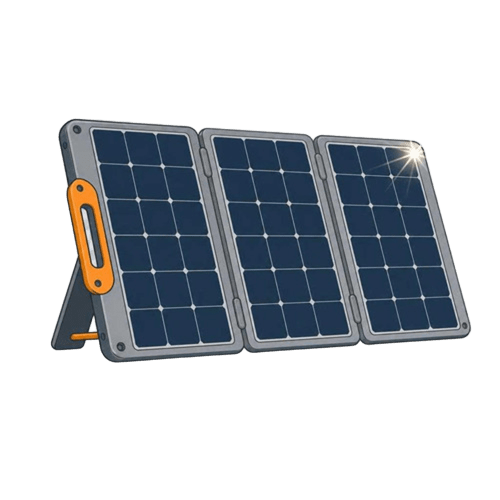
DOKIO 100W Solar Panel Kit Review: The Complete Beginner Setup That Works Straight Out of the Box
At a Glance
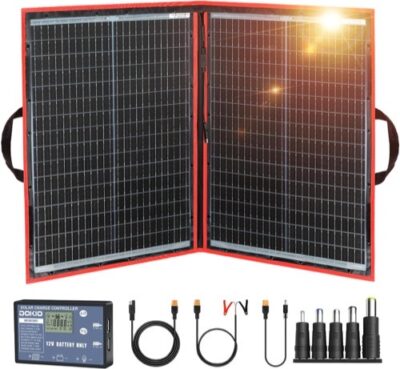
KEY FEATURES
- 110W FFSP110M folding panel.
- 18V Vmp, 22.5V Voc, 6.12A Imp, and 6.35A Isc.
- Approximately five-pound folded package.
- Includes 10A PWM controller and adapter set.
- Best for occasional portable charging and simple supported systems.
PROS
- Very light for the wattage
- Many connection options
- Basic controller included
- Exact electrical values published
- PWM controller is basic
- Connector variation appears in owner reports
- Fabric is not permanent-mount construction
- LiFePO4 buyers must verify profile
CONS
- PWM controller is basic
- Connector variation appears in owner reports
- Fabric is not permanent-mount construction
- LiFePO4 buyers must verify profile
Best lightweight starter kit
Based on exact documentation, retained exact-ASIN evidence, and the expanded qualitative Amazon owner-text review; no hands-on test claimed
This DOKIO 100W review covers the one portable solar kit that consistently shows up on beginner shopping lists for one very practical reason: it includes everything you need to start charging a 12V battery without buying anything extra. Panel, charge controller, cables in four connector formats, and a carry bag — all for around $68. That’s a meaningful value proposition in a market where most panels are sold bare and leave you researching adapters.
Here’s the frustration that this kit sidesteps: you find a 100W panel that looks great, add it to your cart, then discover you also need a PWM or MPPT charge controller, an XT60 cable to connect to your power station, and possibly a SAE adapter for your RV battery. Each purchase takes research, and one wrong compatibility choice means nothing works. The DOKIO 100W ships with all of that figured out.
That said, honest is honest. The included PWM controller is a trade-off. It works reliably, and the protection features are solid — but it won’t harvest as much power as an MPPT controller in variable or overcast conditions. In full sun, expect 65-80W actual output from this 100W panel rather than the theoretical 100W. For a beginner setting up solar for the first time, that trade-off is usually worth the simplicity.
The current panel is treated as a 110W model using its own label values and included-component information.
Handling, textile construction, controller, and connector themes can inform questions, but another wattage’s readings are not transferred to this model.
The available owner evidence is unusually rich but also unusually easy to misuse. It contains reviews that explicitly identify 200W, 220W, and 300W DOKIO folders. Those reports explain why buyers should inspect SAE connections, support the fabric, verify the controller, and store the panel dry. They cannot establish FFSP110M output. This review therefore separates current exact-model specifications from family-level owner observations at every numeric decision.
Included path
- Folding panel
- Basic PWM controller
- Battery clips and adapter routes
Still your responsibility
- Exact battery profile
- Polarity and plug inventory
- Overcurrent protection and conductor sizing
- A support surface that does not over-bend the laminate
Several longer owner updates are especially useful because they distinguish portability from durability. The folder can be convenient to carry even when its connectors, unsupported geometry, or textile construction make it a poor permanent array. Reports of loose connections, heat-softened plugs, controller confusion, and output decline are reasons for a supervised stress test and periodic inspection, not evidence that every kit will behave the same way.
What's in the Box — and Why It Matters
The DOKIO 100W kit comes with more than just a panel:
| Item | Details |
|---|---|
| Foldable solar panel | Monocrystalline, 18V, 6.1A |
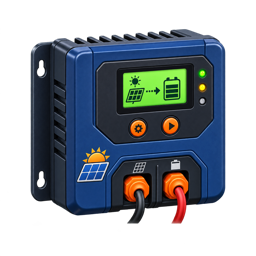
| PWM charge controller | Standalone unit with LED status display and dual USB output |
| SAE cable | For standard 12V automotive/RV battery connectors |
| XT60 cable | For portable power stations that use XT60 input |
| DC barrel cable | 5.5mm connector for compatible devices |
| Alligator clip cable | Direct battery terminal connection |
| Carry bag | Fits panel when folded |
For anyone who’s priced solar components separately, this matters: a standalone PWM controller runs $8-15. A set of cable adapters (SAE, XT60, DC, alligator clips) adds another $15-20. Factor in the carry bag, and the kit saves $20-30 over assembling the same components piece by piece.
The more important thing this kit provides isn’t money — it’s certainty. Every cable in the box is already verified compatible with the panel’s output. There’s no guesswork about whether your XT60 connector matches, or whether the controller is rated for the panel’s amperage. That certainty has real value for someone who just wants to start charging.
Worth Knowing — Some buyers have reported receiving an incorrect XT60 connector type (the XT60 plug vs. socket can be confused). Check your specific power station’s input connector type before assuming a match, and contact DOKIO support if yours doesn’t fit. Most reports of this issue were resolved quickly.
MPPT vs. PWM: What This Unit Uses
This is probably the most important technical point in this DOKIO 100W review, and it’s worth spending time on because it directly explains the output gap between claimed and real-world wattage.
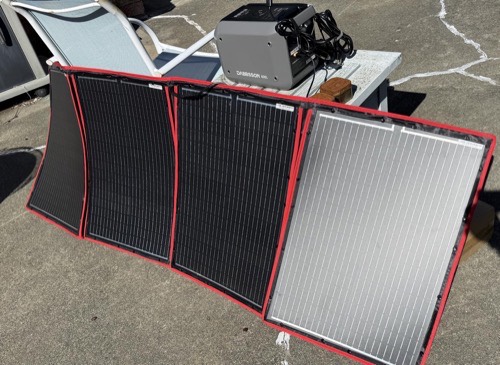
PWM (Pulse Width Modulation) controllers work by rapidly switching the connection between panel and battery on and off. They bring the panel’s voltage down to match the battery voltage, which means a significant portion of available panel voltage is wasted as heat, especially when battery voltage is low.
MPPT (Maximum Power Point Tracking) controllers constantly adjust the electrical operating point to extract the maximum available power from the panel. They’re like a dynamic voltage converter — they find the panel’s most efficient operating point and convert excess voltage into additional current, rather than discarding it.
The practical difference for a 100W panel:
| Controller type | Expected real-world output | Best in cloudy/variable conditions? |
|---|---|---|
| PWM (included) | 65-80W | Limited harvest in variable light |
| MPPT (upgrade, ~$25-50) | 78-90W | Significantly better partial-cloud recovery |
For a beginner who wants everything in one box and plans to charge a 12V battery in full sun on camping weekends, the included PWM controller is entirely adequate. If you’re planning to use this panel frequently in overcast conditions or want to push efficiency, a $30-40 MPPT controller upgrade is worth considering.
The panel itself supports either — the output connector is standard SAE/XT60, so swapping controllers is straightforward.
Does the Cable Reach?
The 9.84ft (3m) cable from panel to controller is adequate for most portable setups. It gives you enough reach to place the panel in direct sun while the controller and battery sit in shade — which matters both for battery safety (heat shortens battery life) and for the controller itself.
For RV use where the panel might hang outside a window or from an awning rail while the battery is inside, 3m is tight but workable for most setups. Multiple customers noted using the full length without issue for RV side-window placement.
Where 3m gets short: trying to place the panel on a roof while the battery/power station is on the ground more than 10 feet away. In those cases, a solar cable extension (MC4 or SAE extension, ~$10-15) adds the length you need without meaningful power loss.
Pro Tip — Keep extension cables as short as practically possible. Longer cable runs increase resistance and reduce effective charging current slightly. A 10-15ft extension is fine; a 50ft run will show measurable voltage drop.
No tilt bracket is included. The panel can lean against a surface, hang from grommets, or sit flat — but you’ll want to prop it toward the sun to maximize output. An inexpensive adjustable stand ($15-20) makes a real difference in output if you’re charging stationary for hours.
Actual vs. Claimed Performance
Here’s what the real output picture looks like across customer feedback:
| Condition | Reported output |
|---|---|
| Full sun, optimal angle | 75-85W |
| Full sun, not perfectly angled | 60-75W |
| Partly cloudy / mixed light | 30-55W |
| Overcast / heavy cloud cover | 10-25W |
The 100W rating is accurate under laboratory STC conditions (25°C, 1000 W/m², specific spectrum). Real-world conditions — elevated panel temperature, non-ideal angles, atmospheric haze — always reduce output. Add the PWM controller’s efficiency vs. MPPT, and 65-80W in ideal conditions is the practical ceiling to plan around.
A recurring customer complaint worth addressing directly: “I only get 60W in full sun — is something wrong with my panel?” The short answer is no. A pattern in the reviews shows that even experienced solar users expected higher output before understanding that PWM control inherently limits harvest efficiency. You’d need to switch to an MPPT controller (which you can do — the panel’s SAE or XT60 output feeds directly into any compatible MPPT unit) to consistently see 80W+ in partial shade or variable conditions.
Pro Tip — If you’re seeing less than 55W in clear midday sun, check two things first: panel angle (should face the sun directly, not obliquely) and the cable connection at the controller. Loose connector seating is a common culprit that customers occasionally overlook before suspecting the panel.
For RV battery maintenance or keeping a portable power station topped up over a weekend, 65-80W in good sun is genuinely useful. It’s not fast-charging performance — it’s steady, reliable, maintenance-level charging.
Build Quality: First Impressions
The solar cells themselves feel solid — the monocrystalline build is consistent with what you’d expect from a mid-tier camping panel. Customers with 2-3 years of regular use report the cells maintaining reasonable output, suggesting the panel itself has decent longevity.
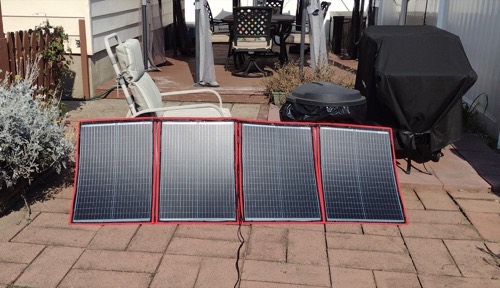
The fabric folding construction is where things get more nuanced. This isn’t an aluminum-framed panel with tempered glass — it’s a fabric-backed foldable design, similar to what you see across most portable panel kits in this price range. That construction trades some robustness for portability. You can fold it, hang it, and carry it easily.
The long-term picture is honest: some multi-year owners report fabric backing degradation and connector wear after extended outdoor exposure in wet climates. Not a universal complaint, but a real pattern that matters if you’re planning to leave this mounted semi-permanently outdoors in a rainy region.
| Element | Assessment |
|---|---|
| Solar cells | Durable; hold output over multiple seasons |
| Fabric construction | Good for portable use; not ideal for permanent outdoor mounting |
| PWM controller | Functional; durability moderate (some reports of failure after extended use) |
| Connectors | Variety is an asset; build quality is adequate |
| Carry bag | Basic but functional |
The DOKIO 100W is a portable camping and vehicle-charging panel at heart. It’s not a permanently-mounted rooftop panel — don’t expect it to perform like one.
Holding Up in Wet Weather
There’s no certified IP waterproof rating on this kit. That’s not unusual for a fabric-fold portable panel at this price point, but it’s worth being clear about what it means in practice.
In normal use — occasional rain, light moisture, being stored outdoors between trips — the panel performs without issues for most buyers. Customers in moderate climates report no water damage concerns.
The specific vulnerabilities are:
- Connector area — the junction where cables meet the panel body is the most water-sensitive spot. Extended exposure to heavy rain or sitting in standing water carries risk.
- Fabric backing — longer-term outdoor exposure (1-2 years, particularly in wet climates) can cause the fabric surface to deteriorate. Multiple multi-year owners flagged this.
- PWM controller — the separate controller unit should be kept dry and sheltered when possible.
For occasional camping use where the panel is deployed during the day and stored at night: no meaningful concerns. For permanent semi-outdoor installation year-round in a rainy climate: the lack of IP certification is a real limitation, and a panel with IP65+ would serve better.
Safety, Certifications, and Warranty
The included PWM controller includes four key protection features: reverse polarity (wrong polarity connection doesn’t damage the battery), overcharge (controller stops charging when battery is full), overload (cuts current if draw exceeds rated capacity), and short-circuit protection (fault current is blocked).
These protections matter for a beginner kit. Accidentally connecting the wrong terminal or leaving a depleted battery connected are common first-time mistakes. Having them covered in hardware is the right design choice.
No exact third-party safety certifications retained for this review (CE, ETL, UL) are mentioned in product specifications. The warranty is 1 year — functional coverage, though shorter than comparable kits from Renogy (5 years) or Goal Zero.
Is This Right for You?
| Buyer profile | Verdict |
|---|---|
| First-time solar buyer who wants to start immediately | Strong yes — the complete kit is exactly for this |
| RV/camper 12V battery maintenance | Good fit — 65-80W is solid for regular top-up charging |
| Portable power station top-up (weekend camping) | Good fit — works with most XT60 stations |
| LiFePO4 battery owner | Acceptable with caveats — controller isn’t LiFePO4-optimized |
| Wants maximum efficiency in variable/cloudy conditions | Better alternatives exist with MPPT control |
| Permanent outdoor installation in wet climate | Not ideal — no IP certification, fabric degrades outdoors |
| 24V system | No — panel output is calibrated for 12V |
What Will It Work With?
The DOKIO 100W kit connects to a broad range of equipment out of the box:
| Device type | Compatible? | Notes |
|---|---|---|
| 12V AGM/SLA/Gel battery | Yes | Primary use case; direct connection via included cables |
| 12V LiFePO4 battery | Marginal | Works but uses lead-acid charge profile (14.4V ceiling, not optimal) |
| Portable power stations (XT60 input) | Yes | Works up to power station’s input cap (often 60-100W) |
| Portable power stations (MC4 input) | No | MC4 adapter not included; requires separate purchase |
| 24V battery systems | No | Output voltage too low for 24V charging |
| Direct USB device charging | Yes | Via dual USB ports on controller (battery required for stable output) |
The two limitations to know: this panel outputs 18V, which is calibrated for 12V battery charging. It won’t work with 24V systems. And if your power station takes MC4 connectors, you’ll need an SAE-to-MC4 adapter (a few dollars, widely available) — it’s not included.
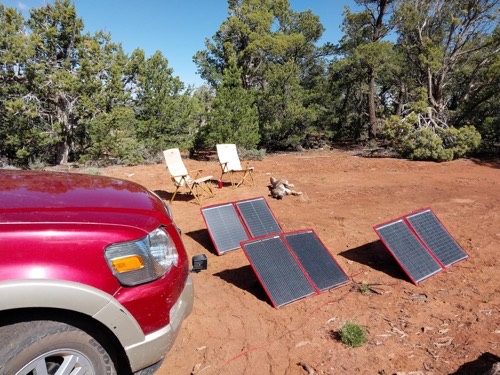
For the most common beginner use cases — RV house battery, boat battery, portable power station on camping trips — the included connector set handles all of them.
DOKIO 100W Kit: First Impressions and Final Thoughts
Pull the DOKIO 100W out of the box and the first thing you notice is how compact it folds. At 19×26×0.5 inches, it sits closer to a large laptop bag than a traditional rigid solar panel. The 5.3lb weight means you can tuck it under an arm or hang it from a hook without fighting with it.
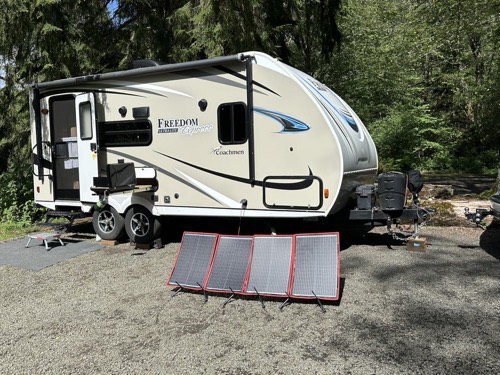
The kit contents feel complete. The PWM controller is a separate, standalone unit with clear LED status lights and dual USB ports on the front. Cables are labeled and coiled — you’re not sorting through a tangle of anonymous wires. That organized presentation matters more than it might seem, because the target buyer for this kit is someone who has never set up solar before.
Output in good sun comes in around 65-80W on a clear afternoon based on consistent customer reports. That’s not 100W, but it’s a functioning, useful amount of power. Whether it’s enough depends entirely on what you’re charging — more on that in the compatibility section.
Our Verdict
The DOKIO 100W kit delivers on its core promise: one box, everything needed to start charging a 12V battery, no additional purchases required. For someone new to solar who doesn’t want to research controllers and cable adapters before they can do anything, that’s a genuine and valuable differentiator.
Real-world output runs 65-80W in full sun — lower than the theoretical 100W, and lower than what an MPPT-equipped panel delivers, but consistently useful for battery maintenance and weekend camping scenarios. The included PWM controller is functional, protective, and reliable enough for standard use.
The trade-offs are real: no IP waterproof certification, fabric construction that doesn’t hold up like aluminum-framed panels under sustained outdoor exposure, and a 1-year warranty shorter than the competition. These are the honest costs of a complete kit at $68.
If your goal is to start charging a 12V battery or portable power station today without another shopping trip, the DOKIO 100W kit earns a clear recommendation. If you’re building a serious off-grid solar setup or planning permanent outdoor installation in a rainy climate, look at panels with IP65+ ratings and MPPT controllers — but you’ll be spending more and assembling more.
For what it is — the easiest beginner entry point in a 100W portable solar panel — the DOKIO 100W gets it right.
Pros & Cons Analysis
Based on documented specifications and owner feedback
Pros
- Complete kit, nothing extra to buy — panel, PWM charge controller, SAE/XT60/DC/alligator clip cables, and a carry bag all included. Customers frequently note this as the primary reason they chose it over bare panels.
- Lightweight and genuinely portable — at 5.3lb and folding to 19×26×0.5 inches, customers describe it as easy to carry on camping trips, store in vans, and hang from awnings or fences.
- 9.84ft cable allows flexible placement — the 3m cable lets buyers position the panel in direct sun while keeping the controller and battery shaded, which matters for both safety and battery longevity.
- Broad connector compatibility — SAE, XT60, DC barrel, and alligator clips cover the majority of 12V battery terminals and portable power stations in one kit without additional purchases.
- Dual USB ports on the controller — when connected to a 12V battery, the controller's USB ports charge phones and small devices without additional adapters.
- Strong value at ~$68 for a full kit — customers who priced out the panel, controller, and adapters separately note that the kit saves $15-25 compared to buying components individually.
- Cells hold up well over multiple seasons — customers with 2-3 years of use report the solar cells themselves maintain decent output, with only modest degradation compared to the original performance.
- PWM controller has solid protection features — reverse polarity, overcharge, overload, and short-circuit protection are all built in, making accidental damage to the connected battery less likely for a first-time setup.
Cons
- No IP weatherproof rating — the panel has no certified IP rating. Long-term owners (3+ years) report the fabric backing and connector area can degrade with sustained outdoor exposure, particularly in wet climates.
- PWM controller limits real-world output — the included controller is PWM, not MPPT. In full sun, customers consistently report 65-80W actual output from the 100W panel. In variable light or partial shade, the gap widens further.
- Controller doesn't display amp output — the included PWM controller shows LED status indicators only. Several customers wanted a numeric readout to verify actual charging current, especially during troubleshooting.
- No kickstand or mount bracket included — the panel must be propped against something or hung. Customers who expected a stand were disappointed, and some purchased a separate mount for angled placement.
- PWM controller not optimized for LiFePO4 — the included controller charges to 14.4V (standard lead-acid profile). For LiFePO4 batteries, the charge ceiling is slightly off, and multiple customers recommend upgrading to an MPPT unit.
- 1-year warranty shorter than competitors — several comparable kits offer 18-month or 2-year coverage. For a panel left outdoors semi-permanently, the limited warranty window is a trade-off worth knowing.
- Occasional DOA units and connector quality issues — a recurring pattern in lower ratings includes units arriving with dead cells or incorrect connectors (wrong XT60 type). Most were resolved via replacement, but it requires contacting support.
- Instructions are thin — several customers searched online for setup guidance. Written instructions in the box are minimal, which can frustrate beginners — the exact audience this kit is designed for.
Bottom Line: A Useful Starter Kit With Boundaries
The DOKIO FFSP110M is a light 110W folding kit with broad connection options and a basic PWM controller. It is convenient for learning and occasional use, but exact connector inventory and battery-profile checks are essential.
Frequently Asked Questions
Is this a 100W or 110W panel?
The exact FFSP110M model in this review publishes 110W. The older URL wording is retained to preserve the existing page address.
Can it charge a power station?
Yes when its electrical output, connector, and polarity match the exact station. Use the station's built-in controller, not the included PWM controller.
Can it charge LiFePO4?
Only with a controller that provides the exact battery's required LFP profile and temperature behavior. Verify the included controller or replace it.
Is it suitable for permanent outdoor mounting?
Its lightweight textile folding construction is better suited to portable use and dry storage than unattended permanent exposure.
What should be checked on arrival?
Verify the FFSP110M label, panel condition, controller, cable types, plug orientation, adapters, and instructions.
Technical Specifications
| Brand | DOKIO |
|---|---|
| Model / SKU | FFSP110M (ASIN B0748FYFSK) |
| Panel format | Folding portable panel kit |
| Rated output (Pmax) | 110W |
| Cell technology | N-Type monocrystalline |
| Module efficiency | — |
| Voltage at maximum power (Vmp) | 18V |
| Current at maximum power (Imp) | 6.12A |
| Open-circuit voltage (Voc) | 22.5V |
| Short-circuit current (Isc) | 6.35A |
| Power tolerance | — |
| Maximum system voltage | — |
| Maximum series fuse | — |
| Output connector | SAE, XT60, DC5521, and alligator clips |
| Output cable | 9.8 ft SAE-to-XT60; 3.3 ft XT60-to-clips; DC lead |
| Deployed dimensions | 38 × 26 × 0.3 in |
| Folded dimensions | 19 × 26 × 0.5 in |
| Weight | 5 ± 0.5 lb |
| Surface and frame | ETFE surface with 1680D Oxford fabric body |
| Positioning / mounting | Portable ground deployment or hanging |
| Environmental protection | Panel IP65 |
| Wind / snow load | — |
| Operating temperature | -49°F to 176°F (-45°C to 80°C) |
| Included accessories | Panel, 10A PWM controller, cables, five DC adapters, and instructions |
| Product warranty | 2-year product warranty |