MARBERO M82 Review: A Tiny 88Wh Backup for Camping, Phones, and Short Outages
At a Glance
KEY FEATURES
- Battery: 88Wh lithium-ion battery; exact chemistry and cycle life not specified
- AC output: 80W continuous, 120W peak; pure sine wave not specified
- Ports: 2 AC outlets, USB-C, USB-A ports, DC output, and included cigarette-lighter-style output cable; exact USB wattages not fully specified
- Recharge: AC wall charging to 80% in about 2 hours claimed; solar charging supported with MARBERO 30W or 60W panels; car charging support requires the correct cable
- Smart features: no app, no Wi-Fi, no UPS/EPS rating specified; pass-through charging is claimed
- Best for: phone charging, small laptops, routers, camping lights, air mattress pumps, small fans, emergency lamps, travel
PROS
- Only about 3.2 lb and easy to store in an emergency or travel kit.
- 88.8Wh can cover phones, lights, radios, and other measured small loads.
- AC, USB, DC, and integrated lighting provide flexible connections.
- Pass-through charging is documented for suitable use.
CONS
- 80W continuous AC output excludes most appliances.
- 88.8Wh drains quickly through AC conversion or moderate loads.
- Lithium-ion rather than LFP chemistry.
- LED battery indication is less precise than a watt-and-time display.
Editor's Choice
Based on exact documentation and qualitative exact-ASIN owner evidence; no hands-on test or population-rate claim
⚡ Can the MARBERO M82 Run It?
Choose a common device and see the estimated runtime, whether the inverter can handle it, and how long the power station may take to recharge.
Picture this: the power cuts out, your phone is low, your router is dead, and you just need a few hours of backup. You’re not trying to run the whole house. You just want lights, Wi-Fi, and enough charge to keep working or stay connected.
The MARBERO M82 is built for that kind of light-duty backup. It’s less about running appliances and more about keeping phones, small laptops, camping lights, routers, air mattress pumps, and emergency lamps alive when an outlet isn’t nearby. Compact step-up options appear in our lightweight backup station roundup.
Good M82 load
Phone, camera, radio, light, router, low-power laptop charger, or a verified CPAP power route.
Wrong M82 load
Heater, kettle, cooking appliance, full-size refrigerator, pump, or any device above 80W continuous.
The MARBERO M82 makes sense only when its scale is kept honest. It stores 88.8Wh and provides 80W continuous AC output with a 120W peak, while weighing about 3.2 pounds. That is closer to a multi-port emergency electronics battery than a conventional portable power station. It can be extremely useful in that role because it fits where a 20- or 40-pound box will not. It becomes disappointing when the word “generator” encourages appliance-sized expectations.
Estimated hours ≈ 88.8Wh × conservative usable factor ÷ measured average watts.
AC conversion and inverter standby consume part of the budget. Native USB or approved DC power can be more efficient for small electronics, but voltage, polarity, and device approval must match.
The owner corpus is rich in phone, light, radio, laptop, router, CPAP, travel, and emergency scenarios. Runtime praise and criticism often become consistent once device wattage and conversion path are considered. The same evidence also raises fan sounds, display interpretation, charging time, outlet behavior, solar expectations, and isolated failure or return friction. None of it establishes a failure percentage. It supports a simple rule: test every intended device and recharge path before the M82 becomes the only power source in a bag.
The two AC sockets share one 80W continuous budget; they are not separate 80W inverters. The USB and DC ports also have combined limits. Eight physical outputs therefore describe connection flexibility, not simultaneous maximum power. Keep a written port budget when several phones, lights, or cameras are connected, and stop if the enclosure, adapter, or cable becomes abnormally hot.
Solar charging is possible only inside the published 15–24V, 1.2A maximum input boundary. A small panel’s nameplate wattage is not its all-day output, and shade can reduce an already modest charging rate. For emergency readiness, the wall adapter should remain the primary recovery path unless the exact solar combination has been timed in realistic weather.
Evidence-led verdict: buy the M82 for portability and a disciplined list of low-power devices. Do not buy it as a miniature refrigerator, cooking, heating, or whole-night appliance station.
The M82 Is an Electronics Kit, Not an Appliance Generator
If you want a pocket-sized power station for camping lights, phones, routers, small laptops, and emergency backup, the MARBERO M82 does a surprisingly useful job. It’s compact, easy to carry, loaded with small-device ports, and the built-in light is more helpful than it looks. That said, this is still an 88Wh battery with an 80W AC inverter. For this MARBERO M82 review, the key takeaway is simple: it’s a handy small-electronics backup, not a replacement for a full-size solar generator.
Three Pounds Changes Where Backup Power Can Go
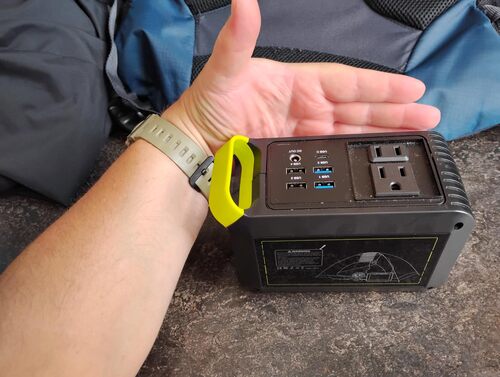
The first thing most people notice is the size. The MARBERO M82 is small enough to sit on a desk, camp table, nightstand, or kitchen counter without feeling like gear you need to plan around. In practice, that makes it much easier to use casually around the house than a 20-pound power station.
The case is ABS plastic, and the fixed handle makes it easy to grab on the way out the door. To be fair, the lightweight build is part of the appeal, but it also explains some complaints about durability. A few owners mention broken handles or a case that feels more budget than premium.
The display is simple, mostly relying on battery bars rather than a full data screen. That works fine for beginners, but it won’t satisfy someone who wants live wattage, precise battery percentage, or time-to-empty estimates. Worth knowing, the simple design keeps the unit easy to use, but it also makes runtime planning a little more guessy.
Buyer Heads-Up — The MARBERO M82 is a small power bank with AC outlets, not a heavy-duty generator. Buy it for phones, routers, lights, and small electronics — not cooking, heating, or refrigerator backup.
Build an 88.8Wh Load Ledger Before Packing
The MARBERO M82 has an 88Wh battery. That’s enough for several phone charges, a few hours of router backup, or short laptop top-ups, but it’s not much capacity once you start using the AC inverter.
Here’s the thing: AC outlets waste some energy through conversion loss. Using a laptop charger, air mattress pump, or small fan through AC will drain the battery faster than USB phone charging. In real use, buyers are happiest when they treat it as a small emergency and camping battery.
| Device | Typical Power Draw | Estimated Runtime | Realistic with Margin |
|---|---|---|---|
| Smartphone charging | 10-15Wh per charge | 5-7 charges | 4-5 charges |
| Tablet charging | 25-35Wh per charge | 2-3 charges | 1-2 charges |
| Small laptop | 50-80Wh per charge | 1 charge or less | Partial to 1 charge |
| Wi-Fi router | 10-20W | 3.4-6.9 hours | 3-5 hours |
| LED camp light | 5-10W | 7-14 hours | 5-10 hours |
| CPAP, no humidifier | 30-60W | 1.1-2.3 hours | 1-2 hours |
| Small fan | 20-40W | 1.7-3.4 hours | 1-3 hours |
| Air mattress pump | Short burst load | Several inflations | 2-3 inflations reported |
| Electric blanket | 50-80W | Under 1.5 hours | Borderline |
| Built-in light | Low draw | Claimed up to 37-68 hours | Depends on brightness level |
Real-World Math — At 0.78 AC efficiency, the listed 88Wh battery delivers roughly 69Wh through the AC outlets. Subtract a 20% reserve, and you’re working with about 55Wh for realistic AC runtime.
That math matches the review pattern pretty well. Owners love it for phone charging, short laptop backup, routers, lights, baby monitors, camping accessories, and air mattress pumps. On the flip side, people who expected it to run a work setup all day or power appliances often came away disappointed.
A common theme is that small loads feel impressive, while medium loads reveal the battery size quickly. Honestly, that’s fair for an 88Wh unit. You’re buying convenience and portability more than deep runtime.
The 80W AC Boundary Is the Main Buying Filter
In practice, this output ceiling is fine for phones, tablets, routers, small laptop chargers, LED lights, camera batteries, and certain low-power accessories. The catch is that many appliances people casually call “small” are not small electrically. Coffee makers, kettles, hair dryers, space heaters, and many vacuums pull far more than 80W.
| Device | Typical Draw | This Unit? |
|---|---|---|
| Phone / tablet | 10-25W | Easy |
| LED lights | 5-15W each | Easy |
| Wi-Fi router | 10-20W | Easy |
| Baby monitor camera | 5-15W | Easy |
| Bluetooth speaker | 10-30W | Easy |
| Small laptop charger | 45-65W | Easy |
| Larger laptop charger | 90-130W | Borderline |
| Small fan | 20-50W | Easy |
| Air mattress pump | Short burst load | Borderline |
| Mini fridge | 40-80W cycling, higher surge | Borderline |
| CPAP without humidifier | 30-60W | Borderline |
| CPAP with humidifier | 50-90W | Borderline to trips inverter |
| Coffee maker | 600-1000W | Trips inverter |
| Electric kettle | 1000-1500W | Trips inverter |
| Hair dryer | 1200-1875W | Trips inverter |
| Space heater | 750-1500W | Trips inverter |
| Shop vacuum | 600W or more | Trips inverter |
Worth Knowing — Continuous output is the real ceiling. The 120W peak rating only helps for very brief startup spikes, not for running a kettle, heater, hair dryer, or coffee maker.
Several buyers learned this the hard way. One wanted to run a coffee pot. Another wanted outdoor lights for winter. Others hoped for heaters or higher-draw appliances. The M82 can be useful, but only when your expectations match the 80W inverter.
That said, the little AC outlet is still valuable. For oddball devices that don’t charge over USB — a monitor camera, router brick, small tool charger, or air pump — having AC in this size class is genuinely handy.
Wall Charging First, Modest Solar Second
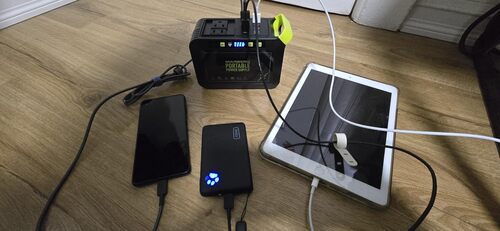
MARBERO claims the M82 can recharge from 0 to 80% in about 2 hours using the included wall adapter. In real use, feedback is mixed. Some buyers say it charges quickly, while others report 5-6 hours for a full charge or slower-than-expected charging from low battery.
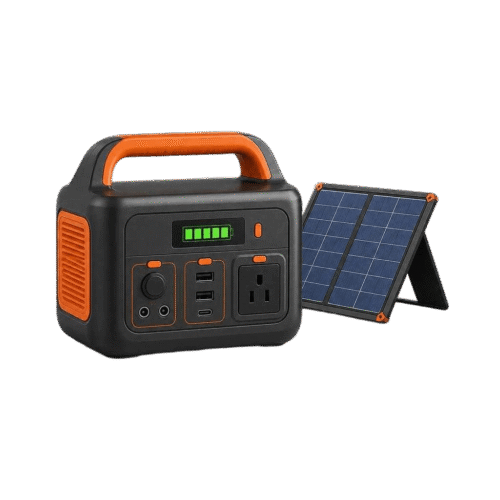
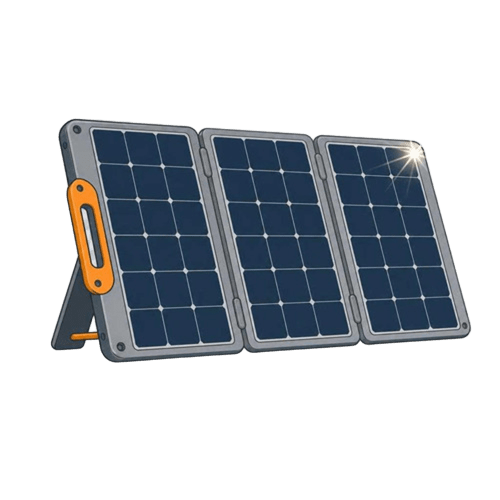
Solar charging is one of the nicer parts of the package if you pair it with MARBERO’s compatible 30W or 60W panels. In strong sun, some owners say it charged in an afternoon. Still, solar speed depends heavily on panel angle, cloud cover, shade, and whether you’re charging while using the station.
| Charging Mode | Time Estimate | Noise Level |
|---|---|---|
| Wall adapter to 80% | About 2 hours claimed | Quiet |
| Wall adapter to 100% | Roughly 3-6 hours reported | Quiet |
| 30W solar panel | About 4-6 hours strong sun | Silent |
| 60W solar panel | About 2-4 hours strong sun | Silent |
| Car charging | Cable support unclear | Silent, aside from vehicle noise |
| Pass-through use while charging | Claimed supported | Depends on load |
Adapter Check — The MARBERO M82 uses a barrel-style charging input, not universal USB-C input. If you plan to charge from a car or third-party solar panel, check cable compatibility before your trip.
The car-charging situation deserves extra attention. The box includes a cigarette-lighter-style output cable, but one buyer specifically noted that a car charging input cable was not included. That matters if your plan is to recharge between campsites or during long drives.
A high solar input matters most when you’re off-grid for several days. Here, the M82’s small battery is the advantage and the limitation. It doesn’t store much, but it also doesn’t take a huge solar setup to refill.
Eight Outputs Do Not Mean Eight Full-Power Loads
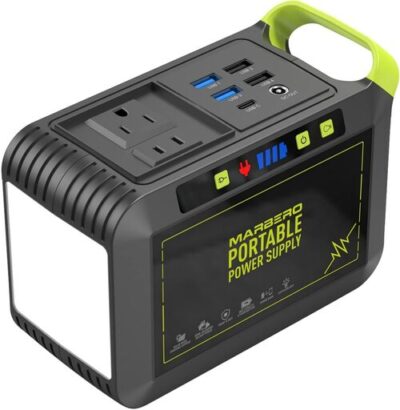
The port mix is generous for the size. You get two AC outlets, USB-C, USB-A ports, DC output, and a cigarette-lighter-style output cable. For camping or outages, that means one person can run a router while someone else charges a phone or light.
In practice, you’ll still want to be selective. Charging two phones, a laptop, and lights at the same time can drain an 88Wh battery much faster than expected. On the flip side, using USB for phones and tablets instead of AC helps stretch the battery.
The port layout is simple rather than fancy. Worth knowing, it does not have an app, Wi-Fi control, high-watt USB-C input, or the cleaner USB-C-heavy layout you’ll see on newer models. If most of your gear is USB-C, you may want a newer power station with stronger PD ports.
Pro Tip — Use USB or DC outputs whenever possible. Running small electronics through AC wastes battery through inverter losses, which matters a lot on an 88Wh power station.
Fan, Ventilation, and Lithium-Ion Storage Discipline
The MARBERO M82 is quiet under light loads because it’s a small battery power station, not a gas generator. That’s a big reason people like it for apartments, bedrooms, tents, night markets, home offices, and travel. There’s no fuel smell, no engine noise, and no exhaust.
Heat management comes from rear cooling vents and the built-in BMS protections. Customer feedback does not point to a widespread overheating pattern, but the unit can still warm up when charging or running heavier AC loads. In real use, give the vents breathing room and don’t bury it under blankets or camping gear.
For indoor emergency use, it makes the most sense beside a router, lamp, phone charger, or laptop. It’s not a bedroom UPS in the formal sense, though. If you need instant switchover for a desktop PC or medical device, look for a model with a rated UPS or EPS feature.
LED Gauges Require Conservative Reserve
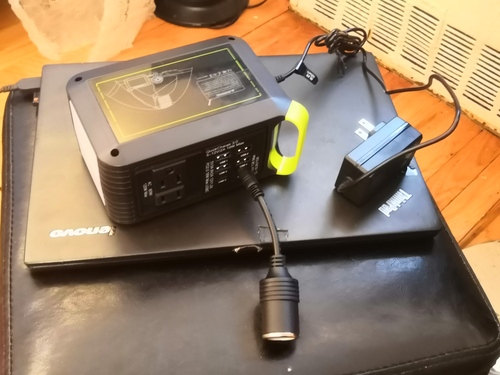
The M82 keeps things basic. You get buttons for power and output control, a battery indicator, and a built-in light with multiple brightness levels. Most buyers find it easy to understand right away.
At the same time, the display is not as detailed as newer midrange power stations. You don’t get a full dashboard with live watts, exact percentage, or estimated runtime. Some owners also mention button feel issues, including power buttons that feel hard to press.
For beginners, that simplicity can be a plus. You charge it, press the right output button, and plug in your gear. The catch is that you’ll need to do a bit of mental math if you’re trying to stretch runtime through a long outage.
A Small Lithium-Ion Pack Rewards Shallow Planning
The MARBERO M82 is listed as a lithium battery, but the product data does not state LiFePO4. That matters because LiFePO4 units usually last longer under frequent cycling, while smaller budget lithium-ion stations tend to be lighter and cheaper but less ideal for daily heavy use.
Long-term feedback is mixed. Many buyers say it works well for camping trips, storms, and occasional backup. On the flip side, there are enough reports of failure, self-discharge, missing chargers, and units that stopped charging within months that I would not rely on it as my only backup for critical gear.
Long-Term Ownership — Since the cycle life is not specified and LiFePO4 is not advertised, treat the MARBERO M82 as an occasional-use battery. It makes sense for camping and emergency kits, but daily cycling may shorten its useful life.
The safety feature list is solid on paper: BMS protection, voltage control, temperature control, short-circuit protection, overload shutoff, over-voltage protection, and UL-style drop testing claims. In real use, buyers also mention responsive support in some replacement cases. To be fair, support responsiveness helps, but it doesn’t erase the inconvenience of a failed unit during an outage.
Best Practice — For storage, leave the unit around 50-80% charged and top it off every few months. Small lithium-ion power stations do not love being stored completely empty for long periods.
M82 Device-Fit Board
| Use Case | Fit | Why |
|---|---|---|
| Weekend car camping | Strong fit | Great for phones, lights, small fans, and air mattress pumps |
| Backpacking | With caveats | Small, but still heavier than a simple USB power bank |
| RV side trips | Solid fit | Handy for small electronics away from shore power |
| Short home blackout | Solid fit | Good for phones, lamps, routers, and a laptop top-up |
| Work-from-home router backup | Solid fit | Can keep a modem or router running for a few hours |
| CPAP overnight backup | Borderline | Capacity and 80W output are limiting, especially with humidifier |
| Refrigerator backup | Skip | Not enough inverter headroom for most fridge startup surges |
| Cooking appliances | Skip | Coffee makers, kettles, and hot plates draw far too much power |
| Night market vendor lights | Solid fit | Works well for LED string lights and small devices |
| Long hurricane outage | With caveats | Useful for devices, but too small as a main outage battery |
| Jobsite tools | Borderline | Fine for charging some batteries, not for corded tools |
| Travel and airport layovers | Solid fit | Handy AC outlet and USB charging in a compact box |
Pack the M82 for These Small Jobs
- A small power station for phones, tablets, lights, routers, and light camping gear
- A quiet indoor backup for short outages
- A budget-friendly unit that’s easy to carry
- A built-in emergency light for storms, tents, and car trouble
- Solar charging with compatible MARBERO panels
Move Up a Class for These Jobs
- Refrigerator, heater, kettle, coffee maker, or hair dryer support
- A full workday of laptop runtime
- A rated UPS for critical electronics
- A LiFePO4 battery with published cycle life
- Strong USB-C charging and modern app controls
Pros & Cons Analysis
Based on documented specifications and owner feedback
Pros
- Portability is the central advantage — The M82 can live in a backpack, drawer, car kit, or bedside emergency box where larger stations are impractical.
- Connection choice can improve efficiency — USB and approved DC routes can power small devices without keeping the AC inverter active.
- Lighting is integrated — The lamp and SOS mode reduce the need to pack a separate emergency light.
- The use case is easy to test — A buyer can trial every intended phone, radio, laptop, router, or CPAP configuration before departure.
- Owner reports describe credible small-load roles — The supplied material supports communications, lighting, travel, and short electronics-backup missions.
Cons
- The word generator overstates its scale — An 80W inverter and 88.8Wh battery are not suited to heating, cooking, pumps, or conventional refrigerator backup.
- Port count can mislead — All simultaneous outputs share battery and circuit limits; two AC receptacles do not double inverter power.
- Solar recovery is slow and weather-dependent — The narrow low-power input is useful for topping up, not guaranteed daily energy independence.
- Runtime estimates need a measured load — Small changes in AC overhead and device settings consume a meaningful fraction of an 88.8Wh pack.
- Return-window testing matters — Charging, fan, outlet, display, and battery behavior should be documented while remedy options remain simple.
Our Verdict
The honest answer in this MARBERO M82 review is yes — for the right buyer. It's a good fit for camping, travel, short outages, router backup, phone charging, small laptops, and emergency lights. It is not a good fit for high-watt appliances, serious home backup, or professional work where failure is a deal-breaker.
If you want a small, affordable battery you can toss in a car, keep in an emergency kit, or use around the house when outlets are inconvenient, the MARBERO M82 makes sense. If you need fridge backup, long CPAP runtime, strong USB-C input, or LiFePO4 longevity, step up to a larger power station. That costs more, but it will be the better tool for the job.
Frequently Asked Questions
Can the MARBERO M82 run a laptop?
Yes, but only within limits. The 80W continuous AC output can handle many small laptops and chargers, but larger laptops or heavy workloads can drain the 88Wh battery quickly.
Can the MARBERO M82 run a CPAP machine overnight?
It depends on the CPAP and settings. Some owners report short CPAP use, while others say it is not powerful enough for their setup. A CPAP without humidifier is more realistic than one with heated humidification.
Will it run a coffee maker, kettle, space heater, or hair dryer?
No for most models. Those devices often draw 600W to 1,800W, while the MARBERO M82 is rated around 80W continuous and 120W peak.
How long does the MARBERO M82 take to recharge?
MARBERO claims 0 to 80% in about 2 hours from the wall adapter, but customer feedback varies. Some buyers report fast charging, while others mention 5 to 6 hours for a full charge.
Can it charge from solar panels?
Yes, it supports solar charging with compatible MARBERO 30W or 60W panels. In strong sun, owners say solar charging works well, but cloudy weather and panel angle will slow it down.
Does it include a car charging cable?
The listing includes a cigarette-lighter-style output cable, but at least one buyer noted that a car charging input cable was not included. Check the current package contents before buying for road trips.
Is the MARBERO M82 good for camping?
Yes, it is a strong fit for light camping use: phones, tent lights, small fans, air mattress pumps, speakers, and camera batteries. It is not ideal for cooking appliances or heaters.
Does the MARBERO M82 hold charge in storage?
Feedback is mixed. Many owners say it holds charge well for emergency use, but some report self-discharge or sudden battery loss after storage.
Is the built-in light useful?
Yes. Customers often mention the bright multi-level LED light as useful for tents, power outages, car trouble, and emergency kits.
Is this a good home backup power station?
Only for small electronics. It can help with phones, lamps, a router, and some laptops during short outages, but it is not meant for refrigerators, heaters, or long-term whole-home backup.
What battery chemistry does it use?
The listing describes it as a lithium battery but does not specify LiFePO4. Since LiFePO4 is not advertised, treat it like a smaller lithium-ion unit with more limited long-term cycle expectations.
Technical Specifications
| Brand | MARBERO |
|---|---|
| Model / SKU | M82 (ASIN: B08G1KB88B) |
| Battery capacity | 88 Wh |
| Battery chemistry | Lithium-ion (exact chemistry not specified; LiFePO4 not advertised) |
| Cycle-life rating | Not published for this exact model in the current source set |
| Expandable capacity | No |
| Continuous AC output | 80 W continuous (pure sine wave not specified) |
| Surge / peak output | 120 W peak |
| AC voltage, frequency, and waveform | pure sine wave; frequency not published for this exact model |
| AC outlets | 2 × AC outlets |
| High-current, RV, or 240V output | No dedicated RV, 30A, 240V, or other high-current AC outlet published for this exact model |
| USB-C outputs | 1 × USB-C (PD wattage not specified) |
| USB-A outputs | Multiple USB-A ports (exact count and wattage not fully specified) |
| 12V / DC outputs | Not included as a built-in socket; cigarette-lighter-style output cable included |
| Maximum solar input | Up to 60 W with MARBERO dedicated panel (station max not separately specified) |
| Solar input range and connector | Not published for this exact model in the current source set; exact PV voltage/current window and connector are unavailable |
| Maximum AC input | Not published for this exact model in the current source set; the prior value was an editorial estimate, not an exact-model rating |
| AC recharge time | 0-80% in about 2 hours manufacturer-rated; full recharge often reported around 3-6 hours |
| Solar recharge estimate | Planning estimate: roughly one sunny afternoon with compatible panel, depending on sun and panel wattage |
| UPS / EPS support and transfer time | No rated UPS / EPS support specified |
| App / connectivity | No app |
| Operating temperature / weather rating | Not published for this exact model in the current source set |
| Dimensions | 6.5 x 4.6 x 3.1 inches |
| Weight | 1.04 kg / 2.3 lb listed (bullet copy also publishes 3.2 lb) |
| Warranty | Not published for this exact model in the current source set |