How We Chose These Portable Solar Panels
We didn’t run a lab — there are no claims of measured output here, and anything we quote about real-world performance comes from manufacturer specs and owner feedback. What we did do was weight the criteria that actually decide a camping purchase. Can a solo camper carry it? Does it plug into the most common power stations without hunting for an adapter? Will it survive an unexpected overnight rain? And does the wattage-to-weight ratio make sense for the kind of trip you take? Honestly, those four questions filter out more bad camping panels than any spec sheet does.
| Criterion | Why It Matters for Camping | Weight |
|---|---|---|
| Portability (folded size + weight) | Panels you won’t actually pack don’t get used — size matters as much as wattage | High |
| Power station connector compatibility | Most campers pair with EcoFlow, Jackery, or Bluetti — wrong connector = no charging | High |
| IP weatherproofing rating | Camping = unexpected rain; IP65 minimum, IP67/68 preferred for exposed setups | High |
| Real-world output vs rated watts | Rated watts don’t equal delivered watts; N-Type 25% panels outperform standard 22% significantly | Medium |
| Setup speed and stability | Kickstands, carabiners, snap hooks — how quickly can you get the panel producing at camp | Medium |
| Direct USB output | Panels with USB-C/USB-A let you charge phones without occupying the power station’s output | Medium |
| Warranty and brand support | Longer warranty = more confidence for a product that lives outdoors | Low |
Selection criteria:
- Portability — folded size must fit in a vehicle trunk or pack; weight must be manageable solo
- Connector compatibility — native or included cables for EcoFlow (XT60/DC5521), Jackery (DC8020/DC7909), and Bluetti
- IP rating — IP65 minimum for camping; IP67 preferred for unsheltered panels
- Real-world output — N-Type monocrystalline (25%) or standard mono (23%) with real-world factor applied
- Setup mechanism — kickstands, carabiners, or snap hooks for hands-free deployment
- USB outputs — direct device charging without occupying the power station
- Kit completeness — what’s in the box vs what you need to buy separately
- Warranty — 2+ years preferred; Jackery’s 5-year warranty is best in class here
Trip Type Fit Guide
Not every camping trip has the same power needs. Match your panel to your trip type — not to the highest wattage you can afford. A backpacker and a base-camper can both be perfectly happy with totally different panels, and the table below maps the lineup to the way you actually camp.
| Trip Type | Best Panel Match | Why | Skip If |
|---|---|---|---|
| Multi-day backpacking (hiking to camp) | EF ECOFLOW 45W (3.1 lb) | Light enough to carry; keeps a small EcoFlow RIVER topped for phone, GPS, headlamp | You’re running a fridge or need fast station charging |
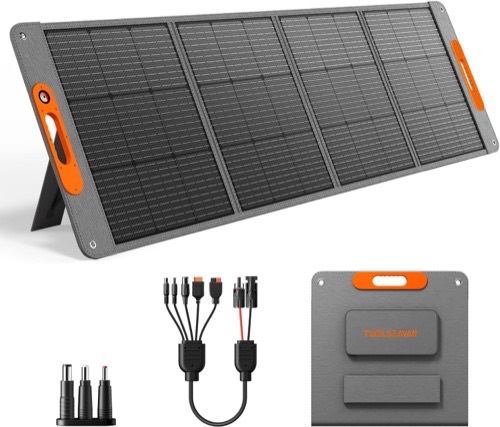
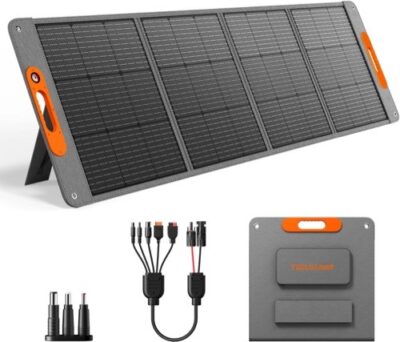
| Car camping or truck bed setup | ZOUPW 100W (9.5 lb) | Multi-connector cable set fits most stations; full afternoon charge for a 300-500Wh station | You also want USB charging without touching the station |
| Overlanding / van life weekend | BougeRV 200W (13.8 lb) | IP67 panel and rugged build handle dust, wet ground, and rough handling | Weight or pack space is the limiting factor |
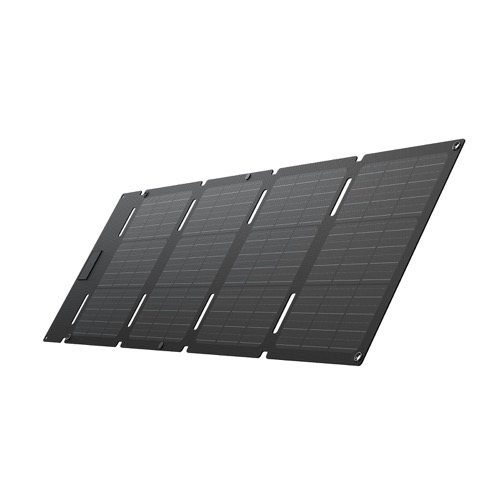
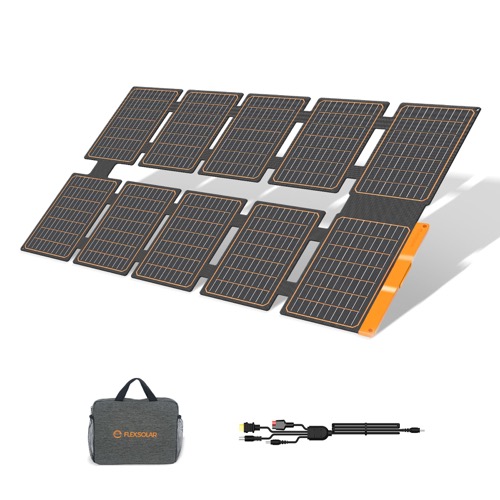
| Festival camping (no hiking) | FlexSolar 100W (4.1 lb) | Quad-fold packs tiny; USB-C/USB-A charge phones directly with no station needed | You need to charge a large 1kWh station |
| Basecamp (multiple nights, static camp) | Renogy 200W (13.9 lb) | High N-Type output and a stable 4-position kickstand for all-day production | You’re moving camp daily and carrying the panel |
| First-time solar buyer, budget-focused | DOKIO 100W Kit | Includes controller and every common connector for around $68 — covers 12V and stations | You need a certified IP rating for wet weather |
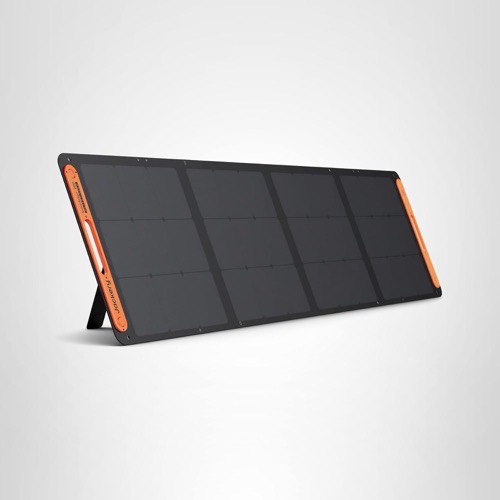
| Power station owner (brand match) | Jackery SolarSaga 200W | Native DC8020 plug, IP68 panel, 5-year warranty — plug-and-play for Jackery stations | You don’t own a Jackery station |
Worth Knowing — The single most common mistake is buying a 200W panel for a trip where you’re moving camp every day. A 100W panel at 9.5 lb is often the better call — it covers the same phone and station charging as 200W on most real 4-5 PSH days, and you’ll actually bring it.
How to Choose a Solar Panel for Camping
Two decisions actually determine which camping solar panel you buy: how far you’re carrying it, and what you’re plugging it into. Wattage, weatherproofing, and cell type are real, but they’re secondary filters once portability and compatibility have narrowed the field. Here’s how to work through them in the order that matters.
Portability: What “Foldable” Actually Means Across Different Wattages
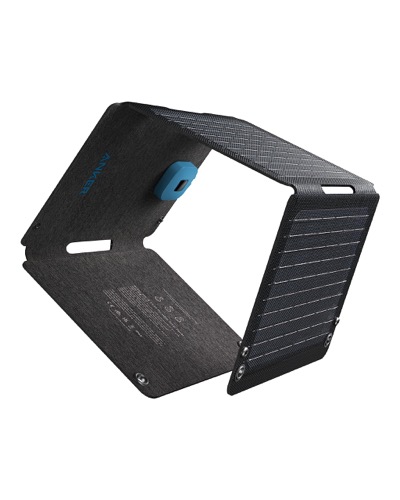
Picture the spread in this lineup. At one end sits the Anker PS30 at 2.2 lb, slim enough to slide into a day bag. At the other end is the Renogy 200W at 13.9 lb — the kind of weight that strains a backpack within the first mile. Everything else falls between.
The no-free-lunch rule is simple: more watts means more weight. The 200W panels here run roughly 2.5 to 3 times heavier than the 100W models, and there’s no clever folding that escapes that math.
What to prioritize for camping solar:
- IP65 or IP67 weatherproofing (certified, not just “waterproof claimed”)
- Correct connector for your power station — check before buying, not after
- Weight under 10 lb for car camping; under 4 lb if hiking to the site
- USB-C direct output if you want to charge a laptop or tablet without the station
- Kickstand, snap hooks, or carabiner mount for easy hands-free deployment
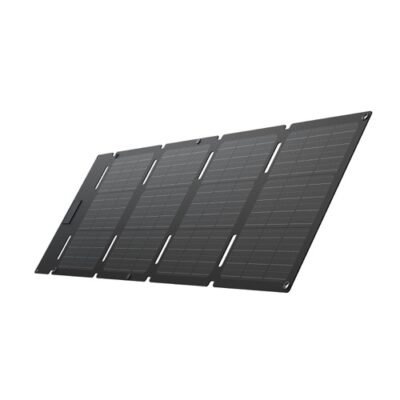
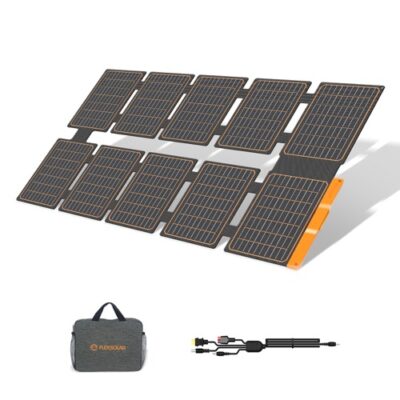
The practical weight thresholds break down like this — under 4 lb is hiking-feasible (EcoFlow 45W, FlexSolar 100W, Anker PS30); 5 to 10 lb is car-camping comfortable (ZOUPW 100W, DOKIO 100W kit); and 10+ lb is static base camp or vehicle-mounted territory (every 200W panel here). Fold count matters too. FlexSolar’s quad-fold gets a full 100W down to about 13 x 10 inches — smaller than many laptops — while bi-fold 200W panels stay closer to the size of a folded card table.
Best Practice — The rule of thumb for backpacking solar: the panel should weigh under 10% of your base pack weight. For a 40 lb pack, that’s 4 lb — which puts the EcoFlow 45W and Anker PS30 in range. For car camping, weight is basically irrelevant — bring the 200W.
Power Station Compatibility: Will Your Panel Actually Plug In?
This is the section that saves buyers the most headaches. A panel can be perfect on paper and still leave you stuck at camp with a cable that doesn’t fit. Connector matters as much as wattage here.
The connector picture across the major brands looks like this: EcoFlow uses XT60 or XT60i; Jackery uses DC8020 on the 300/500-class stations and DC7909 on older models; Bluetti runs a T500 or aviation connector depending on the model; and Anker SOLIX stations take XT60. Match it before you buy.
| Power Station | Native Match | Needs Adapter |
|---|---|---|
| EcoFlow (XT60) | EF ECOFLOW 45W, ZOUPW 100W (XT60 cable) | Renogy 200W, Jackery SolarSaga |
| Jackery (DC8020) | Jackery SolarSaga 200W, ZOUPW 100W (DC8020 cable) | Renogy 200W, EcoFlow 45W |
| Bluetti (MC4/T500) | Renogy 200W, BougeRV 200W (MC4) | Jackery SolarSaga, EcoFlow 45W |
Voltage matching is the other half of the equation. Most 200W panels in this lineup output 18 to 23V, which sits comfortably inside the 11 to 60V solar input range of most portable power stations. Still, confirm your specific station’s solar input ceiling — some smaller models cap at 60W even when the voltage is compatible.
Adapter Check — Before you buy, check two things. First, does the panel’s included cable have the right connector for your station? Second, does the panel’s output voltage fall within your station’s solar input range? EcoFlow’s RIVER 2 accepts 11 to 25V, so a 200W panel at 22V Vmp fits fine — but a panel that exceeds the station’s input ceiling won’t.
Wattage: Match the Panel to Your Actual Daily Power Need
It’s evening, the station reads 40 percent, and the real question on your mind is whether this panel can recover it by noon tomorrow. That’s the wattage question, and it’s better answered in watt-hours than in marketing numbers.
Real-world output factors vary by cell type and controller. N-Type panels feeding a station’s built-in MPPT land around a 0.82 factor; standard mono with built-in MPPT sits near 0.78; the DOKIO kit’s PWM controller drops to about 0.68; and the USB-only Anker PS30 runs near 0.40 based on customer testing. Those factors are why rated watts and delivered watts rarely match.
| Panel | Daily output (4 PSH) | What it covers |
|---|---|---|
| 30W (Anker PS30) | ~48 Wh | 1-2 phone charges, headlamp top-off |
| 45W (EcoFlow) | ~148 Wh | Daily phone + GPS + small RIVER top-off |
| 100W (ZOUPW/FlexSolar) | ~312 Wh | Full 300-500Wh station in one afternoon |
| 200W (Renogy/Jackery) | ~656 Wh | 1kWh station plus simultaneous USB charging |
Real-World Math — For car camping: 656 Wh/day from a 200W panel easily covers a mini fridge (400 Wh/day avg), a laptop charge (50 Wh), LED lights (20 Wh), and two phone charges (30 Wh). That’s about 500 Wh of daily load with headroom to spare on a 4 PSH day.
IP Rating: What Camping Weather Actually Demands
Camping is wet, muddy, and unpredictable, so the IP rating isn’t a spec to skim past. Here’s what the numbers mean in real conditions.
- IP65: spray and rain from any direction — adequate for panels sheltered under a tarp or awning
- IP67: brief submersion (1m, 30 min) — better for exposed setups on wet grass or muddy ground
- IP68: full waterproof — the rating on the Jackery SolarSaga 200W and the EcoFlow 45W; confident in any weather
There’s a controller caveat worth flagging. DOKIO’s panel carries no IP rating at all, and while FlexSolar and ZOUPW rate the panel itself at IP67, their controller or junction modules may not match that. For camping, lean toward IP67 or IP68 on any panel you’ll leave out overnight. IP65 is fine for tarped setups or panels you stow between showers.
Cell Technology: N-Type vs Standard Mono for Camping
Cell tech matters more outdoors than at home, and the reason is the light. Camping sun is often early morning or late afternoon — lower angle, cooler temps — exactly the conditions where N-Type cells pull ahead of older PERC.
- N-Type (25%): Renogy 200W, BougeRV, Jackery SolarSaga (IBC 26.7%), EcoFlow 45W — better low-light and high-temp performance
- Standard mono (23-24%): ZOUPW, FlexSolar — still strong output, slightly lower efficiency per square inch
- Budget tier: DOKIO — monocrystalline, efficiency not specified; fine for basic 12V battery and power station use
Setup Speed and Stability at Camp
How fast you can get producing matters when you’re chasing morning sun. The lineup splits across mounting styles: integrated kickstands (Renogy’s 4-position, plus BougeRV, ZOUPW, and Jackery), snap hooks (EcoFlow 45W), carabiners (FlexSolar, Anker), and none at all (DOKIO ships with a separate stand).
Stability in wind follows weight. Heavier panels with integrated kickstands hold their ground better, while lightweight panels with carabiners or snap hooks hang nicely from tent poles, van doors, or fence lines instead. For angle, summer sun is forgiving — flatter works — but spring, fall, and winter want a steeper tilt toward the sun, so check your destination’s latitude for longer trips. On cables, most panels include 9 to 10 ft leads, which covers typical setups; for a roof or awning mount with the station inside, an XT60 or MC4 extension (about $10-15) earns its keep.
What Can These Solar Panels Do?
At 4 peak sun hours — a reasonable average for most US and EU camping regions in summer — here’s what each wattage tier actually delivers in the field. These are field estimates with a real-world factor applied, not bench numbers.
| Panel Size | Est. Daily Output (4 PSH) | Best Camping Use | Camping Reality Check |
|---|---|---|---|
| 30W | ~48 Wh | Phones, headlamps, GPS | USB-only; won’t touch a power station |
| 45W | ~148 Wh | Small EcoFlow RIVER top-off | Slow on cloudy days; one device focus |
| 100W | ~312 Wh | 300-500Wh station in an afternoon | The car-camping sweet spot for most |
| 200W | ~656 Wh | 1kWh station + fridge + USB | 13-15 lb of panel to carry and store |
Cloudy camping days hurt more than you’d expect. A 100W panel in full overcast can drop to 15-30W of actual output — enough to slow your station’s drain but not fully recover it. For trips with more than two days of likely cloud cover, size up a tier or plan a wall-outlet top-off on the drive home.
Solar Panel Wattage Guide for Camping
- Under 30W: Phone trickle charge and small device topping — don’t expect to run a power station; brings 1-2 phone charges per day
- 30W-45W: Light travelers with a compact power station (EcoFlow RIVER, Jackery 300); covers daily phone + small device consumption on sunny days
- 80W-100W: The sweet spot for most car campers; charges a 300-500Wh station fully in one afternoon; manageable weight (4-10 lb depending on model)
- 150W-200W: Multi-day base camp or overlanding; covers a 1kWh station plus direct USB charging simultaneously; brings 13-15 lb of panel with you
- 200W+ (multiple panels): Extended off-grid trips; most portable panels top out at 200W — at this point, paired setups or semi-rigid panels are more practical
Will It Work With Your Power Station?
Most portable panels in the camping category output 18 to 23V DC through their primary connector — which lands inside the 12 to 60V input range of most EcoFlow, Jackery, and Bluetti portable power stations. The station’s built-in MPPT charge controller handles the regulation from there. In practice, that means you don’t need a separate controller when you’re charging a power station. You do need one if you’re charging a standalone 12V lead-acid or LiFePO4 battery directly — and that’s a different setup entirely.
| Charging Scenario | Separate Controller Needed? | Why |
|---|---|---|
| Panel to EcoFlow / Jackery / Bluetti power station | No | The station has built-in MPPT; just connect the right cable |
| Panel to standalone 12V AGM or lead-acid battery | Yes — PWM or MPPT | No overcharge protection without a controller; battery can be damaged |
| Panel to LiFePO4 battery (van, RV, DIY battery bank) | Yes — MPPT with LFP mode | LiFePO4 requires a specific charge profile; wrong profile shortens battery life |
| Panel to phone / tablet via USB | No | USB output already regulated; plug your cable directly |
| Solar kit with included PWM controller to 12V battery | Included (PWM 10A) | Kit ships with a standalone PWM controller; sufficient for lead-acid maintenance |
Best Practice — If you ever wire a solar panel straight to a 12V battery (car, RV, boat) without a controller, the panel can backfeed current at night and slowly drain the battery. Every 12V battery setup needs a controller with anti-drain protection. Power stations handle this automatically — no extra hardware required.