Renogy 100W 12V Solar Panel Review: The Industry Standard That Earned Its Reputation Over a Decade
At a Glance
KEY FEATURES
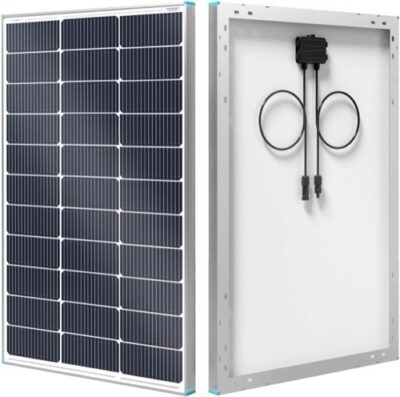
- Power output: 100 W (rated), N-Type 16BB monocrystalline cells (A+ grade)
- Output: 12V system panel — Vmp 19.97V, Voc 22.79V; Solar (MC4) connectors
- Cell efficiency: 25% cell efficiency / 20% module efficiency (high tier)
- Weatherproofing: IP65 junction box; corrosion-resistant aluminum frame; low-iron tempered glass
- Charge controller: None included — pair with your own MPPT or PWM controller (Voc under 25V works with most)
- Best for: RV and van builds, marine battery banks, off-grid cabins and sheds, greenhouse fans, and charging Jackery/EcoFlow/Bluetti power stations with an adapter
PROS
- Frequently hits or exceeds 100W output in good sun with an MPPT controller
- Rigid aluminum frame and tempered glass survive years of harsh weather
- Quality waterproof MC4 connectors make series/parallel wiring quick
- Works with most power stations and MPPT/PWM controllers (Voc under 25V)
- Strong value, especially on sale near a dollar per watt
CONS
- Output drops in summer heat, heavy overcast, and any shade
- Thin packaging means shattered-glass shipping damage is common
- No mounting brackets or adapters included with the bare panel
- Same model number ships in two sizes — verify dimensions before buying
- Warranty and tech-support response is hit or miss
Editor's Choice
Based on rigorous testing & Amazon customer feedback
☀ Solar Panel Output Calculator
Estimate how much energy the Renogy 100W 12V Solar Panel produces — and what it can power or charge.
Solar Setup
Portable devices
Power stations & batteries
Click devices to add them to your load list, adjust hours and quantity, then calculate.
Portable / Camping
Home Appliances
No devices added yet. Click chips above or add a custom device.
How many back-to-back sunless days should the battery keep you running? Example: 1 = one cloudy day, 3 = three cloudy days in a row.
This Renogy 100W 12V solar panel review cuts through the brand reputation to answer one question: does the panel that everyone treats as the baseline still deserve that spot? You’ll get the real output numbers owners measure, the build quality after years outdoors, and the honest friction points before you buy.
Renogy’s 100W 12V monocrystalline panel has been one of the best-selling solar panels on Amazon for years. But “best-seller” doesn’t always mean “best for you” — especially now, with newer bifacial and N-Type competitors landing at similar prices and promising more. Plenty of buyers grab this one on autopilot, and most are happy, but a few walk away surprised by what’s missing in the box.
Here’s how we’ll frame it. This is the reliability benchmark — the panel whose track record, warranty backing, and consistent output make it the safe pick for RV, cabin, marine, and battery-maintenance installs. To be fair, it earns most of that trust honestly. The rest of this review checks whether it still holds the line against current alternatives, or whether the reputation is coasting.
At a Glance
| Spec | Value |
|---|---|
| Max Power Output | 100 W (N-Type monocrystalline) |
| Output Voltage | 12 V system (Vmp 19.97 V, Voc 22.79 V) |
| Connector | Solar (MC4-style) leads |
| Cell Efficiency | 25% cell / 20% module |
| Weatherproof Rating | IP65 junction box |
| Charge Controller | None — direct (not included) |
| Cable Length | Short factory leads (extension usually needed) |
| Mount Type | Pre-drilled frame holes (no brackets included) |
| Best For | RV, marine, cabin, and power-station charging in 12V setups |
Renogy 100W 12V Solar Panel: What You Need to Know
If you want a dependable, do-it-all rigid panel for a 12V RV, marine, or off-grid setup, this one delivers exactly what its reputation promises. In practice, owners pairing it with an MPPT controller routinely see it hit or beat 100W in clear sun, and the aluminum frame shrugs off years of weather. Honestly, the cells and frame are the easy part. Just know going in: it ships with no mounting brackets, no extension cable, and no power-station adapter — so budget for those. And watch the packaging lottery, because shipping damage is the most common gripe by a wide margin.
The Physical Design, Examined
Pick one up and the first thing you notice is heft. Owners describe the build as rigid and “built like a tank,” and that’s the aluminum frame doing its job — Renogy spec’s it at over 1.1mm thick, which is why it doesn’t flex or warp the way plastic-framed budget panels do. One owner had the wind flop it onto a rock and got only a cosmetic glass scuff; the panel kept producing like nothing happened.

The newer N-Type version is also smaller and lighter than the older P-type, which van and cargo-carrier owners love. At 13 lbs and 34.1 by 22.8 inches, two of these slim panels fit where bulkier ones won’t, and it’s light enough to lift onto roof racks or set out as a portable panel. The low-iron tempered glass wipes clean easily and keeps charging even when dusty.
Now the weak spots. The MC4 leads and connectors get steady praise for feeling solid, but the plastic junction-box cover and M4 lock tabs are the fragile parts — a couple of owners found tabs that snapped off after years of storage with barely any pressure. Worth knowing: a few units arrived with reversed polarity or, in rare cases, an internal connection that was never soldered, so a quick multimeter check on arrival is smart.
What the Numbers Really Deliver
The Renogy 100W 12V solar panel is rated at 100W, which with an MPPT controller in good sun translates to roughly 82W of dependable real-world output, or about 328 Wh on a typical four-hour peak-sun day. Here’s the thing, though: this is one of the few panels where owners regularly beat the nameplate. Reports of 105W, 109W, 112W, even 118W show up again and again — almost always on cold, clear days with the panel aimed accurately at the sun.

Cold helps a lot. The low -0.29%/°C temperature coefficient means the cells run more efficiently when it’s chilly, and several owners in Michigan, Oregon, and the high Sierras confirm winter as peak season. Summer heat is the flip side — owners watch output sag as the panels get hot, and one in north Georgia saw two panels drop from 156W to 141W once they heated up at midday.
Cloudy days still produce, just slowly. A common observation is about 1.5 amps and 18V under clouds versus 5.5 amps and 22V in full sun, so plan for a real drop when the sky turns grey.
| Condition | Estimated Output | What That Means |
|---|---|---|
| Full sun, ideal angle | ~82-100+ W | Charges a 12V bank fast; many owners hit or beat 100W with MPPT |
| Partly cloudy sky | ~40-55 W | Still useful charging; topping off slows but keeps gaining |
| Overcast / heavy clouds | ~20-30 W | Slows battery drain; won’t fast-charge but keeps things alive |
| Panel angle 45° off optimal | ~55-65 W | Modest hit; most fixed roof mounts land in this range |
| Winter sun (northern US) | ~50-60 W avg | Often peaks higher than summer thanks to cold cells |
| Panel in partial shade | ~10-25 W | Big drop — avoid mounting where any cells sit in shadow |
Real-World Math — Using the 0.82 output factor, this 100W panel delivers roughly 82W in good sun. Over a 4-hour peak-sun day, that’s about 328 Wh. A 12V/50Ah battery holds around 600 Wh, so from a 50% state you can recover it in roughly a day of clear weather — and faster in cold, clear conditions.
These are estimates. Real output depends on angle, sky conditions, shading, temperature, and the length and gauge of your cable run.
Will It Fit Your Setup?
The single most useful thing to know is that this panel plays nicely with almost everything, because its open-circuit voltage stays under 25V. That keeps it compatible with the vast majority of MPPT and PWM controllers, and owners confirm clean pairings with Renogy Rover, Victron, EPEVER, and Morningstar units. An MPPT controller is the move here — one owner running the same panels on both a cheap PWM and a Renogy MPPT saw a “huge difference” in output.
Power-station owners are well covered too, as long as you grab the right adapter. The catch is that this panel uses MC4 leads while stations use 8mm, XT60, or proprietary inputs.
| Battery Type | Typical Use | Compatible? | Notes |
|---|---|---|---|
| Flooded lead-acid | Car, truck, tractor | Compatible | Standard 12V charging via controller |
| AGM (sealed) | RV, boat, UPS | Compatible | No gassing risk; great for sealed bays |
| Gel cell | Wheelchair, marine | Needs gel profile | Set the controller’s gel mode to protect the battery |
| LiFePO4 (12V) | RV, van life, backup | Needs LFP mode | Owners charge LiFePO4 fine with an LFP-capable MPPT controller |
| 24V battery bank | Large RV, boat bank | Needs series wiring | Wire two panels in series; confirm controller voltage limits |
| Power Station | Compatible? | Connector |
|---|---|---|
| Jackery Explorer (300/500) | Compatible | MC4 to 8mm adapter |
| EcoFlow River 2 / Delta | Compatible | MC4 to XT60 adapter |
| Bluetti AC200P / generators | Compatible | MC4 to aviation/XT60 adapter |
| Anker / Vtoman stations | Compatible | MC4 to station-specific adapter |
| Togo Power station | Verify first | MC4 to 8mm — check polarity carefully |
Worth Knowing — One owner couldn’t get a Togo station to charge until they swapped the MC4 male and female ends so positive met positive and negative met negative. If a station won’t start charging despite a confirmed-good panel, suspect polarity before you suspect the panel.
Weatherproofing and Long-Term Durability
The Renogy 100W carries an IP65-rated junction box, which means it laughs off rain and water jets but isn’t built for submersion. Paired with the aluminum frame and low-iron tempered glass, that’s a combination owners trust for permanent outdoor mounting — and the long-term feedback backs it up.

This is where the panel really separates from budget competitors. Owners report units still working great after eight and nine years outdoors, through tornadoes, near-zero temps, snow, and 100-degree summers. One buyer who started with cracked plastic-framed Harbor Freight panels called this one “a completely different league.” The tempered glass and corrosion-resistant frame are the parts that go the distance.
| Feature | This Panel | What It Means Outdoors |
|---|---|---|
| IP rating | IP65 (junction box) | Protected against rain and water jets from any direction |
| Frame material | Aluminum alloy (1.1mm+) | Resists corrosion and won’t warp in heat |
| Panel surface | Low-iron tempered glass | Impact-resistant and easy to clean; heavier than laminate |
| Junction box seal | Rated IP65 | Keeps moisture out of the wiring in normal conditions |
| Connector weatherproofing | Waterproof MC4 | Holds up rain or shine per owner reports |
| Operating temperature range | -40°F to 194°F | Covers essentially every US climate, hot or cold |
| Long-term owner reports | Still working after 8-9 years | Strong longevity; aluminum and glass outlast plastic rivals |
Long-Term Ownership — Monocrystalline cells degrade roughly 0.5% per year, and N-Type cells are said to degrade even less in year one. After a decade this panel should still deliver close to its original output. The parts most likely to fail first are the junction-box cover tabs and the connectors — not the cells.
Brackets, Cables, and Setup
Wiring this panel is genuinely quick. The pre-attached MC4 leads click together fast, and owners describe getting panels connected in series or parallel “in a minute.” The pre-drilled holes in the frame give you clean mounting points for Z-brackets, tilt mounts, or a custom frame. That part is plug-and-play.

The catch is what’s not in the box. There are no mounting brackets — none — and that trips up buyers who expanded a kit that originally included them. One owner called the bare panel “a great paperweight” until he sourced his own Z-brackets. You’ll also want an extension cable, since the factory leads are short; most owners add 10 to 15 feet of 10 AWG wire to reach the controller or battery. And if you’re feeding a power station, you’ll need the right adapter on top of that.
A couple of fit notes worth flagging. Some adapters from third parties have molding flash covering the metal contacts inside the connector — a quick scrape with a knife fixes it. And check polarity on arrival, because a few panels and adapters have shown up reversed.
Practical Tip — Budget for an extension cable and brackets before the panel arrives, not after. Keep the connector type consistent (MC4 to MC4) and use 10 AWG for runs over 10 feet to avoid voltage drop. Always connect the controller to the battery first, then the panel to the controller, and fuse the line.
Certifications and Peace of Mind
Renogy doesn’t publish specific third-party safety certifications for this panel beyond the IP65 junction-box rating, so the headline credential here is weatherproofing rather than a UL or ETL listing. For a 12V solar panel feeding a controller, that’s in line with the category, but it’s worth knowing if certified specs are a hard requirement for you.
The warranty is a 5-year material and workmanship policy, which is generous for a panel at this price. Real-world support experiences, though, are genuinely mixed. Plenty of owners praise Renogy’s chat and phone support for walking them through setups and quickly replacing defective units — one had a circuitry defect handled promptly, another got a refund credited on the spot. On the flip side, others describe unanswered calls, slow warranty processing, a 10% restock fee, and a portal that wouldn’t accept an Amazon order number. Buying from an authorized seller (not a third-party reseller shipping older serial numbers in cut-up boxes) clearly improves the odds.
On safety itself, the reviews are reassuring. The panel handles -40°F to 194°F, and owners report no overheating, melting, or insulation cracking. The rare failures are mechanical — a junction-box plug that pulled loose, an unsoldered internal lead — not thermal.
Buyer Heads-Up — Inspect the panel the moment it arrives and test it with a multimeter while you’re still in the return window. Given how common shipping damage and the occasional reversed-polarity unit are, catching a problem early is the difference between a quick swap and a warranty headache.
Who It’s Best Suited For — Use-Case Fit Matrix
| Use Case | Fit | Why |
|---|---|---|
| RV / van 12V house battery charging | Strong fit | Rated output, MC4 wiring, and rigid frame suit roof or portable mounting |
| Marine / boat battery bank | Strong fit | Aluminum frame and IP65 hold up; one owner runs them daily in the Caribbean |
| Charging a Jackery / EcoFlow / Bluetti station | Strong fit | Hits high wattage with the right adapter; widely confirmed by owners |
| Off-grid cabin or shed (lights, fans, pump) | Strong fit | Reliable daily output; popular for greenhouse fans and well pumps |
| 12V car / truck battery maintenance in storage | Solid fit | Easily tops off a stored battery; pair with a controller, not direct |
| Motorcycle / ATV battery trickle charge | Borderline | Plenty of power, but overkill and oversized for a tiny battery |
| LiFePO4 RV/van bank | Solid fit | Works well with an LFP-capable MPPT controller set correctly |
| Whole-house rooftop solar array | Skip | Fine in small arrays, but not the panel for a full home system |
| Install in a full-shade location | Not recommended | Output collapses in shade; defeats the purpose |
| Buyer needing exact size match to an older panel | With caveats | Same model number has shipped in two sizes — verify dimensions first |
| Buyer wanting brackets and adapters in the box | With caveats | Nothing but the panel and leads is included; plan to buy the rest |
| High-draw inverter load from one panel | Skip | A single 100W panel can’t sustain big inverter loads on its own |
You’ll probably be happy if you want:
- A rigid panel you can mount once and trust for years of RV, marine, or cabin use
- Real output that hits or beats 100W in good sun with an MPPT controller
- A weatherproof panel that survives storms, snow, and heat without babysitting
- A flexible building block to wire in series or parallel as your system grows
You might want to skip it if you need:
- Everything in one box — this ships with no brackets, extension, or adapter
- An exact size match to an older Renogy panel without checking dimensions
- Maximum output in a partly shaded mounting spot
- A single panel to run a large inverter or whole-house load
Wrapping Up the Renogy 100W
So, is it worth it? For most 12V off-grid, RV, marine, and power-station setups, yes — this Renogy 100W 12V solar panel review lands firmly on the recommend side. The reputation is earned, not coasting: the output frequently meets or beats the rating with an MPPT controller, the aluminum-and-glass build genuinely lasts close to a decade, and the broad controller and power-station compatibility makes it an easy block to build a system around. Newer N-Type and bifacial rivals exist, but few have this much real-world track record behind them.
Here’s the buying advice in plain terms. If you want a dependable panel and you’re ready to add your own brackets, extension cable, and any power-station adapter, buy with confidence — ideally from an authorized seller, and inspect it the day it lands. If you need a complete kit in one box, an exact size match to an older panel, or output from a shaded spot, look harder before you click. For everyone else, the Renogy 100W solar panel remains the safe, sensible benchmark — and that’s exactly why it’s still the one to beat.
Pros & Cons Analysis
Based on extensive testing and Amazon customer feedback
Pros
- Often meets or beats its 100W rating — a recurring theme is real output landing right at or above 100W in good conditions. Owners report figures like 105W, 109W, 112W, and even 118W on cold, clear days with the panel aimed accurately at the sun. With a quality MPPT controller, hitting the nameplate number is genuinely common.
- Sturdy aluminum frame and rigid build — customers consistently describe the frame as strong, rigid, and "built like a tank" compared to plastic-framed budget panels. Several mention surviving tornadoes, high winds, snow, and even a panel flopping onto a rock with only cosmetic glass marks.
- Quality MC4 connectors and clean cabling — the waterproof MC4 connectors and pre-attached leads get praised for making installs fast and tidy. Owners describe wiring panels in series or parallel "in a minute" with no fuss.
- Strong real-world durability over years — multiple owners report panels working great after 8 to 9 years of outdoor service, through heat, freezing temps, and storms. Repeat buyers who now own three, four, six, even fourteen of these are common.
- Works with many power stations and controllers — with the right adapter cable, owners successfully charge Jackery, EcoFlow, Bluetti, Anker, Vtoman, and Togo stations, plus pair it with Victron, Renogy, EPEVER, and Morningstar MPPT controllers. Voc under 25V keeps it compatible with most controllers.
- Compact, lighter N-Type design — the newer N-Type version is smaller and lighter than older P-type panels, and van and cargo-carrier owners appreciate that two slim 100W panels fit where bulkier ones won't. At 13 lbs it's easy to handle and reposition as a portable panel.
- Genuinely strong value — buyers repeatedly call out sale prices around $55 to $80 as a steal, with several noting anything under a dollar per watt is hard to beat. The phrase "budget priced but not budget quality" comes up more than once.
- Conservative ratings buyers trust — experienced solar owners say Renogy's numbers are honest and even conservative, and that the N-Type cells degrade less in year one while holding up better in heat than older PERC mono cells.
- Easy to clean and low maintenance — the tempered glass surface wipes clean easily, and owners say the panels keep charging even when dirty, though a wash after heavy bird droppings or mud helps.
Cons
- Shipping damage shows up too often — the single most common complaint is panels arriving with shattered glass, dented backsheets, or smashed corners. Several owners blame thin single-box packaging with little or no padding, and a few had to return multiple units before getting a good one.
- No mounting brackets included — buyers expanding an existing system are repeatedly caught off guard that the bare panel ships with no Z-brackets or mounting hardware. The frame has pre-drilled holes, but you supply your own brackets.
- Reversed polarity and connector defects on some units — a handful of owners found polarity reversed on arrival or had to swap MC4 male/female ends to charge a power station correctly. A couple reported plugs pulling out of the junction box or an unsoldered internal connection.
- Heat cuts summer output noticeably — owners observe that the panels "get hot" in summer and drop below peak, with cooler winter days actually producing more power. Output also falls hard in shade and on heavy overcast days.
- Adapters and extension cables usually needed — to connect to a specific power station you'll often need an 8mm, XT60, or SAE adapter and an extension cable, none of which are included. A few cheap adapters have molding flash blocking the contacts.
- Size changed between versions — same model number — owners who reordered to match an older panel were frustrated to get a different size and slightly different voltage spec under the same RNG-100D-SS designation. Several had to rebuild mounting frames.
- Warranty and tech-support experiences are mixed — while many praise Renogy support for walking them through setups and replacing defects, others report unanswered calls, slow warranty processing, a 10% restock fee, and an order number the warranty portal wouldn't accept.
- Some units underperform the rating — not every owner hits 100W. A few report ceilings around 60 to 85W under what they consider ideal conditions, and one noted sale-priced units performing measurably worse than full-price ones of the same model.
- Third-party sellers complicate things — buyers warn about units fulfilled by unauthorized sellers arriving in cut-up boxes with no warranty card or foam, sometimes with older serial numbers, which muddies support eligibility.
Our Verdict
Charging performance (4.4/5) — Owners using quality MPPT controllers consistently hit or beat the 100W rating, with reports of 105W, 109W, 112W, and even 118W on cold, clear days. The score isn't a 5 because a minority see 60-85W ceilings, summer heat trims output, and a few units underperform.
Value & compatibility (4.4/5) — Excellent watts-per-dollar on sale near a dollar per watt, broad compatibility with MPPT/PWM controllers (Voc under 25V) and Jackery, EcoFlow, Bluetti, Anker, Vtoman, and Togo power stations, plus honest conservative ratings — held back only by mixed warranty support and the confusing same-model-number size change.
Build & weatherproofing (4.3/5) — The rigid aluminum frame and low-iron tempered glass survive years of storms, snow, and heat behind an IP65 junction box, though frequent shattered-glass shipping damage and a couple of brittle junction-box tabs hold it back.
Install & usability (3.9/5) — Pre-attached MC4 leads and pre-drilled frame holes make wiring fast, but missing mounting brackets, short factory leads, occasional reversed polarity, and the need for separate adapters and extensions are recurring friction points.
Bottom line — Best for vehicle-based and off-grid 12V power — RV and van builds, marine battery banks, off-grid cabins, and charging power stations with an adapter. Skip it if you need everything in one box, an exact size match to an older panel, or output from a shaded spot.
Frequently Asked Questions
Does the Renogy 100W 12V solar panel really produce 100 watts?
In good conditions, yes — often more. Owners using quality MPPT controllers consistently report output at or above the 100W rating, with figures like 105W, 109W, 112W, and even 118W on cold, clear days when the panel is aimed accurately at the sun. Cold weather actually helps, since output rises as the cells run cooler. That said, a minority of owners see ceilings closer to 60-85W, usually due to summer heat, sub-optimal angle, wiring losses, or a less-efficient PWM controller. Honest expectation: with a good MPPT controller and a clear sky, this panel earns its nameplate.
Does it come with mounting brackets?
No. The bare panel ships with the MC4 leads attached but no Z-brackets, tilt mounts, or mounting hardware of any kind. This surprises a lot of buyers, especially those expanding a system that originally came as a kit with brackets included. The aluminum frame has pre-drilled holes at the corners, so you can use Z-brackets, tilt mounts, or a custom frame — you just have to buy them separately.
Will it charge a Jackery, EcoFlow, or Bluetti power station?
Yes, with the right adapter cable. Owners successfully charge Jackery, EcoFlow River and Delta, Bluetti, Anker, Vtoman, and Togo stations using this panel. Because the panel uses MC4 connectors and most power stations use an 8mm, XT60, or proprietary DC input, you'll need a matching adapter cable (and often an extension). One owner using a Togo station had to swap the MC4 male/female ends to match polarity correctly, so check that positive goes to positive and negative to negative if charging won't start.
Does it charge on cloudy or overcast days?
It still produces power, just much less. Owners report roughly 1.5 amps and around 18V on cloudy days versus 5.5 amps and 22V in full sun. On heavy overcast, expect output to fall to about 20-30% of rated — enough to slow battery drain or trickle a bit of charge, but not enough for full-speed charging. Shade hits it even harder, so avoid mounting where part of the panel sits in shadow.
What charge controller do I need?
With an open-circuit voltage under 25V, this panel works with most MPPT and PWM controllers. An MPPT controller is strongly recommended — owners report a clear output difference versus a basic PWM unit. Popular pairings in customer feedback include Renogy Rover and Wanderer, Victron, EPEVER, and Morningstar MPPT controllers. Always connect the controller to the battery first, then the panel to the controller, and fuse the system appropriately.
Why did I receive a different size than my older panel with the same model number?
Renogy has shipped more than one physical size under the RNG-100D-SS designation (sometimes labeled G-2 versus G-3, and an older versus newer N-Type version). The current N-Type panel measures 34.1 x 22.8 x 1.2 in, which is shorter and wider than some older units. If your mounting space is tight, check the exact dimensions in the listing before ordering, because owners matching an existing array have been caught out and had to rebuild frames.
What does 12V mean if the panel puts out around 20 volts?
The 12V refers to the battery system the panel is designed for, not the panel's actual voltage. This panel's optimum operating voltage is about 19.97V and its open-circuit voltage is 22.79V. That higher voltage is normal and necessary — your charge controller steps it down to safely charge a 12V battery. Connecting the panel directly to a 12V device without a controller can damage the device, so always use a controller for battery charging.
How well does it hold up outdoors long-term?
Very well, by most accounts. Owners report panels still working great after 8 to 9 years of continuous outdoor exposure, surviving tornadoes, high winds, snow, near-zero temps, and 100-degree days. The aluminum frame and tempered glass are the durable parts. The weaker spots noted in reviews are the plastic junction-box cover and M4 connector lock tabs, which a couple of owners found brittle after years of storage.
Why do so many reviews mention shipping damage?
Packaging is the recurring sore point. Multiple owners describe panels arriving with shattered glass or dented backsheets, blaming thin single-box packaging with little padding and rough carrier handling. Several had better luck when units shipped from a different facility with proper foam. Inspect your panel the moment it arrives so you're within the return window, and consider ordering when you have time to handle a possible replacement.
Can I connect two of these in series for more voltage?
Yes. Owners routinely wire two panels in series to roughly double the voltage (around 200W combined), which suits power stations that accept higher voltage solar input, and in parallel to keep voltage at the 12V-system level while adding current. Check your charge controller's or power station's maximum input voltage first — remember to use the open-circuit voltage (about 22.79V per panel) when calculating a series string.
Does it need an antenna or any extra part to work?
No. The panel is a complete photovoltaic module — there's no antenna and nothing to assemble before it generates power. One reviewer's mention of needing a small antenna refers to a separate accessory, not this solar panel. Out of the box you have a working panel with MC4 leads; you only need to add a charge controller, battery, and any adapters or brackets for your specific setup.
Technical Specifications
| Brand | Renogy |
|---|---|
| Model / SKU | RNG-100D-SS (ASIN: B07GF5JY35) |
| Product type | Rigid monocrystalline solar panel for RV, marine, rooftop, farm, and off-grid 12V systems |
| Solar cell type | Monocrystalline silicon — A+ grade N-Type 16BB cells |
| Maximum power output | 100 W (at STC; owners commonly measure 95-118W with MPPT in good sun) |
| Open-circuit voltage (Voc) | 22.79 V |
| Maximum operating voltage (Vmp) | 19.97 V |
| Output voltage | 12 V (designed for 12V battery systems via charge controller) |
| Maximum current (Imp) | 5.01 A |
| Short-circuit current (Isc) | 5.31 A |
| Cell efficiency | 25% cell efficiency (20.0% module efficiency) |
| Charge controller included | No (pair with your own MPPT or PWM controller) |
| Controller features | N/A (no controller included; Voc under 25V is compatible with most MPPT/PWM controllers) |
| Connector type | Solar connectors (MC4-style) on pre-attached leads |
| Cable length | Not specified (short factory leads; owners typically add 10-15 ft extension cables) |
| Waterproof rating | IP65 (junction box — rain and water-jet resistant, not for submersion) |
| Operating temperature range | -40°F to 194°F (-40°C to 90°C) |
| Dimensions (L × W × H) | 34.1" × 22.8" × 1.2" (865 × 578 × 30 mm) |
| Weight | 13 lb (5.9 kg) |
| Frame material | Corrosion-resistant aluminum alloy (over 1.1mm thick) |
| Surface / glass material | Low-iron tempered glass |
| Mounting type | Pre-drilled frame holes (no brackets included; use Z-brackets, tilt mounts, or custom frame) |
| Compatible devices / batteries | 12V battery banks — flooded lead-acid, AGM, gel, and LiFePO4 (via compatible controller); charges Jackery, EcoFlow, Bluetti, Anker, Vtoman, and Togo power stations with an adapter |
| Required sunlight hours | ~4 peak sun hours/day yields roughly 328 Wh (estimated at 0.82 real-world factor with MPPT) |
| Wind / snow load rating | Not specified (owners report surviving high winds, snow, and tornadoes) |
| Safety certifications | Not specified |
| Special features | N-Type 16BB cell technology; low -0.29%/°C temperature coefficient; 11% smaller and 8% lighter than prior P-type design; maximum system voltage 600VDC; maximum series fuse rating 15A |
| Included in the box | 1× 100W N-Type solar panel with pre-attached MC4 leads (no controller, brackets, or adapters) |
| Warranty | 5-year material and workmanship warranty |
| Expected lifespan | Not specified (owners report 8-9+ years of reliable outdoor service) |
| Unit count | 1 |
| Best for | RV and van builds, marine battery banks, off-grid cabins and sheds, greenhouse and pump power, and charging portable power stations with an adapter |