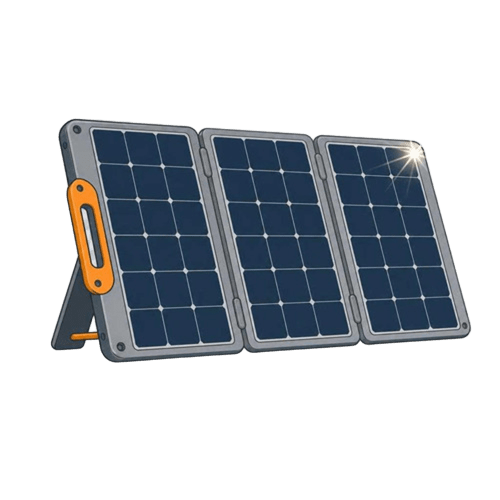
Renogy RPP200EF-SE Review: Strong Electrical Fit, Inspect the Stand
At a Glance
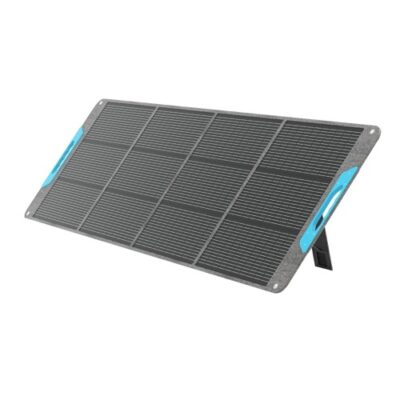
KEY FEATURES
- 200W folding panel with 18.8V Vmp and 21.6V Voc.
- 10.6A operating current and 11.3A short-circuit current.
- 13.89-pound weight is light for the 200W portable class.
- Integrated support and solar-connector output simplify deployment.
- Best for compatible power stations with enough input current.
PROS
- Complete electrical limits published
- Strong power-to-weight ratio
- Compact fold
- Useful owner output reports
- Stand failure incident in evidence
- Heat-related surface bubble incident
- Low operating voltage means higher current
- Connector adapter may still be required
CONS
- Stand failure incident in evidence
- Heat-related surface bubble incident
- Low operating voltage means higher current
- Connector adapter may still be required
Lightweight 200W Compatibility Pick
Based on exact documentation, retained exact-ASIN evidence, and the expanded qualitative Amazon owner-text review; no hands-on test claimed
This Renogy RPP200EF-SE review cuts through the 200W claim and looks at what real owners are actually getting from this foldable solar panel in campgrounds, driveways, RV sites, and emergency power setups. It’s a popular pick for people who want more solar input without paying power-station-brand prices.
You might be trying to keep an EcoFlow, Bluetti, Anker SOLIX, Jackery, or Goal Zero topped off while camping. Or maybe you’re running a CPAP, laptop, RV fridge, sailboat battery, or van power system and you’re tired of hearing generators drone in the background.
Here’s the thing: the Renogy RPP200EF-SE isn’t a magic 200W outlet you can count on every minute of the day. In practice, it’s a portable monocrystalline panel that often lands in the 150W to 190W range in strong sun, folds down neatly, and works best when you already know which adapter cable your power station needs.
- Four-section folding body
- Integrated carrying form
- Built-in support legs
- Portable-station and controller use cases
- Four legs interact on uneven ground
- Short leads may require a verified extension
- A broad surface catches wind
- The receiving device still sets every electrical limit
Owner evidence repeatedly places this panel between lightweight blankets and rigid suitcases. It is compact enough for vehicle travel and temporary RV or campsite use, yet substantial enough that terrain, wind, cable route, and solo setup determine whether it gets deployed often. Several owners describe strong station input after careful south-facing alignment; others describe lower production, frustrating legs, early damage, cable omissions, or support disputes. Those outcomes identify checks, not a universal performance range.
Best fit for learning the four-leg sequence and adjusting angle through the day.
Use a compatible charge controller and do not feed a second controller through an unsuitable RV port.
Confirm input voltage, current, watts, connector, and polarity; an adapter name alone is insufficient.
Add safe distributed restraint or move to shelter rather than loading the fabric and hinges.
A receiver reading is the result of the whole path: irradiance, angle, temperature, shade, extension loss, station tracking, battery state, and panel condition. This is why one owner can report input close to 200W while another sees much less. Neither number should be published without its setup, and neither proves how a new unit will perform.
Before depending on it, inspect the packaging handle, laminate, seams, stands, leads, and connector; then complete a full clear-day cycle. That routine directly addresses the most actionable owner reports without pretending the qualitative evidence can calculate product reliability.
What Can You Connect? — Renogy RPP200EF-SE
Compatibility is one of this panel’s strengths, but only if you understand the connector situation. Renogy gives you MC4 output, which is common in solar gear and works well with charge controllers, extension cables, series/parallel wiring, and lots of adapters.
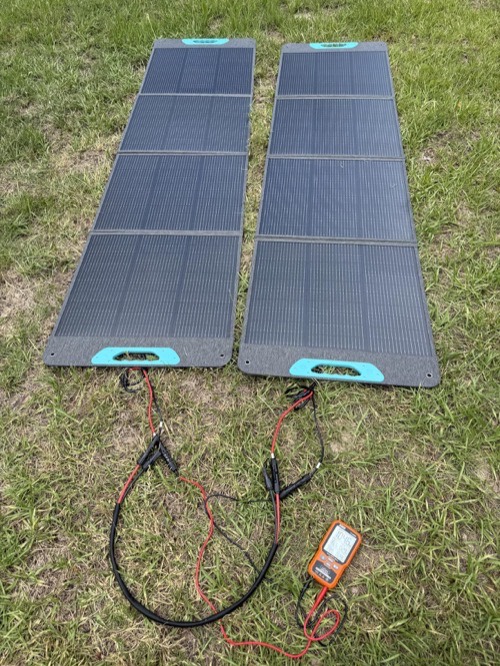
In practice, power station owners often need one extra cable. EcoFlow users commonly mention MC4-to-XT60 or XT60i, Anker users may need an XT60 adapter, and Bluetti, Goal Zero, Jackery, and EGO setups can require their own matching inputs.
| Device or Battery Type | Compatible? | What You’ll Likely Need |
|---|---|---|
| EcoFlow Delta / River series | Needs adapter | MC4-to-XT60 or XT60i cable |
| Anker SOLIX power stations | Needs adapter | MC4-to-XT60, depending on model |
| Bluetti power stations | Needs adapter | MC4-to-Bluetti-compatible input cable |
| Goal Zero Yeti | Needs adapter | MC4-to-Goal Zero input adapter |
| Jackery Explorer | Needs adapter | MC4-to-8mm or model-specific cable |
| EGO Nexus+ PST3040 | Needs adapter | EGO solar charger accessory |
| 12V AGM battery | Compatible with controller | Solar charge controller required |
| 12V LiFePO4 battery | Compatible with controller | LiFePO4-capable charge controller required |
| RV house battery bank | Compatible with controller | Verify voltage/current limits |
| Direct phone/tablet charging | Compatible | USB-C or USB-A cable |
Worth Knowing — MC4 is a good solar connector, but it isn’t the same as “plug-and-play” for every power station. Before buying, check your power station’s solar input connector, voltage range, and maximum input watts.
The USB ports are genuinely useful. Renogy lists one USB-C PD port up to 45W max, plus two USB-A outputs rated at 18W and 15W, so you can charge phones, tablets, cameras, and some small laptops directly.
On the flip side, USB charging pulls from the same sunlight hitting the panel. If your phone is taking power, that energy isn’t going into your power station at the same time.
What It Does in Real Sun
The Renogy RPP200EF-SE solar panel is rated at 200W, with 25% efficient N-Type monocrystalline cells and a 21.6V maximum operating voltage. In practice, many owners report roughly 150W to 180W in good sun, with some seeing 187W, 190W, or brief peaks close to the rating.
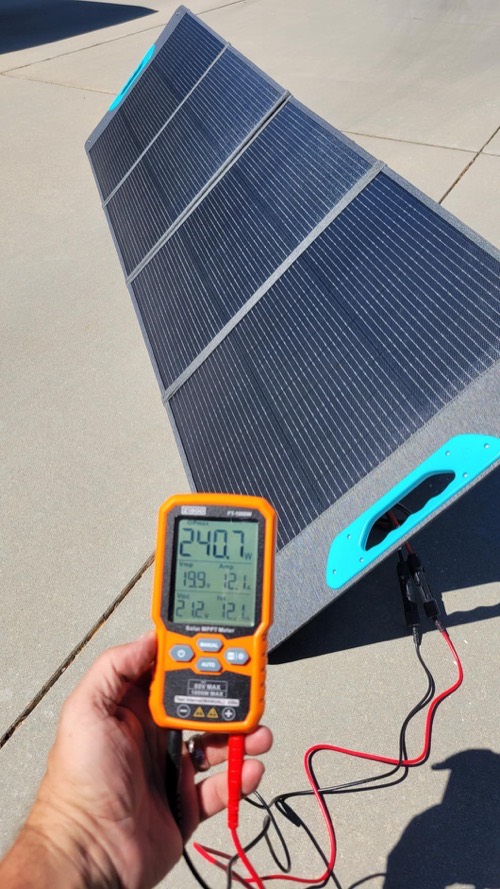
That said, expectations matter. A portable solar panel rated at 200W won’t sit at 200W all day unless the sun angle, temperature, cable run, power station input range, and battery state are all lining up nicely.
The catch is that some buyers see much lower output, often around 100W to 140W, even after careful aiming. A smaller group reports severe underperformance, which points to possible defective units or inconsistent quality control rather than normal solar losses.
| Condition | Estimated Output | What That Means |
|---|---|---|
| Full sun, ideal angle | ~150W to 190W | Fast power station charging; useful RV and camp energy |
| Full sun, hot panel | ~135W to 170W | Still productive, but heat trims output |
| Partly cloudy sky | ~70W to 130W | Keeps charging, just slower |
| Heavy overcast | ~30W to 60W | Slows battery drain more than it recharges quickly |
| Poor angle or flat placement | ~100W to 155W | Still workable, especially on vehicles or boats |
| Partial shade | Highly variable | Often reduced, not always fully stopped |
Real-World Math — Using a realistic 0.76 output factor, a 200W panel delivers about 152W in good sun. Over 4 peak sun hours, that’s roughly 608 Wh/day — enough to refill a meaningful chunk of a 1,000Wh power station or recover overnight CPAP use with room to spare.
Customers using this with CPAP setups are especially happy when the daily energy need is modest. One common pattern is using the panel to recover an overnight draw in under a couple hours of decent sun, then letting the power station stay near full through the day.
At the same time, don’t buy a single 200W panel expecting it to run a large inverter load around the clock. It can help carry a fridge, laptop, lights, and small devices during the day, but large battery banks need more panel area if you want fast recovery after a deep discharge.
Getting It Up and Running
Setup is simple in theory: unfold the panel, pull out the kickstands, aim it at the sun, and connect the MC4 leads to your adapter, power station, or charge controller. In practice, the panel is long and floppy when unfolded, so one-person setup can feel awkward until you find a routine.
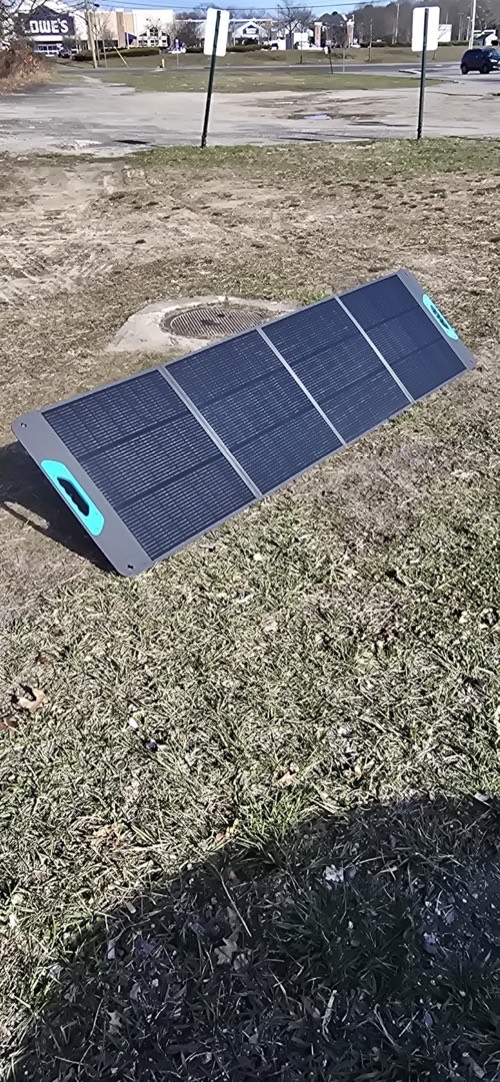
The kickstands are the most polarizing design choice. Some owners like the built-in legs and angle options, while others describe them as fiddly because they flop around, stick to the rear pads, or struggle in uneven ground.
Wind is another real factor. Because the panel is relatively light for its size, a gust can knock it over unless you use stakes, tie-down points, blocks, or a nearby RV, picnic table, or vehicle as support.
Practical Tip — Buy the adapter and extension cable before your first trip. A 10-foot 12AWG solar extension is a common sweet spot because it lets the panel sit in sun while your power station stays shaded, cooler, and safer.
The built-in pouch is a nice touch. It keeps the MC4 cables tucked away and gives you a place to store a short adapter, though it won’t replace a proper padded travel bag.
At the same time, the lack of included adapters is frustrating. Many buyers were ready to test the panel immediately, then had to wait another day or two for the right cable.
Construction and Portability
Renogy lists the panel at 13.9 lb, and for a 200W foldable setup, that’s pretty manageable. Customers describe it as light enough to carry from the van to the campsite or from the garage to the driveway, but not something you’d want strapped to a backpack for miles.
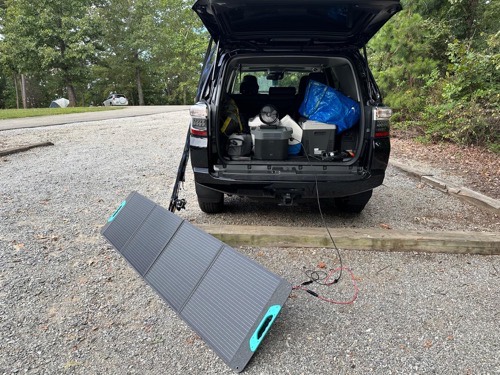
The quad-fold design is the big win here. Folded down, it measures about 23.72 x 22.99 x 1.97 inches, so it slides into RV storage bays, truck beds, closet shelves, and van nooks without the awkward bulk of rigid panels.
In real use, the panel has a solid heft without feeling like dead weight. Several owners mention that it feels well made, though a few complain that the fabric-like outer material can collect dust, fray at the edges, or look less durable than a padded nylon case.
| Build Detail | What Owners Tend to Notice |
|---|---|
| Folded size | Compact enough for vans, RVs, trucks, closets |
| Weight | Manageable for car camping, too heavy for backpacking |
| Closure | Magnetic handle is convenient and cleaner than loose straps |
| Rear pouch | Handy for MC4 leads and adapter cables |
| Outer material | Can collect dirt and may show edge wear |
| Carry protection | Many buyers wish a padded bag was included |
To be fair, portable panels always trade some toughness for packability. Still, our only real gripe on the build side is the lack of a better travel case, because this panel is clearly meant to be moved around.
Weather Resistance in Practice
Renogy gives this panel an IP65 rating, which means it’s protected against dust and low-pressure water jets. For camping rain, dusty desert roads, and short outdoor charging sessions, that’s a useful rating.
Worth knowing: IP65 does not mean you can leave it submerged, flat in standing water, or exposed without thinking about connector placement. Owners generally treat it as weather-resistant for outdoor use, not as a permanent roof panel.
| Feature | This Panel | What It Means Outdoors |
|---|---|---|
| IP rating | IP65 | Protected against dust and water splashes/jets |
| Frame material | Not specified | Portable construction, not a rigid aluminum-frame panel |
| Panel surface | Not specified | Treat with care during transport and ground use |
| Connector weatherproofing | MC4 output | MC4 is weather-friendly, but adapters may not be |
| Operating temperature range | Not specified | Hot weather can reduce wattage |
| Wind behavior | Needs securing | Light enough to blow over in gusts |
| Long-term reports | Mostly positive, with some wear complaints | Works well for many, but fabric edges and warping appear in some feedback |
Worth Knowing — IP65 is usually fine for angled portable use in rain. The bigger risk is wind, abrasion, or leaving connectors where water can sit. If you camp in gusty areas, stake it down or lean it against something stable.
Several owners mention using the panel on RV trips, sailboats, desert camping, and vehicle roofs without major failures. That said, a few buyers report bowed panels, edge fraying, or reduced output after months of use.
Honestly, this is where expectations need to stay grounded. The Renogy 200W solar panel is built for portable adventure and backup use, not permanent year-round roof mounting like a framed glass module.
Safety Ratings and Warranty Terms
Renogy lists UL 61730 certification, plus CE, RoHS, FCC, PSE, CA65, and ISO 9001 manufacturing claims. For a portable solar panel that may be used around RVs, batteries, and power stations, those certifications are a welcome layer of confidence.
The warranty is 2 years for material and workmanship. To be fair, that’s better than many no-name portable panels, but customer support experiences are mixed.
Some buyers report successful replacements after a defective or low-output unit. On the flip side, others describe slow email support, warranty registration frustration, or disappointment when a panel underperformed after the coverage window.
Long-Term Ownership — Solar cells usually lose output slowly over time, but portable panels often fail first at the fabric edges, connectors, hinges, or cable strain points. Keep it dry before storage, avoid dragging it on asphalt, and use a tarp under it on rough ground.
Heat is also part of the story. Solar panels are rated under lab conditions, and real panels lose output as they get hot, so a reading that starts near 200W and settles closer to 170W on a hot day is normal.
Safety-wise, this panel does not include a charge controller. If you’re connecting to a bare 12V battery, you need a proper controller between the panel and battery — especially for LiFePO4, AGM, or gel chemistries.
Which Buyers Will Love This — Use-Case Fit Matrix — Renogy RPP200EF-SE
The Renogy RPP200EF-SE review sweet spot is clear: vehicle-based portable power. It’s especially useful when you can move the panel into sun while keeping your battery station, RV, or van parked in shade.
| Use Case | Fit | Why |
|---|---|---|
| EcoFlow / Bluetti / Anker power station charging | Strong fit | Good output and MC4 compatibility with the right adapter |
| RV house battery support | Strong fit | Useful daily harvest when paired with a proper controller |
| Van camping and overlanding | Strong fit | Folds compactly and can be aimed away from the vehicle |
| CPAP backup power | Strong fit | Can recover typical overnight draw in decent sun |
| Sailboat or marine battery top-off | Solid fit | Owners report good results, but protect connectors from salt and spray |
| Camping fridge and lights | Solid fit | Helps carry small loads during the day |
| Large off-grid cabin battery bank | Borderline | One panel helps, but more wattage is usually needed |
| Apartment balcony solar | With caveats | Poor sun angle or limited direct sun can make output disappointing |
| Backpacking | Skip | Too large and heavy for foot travel |
| Full-shade installation | Not recommended | Output drops too much to be useful |
| High-draw inverter loads | Not recommended | Better as charging support, not a stand-alone power source |
| Buyers who want every cable included | With caveats | Panel is good, accessory bundle is sparse |
Renogy RPP200EF-SE: Decision Snapshot
| Spec | Value |
|---|---|
| Max Power Output | 200 W monocrystalline silicon |
| Output Voltage | 21.6 V DC maximum operating voltage |
| Connector | MC4, USB-C PD, USB-A |
| Cell Efficiency | 25% |
| Weatherproof Rating | IP65 |
| Charge Controller | None included — use power station input or separate controller |
| Cable Length | Not specified; built-in MC4 leads are commonly described as short |
| Mount Type | Integrated kickstands, 40° / 50° / 60° adjustment |
| Best For | Power stations, RVs, vans, boats, camping, CPAP backup, and 12V battery charging with a controller |
You'll probably be happy if you want: — Renogy RPP200EF-SE
- A 200W portable solar panel for camping, RVs, vans, or boats
- Strong value versus pricier power-station-branded panels
- MC4 output that can adapt to lots of systems
- Enough daily harvest for CPAP backup, laptops, phones, fridges, and lights
- A panel that folds small enough to store inside a vehicle
You might want to skip it if you need: — Renogy RPP200EF-SE
- A panel that includes every adapter cable in the box
- Backpack-friendly solar gear
- Guaranteed 200W output in normal conditions
- A polished kickstand system that’s effortless in wind
- Permanent year-round roof mounting
Quick Verdict on the Renogy RPP200EF-SE Review
If you want a portable 200W panel for power stations, RV camping, and emergency backup, the Renogy RPP200EF-SE does what most buyers expect. It’s light for its class, easy to store, and often delivers genuinely useful output in the 150W-plus range when the sun cooperates. That said, this Renogy RPP200EF-SE review wouldn’t be honest without the catches: the kickstands can be annoying, the MC4 leads are short, and you’ll probably need to buy an adapter cable before you can plug it into your power station.
Adapter Check — Don’t assume this panel plugs straight into your power station. It comes with MC4 output, while many EcoFlow, Anker, Bluetti, Jackery, and Goal Zero units need MC4-to-XT60, XT60i, 8mm, or another adapter.
So, Is It Worth It? — Renogy RPP200EF-SE
For the right buyer, yes. This Renogy RPP200EF-SE review comes down to value, portability, and realistic output: it’s not flawless, but it punches above its weight when paired with a compatible power station or a proper charge controller.
If you’re camping from a vehicle, topping off an RV battery, supporting a CPAP power station, or building a quiet backup setup for outages, the Renogy RPP200EF-SE solar panel is a solid pick. Just order the right adapter cable, secure it in the wind, and don’t expect lab-rated 200W performance all day.
Pros & Cons Analysis
Based on documented specifications and owner feedback
Pros
- Strong real-world output in good sun — Many owners report seeing roughly 150W to 190W in clear conditions, with some seeing near-rated or even briefly above-rated output when the panel is cool and well angled.
- Works well with popular power stations — Customers successfully pair it with EcoFlow, Anker SOLIX, Bluetti, Goal Zero, Jackery, EGO Nexus+, and RV battery systems using MC4-to-input adapters.
- Light for a 200W folding panel — At about 13.9 lb, buyers describe it as manageable for car camping, RV use, sailboats, vans, and emergency kits.
- Compact quad-fold storage — The folded size of about 23.72 x 22.99 x 1.97 in makes it easy to slide into a van, RV storage nook, truck bed, or closet.
- Useful direct USB charging — Built-in USB-C PD and USB-A ports are handy for topping up phones, tablets, cameras, and smaller electronics without a power station in between.
- Good value versus power-station-branded panels — Buyers often compare it favorably against pricier EcoFlow, Anker, Bluetti, or Goal Zero panels, especially when bought on sale.
- Decent partial-shade behavior — Owners mention that partial shade often reduces output rather than killing charging completely, which helps in campgrounds, boats, and vehicle setups.
- Good for RVs, vans, boats, and CPAP backup — Customers use it to maintain LiFePO4 banks, run RV lighting and fridges, recharge CPAP power stations, and keep camp setups going quietly.
- Easy to unfold once you learn the routine — Many users like that it deploys faster than rigid panels and packs away neatly after camping or emergency use.
- IP65 rating and safety certifications — The panel is rated IP65 and listed with UL 61730, CE, RoHS, FCC, PSE, CA65, and ISO 9001 manufacturing claims, which adds confidence for outdoor use.
Cons
- Output is inconsistent from unit to unit — Some buyers only see 100W to 140W in conditions where they expected more, and a few report severe underperformance even after checking cables, angles, and charge controllers.
- Adapter cable usually not included — A recurring gripe is that it ships with MC4 output but not the XT60, XT60i, 8mm, aviation, or brand-specific cable many power stations require.
- Still too bulky for backpacking — Even though it is light for its wattage, owners consistently frame it as a vehicle-based panel, not something you would want to carry far on foot.
- Travel protection could be better — Several customers wish Renogy included a proper padded carry bag, since the panel surface and fabric edges can take wear during transport.
- USB output shares available solar power — Owners note that using the USB ports reduces what is left for the battery or power station, which is normal but worth understanding.
- Warranty support gets mixed feedback — Some customers are happy with replacements, while others describe slow back-and-forth support or disappointment when low-output panels fall outside the 2-year warranty.
- Full shade still kills performance — Like any solar panel, it needs real sun; shaded balconies, poor orientation, or trees can turn a 200W panel into a slow trickle.
- Not enough for high-draw loads by itself — One 200W panel can help a lot, but buyers with large battery banks or inverter-heavy use may still need more panels or generator backup.
- Kickstands can be fiddly — The support legs and hook-and-loop/holding pads frustrate some owners because they flop, stick, and require patience to position by yourself.
- IP65 is not waterproof for submersion — It should handle splashes and rain, but owners still need to protect connectors and avoid leaving it flat in pooling water.
Bottom Line: An Electrically Transparent 200W Panel
The RPP200EF-SE combines exact published electrical limits with a favorable 13.89-pound weight. Its best case is a power station that accepts roughly 19V at more than 10A. Inspect the stand and surface carefully because the owner evidence includes individual support and heat-related incidents.
Frequently Asked Questions
What are the Renogy RPP200EF-SE electrical specifications?
Renogy specifies 18.8V Vmp, 10.6A Imp, 21.6V Voc, and 11.3A Isc for this exact model.
Will it work with my power station?
Only if the station accepts the panel's voltage, current, wattage, connector, and polarity. A station with an 8A input ceiling can clip a panel capable of 10.6A even when the voltage fits.
How much output did owners report?
Examples in the reviewed sample include about 154W flat on a truck cover, 160W in another setup, and a meter reading of 209W in Arizona. These are individual observations under different conditions, not a controlled average.
Is the RPP200EF-SE waterproof?
Renogy rates it IP65. That supports outdoor deployment but not immersion or careless treatment of open connectors.
What should I inspect on arrival?
Open the panel fully, inspect the laminate, seams, support, hinges, cable, and connectors, then commission it under moderate sun while watching for unstable support, unusual heat, or intermittent output.
Technical Specifications
| Brand | Renogy |
|---|---|
| Model / SKU | RPP200EF-SE (ASIN B0CNPHD4VY) |
| Panel format | Two-section folding portable |
| Rated output (Pmax) | 200W |
| Cell technology | Monocrystalline |
| Module efficiency | — (manufacturer states >25% cell efficiency, not module efficiency) |
| Voltage at maximum power (Vmp) | 18.8V |
| Current at maximum power (Imp) | 10.6A |
| Open-circuit voltage (Voc) | 21.6V |
| Short-circuit current (Isc) | 11.3A |
| Power tolerance | — |
| Maximum system voltage | — |
| Maximum series fuse | — |
| Output connector | Solar connectors |
| Output cable | Integrated output lead; adapter depends on receiving device |
| Deployed dimensions | 87.80 × 22.99 × 0.12 in |
| Folded dimensions | 23.72 × 22.99 × 1.97 in |
| Weight | 13.89 lb |
| Surface and frame | Flexible folding laminate |
| Positioning / mounting | Integrated adjustable support |
| Environmental protection | IP65 |
| Wind / snow load | — |
| Operating temperature | 14°F to 149°F (-10°C to 65°C) |
| Included accessories | Panel and attached output lead |
| Product warranty | 2 years |