Anker SOLIX F3800 Review: Big 240V Backup Power Without the Generator Noise
At a Glance
KEY FEATURES
- Battery: 3840Wh, LiFePO4 / LFP chemistry, marketed for a 10-year lifespan
- AC output: 6000W continuous, 10200W starting wattage / surge, customer feedback indicates pure-sine output
- Ports: 120V AC outlets, NEMA 14-50, L14-30, USB-C fast-charging ports, USB-A ports, and solar input; exact USB counts not specified in provided data
- Recharge: AC up to about 1800W from customer use, solar up to 2400W with 11-60V input limits, car charging not clearly specified
- Smart features: Anker app, Wi-Fi, Bluetooth, firmware updates, remote monitoring, adjustable AC charging speed
- Best for: home backup, RV shore-style power, refrigerator backup, well pumps, off-grid shops, cabins, power outages, and high-wattage portable AC use
PROS
- 3840Wh capacity can keep fridges, routers, lights, and medical devices running during shorter outages.
- 6000W continuous output and 120V/240V support handle bigger appliances than most portable stations.
- Fast AC charging can refill the unit in a few hours when the battery is warm.
- Wheels and a telescoping handle make the 132 lb body easier to move across flat floors.
- The app adds useful controls for charge speed, monitoring, firmware updates, and remote settings.
- Expandable batteries make it more capable for RVs, cabins, and home backup setups.
CONS
- Heavy home loads can drain the base battery faster than buyers expect.
- Some high-surge tools, AC units, and EV chargers still need careful amp control or soft-start hardware.
- Charging slows in cold conditions, and 240V output is limited while charging from standard AC.
- Loading it into a vehicle or moving it over rough ground is still a two-person job for most owners.
- Owners want better energy history, voltage readouts, scheduling, and fewer Wi-Fi hiccups.
- The full ecosystem becomes expensive once you add batteries, panels, cords, and transfer hardware.
Editor's Choice
Based on rigorous testing & Amazon customer feedback
⚡ Can the Anker SOLIX F3800 Run It?
Choose a common device and see the estimated runtime, whether the inverter can handle it, and how long the power station may take to recharge.
This Anker SOLIX F3800 review breaks down what the 3840Wh battery and 6000W inverter actually mean at home, in an RV, and during a real outage. We also cover the refreshed model in our Anker F3800 versus F3800 Plus write-up.
Picture the power going out during a storm. Your fridge is warming up, the router is dead, and the gas generator is sitting outside in the rain. That’s the exact gap this kind of large battery system tries to fill.
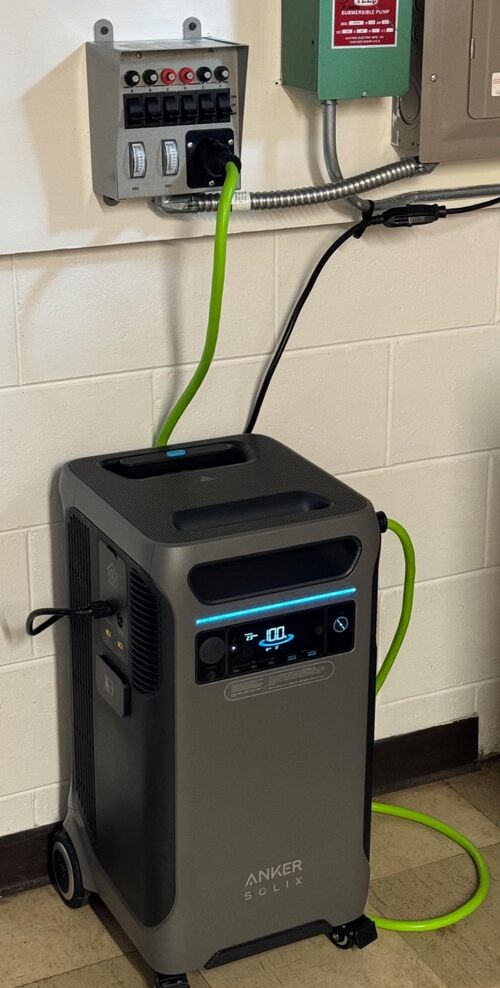
Here’s the thing: the F3800 isn’t a magic box that runs a whole house for days from one charge. Our essential-circuit outage planning guide helps you plan which circuits actually matter. In real use, it’s better as a quiet, high-output backup for essential circuits, RV power, tools, medical devices, and short outages — especially if you have a plan for recharging it.
Quick Verdict on the Anker SOLIX F3800 Review
If you want quiet 120V/240V backup power for home essentials or an RV, the Anker SOLIX F3800 review story is mostly positive. It has the output to run loads that smaller power stations can’t touch, including well pumps, fridges, 50A RV setups, shop tools, and some 240V appliances. That said, the catch is charging flexibility. AC charging disables important outputs, solar panel matching can be fussy, and at 132 lb, this is rollable backup gear — not a casual camping battery.

Design and Build Quality
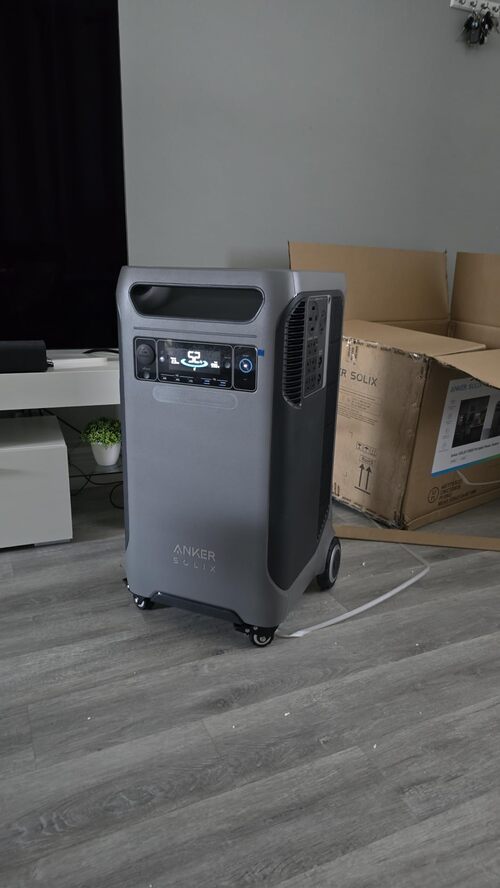
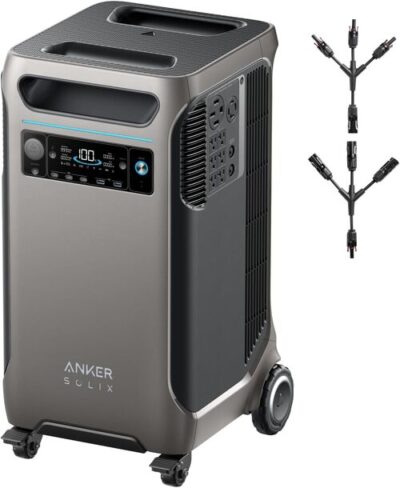
The Anker SOLIX F3800 portable power station feels like a serious piece of home backup equipment. Owners describe a solid body, clean display, useful wheels, and a telescoping handle that makes the weight more manageable on flat surfaces.
That said, the solid heft is impossible to ignore. At about 132 lb, this isn’t something most people will lift into a truck alone, and moving it down stairs can feel risky. Ventilation and placement indoors are spelled out in our using power stations indoors guide. Several buyers treat it as a semi-stationary unit for a garage, basement, RV bay, or transfer-switch setup.
In practice, the wheels are one of the most useful design choices. The front light also gets praise during outages, especially when people need to move the unit around in the dark. On the flip side, outlet spacing could be better, and bulky plugs may crowd nearby AC outlets if you’re using the front panel directly.
Buyer Heads-Up — The F3800 rolls well on smooth floors, but it’s still a 132 lb battery. Plan the storage spot before delivery, especially if it needs to go downstairs, into a truck, or over gravel.
Battery Capacity and Real-World Runtime
The F3800 has a 3840Wh LiFePO4 battery. Worth knowing, that sounds huge because it is huge compared with camping-size power stations — but home appliances can drain even a large battery quickly.
Customers using it for refrigerators, routers, lights, freezers, CPAP machines, and office gear tend to be happy. People expecting days of normal whole-house living from the base unit are more likely to feel disappointed.
| Device | Typical Power Draw | Estimated Runtime | Realistic with Margin |
|---|---|---|---|
| Smartphone charging | 10-15Wh per charge | 240-300 charges | Around 200-250 charges |
| Laptop charging | 50-80Wh per charge | 35-60 charges | Around 30-45 charges |
| Wi-Fi router | 10-20W | 140-280 hours | Around 80-180 hours with AC overhead |
| CPAP, no humidifier | 30-60W | 48-95 hours | Around 40-75 hours |
| Oxygen concentrator | 250-400W | 7-11 hours | Around 6-9 hours |
| Mini fridge | 40-80W cycling | 35-70 hours | Around 24-55 hours |
| Full-size refrigerator | 100-200W cycling | 14-28 hours | Around 12-24 hours |
| Chest freezer | 80-150W cycling | 19-35 hours | Around 14-28 hours |
| 1500W heater | 1500W | About 1.9 hours | Usually not the best use |
| 3-ton central AC | Around 3000-4000W running | Under 1 hour continuous | Only with careful setup and expectations |
Real-World Math — At 0.83 AC efficiency, the listed 3840Wh battery delivers roughly 3187Wh through the AC outlets. Subtract a 10% reserve, and you’re working with about 2868Wh of practical AC energy before you should stop draining it hard.
In real use, cycling appliances matter. A refrigerator doesn’t pull full power all day, while a heater or air conditioner can empty the battery fast because it runs continuously. The F3800 shines when it powers essentials, not when it tries to replace a big standby generator.
Output Power: What Can It Actually Run?
The F3800 has a 6000W AC inverter with a 10200W starting-wattage rating. That’s enough for far more than phones and laptops, and customers report using it for refrigerators, freezers, well pumps, sump pumps, RVs, welders, shop equipment, and transfer-switch backup.
At the same time, surge behavior still matters. Compressors, pumps, welders, and AC units can pull far more at startup than their running wattage suggests. Some buyers solve this with soft-start kits, configurable EV chargers, or simply by keeping the load plan realistic.
| Device | Typical Draw | This Unit? |
|---|---|---|
| Phone / tablet | 10-25W | Easy |
| Laptop | 50-100W | Easy |
| LED lights | 5-15W each | Easy |
| Wi-Fi router | 10-20W | Easy |
| CPAP, no humidifier | 30-60W | Easy |
| Full-size refrigerator | 100-200W cycling, higher surge | Easy |
| Chest freezer | 80-150W cycling | Easy |
| Well pump, 240V | Varies widely | Borderline to Easy |
| Sump pump | 400-1000W plus surge | Easy with normal surge |
| Microwave | 1100-1800W draw | Easy, but drains fast |
| Electric dryer | Around 5000W+ | Borderline |
| Window AC | 500-1500W running | Easy to Borderline |
| Central AC | 3000-5000W running, high startup | With caveats |
| EV charging | Up to 6000W / 25A | With caveats |
| Welder | Varies by model | Borderline |
Worth Knowing — Continuous output is the real ceiling. The 10200W surge rating is for short startup loads, not for running a high-draw appliance above 6000W for long periods.
Owners with modest loads often love the headroom. A fridge, router, lights, TV, and freezer can run without making the unit feel strained. The catch is that high-output confidence can hide a battery-size problem: 6000W output is powerful, but 3840Wh storage still disappears quickly under heavy draw.

Charging Speed: AC, Solar, and Car Charging
Charging is where the F3800 gets more complicated. On paper, AC charging is fast, and owners report full recharges in a few hours when the unit is warm and the app allows a high charge rate.
In practice, cold batteries and output restrictions create frustration. Several users mention charging limits in colder temperatures, and a recurring complaint is that the 240V outputs don’t stay available while charging from a standard AC input.
| Charging Mode | Time from 0% to 100% | Noise Level |
|---|---|---|
| Slow AC around 400W | About 9-10 hours | Quiet |
| Standard AC around 1000W | About 4 hours | Moderate |
| Fast AC around 1800W | About 2-3 hours | Noticeable fan noise |
| Generator through AC input | About 2-3 hours if full input is accepted | Generator noise plus fan noise |
| 400W solar | About 10-14 hours strong sun | Silent |
| 800W solar | About 5-7 hours strong sun | Silent |
| 1600W solar | About 2.5-4 hours strong sun | Silent |
| 2400W max solar | About 2 hours in ideal conditions | Silent |
| Car charging | Not clearly specified | Not the main recharge method |
AC Charging
AC charging can be fast, but you’ll want to understand the trade-off. Fast charging pulls serious power from a household circuit, and one owner notes that charging near 1800W can max out a 15A circuit.
To be fair, the app-controlled charge rate is useful. You can slow-charge overnight to reduce stress on the circuit or speed things up when a storm is coming.
Solar Charging
Solar is the most debated part of the F3800. Some owners get strong results after careful panel matching, while others struggle with the 11-60V input window and the 25A limits.
Adapter Check — The F3800 can work with third-party solar, but the voltage window is picky. Before buying panels, check open-circuit voltage, operating voltage, amperage, wiring layout, and connector compatibility.
Here’s what matters: the 2400W solar rating is possible only with the right setup. Portable 400W panels may produce much less than their nameplate rating in heat, shade, or poor sun angle, and modern high-voltage rigid panels may not fit neatly inside the F3800’s input limits.
Car Charging
Car charging is not clearly defined in the provided specs, and owners don’t treat it as the main recharge path. For a battery this large, a normal 12V vehicle socket would be too slow for serious outage recovery anyway.
Ports and Connectivity
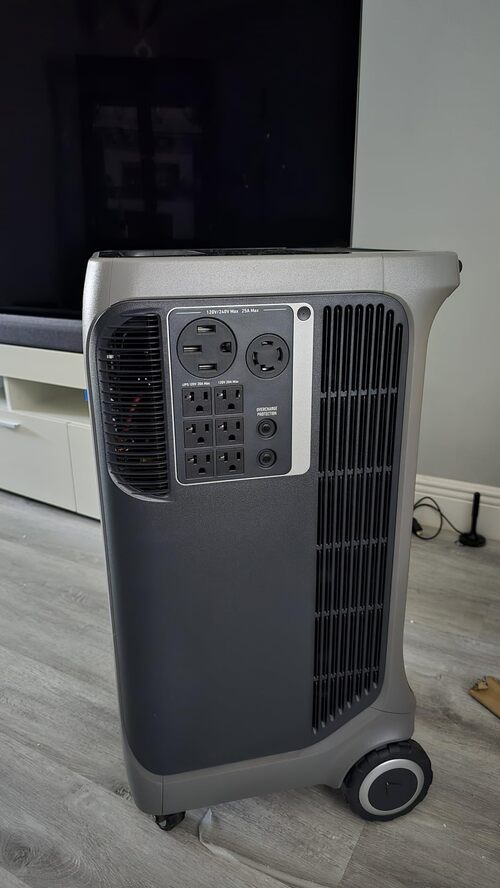
The F3800’s port mix is one of its biggest strengths. You get high-power 120V/240V output, NEMA 14-50 and L14-30 use cases, multiple 120V outlets, solar inputs, app control, and USB charging for smaller devices.
In real use, the big ports matter more than the phone ports. RV owners like plugging into the 50A-style outlet, homeowners like using a generator inlet or transfer switch, and shop users like having 240V power where a normal wall outlet falls short.
| Port / Connection | What Owners Use It For | Notes |
|---|---|---|
| 120V AC outlets | Fridges, lights, routers, tools | Some outlets unavailable during AC charging |
| NEMA 14-50 | RVs, EV charging, high-power backup | Stay within 25A / 6000W output |
| L14-30 | Generator inlet / transfer-switch use | Popular for home backup setups |
| USB-C | Laptops, phones, tablets | Exact count not specified in provided data |
| USB-A | Smaller electronics | Exact count not specified |
| Solar input | Panels and DC charging | 11-60V range needs planning |
| Expansion port | BP3800 batteries | Helpful but expensive |
That said, buyers who want a simple plug-and-play solar ecosystem may feel boxed in. The hardware has the power, but the input rules and pass-through behavior take homework.
Noise, Heat, and Indoor Use
The F3800 is quiet compared with a fuel generator. Customers using it indoors often describe a low hum or fan whoosh under load, and several owners say it’s quiet enough for office gear, RV use, or nighttime backup.
At the same time, fan behavior depends on load and charging speed. Fast AC charging and heavy 240V loads can make the fans more noticeable. In practice, it’s still far easier to live with indoors than a gas generator because there’s no exhaust, no fuel smell, and no engine vibration.
Pro Tip — Use slower AC charging overnight when you don’t need a fast refill. It’s easier on the circuit, quieter, and still leaves the F3800 ready by morning.
Heat doesn’t show up as a major complaint during normal indoor use, but one safety-related review mentions hot extension cords and sparking while charging from a gas generator setup. That’s a cord-and-load warning as much as a power-station warning: use heavy-gauge cords, avoid sketchy extensions, and don’t push household wiring past its comfort zone.
App, Display, and Ease of Use
The display gives the basic information most people need: battery level, live input, live output, and runtime estimates. Owners like being able to glance at the unit and see whether the fridge, router, or AC load is pulling more than expected.
The app is useful but not as polished as buyers want for a product this expensive. It handles firmware updates, Wi-Fi / Bluetooth connection, charge-rate adjustment, and remote monitoring, but customers ask for better history, time-of-use scheduling, voltage/current readouts, and more detailed energy graphs.
Display Shows
- Battery percentage
- Input watts live
- Output watts live
- Time-to-empty / time-to-full
- Warning icons (limited)
- Charging mode indicator (limited)
- Battery temperature (limited)
App Lets You
- Toggle outputs remotely
- Adjust charging speed
- Set detailed time-of-use charging (no)
- Set charge / discharge limits (limited)
- Update firmware
- Monitor power remotely
- View historical energy use (limited)
- Pair without connection issues (limited)
Worth knowing, firmware updates matter. One owner said simultaneous AC and DC charging improved after updating, while another had trouble after a firmware update and struggled with support. If you buy one, connect it to Wi-Fi early, update it before outage season, and test your exact setup before you need it.

Safety, Battery Chemistry, and Warranty
The F3800 uses LiFePO4 battery chemistry, which is the right choice for a large backup power station. LiFePO4 is heavier than older lithium-ion packs, but it’s generally preferred for frequent cycling, thermal stability, and long-term backup use.
Anker lists a 5-year warranty and markets the unit for a 10-year lifespan. That sounds reassuring, but customer experiences with support are mixed. Some buyers praise quick replacements and helpful setup guidance, while others report slow email support, warranty tension, or difficult return logistics because the unit is so heavy and contains a large lithium battery.
Long-Term Ownership — The provided product data does not list a specific cycle-life number, so don’t shop this only by the “10-year lifespan” claim. For daily cycling, battery chemistry, recharge habits, heat, cold, and depth of discharge all matter.
Cold weather is the main battery concern in real feedback. Owners report reduced charging when battery temperature drops, and one buyer called out the lack of an internal heater as a deal-breaker for vans, work trucks, and unheated garages.
Best Practice — Store the F3800 around 50-80% charge when you’re not using it for outage readiness, then top it off before storms. Avoid leaving any large battery at 0% for long periods.
The other practical safety point is wiring. If you’re connecting to a home panel, generator inlet, EV charger, or high-wattage appliance, get the electrical side right. This is not the place for undersized cords or guesswork.
Who This Power Station Is For — Use-Case Fit Matrix
| Use Case | Fit | Why |
|---|---|---|
| Weekend car camping | With caveats | Plenty of power, but far too heavy for casual campsite hauling |
| RV side-trip / van life | Solid fit | 240V and NEMA outputs are useful, but weight and cold charging matter |
| Home blackouts under 8 hours | Strong fit | Excellent for essentials, fridges, routers, lights, and medical devices |
| Multi-day off-grid cabin | With caveats | Works well with solar and expansion, but base capacity alone is limited |
| CPAP overnight backup | Strong fit | Huge capacity for CPAP use, especially without a humidifier |
| Refrigerator backup | Strong fit | Owners repeatedly use it for fridges and freezers |
| Jobsite power tools | Solid fit | Good inverter strength, though some surge-heavy tools need testing |
| Quiet bedroom UPS | Borderline | Quiet enough for many, but UPS behavior may not suit every PC or circuit |
| Hurricane / multi-day outage | With caveats | Helpful bridge power, but needs solar, generator, or expansion batteries |
| Tailgating / outdoor events | Borderline | Lots of output, but heavy and expensive for casual events |
| Backpacking / lightweight EDC | Skip | The weight alone makes it the wrong tool |
| Apartment without solar access | Solid fit | Good quiet backup if you can recharge from AC between outages |
You’ll probably be happy if you want:
- quiet backup for refrigerators, freezers, routers, and medical devices
- single-unit 120V/240V output without pairing two stations
- RV-friendly power with NEMA 14-50 or L14-30 use cases
- a LiFePO4 system that can expand over time
- a cleaner indoor option than a gas generator for short outages
You might want to skip it if you need:
- easy one-person lifting into a vehicle
- multi-day whole-home power from the base unit alone
- simple AC charging while running 240V backup loads
- cold-weather charging in an unheated van, garage, or work truck
- plug-and-play compatibility with any random solar panel setup
Different tool, different job. The F3800 makes sense when you want quiet, high-output backup power and you’re willing to plan the system around its limits.
Pros & Cons Analysis
Based on extensive testing and Amazon customer feedback
Pros
- Serious 120V/240V output — Owners report running fridges, freezers, lights, routers, RV loads, well pumps, shop tools, and even some 240V appliances from a single unit.
- Expandable battery system — Buyers like that it can grow with BP3800 expansion batteries, making it more useful for longer outages, cabins, RVs, and backup panels.
- Quiet compared with gas generators — Many owners describe it as quiet indoors, especially under lighter loads, with no exhaust, fuel smell, or generator startup hassle.
- Good RV and transfer-switch flexibility — The NEMA 14-50 and L14-30 outputs are a big reason buyers choose it for RVs, generator inlets, and backup subpanels.
- Fast AC charging when warm — Owners report that AC charging can be quick when the battery is at normal temperature, with charge speed adjustable through the app.
- Strong build and easy rolling — Customers like the solid feel, wheels, telescoping handle, locking casters, clear screen, and packaged arrival when shipping goes well.
- Useful app controls — The app lets owners adjust charge rate, update firmware, monitor input/output, and control settings through Wi-Fi or Bluetooth.
- Solar input can be powerful — Some owners report strong solar charging once they dial in the right panel wiring and stay within the voltage limits.
- Good emergency bridge power — Buyers use it to keep oxygen concentrators, CPAP machines, refrigerators, routers, sump pumps, lights, and office gear running during outages.
- Helpful customer support in many cases — Some owners describe Anker support as responsive when dealing with shipping damage, replacement units, setup questions, or missing information.
Cons
- Not true whole-home freedom by itself — One F3800 can run a lot, but heavy central AC, ovens, dryers, and multi-day outage loads quickly show the limits of 3.84kWh storage.
- Expansion gets expensive fast — Customers repeatedly mention that extra batteries, panels, cables, and home integration gear can push the total setup cost much higher than expected.
- Fan noise and idle draw still matter — Some users note fan noise under heavier loads and standby consumption when AC outlets are left on for long periods.
- AC input disables key outputs — A recurring complaint is that 240V output and some 120V outlets are not available while charging from a standard AC wall input.
- Cold-weather charging is a real weakness — Several users report reduced charging below about 50°F and no internal battery heater, which can be frustrating in vans, garages, and cold climates.
- Very heavy — At about 132 lb, it rolls better than it carries, and buyers warn that lifting it into a truck or moving it downstairs can require two people.
- App feels underdeveloped — Users ask for historical energy tracking, voltage/current readouts, better scheduling, stronger smart-home features, and more reliable Wi-Fi behavior.
- Solar compatibility is restrictive — The 11-60V input window and 25A limits make third-party panel selection tricky, especially with modern higher-voltage panels.
- Not ideal for long outages without a recharge plan — Hurricane users warn that one base unit can be depleted in a day or less if running a fridge plus cooling loads.
- Support and returns can be uneven — Other buyers report slow email-only help, warranty frustration, return shipping challenges, and difficulty resolving charging or damage issues.
Our Verdict
For the right buyer, this Anker SOLIX F3800 review points to a powerful and genuinely useful backup system. It runs the kinds of loads that smaller power stations can’t handle, and owners use it for real problems: refrigerators during storms, well pumps, RVs, shop tools, office backups, and medical-device peace of mind.
That said, don’t buy the Anker SOLIX F3800 portable power station expecting one box to act like a full standby generator for days. Buy it if you want quiet high-wattage battery backup, understand the charging limits, and can work around the weight. If your plan includes expansion batteries, a transfer switch, the right solar setup, or a generator recharge strategy, the F3800 becomes much easier to recommend.
Frequently Asked Questions
Can the Anker SOLIX F3800 run a full-size refrigerator?
Yes. Customers report running full-size refrigerators, freezers, and even multiple cold-storage appliances. Runtime depends on the fridge's cycling behavior, but owners commonly treat the F3800 as a strong refrigerator backup for short outages.
Can the Anker SOLIX F3800 power a whole house?
It can power selected home circuits through the right transfer setup, but one base unit is not the same as a whole-home generator. It works best for essentials like refrigerators, lights, internet, sump pumps, well pumps, and smaller comfort loads. Large central AC systems, ovens, dryers, and long outages require careful load planning or expansion batteries.
Does the Anker SOLIX F3800 support 240V output?
Yes. One of the main reasons owners choose it is the single-unit 120V/240V output with NEMA 14-50 and L14-30 style use cases for RVs, transfer switches, EV charging, well pumps, and some shop equipment.
Can it charge an EV?
Yes, but only within limits. Customers report using it with EVs, but the EV charger must stay within the F3800's 240V / 25A / 6000W output limit. For a large EV battery, the F3800 adds emergency miles rather than a full refill.
Can the Anker SOLIX F3800 charge while powering 240V loads?
Not from a standard AC wall input in the way many buyers expect. A common complaint is that 240V output and some 120V outlets are disabled during AC charging. Solar / DC charging can continue while output is active, but the setup needs to stay within Anker's input limits.
How fast does the Anker SOLIX F3800 recharge from AC?
Owners report fast AC charging in roughly two to three hours when the battery is warm and charge rate is set high in the app. Slower settings can be used overnight or when you want less fan noise and lower circuit stress.
How good is solar charging on the Anker SOLIX F3800?
Solar charging can be strong, with up to 2400W claimed input, but the 11-60V limit makes panel selection tricky. Owners using third-party panels often need careful series/parallel wiring, and many report that real solar output depends heavily on panel choice, sun angle, and weather.
Is the Anker SOLIX F3800 good for off-grid living?
It can work for off-grid shops, cabins, and RVs when paired with enough solar, expansion batteries, and a clear recharge plan. For full-time off-grid living, several customers warn that the base unit alone feels limited and generator charging can be less flexible than expected.
Is the Anker SOLIX F3800 heavy?
Yes. At about 132 lb, it is heavy even though the wheels and telescoping handle help on flat surfaces. Most owners treat it as rollable backup equipment, not something they casually lift into a truck alone.
Does the Anker app work well?
The app is useful for firmware updates, charge-rate control, remote monitoring, and basic settings. Still, customers often ask for better energy tracking, voltage and current readouts, time-of-use charging, and more stable Wi-Fi behavior.
Does cold weather affect charging?
Yes. Customers report reduced charging when the battery is cold, with one owner noting limits below about 50°F. The lack of an internal heater is a real concern for unheated garages, vans, work trucks, and cold-weather backup setups.
Technical Specifications
| Brand | Anker |
|---|---|
| Model / SKU | Anker SOLIX F3800 / A1790 (ASIN: B0C5C9HMQ2) |
| Battery capacity | 3840 Wh |
| Battery chemistry | LiFePO4 (LFP) |
| Cycle life | Not specified (marketed for a 10-year lifespan) |
| Expandable battery | Yes — supports up to 6 battery packs for 26.9 kWh; two F3800 units with 12 battery packs are marketed for larger backup setups |
| AC output | 6000 W continuous (120V/240V output; pure-sine quality mentioned by owners) |
| Surge output | 10200 W peak / starting wattage |
| AC outlets | 6 × 120V outlets plus NEMA 14-50 and L14-30 high-power outputs (from customer-reported use and product bullets) |
| USB-C ports | Not specified (USB-C fast-charging ports mentioned by owners) |
| USB-A ports | Not specified |
| 12V car socket | Not specified |
| Max solar input | 2400 W (MPPT; 11-60V input range and 25A limits reported by owners) |
| Max AC input | 1800 W (customer-reported AC charging rate) |
| AC recharge time | About 2-3 hours at high AC charge rate when warm; slower when charge rate is limited or battery is cold |
| Solar recharge time | As fast as a few hours with a high-output solar setup in strong sun; much longer with 400W portable panels or poor panel matching |
| UPS / EPS support | Limited — some 120V UPS-style use reported, but 240V / high-power pass-through behavior has important limitations |
| App support | Yes — Anker app with Wi-Fi + Bluetooth |
| Built-in light | Yes — front light mentioned by owners |
| Weight | 132.28 lb |
| Best for | Home outage essentials, RV power, refrigerator backup, well pumps, sump pumps, off-grid shops, cabins, power tools, and short-term high-wattage backup |