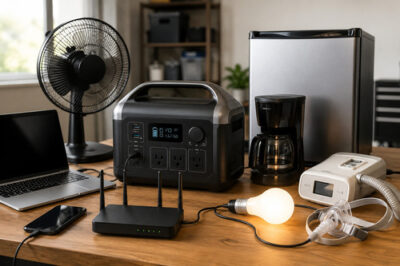
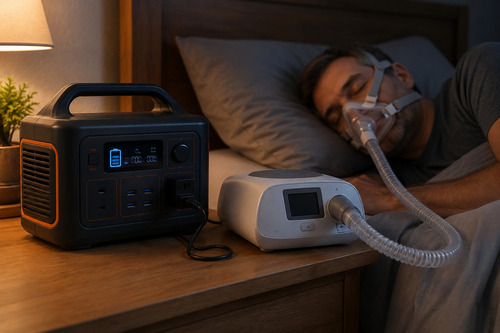
Can a portable power station run a CPAP? Usually yes, when the station provides the voltage, connector, waveform, watt-hours, and operating time required by the exact therapy device. Heated humidification and heated tubing can change the energy requirement dramatically, so size from manufacturer guidance or a measured overnight—not a generic CPAP watt figure.
Verify every power accessory and operating plan with the CPAP manufacturer or care provider. This guide explains energy planning; it does not replace medical or device-specific advice.
Start with the Therapy Configuration You Will Actually Use
Record the machine model, pressure mode, humidifier setting, heated tube setting, oxygen connection if any, and approved power supply. ResMed’s published Air10 battery guidance, for example, shows that current draw changes substantially with pressure and heated accessories. That is why “CPAP uses 40W” is not a universal planning fact.
| Configuration variable | Why it changes the plan | What to record |
|---|---|---|
| Pressure / therapy mode | Blower demand varies | Exact prescribed configuration |
| Humidifier | Heater can dominate energy use | Setting and whether it may be disabled |
| Heated tubing | Adds another controlled heat load | Temperature setting |
| AC power brick | Adds inverter and supply loss | Measured AC Wh if used |
| Approved DC converter | May avoid the AC inverter | Part number, voltage, polarity |
The safest input is the energy used by the exact setup over a representative night. If measurement is not available, use the manufacturer’s current battery guide and preserve a conservative reserve.
Build a Two-Night Energy Budget
One night is the therapy hours multiplied by average demand. Then account for the power path and reserve. Planning for two nights gives time to respond when an outage lasts longer or recharge fails.
Wh ≈ average device W × hours/night × nights ÷ efficiency ÷ (1 − reserve)
Use measured average watts, not the power supply’s maximum rating, when a safe measurement is available.
| Example only | Without heat | With heat enabled |
|---|---|---|
| Average input used for model | 12W | 55W |
| Eight-hour night | 96Wh | 440Wh |
| Two nights, load-side | 192Wh | 880Wh |
| At 90% path efficiency + 15% reserve | About 251Wh rated | About 1,150Wh rated |
| Meaning | Compact station may work | Larger station or recharge plan |
These values illustrate sensitivity; they are not promises for a particular machine. The ResMed Air10 battery guide is an example of the exact-model documentation that should replace a generic table.
Estimate Nights with Your Own Measured Load
CPAP Backup-Nights Estimator
Enter power-station capacity and the average input of your complete CPAP configuration.
Planning estimate only. Confirm the exact CPAP, accessories, approved converter, environmental limits, and backup procedure.
Choose AC or Approved DC Deliberately
AC is simple: plug the normal medical-device power supply into a pure-sine outlet that meets its input requirements. The station’s inverter and the CPAP power brick both consume energy. An approved DC/DC converter may reduce those losses, but a fitting connector does not prove electrical compatibility.
Test the selected path with the intended pressure and comfort settings. Confirm that low-battery alarms, station timeouts, screen behavior, and any EPS transfer do not interrupt therapy.
Use a Settings Ladder Instead of Guessing
- Baseline: preserve prescribed therapy and measure the complete normal configuration.
- Comfort review: ask the care provider or manufacturer which humidifier/tube changes are acceptable during backup.
- Path test: compare normal AC with an approved DC converter if available.
- Reserve test: verify one full night while keeping the planned emergency margin.
- Recovery: confirm how the station recharges before the next sleep period.
Do not change therapy pressure or clinical settings to save battery. Comfort accessories can also be medically relevant for some users, so decisions about disabling heat or humidification belong with the care team and manufacturer guidance.
Check the Failure Modes Before Bed
- ✅ Station starts fully charged and remains within manual temperature limits.
- ✅ AC/DC output timeout is disabled only through an approved setting.
- ✅ Cables cannot be kicked loose and vents remain clear.
- ✅ A backup plan exists if the station, cable, or CPAP fails.
- ⚠️ EPS/UPS transfer is tested with the exact device; a fast advertised time is not universal medical approval.
- ❌ No unapproved adapters, wet placement, damaged packs, or overnight charging under bedding.
Recharging Is Part of the Prescription-Support Plan
For a one-night outage, stored energy may be enough. For several nights, daily load energy must be matched by reliable charging from utility power, an outdoor fuel generator feeding the approved charger, a vehicle system, or compatible solar. Weather-dependent charging needs a bad-day margin.
| Recovery source | Useful when | Verify first |
|---|---|---|
| Wall AC | Power returns between nights | Charge time and shared circuit |
| Vehicle outlet | Driving is planned | Vehicle socket and slow recharge rate |
| Installed alternator charger | Regular mobile use | Vehicle-approved installation |
| Solar | Daylight and safe panel placement exist | PV voltage/current/connector |
| Outdoor fuel generator | Extended outage with fuel | CDC outdoor placement and station input limit |
Keep a Bedside Backup Record
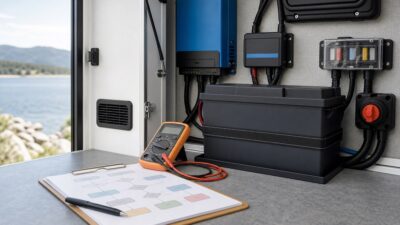
Write down machine model, power-path part number, measured Wh per night, station capacity, tested settings, expected nights, and recharge method. Add support phone numbers and the date of the last full test. A caregiver should be able to understand the setup without reconstructing your calculation at 2 a.m.
For the broader energy model, use the runtime formula lab. For room placement and combustion boundaries, follow the indoor-use safety map.
Worked Night: Why Power-Supply Maximum Is Not Average Use
An AirSense 10 user guide publishes a 90W power supply, typical consumption of 53W, and peak consumption of 104W for the documented configuration. Those numbers perform different jobs. The supply rating and peak help with compatibility, while overnight energy depends on actual pressure, tube, humidifier, environment, and operating time.
If a complete setup averages 45W for eight hours, it uses 360Wh at the device side. With an 85% AC path and 15% reserve, the model calls for roughly 498Wh rated capacity for one night. A two-night plan doubles load energy before the same path assumptions, reaching roughly 997Wh.
| Entered average | 8h load energy | Two-night load energy | Planning implication |
|---|---|---|---|
| 12W | 96Wh | 192Wh | Compact approved setup may work |
| 25W | 200Wh | 400Wh | Mid-size reserve helpful |
| 45W | 360Wh | 720Wh | About 1kWh after modeled loss/reserve |
| 60W | 480Wh | 960Wh | Recharge or larger capacity |
| 90W | 720Wh | 1,440Wh | Large station / daily recovery |
Humidifier Water and Power Are Separate Preparedness Items
Turning down heat may save energy only if the care plan permits it, and the humidifier still needs the correct water and cleaning routine. Stock approved supplies and follow infection-control and maintenance instructions. A power calculation does not decide whether alternative water or settings are clinically acceptable.
Cold camping conditions can increase comfort-heating demand while also moving the battery outside its preferred environment. Keep the therapy device and station within their documented operating ranges and manage condensation according to the CPAP manual.
Travel Adds Transport Rules and Recharge Uncertainty
Air travel
Large portable power stations usually exceed ordinary passenger spare-battery limits. Check the current airline and regulator rules before travel; do not arrive expecting a 1kWh pack in cabin baggage.
Vehicle travel
Secure the station, protect it from heat, and use only approved vehicle charging. Do not operate a vehicle engine in an enclosed space to recharge.
Camping
Model all nights plus poor-sun recovery. Keep the station dry and do not route CPAP cords where they create a trip or disconnect hazard.
Shelter or hotel
Carry device and power documentation, extension arrangements approved by the location, and a non-battery fallback plan.
Test Alarms and Human Response, Not Only Runtime
Some stations silence or dim displays; others beep when AC output changes or battery reaches a threshold. During a supervised test, confirm whether the sleeper or caregiver notices the relevant alarm and can restore power without changing therapy settings.
- Record the expected low-battery warning and shutdown point.
- Confirm the CPAP restarts correctly after an approved source interruption.
- Keep a flashlight and labeled spare cable within reach.
- Define who to contact if therapy cannot continue.
- Retest after firmware, accessory, pressure-mode, or comfort-setting changes.
Separate Therapy Continuity from Battery Convenience
The battery plan should sit inside a broader care plan. Record the device’s exact model and serial number, prescribed setup, approved DC or AC power path, who can authorize setting changes, and what to do if the device or station fails. Keep the equipment provider and clinician contact route available offline.
If uninterrupted therapy is medically critical, one untested portable station is not a complete fallback. Consider redundant approved power paths, the time required to reach powered care, and whether another caregiver can execute the plan. A successful overnight bench test confirms only that configuration under those conditions; it does not replace medical advice or guarantee future battery capacity.
A heated tube, humidifier setting, mask-heating accessory, pressure mode, cable, firmware update, or replacement machine can change compatibility or overnight energy.
Keep the completed worksheet with the machine rather than only on a phone that may also need charging.
Bottom Line: Size the Exact Night, Then Add Redundancy
A portable power station can run a CPAP when the exact therapy configuration and power path fit its output and energy budget. Humidification, heated tubing, pressure, conversion path, and hours—not the word “CPAP”—determine the capacity.
Verify compatibility with the manufacturer or care provider, measure one representative night, preserve reserve, and maintain a second plan. Medical backup should not depend on one untested battery and one cable.