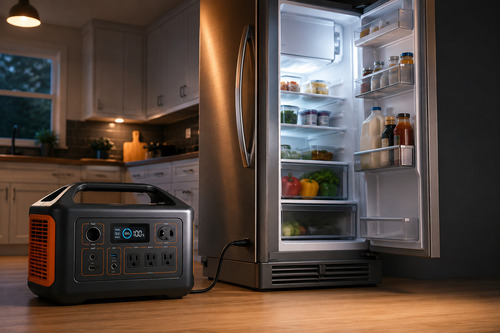
Can a portable power station run a refrigerator? Yes, if its inverter starts the compressor, its continuous output supports the running load, and its usable watt-hours cover the required outage window. Measure the refrigerator’s energy and startup behavior when possible; model labels and broad appliance averages cannot promise runtime for your kitchen.
First Decision: Can the Compressor Start?
A refrigerator’s average energy can be modest while its compressor demands a brief higher input at startup. The station must clear that event without tripping. Check the refrigerator documentation and a measurement capable of capturing inrush, then compare it with the station’s time-rated surge rules.
| Gate | Evidence needed | Pass condition |
|---|---|---|
| AC voltage and waveform | Both exact manuals | Compatible supply requirements |
| Continuous output | Running load plus other simultaneous loads | Below station continuous rating |
| Startup event | Measured or manufacturer-provided inrush | Within allowed surge and duration |
| Outlet / grounding | Manual requirements | Correct connection without improvised wiring |
| Protective behavior | Commissioning test | Starts repeatedly without trips |
A station with abundant watt-hours can still fail instantly if the inverter cannot start the compressor.
Second Decision: Read Energy, Not Only Running Watts
The yellow EnergyGuide label’s annual kWh can provide a rough daily-energy starting point: multiply by 1,000 and divide by 365. Better still, measure Wh over representative hot and cool periods. Door openings, ambient heat, defrost, ice making, ventilation, and food loading all change the result.
daily Wh ≈ annual kWh × 1,000 ÷ 365
Runtime hours ≈ usable station Wh ÷ estimated average W, where average W = daily Wh ÷ 24.
| Annual label example | Estimated daily energy | Average across 24h |
|---|---|---|
| 300kWh/year | 822Wh/day | 34W average |
| 400kWh/year | 1,096Wh/day | 46W average |
| 500kWh/year | 1,370Wh/day | 57W average |
| 600kWh/year | 1,644Wh/day | 69W average |
| 800kWh/year | 2,192Wh/day | 91W average |
The arithmetic averages defrost and compressor cycles across a year. It does not reveal startup surge or guarantee a hot-day load, so keep both the power gate and energy estimate.
Model Your Refrigerator and Station
Refrigerator Outage Runtime Estimator
Use the refrigerator’s annual kWh label as a starting point, then enter exact surge information if available.
Label-based estimate only. Measure actual Wh and inrush, and keep food temperature—not battery percentage—as the safety decision.
Run the Outage Clock Alongside the Battery Clock
The USDA says an unopened refrigerator keeps food safely cold for about four hours. It also advises keeping the refrigerator at or below 40°F and using an appliance thermometer. Power-station runtime does not override food-safety temperature.
Reduce Energy Without Creating a Food-Safety Guess
- ✅ Keep doors closed and organize needed items before the outage.
- ✅ Use an appliance thermometer rather than touch, smell, or battery percentage.
- ✅ Preserve airflow around refrigerator coils and the power station.
- ✅ Move nonessential loads off the station when runtime tightens.
- ⚠️ Schedule high-watt cooking loads separately from compressor starts.
- ❌ Do not unplug repeatedly just to chase a theoretical duty cycle.
A full freezer and refrigerator behave differently, and a chest freezer does not share a refrigerator’s energy profile. Build a separate measurement and temperature plan for every appliance you intend to protect.
Plan Recharge Before the First Battery Cycle Ends
| Source | Best role | Watch |
|---|---|---|
| Utility AC | Fast recovery when service returns | Circuit loading and input setting |
| Solar | Daytime energy replacement | Weather, PV compatibility, daily Wh |
| Vehicle source | Top-up during necessary travel | Slow rate and vehicle limits |
| Outdoor fuel generator | Extended-outage recharge window | CO-safe placement, fuel, station input |
| Second battery/station | Quiet swap and redundancy | Charge state and compatible load transfer |
If the refrigerator consumes 1.2kWh/day but a cloudy-day array delivers only 500Wh to the battery, the plan loses about 700Wh per day before other loads. Track delivered Wh, not “hours of sun.”
A room AC has a different voltage, compressor, heat-load, and duty-cycle problem. Use the four-band AC outage planner for the exact appliance and weather scenario.
Commission the Exact Pair Before an Outage
- Measure: log 24-hour Wh and startup watts under representative conditions.
- Start: prove the station can start the compressor several times without overload.
- Transfer: test safe movement from utility to station and back.
- Stress: include other essential simultaneous loads, but schedule cooking separately.
- Record: save runtime, temperature, remaining reserve, and recharge energy.
Do not backfeed household wiring. Connect directly as approved, or use professionally installed compatible transfer equipment. See the indoor placement guide before deciding where the station operates.
Worked Example: Convert the EnergyGuide Label Carefully
A refrigerator labeled 475kWh/year averages about 1,301Wh/day, or 54W across the year. If a station provides 1,500Wh of modeled usable AC energy, simple division suggests about 27.7 hours. That result still needs stress testing because the label averages seasons, defrost, and test conditions.
On a hot outage day, the compressor may run longer, doors may open more often, and the station itself may operate less efficiently. Treat the label result as the center of a range, not its guaranteed low boundary.
| Case around 1,301Wh/day | Modeled daily energy | 1,500Wh usable result |
|---|---|---|
| Cool / low-use boundary | 1,000Wh/day | About 36h |
| Label average | 1,301Wh/day | About 27.7h |
| Hot / high-use planning case | 1,600Wh/day | About 22.5h |
| Defrost/extra-load stress case | 1,900Wh/day | About 18.9h |
Older and Specialty Refrigerators Need Their Own Evidence
An older second refrigerator in a garage may face high ambient temperature and degraded seals. A side-by-side with ice making, a compact dorm unit, a chest freezer, and a 12V compressor fridge use different controls and energy profiles. Do not transfer one appliance’s measured duty cycle to another.
Absorption refrigerators and units with multiple energy sources require their own manuals. The presence of a plug does not mean the electric mode behaves like a modern compressor refrigerator.
Switching Sources Can Create a Restart Problem
- Observe normal cycling before interrupting utility power.
- Transfer according to both manuals without backfeeding wiring.
- Allow any required compressor delay rather than rapid unplug/replug cycling.
- Watch the first start for overload, voltage alarm, or repeated attempts.
- Verify restoration when utility power returns or EPS changes state.
A source that starts the refrigerator from a relaxed state may behave differently during rapid restoration. Test the sequence you expect the household to use.
Assign Priority Before Capacity Gets Low
- Priority 1: refrigerator or freezer temperature within the food-safety plan.
- Priority 2: medical, communication, and lighting loads documented separately.
- Defer: cooking appliances that can use another safe method.
- Reject: space heating and discretionary high-draw loads.
- Trigger: move food to a cooler or alternate storage before the battery becomes the only plan.
A load-priority list prevents a 1,500W kettle from consuming energy reserved for cold food. Everyone using the station should know that priority before the outage.
Measure Temperature, Not Just Battery Percentage
A station display tells you about stored energy, not whether food remains safe. Keep an appliance thermometer in the refrigerator and freezer, limit door openings, and follow current food-safety guidance when temperature or outage duration crosses its boundary. Do not taste food to decide whether it is safe.
| What to log | Where | Decision it supports |
|---|---|---|
| Interior temperature | Refrigerator/freezer thermometer | Food-safety action |
| Station state of charge | Station display/app | Load shedding and recharge |
| Appliance Wh | Meter or station energy log | Next runtime estimate |
| Peak/start behavior | Compatible meter or station event log | Inverter compatibility |
| Door-opening time | Household log | Explains changing duty cycle |
Plan the End of the Outage Before the Start
When utility power returns, avoid a chaotic reconnection of the refrigerator, station charger, and other large loads. Follow appliance and station instructions, confirm the supply is stable, and let any required compressor delay expire. Recharge the station in its approved environment and document how much reserve remained.
If the refrigerator tripped the station, warmed faster than expected, or required more daily energy than the model, revise the outage card immediately. The next plan may need a larger inverter, more usable energy, a different startup sequence, another cold-storage option, or earlier food transfer—not merely a fresh 100% charge.
Repeat the representative test seasonally if the appliance operates in a garage or another space with large temperature swings. Ambient heat can change compressor duty enough to invalidate a cool-weather runtime record.
Bottom Line: Protect Temperature, Not a Runtime Claim
A portable power station can run a refrigerator only after it passes the compressor-start gate and the energy calculation. Annual kWh and rated Wh are useful planning inputs, but a representative measurement is stronger.
Pre-charge, test, keep the door closed, and monitor temperature. During a real outage, USDA food-safety guidance—not a marketing runtime—decides whether food remains safe.