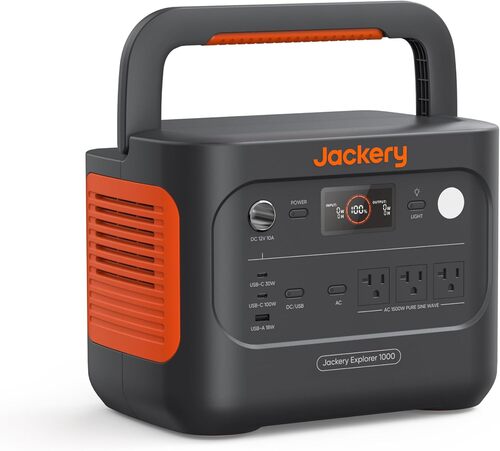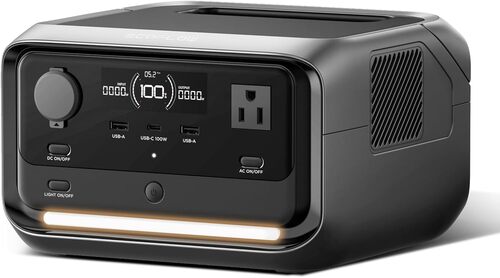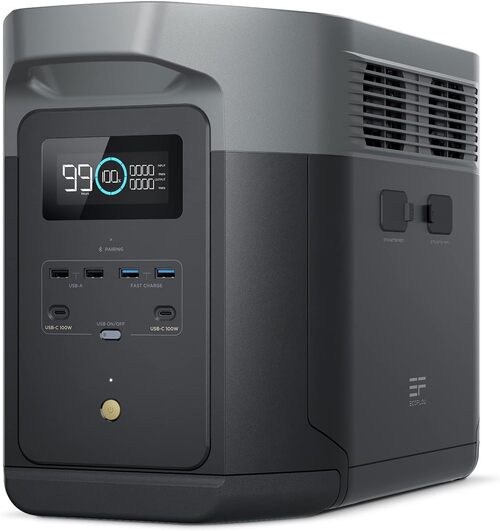
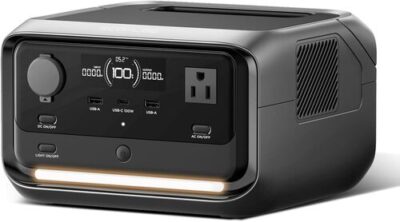
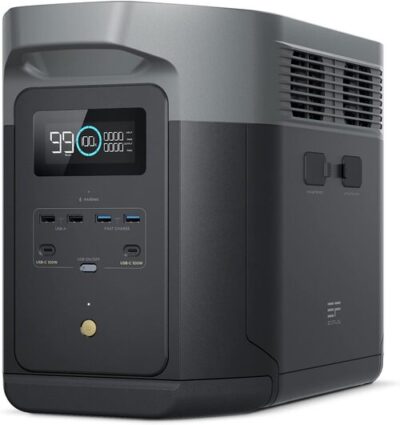
Choosing between Jackery vs EcoFlow usually comes down to philosophy as much as specs. Both brands appear in our top-rated portable power stations roundup. Jackery tends to feel simpler, more camping-friendly, and easier to understand for buyers who want a straightforward power station. EcoFlow usually leans harder into fast charging, app control, expandable systems, and higher solar input.
That doesn’t mean one brand wins for everyone. A lightweight Jackery Explorer 1000 V2 makes more sense for car camping than a heavy home-backup box. Read our Jackery Explorer 1000 v2 test notes for carry weight and charging speed. Meanwhile, the EcoFlow Delta 2 Max is much better suited to fridge backup, RV power, and longer outage prep than a tiny River model. See our EcoFlow Delta 2 Max outage review for load testing.
In this comparison, we’ll use four real models to ground the decision: Jackery Explorer 1000 V2, Jackery HomePower 3000, EcoFlow River 3 Plus, and EcoFlow Delta 2 Max. Campers should also browse quiet camping power station picks.
Jackery vs EcoFlow Quick Verdict
| Pick | Best For | Why |
|---|---|---|
| Choose Jackery | Camping, simpler controls, RV convenience | Jackery’s selected models are easy to understand, and the HomePower 3000 adds TT-30 RV support. |
| Choose EcoFlow | Faster charging, solar flexibility, app-driven backup | EcoFlow wins on solar input, expansion, small UPS-style use, and recharge speed. |
| Avoid both if | Whole-home multi-day backup | These models are better treated as backup power, not whole-home power. |
Quick verdict: EcoFlow is the better fit if your main goal is fast charging, solar flexibility, and scalable backup power. Jackery is the easier pick if you want simpler camping power or a 3kWh RV-friendly station with a TT-30 port. Neither brand should be treated as a full replacement for a professionally installed whole-home battery system.
Best For Each Use Case
| Use Case | Winner | Why |
|---|---|---|
| Camping | Jackery Explorer 1000 V2 | It gives you 1070Wh without crossing 24 lb. |
| RV use | Jackery HomePower 3000 | The TT-30 RV port is the cleanest RV feature here. |
| Home backup | EcoFlow Delta 2 Max | It has strong capacity, expansion, fast charging, and six AC outlets. |
| CPAP / overnight | Jackery Explorer 1000 V2 | It has enough battery for overnight use without 50 lb weight. |
| Refrigerator backup | Jackery HomePower 3000 | The 3072Wh battery and 3600W output give it the most headroom. |
| Solar charging | EcoFlow Delta 2 Max | Dual solar inputs and up to 1000W make it the clear solar winner. |
| Long-term ownership | Tie | All four use LiFePO4 batteries with strong cycle-life claims. |
| Budget value | EcoFlow River 3 Plus | It’s the smallest option, but it fills the router / UPS role well. |
Battery Capacity and Real-World Runtime
Battery capacity is where most shoppers start, but it’s easy to misunderstand. A 1,000Wh power station doesn’t mean you can always use the full 1,000Wh through AC outlets. Inverter losses and real-world efficiency reduce the usable amount, especially when running AC appliances.
The Jackery HomePower 3000 has the biggest battery in this matchup at 3072Wh. Unsure what capacity you need? Start with how to size a portable power station. The EcoFlow Delta 2 Max comes next at 2048Wh, while the Jackery Explorer 1000 V2 sits in the lighter 1kWh class. The EcoFlow River 3 Plus is a different tool entirely — better for routers, laptops, phones, and short backup jobs.
If you’re still learning runtime math, read our watts vs watt-hours guide before choosing a size.
| Device | Typical Power Draw | Jackery Explorer 1000 V2 | Jackery HomePower 3000 | EcoFlow River 3 Plus | EcoFlow Delta 2 Max |
|---|---|---|---|---|---|
| Phone charging | 15–20Wh per charge | ~45–50 charges | ~130–140 charges | ~12–14 charges | ~85–95 charges |
| Laptop | 60–100Wh per charge | ~8–12 charges | ~25–35 charges | ~2–4 charges | ~18–25 charges |
| LED lights | 20W | ~40 hours | ~115 hours | ~11 hours | ~78 hours |
| CPAP, no humidifier | 40–60W | ~13–20 hours | ~38–57 hours | ~3–5 hours | ~26–39 hours |
| Wi-Fi router | 10–20W | ~40–80 hours | ~115–230 hours | ~11–22 hours | ~78–156 hours |
| Electric cooler | 40–80W average | ~10–20 hours | ~28–57 hours | ~3–5 hours | ~19–39 hours |
| Full-size refrigerator | 100–200W average + surge | ~4–8 hours | ~11–23 hours | Not ideal / short backup only | ~8–15 hours |
| Space heater | 1500W | Not ideal / ~30 minutes | Not ideal / ~90 minutes | No | Not ideal / ~60 minutes |
These are estimates based on listed capacity, typical inverter losses, and a small battery reserve — not measured runtimes. Refrigerator and cooler runtime can vary a lot because compressors cycle on and off.
Output Power: What Can They Actually Run?
Capacity tells you how long a power station can run something. Output tells you whether it can run that device at all. This is where continuous wattage matters more than the marketing-friendly surge numbers.
The EcoFlow River 3 Plus has a 600W inverter, so it’s best for routers, laptops, CPAP machines, small fans, lights, phones, and some small coolers. It can technically support higher short bursts with X-Boost, but buyers shouldn’t treat it like an appliance power station.
The Jackery Explorer 1000 V2 steps up to 1500W continuous and 3000W surge. That makes it much more useful for camping fridges, Starlink, coffee gear, microwaves in short bursts, and smaller tools. However, it’s still not the right pick for long heater use.
The EcoFlow Delta 2 Max gives you 2400W continuous output and six AC outlets. Meanwhile, the Jackery HomePower 3000 has the highest output here at 3600W continuous and 7200W surge.
Output winner: Jackery HomePower 3000 wins for raw appliance headroom. EcoFlow Delta 2 Max is the better middle-ground pick if you want strong output without moving a 60 lb box.
Charging Speed: AC, Solar, and Car
Charging speed matters more than many buyers expect. A larger battery is useful, but not if it takes all day to recharge before a trip or during an outage.
AC Charging
EcoFlow usually has the stronger fast-charging story. The Delta 2 Max can recharge in about 1–1.5 hours, while the River 3 Plus can recharge in about an hour. That’s excellent for storm prep, quick top-offs, or charging during a short generator window.
Jackery is still competitive. The Explorer 1000 V2 can hit about 1 hour in fast mode or 1.7 hours in default mode. The HomePower 3000 needs about 2.2 hours from AC, which is still quick for a 3kWh station.
Solar Charging
Solar is where EcoFlow pulls ahead. The Delta 2 Max supports up to 1000W solar input through dual inputs, though panel matching and XT60i / MC4 adapters still matter. The River 3 Plus supports up to 220W, which is strong for its small 286Wh battery.
Jackery’s selected models are more limited here. The Explorer 1000 V2 supports up to 400W solar input, and the HomePower 3000 is also listed around a 400W SolarSaga setup. That’s useful, but slower for large batteries.
Car Charging
Car charging works across this class, but it’s best treated as a top-off method. A 12V socket usually charges slowly compared with AC or solar.
Charging winner: EcoFlow wins overall because the Delta 2 Max has the best solar ceiling, expansion path, and fast AC behavior.
Portability and Weight
Both brands sell portable power stations, but “portable” means different things at different sizes. A 10 lb router backup unit and a 60 lb RV backup station should not be judged the same way.
- Under 10 lb: easy grab-and-go power
- 10–30 lb: realistic for car camping and room-to-room use
- 30–50 lb: still movable, but not fun to carry far
- 50+ lb: better treated as semi-portable backup power
- 100+ lb: wheels matter more than handles
The EcoFlow River 3 Plus is the easiest to move at 10.4 lb. The Jackery Explorer 1000 V2 is the best camping-size balance at 23.8 lb, because it gives you a real 1kWh battery without becoming a two-person lift.
The EcoFlow Delta 2 Max sits at about 50.7 lb, so it’s movable but not fun to carry far. The Jackery HomePower 3000 is heavier at 59.52 lb and really benefits from a cart or fixed RV / garage spot.
Portability winner: Jackery Explorer 1000 V2 for camping; EcoFlow River 3 Plus for desk, router, and small UPS-style backup.
Battery Chemistry and Lifespan
Battery chemistry affects lifespan more than most shoppers realize. LiFePO4 batteries are usually heavier, but they offer much longer cycle life and better long-term durability. Older NMC-style lithium-ion batteries can be lighter, but they usually have shorter cycle ratings.
The good news is simple: all four selected models use LiFePO4 batteries. That makes this Jackery vs EcoFlow comparison much closer than older brand matchups where Jackery often used more NMC models.
| Battery Type | Best For | Tradeoff |
|---|---|---|
| LiFePO4 / LFP | Long-term ownership, home backup, frequent use | Heavier per Wh |
| NMC / lithium-ion | Lightweight camping units, occasional use | Shorter cycle life, less thermally stable |
Jackery’s two selected units claim 4,000 cycles to 70% capacity. EcoFlow’s two selected units claim 3,000 cycles to 80% capacity. Those aren’t directly identical ratings, but both are strong for frequent use.
If you’ll cycle the battery often, LiFePO4 is usually the safer long-term bet.
Ports, Display, App, and Everyday Usability
Small usability details matter more during an outage than they do on a product page. A clear display, accurate runtime estimate, quiet fan, and enough outlets can make the difference between easy backup and a frustrating night.
Jackery’s biggest usability win is simplicity. The Explorer 1000 V2 has three AC outlets, two USB-C ports, a USB-A port, and a familiar car socket. The HomePower 3000 adds a TT-30 RV port, which matters more for RV owners than extra USB ports.
EcoFlow wins on app-driven control and port density. The Delta 2 Max gives you six AC outlets, dual USB-C, four USB-A ports, dual solar inputs, and expansion battery ports. The River 3 Plus adds under-10ms UPS-style switchover for routers, modems, cameras, and home-office gear.
For CPAP or bedroom use, fan noise still matters. Fast charging usually makes any brand louder, so slower overnight charging is the better habit.
Usability winner: EcoFlow for app, UPS-style behavior, and port flexibility; Jackery for simpler use and RV-specific convenience.
Price and Value
The cheaper power station isn’t always the better value. If one model costs more but includes LiFePO4 chemistry, faster charging, a longer warranty, better ports, or expansion support, it may be the better long-term buy.
Because power-station pricing changes constantly, use current checkout pricing before publishing exact $/Wh figures. The formula is simple: current price ÷ listed Wh capacity.
| Value Factor | Jackery | EcoFlow |
|---|---|---|
| Lower upfront price | Often competitive on camping units | Often strong on River and Delta sales |
| Better $/Wh | Calculate from current sale price ÷ Wh | Calculate from current sale price ÷ Wh |
| Better long-term battery life | Strong LFP cycle ratings in these models | Strong LFP ratings plus expansion on selected models |
| Better warranty | Not specified in supplied data for selected products | 5 years listed for River 3 Plus and Delta 2 Max |
| Better for future expansion | No expansion on these selected models | River 3 Plus and Delta 2 Max both support expansion |
| Stronger sale / deal potential | Good when Jackery bundles panels | Good when EcoFlow discounts Delta bundles |
$/Wh is useful, but it doesn’t capture chemistry, output, warranty, or ecosystem. Value winner: EcoFlow for expansion and solar flexibility; Jackery when you want simple camping or RV-ready backup without building a larger system.