Solar Power Picks logo with sun, solar panel, and green energy icon

  • Home
  • Reviews
  • Best
    • Best portable power stations
    • Best Solar Panels
  • Guides
    • Portable Power Stations Guides
  • Comparisons
    • Portable Power Stations Comparisons
  • Calculator
Home / Solar Panels / Best / Best 200W Portable Solar Panels: Which Ones Actually Deliver 200 Watts

Best 200W Portable Solar Panels: Which Ones Actually Deliver 200 Watts

OUR PICKS

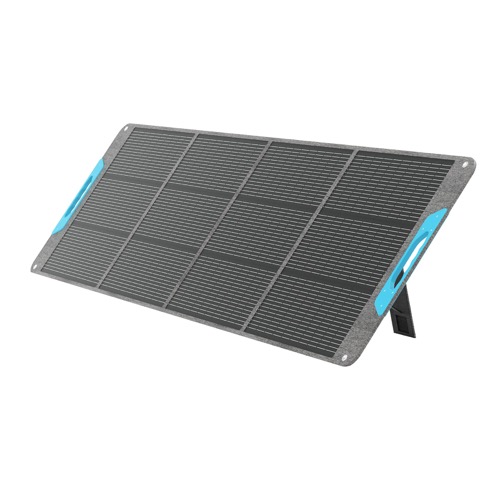
Renogy RPP200EF-SE Review: A Lightweight 200W Portable Panel for Camping, RVs, and Power Stations

Best Overall

Renogy RPP200EF-SE Review: A Lightweight 200W Portable Panel for Camping, RVs, and Power Stations

Check price at Amazon Jump to details
BougeRV 200W Solar Panel Review: The Rugged Camping Panel Built for People Who Use Their Gear Hard

Best Durable 200W Panel

BougeRV 200W Solar Panel Review: The Rugged Camping Panel Built for People Who Use Their Gear Hard

Check price at Amazon Jump to details
Jackery SolarSaga 200W Review: Bifacial Cells, IP68 Waterproofing, and Built for Jackery Owners

Best for Jackery Power Stations

Jackery SolarSaga 200W Review: Bifacial Cells, IP68 Waterproofing, and Built for Jackery Owners

Check price at Amazon Jump to details
EcoFlow 220W Solar Panel Review: The Ecosystem-Native Panel Built to Plug Straight Into Your EcoFlow

Best EcoFlow Alternative

EcoFlow 220W Solar Panel Review: The Ecosystem-Native Panel Built to Plug Straight Into Your EcoFlow

Check price at Amazon Jump to details
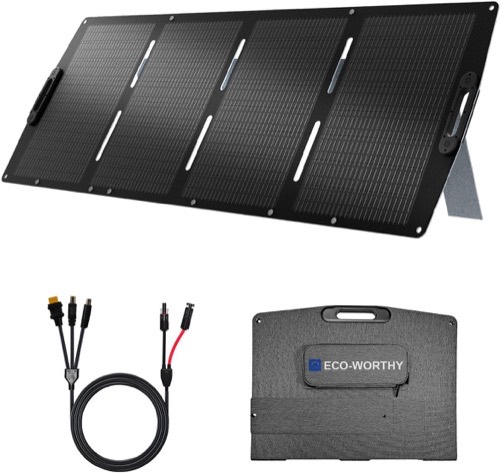
ECO-WORTHY 200W Portable Solar Panel Review: Competitive Wattage at a Lower Price — Is the Trade-Off Worth It?

Best Budget 200W Portable

ECO-WORTHY 200W Portable Solar Panel Review: Competitive Wattage at a Lower Price — Is the Trade-Off Worth It?

Check price at Amazon Jump to details
EBL 200W Solar Panel Review: Can a Battery Brand Make a Reliable Solar Panel?

Best Connector Variety

EBL 200W Solar Panel Review: Can a Battery Brand Make a Reliable Solar Panel?

Check price at Amazon Jump to details
200W Portable Solar Panel Review: 24% ETFE Efficiency at a Budget Price — What You’re Actually Getting

Best Value Amazon Pick

200W Portable Solar Panel Review: 24% ETFE Efficiency at a Budget Price — What You’re Actually Getting

Check price at Amazon Jump to details

Most buyers assume the best 200w portable solar panels are simply whichever ones cram the most watts in for the least money — and that once you hit the 200-watt number, the panels are basically interchangeable. Both ideas are wrong. The rated 200W stamped on the box and the power that actually reaches your station are two different numbers, and the gap between them depends heavily on cell type, heat, and the angle you set the panel at.

Here’s the thing — the real problem isn’t choosing 200W over 100W. It’s that two panels both labeled “200W” can deliver wildly different real output. An N-Type panel and a cheap standard-mono ETFE panel both print 200W on the spec sheet, yet one quietly hands you more Wh/day in the same sun. Connector mismatch is the other silent failure: a great panel that ships with the wrong plug for your EcoFlow, Jackery, or Bluetti charges nothing until you buy an adapter.

This guide compares eight 200W-class portable panels on what actually matters at this tier — real-world Wh/day, cell technology, connector compatibility, and weight. The picks below span N-Type, IBC, bifacial, and standard-mono ETFE designs, range from 13.8 lb to 22 lb, and cover every major power-station connector. The right 200w portable solar panel depends on your station’s input limit, your brand, and how much real output you need per day.

Not Sure 200W Is the Right Tier?

Our Solar Panel Output Calculator estimates how much energy a 200W panel actually produces per day for your location’s sun hours — and whether that’s enough to recover your power station overnight, run a 12V RV fridge, or whether you need a second panel.

Use the Solar Calculator — Jump to the 200W Reality Check

How We Chose the Best 200W Portable Solar Panels

We don’t run a solar lab, so nothing here claims hands-on measurement. Instead, we leaned on manufacturer specs, owner feedback, and the physics of how cells behave in real sun to rank these on the criteria that actually decide a 200W panel: real-world Wh/day (not the nameplate), cell technology — N-Type, TOPCon, and IBC versus standard mono and ETFE — power-station and RV connector compatibility, and weight-per-watt. Worth knowing, at this wattage tier the panels are heavy enough that you set them down once and leave them, so durability and angle stability matter more than packability. In real use, the difference between two “200W” panels comes down to how well they hold output when it’s hot and the sun is low.

Criterion Why It Matters at 200W Weight
Real-world output vs rated watts Two “200W” panels can deliver very different Wh/day — cell type and heat decide it High
Cell technology (N-Type / IBC vs standard mono) N-Type and IBC hold output better in heat and low angle, where 200W panels live High
Power station and RV connector compatibility EcoFlow, Jackery, Bluetti each use different plugs — wrong connector means no charging High
Solar input voltage match A 200W panel can exceed a small station’s input ceiling — voltage and watt limits matter Medium
Weight and foldability 13.8 to 22 lb across this lineup — heavy panels need to justify the bulk Medium
Weatherproofing (IP rating) 200W panels stay deployed for hours; IP65 minimum, IP68 for left-out setups Medium
Warranty and brand support A panel left out all day for years needs a warranty that backs it Low

Selection criteria:

  • Real-world output — Wh/day delivered at 4 PSH, not the nameplate 200W
  • Cell technology — N-Type, IBC, or bifacial preferred over standard mono ETFE for heat and low-angle output
  • Connector compatibility — native or included cables for EcoFlow (XT60), Jackery (DC8020/DC7909), Bluetti, plus MC4 for controllers
  • Solar input match — output voltage within the station’s solar input range; watt limit not exceeded
  • Weight and foldability — manageable for the intended setup (vehicle, RV, base camp)
  • Weatherproofing — IP65 minimum; IP68 for panels left out all day
  • Kit completeness — adapters, cables, and kickstand quality in the box
  • Warranty — multi-year coverage; Jackery’s coverage is strongest here

200W Reality Check: Rated Watts vs Real Output

This is the section that separates the best 200w portable solar panels from the ones that just print “200W” on the box. Rated wattage is measured at lab conditions — 25°C, a perfect 1,000 W/m² of sun, and a dead-on angle. Real camp and RV conditions are never that clean. Heat alone can shave 10-15% off output, and a low morning or evening sun angle takes more on top of that. In practice, what you actually collect per day depends most on cell type.

Panel Cell Type Real-World Factor Est. Output (Wh/day, 4 PSH) Why the Difference
Renogy 200W N-Type monocrystalline 0.82 ~656 Wh/day N-Type holds output in heat and at low angle
BougeRV 200W N-Type monocrystalline 0.82 ~656 Wh/day N-Type cells lose less to heat on hot afternoons
Jackery SolarSaga 200W IBC bifacial mono 0.82 ~656 Wh/day IBC layout plus rear-side pickup keeps output steady
EF ECOFLOW 220W N-Type bifacial ETFE 0.82 ~722 Wh/day Extra 20W rating plus rear-side gain over reflective ground
ECO-WORTHY 200W Standard mono ETFE 0.78 ~624 Wh/day Standard mono drops faster when hot
EBL 200W Standard mono ETFE 0.78 ~624 Wh/day Standard mono gives up more output at low angle
200W 24% ETFE (Amazon) Standard mono ETFE 0.78 ~624 Wh/day Decent efficiency, but heat losses are higher than N-Type
HQST N-Type 16BB 200W N-Type 16BB bifacial mono 0.82 ~656 Wh/day N-Type with 16 busbars and rear-side gain holds output

Real-World Math — A 200W N-Type panel at 4 peak sun hours and a 0.82 factor delivers roughly 656 Wh/day. A standard-mono ETFE 200W panel at a 0.78 factor lands closer to 624 Wh/day in the same sun — and the gap widens on a hot 95°F afternoon, where N-Type cells lose less output to heat. Across a 5-day trip, that’s an extra 160 Wh — most of a phone-plus-laptop day.

Worth Knowing — Bifacial panels like the EcoFlow 220W and HQST 200W pick up reflected light off the rear — pavement, sand, snow, or a light tarp can add a few percent. The catch is that the bonus only shows up when the back of the panel faces something bright; flat on dark grass, it’s mostly the front cells doing the work.

How to Choose a 200W Portable Solar Panel

What to prioritize in a 200W portable panel:

  • Real-world Wh/day output, not just the rated 200W number
  • N-Type, IBC, or bifacial cells for better heat and low-angle output
  • The right connector for your power station — XT60, DC8020, or an included adapter
  • Output voltage within your station’s solar input range
  • IP65 minimum; IP68 if the panel stays out all day
  • A stable kickstand or mounting that holds the panel angled into the sun

Common buyer mistakes at 200W:

  • Assuming all 200W panels deliver the same Wh/day — cell type decides it
  • Buying a 200W panel that exceeds a small station’s solar input ceiling
  • Ignoring the connector — Jackery DC8020 and EcoFlow XT60 are not interchangeable
  • Paying brand-premium prices when a cheaper N-Type panel delivers the same output
  • Wiring a 200W panel straight to a bare 12V battery with no charge controller

Real-World Output vs Rated Watts

The “200W” label is a lab number, not a field number. What you actually collect comes down to peak sun hours — the number of hours your spot gets full-strength sun — multiplied by a real-world factor that accounts for heat, angle, and conversion losses. The math is simple: rated watts × peak sun hours × factor.

In practice, a 200W N-Type panel at 4 PSH and a 0.82 factor delivers about 656 Wh/day, while a standard-mono ETFE 200W panel at 0.78 lands near 624 Wh/day. Tie that to a real load: ~656 Wh recovers most of a 1kWh power station in a single good day, with the last slice arriving on day two. Our guide on how much power a solar panel produces walks through the same math step by step.

The takeaway is short — always size from Wh/day delivered, never from the nameplate watt number.

Cell Technology: N-Type / TOPCon / IBC vs ETFE / Mono

Cell type matters more at 200W than most buyers expect. N-Type and IBC cells hold their output better in heat and at low sun angle — exactly the conditions a deployed panel faces through a long afternoon. That’s why two panels with identical 200W labels can drift apart by 30+ Wh/day once it’s hot.

Here’s how the lineup maps out. N-Type: Renogy, BougeRV, the EcoFlow 220W, and HQST. IBC bifacial: the Jackery SolarSaga 200W. Standard mono ETFE: ECO-WORTHY, EBL, and the 24% ETFE Amazon pick. Worth knowing, the EcoFlow 220W and HQST add rear-side gain from their bifacial design when the back faces something bright.

Long-Term Ownership — N-Type cells degrade more slowly than older PERC mono — roughly 0.4% a year versus 0.5-0.6%. Over a panel’s life that’s a meaningful output difference, but the real weak points on a 200W portable are the folding hinges, the cable, and the connector. Store it dry and don’t crease the cable at the junction box, and the cells will outlast the rest of the panel.

Power Station & RV Compatibility: Will It Actually Plug In?

This is the section that saves buyers the most headaches at this wattage. Connector matters as much as wattage here — a panel that can’t plug into your station charges nothing. Each major brand uses its own input:

  • EcoFlow: XT60 / XT60i input
  • Jackery: DC8020 (newer) or DC7909 (older)
  • Bluetti: T500 or aviation connector by model
  • Anker SOLIX: XT60
  • Bare controller / RV: MC4
Power Station / Target Native Match in This Lineup Needs Adapter
EcoFlow (XT60) Renogy, BougeRV, EcoFlow 220W, ECO-WORTHY, 24% ETFE Amazon Jackery, EBL, HQST
Jackery (DC8020/DC7909) Jackery SolarSaga, BougeRV (DC7909), ECO-WORTHY (adapter included) Renogy, EcoFlow 220W, EBL, HQST, 24% ETFE Amazon
Bluetti (T500/aviation) EBL (aviation/DC out of the box) All others (T500 adapter)
Bare controller / RV (MC4) Renogy, BougeRV, EcoFlow 220W, ECO-WORTHY, 24% ETFE Amazon, HQST Jackery, EBL

A 200W panel outputs roughly 18-23V Vmp, which fits the 11-60V input of most stations — but a small station may cap solar input watts, often somewhere between 100W and 220W. Confirm both the voltage range and the watt ceiling before you buy. If you’re weighing two brand ecosystems, our EcoFlow vs Jackery solar panel comparison and the portable solar panel for a power station guide both cover the connector trade-offs in detail.

Buying Note — The EBL 200W ships with the widest connector set in this lineup (Anderson, aviation/DC, XT60, plus USB), so it plugs into more stations out of the box than the others. The Jackery SolarSaga uses DC8020 — native for Jackery stations, but you’ll need an adapter for EcoFlow or Bluetti. Match the connector to your station first, then compare output.

Weight & Foldability

The weight spread here runs from 13.8 lb on the BougeRV up to 22 lb on the ECO-WORTHY. At 200W, none of these are backpacking-friendly — they’re vehicle, RV, and base-camp panels you carry from the trunk to the campsite and back.

Lighter isn’t automatically better, either. A heavier panel with a sturdy kickstand often holds its angle in wind better than a flimsy light one, and a panel that folds flat tucks into a trunk or RV bay more easily. Foldability matters for storage, not for carrying distance.

The takeaway: pick the lightest panel that still delivers the output and connector you need — don’t pay a weight penalty for watts you won’t use.

Weatherproofing: What the IP Rating Means at 200W

Since a 200W panel sits out for hours, the IP rating tells you how it handles weather while it’s working:

  • IP65: rain and spray from any direction — fine for a panel under an awning or stowed between showers
  • IP68: dust-tight and submersion-rated — the Jackery SolarSaga 200W and EcoFlow 220W carry this, best for panels left out all day in unsettled weather

To be fair, the panel’s IP rating may not cover a bundled charge controller or junction box, so check the cable end too — that’s often the first part to let water in.

Charge Controller: Only If You’re Charging a Bare 12V Battery

Most 200W buyers pair with a power station that has built-in MPPT, so no separate controller is needed — just the right cable. Plug in and charge.

You do need a controller if you wire the panel straight to a standalone 12V lead-acid, AGM, or LiFePO4 battery in an RV or off-grid setup. MPPT is worth it at 200W; PWM leaves real output on the table at this wattage, as our MPPT vs PWM charge controller guide breaks down. For LiFePO4, confirm the controller has an LFP charge profile.

One line to remember — power station means no extra controller; bare battery means an MPPT controller is required.

What Can a 200W Panel Actually Run?

Watts and watt-hours stay abstract until you put real devices next to them. Here’s what a 200W portable panel covers per day at 4 peak sun hours — and where you’ll want a second panel.

Daily Need Approx. Daily Draw Covered by One 200W Panel (4 PSH)? Reality Check
Phones, laptop, lights, small power station top-off ~150-300 Wh/day Yes — comfortably One 200W panel recovers a 500Wh station in well under a day
Recover a 1kWh power station from empty ~1,000 Wh Most of it in one good day ~656 Wh/day from an N-Type panel; budget two solid sun days for a full refill
12V RV fridge (compressor) plus phones and lights ~400-600 Wh/day Yes, on clear days Tight on cloudy days; a second 200W panel adds a safety margin
RV essentials: fridge, water pump, lights, fans, devices ~800-1,200 Wh/day Borderline to no Pair two 200W panels or step up to a 400W array for full coverage

Cloudy days hit 200W panels harder than the rated number suggests. Full overcast can drop a 200W panel to 30-60W of real output — enough to slow your station’s drain but not enough to recover a 1kWh station in a day. For trips with more than two likely cloudy days, plan a second panel or a wall-outlet top-off before you leave.

When 200W Is the Right Tier

Is 200W the Right Tier for You?

  • Under 100W: Phone and small-device charging, slow top-off of a compact power station — step up to 200W if you run anything bigger
  • 100W: Single panel for a 300-500Wh station; the lighter, cheaper choice if you don’t need fast recovery. See our 100W vs 200W portable solar panel comparison if you’re on the fence
  • 200W (this guide): The sweet spot for charging a 500Wh-1kWh power station in a day, plus 12V RV fridge support — enough output without an unwieldy array
  • 220W bifacial: A small step up from 200W with rear-side gain — worth it if your panel will sit near reflective ground
  • 400W+ (paired panels): Full RV essentials or fast 1kWh+ recovery; usually two 200W panels in parallel or a dedicated 400W array

Will It Work With Your Power Station or RV?

A 200W portable panel outputs roughly 18-23V DC through its main connector — within the 11-60V solar input range of most EcoFlow, Jackery, and Bluetti stations, which handle charge control with their built-in MPPT. You don’t need a separate controller to charge a power station. On the flip side, you do need one to charge a bare 12V battery in an RV, van, or off-grid setup — and at 200W, that controller should be MPPT, not PWM.

Charging Scenario Separate Controller Needed? Why
200W panel → EcoFlow / Jackery / Bluetti power station No The station’s built-in MPPT handles it — just match the connector and stay under its watt ceiling
200W panel → standalone 12V AGM or lead-acid battery (RV/van) Yes — MPPT No overcharge or reverse-current protection without one; PWM wastes output at 200W
200W panel → LiFePO4 battery bank (van, RV, DIY) Yes — MPPT with LFP mode LiFePO4 needs a specific charge profile; the wrong one shortens battery life
Two 200W panels in parallel → power station No (station MPPT) — check watt ceiling Parallel keeps voltage the same and adds current; confirm the station’s max solar input watts
200W panel via USB output → phone / tablet No USB output is already regulated; plug the cable directly

Buying Note — Before wiring two 200W panels together, check your station’s solar input ceiling. A station capped at 220W solar input won’t use the full output of two 200W panels in parallel — you’d be carrying weight you can’t harvest. When in doubt, one well-matched 200W panel beats two that overshoot the input limit.

Best Overall

Renogy RPP200EF-SE Review: A Lightweight 200W Portable Panel for Camping, RVs, and Power Stations

Renogy RPP200EF-SE Review: A Lightweight 200W Portable Panel for Camping, RVs, and Power Stations

Get it now:

Check latest price

What to know

  • N-Type cells at 25% with a 0.76 factor put real harvest near 608Wh on a 4-PSH day
  • That daily figure refills roughly 60% of a 1,000Wh station, so a depleted unit recovers in one good afternoon
  • Owners measure 150W to 190W into a station in strong sun — close to the rated draw a 1000-class input accepts
  • N-Type cells hold voltage in heat better than the PERC panels lower in this tier, steadying mid-day output
  • Brand-neutral MC4 means the same panel recovers an EcoFlow, Bluetti, or Anker SOLIX without a proprietary lead

Best if

  • You want a panel that refills most of a 1,000Wh station in a single 4-PSH day at this tier's rated efficiency
  • You want the steadier mid-day curve N-Type gives over cheaper PERC 200W panels in heat
  • You rotate between EcoFlow, Bluetti, and Anker stations and want one MC4 panel for all of them

Skip if

  • You need a 2,000Wh-plus station filled from empty in one day — a single 200W panel can't keep that pace
  • You're comparing on price per watt alone — budget PERC panels in this tier cost less up front
  • You expect a station-ready connector in the box — plan for an MC4-to-XT60 or 8mm adapter

If you want one 200W panel that recovers a power station without locking you into a brand, the Renogy RPP200EF-SE is the easiest all-rounder in this tier. It's the pick van campers and EcoFlow, Bluetti, and Anker SOLIX owners keep coming back to, and owners regularly clock 150W to 190W in strong sun. The spec-to-benefit story is simple: 200W of 25% N-Type monocrystalline cells push roughly 608Wh on a 4-PSH day — enough to refill a big chunk of a 1,000Wh station — while MC4 output plus built-in USB-C PD and USB-A let you top phones directly. At 13.9 lb it folds flat for a storage bay.

Just know the MC4 leads are short and most stations need a separate adapter cable before you're charging.

Wattage200W N-Type monocrystalline, 25% efficiency (~608Wh/day at 4 PSH, 0.76 factor)
IP RatingIP65
ConnectorMC4 output; USB-C PD (45W) and USB-A (18W / 15W) included
ControllerNone — use a power station solar input or separate MPPT; supports AGM, LiFePO4 with controller
Cable & MountShort built-in MC4 leads (extension recommended); integrated kickstands at 40° / 50° / 60°
Best Durable 200W Panel

BougeRV 200W Solar Panel Review: The Rugged Camping Panel Built for People Who Use Their Gear Hard

BougeRV 200W Solar Panel Review: The Rugged Camping Panel Built for People Who Use Their Gear Hard

Get it now:

Check latest price

What to know

  • A 0.82 real-world factor yields close to 656Wh a day — the highest realistic harvest in this 200W tier
  • That output charged an EcoFlow Delta 2 at a measured 165W to 198W in bright sun, near the panel's ceiling
  • The high yield comes from N-Type cells, which sustain current better than the 23% PERC panels in this tier
  • At 656Wh it refills a midsize station faster than the 560-600Wh PERC and ETFE options here
  • Output drops sharply the moment a corner falls into shade — keep all four sections square to the sun

Best if

  • You want the fastest realistic station recovery in this tier at a measured 656Wh a day
  • You want the current stability of N-Type over the cheaper PERC 200W panels in this group
  • You charge an EcoFlow-class station and want XT60 and DC7909 leads ready in the box

Skip if

  • You can't keep the full face in sun — shade collapses the harvest faster than on lower-yield panels
  • You only need to trickle-maintain a station and the extra yield isn't worth the price step
  • You're charging a bare 12V battery — there's no controller included with this panel

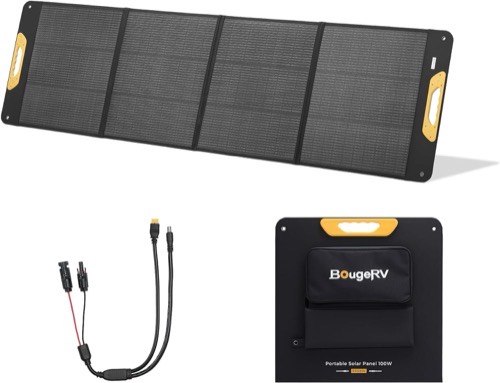
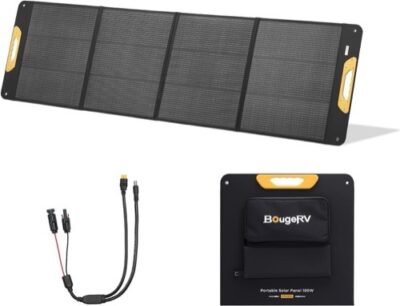
N-Type cells at 25% efficiency and a 0.82 real-world factor put the BougeRV FS200W near 656Wh of daily harvest — the highest realistic yield in this 200W roundup, and fast enough to keep a cooler and a midsize station alive through the day. Owners back the numbers up, clocking 165W to 198W into an EcoFlow Delta 2 in bright sun. A fiberglass-reinforced surface gives it the toughest build here, less fragile than fabric-style folders when it gets knocked around. The included MC4-to-XT60 and DC7909 adapter cable cuts the connector guesswork most 200W panels leave you with.

The catch: shade hits it hard, and the 8.2 ft cable may need an extension to keep your station in the shade.

Wattage200W N-Type monocrystalline, 25% efficiency (~656Wh/day at 4 PSH, 0.82 factor)
IP RatingIP65
ConnectorMC4 output; XT60 and DC7909 adapter cable included
ControllerNone — pairs with a power station's MPPT or a separate controller for 12V batteries
Cable & Mount8.2 ft cable; built-in folding kickstands with grommets (no permanent bracket)
Best for Jackery Power Stations

Jackery SolarSaga 200W Review: Bifacial Cells, IP68 Waterproofing, and Built for Jackery Owners

Jackery SolarSaga 200W Review: Bifacial Cells, IP68 Waterproofing, and Built for Jackery Owners

Get it now:

Check latest price

What to know

  • Bifacial IBC cells at 26.7% are the highest efficiency in this 200W field — more watts per hour of sun than any rival here
  • At a 0.82 factor that's roughly 656Wh a day, matching the top realistic harvest in the tier from a smaller cell area
  • The bifacial rear adds 10-25% over sand, snow, or gravel, so on the right ground it edges past every front-only 200W here
  • The 5-year warranty is the longest coverage among the 200W panels in this group
  • That efficiency only flows into a Jackery — the DC8020 connector limits other stations to USB or an adapter

Best if

  • You want the highest cell efficiency and longest warranty among the 200W panels in this tier
  • You deploy over sand, snow, or gravel and want the bifacial rear to push past front-only 200W panels
  • You want top per-hour yield from a compact cell area rather than a larger budget folder

Skip if

  • You run a non-Jackery station — the proprietary DC8020 caps it to USB or an adapter elsewhere
  • You set up on dark soil or grass, where the rear side adds almost nothing over a standard panel
  • You're buying purely on price per watt — the premium efficiency costs more than the PERC panels here

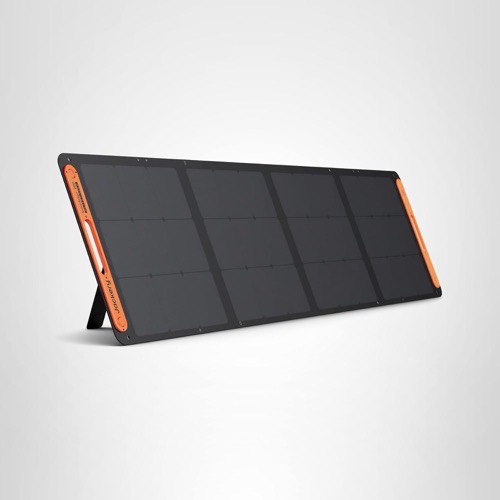
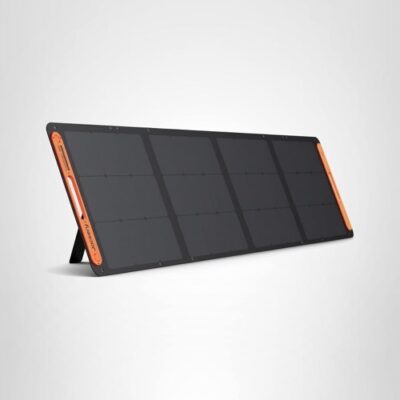
For Jackery Explorer owners, the SolarSaga 200W skips the adapter hunt entirely — its DC8020 cable plugs straight into a 1000 Plus, 2000 Pro, or 3000 Pro and starts charging. What makes this one different in the 200W field is the cell tech: bifacial IBC monocrystalline at 26.7% efficiency, the highest tier here, which squeezes more watts out of every hour of sun and holds up better in overcast light. At a 0.82 factor that's roughly 656Wh a day into a Jackery's built-in MPPT. Genuine IP68 waterproofing means you can leave it out in a downpour, and the 5-year warranty is the longest in this lineup.

One thing: the proprietary DC8020 connector limits non-Jackery use, the included cable isn't weatherproof, and at 14.3 lb it's better for car camping than the trail.

Wattage200W bifacial IBC monocrystalline, 26.7% efficiency (~656Wh/day at 4 PSH, 0.82 factor)
IP RatingIP68 (panel body; included cable not weatherproof)
ConnectorDC8020 (Jackery), DC7909, USB-A, USB-C — all on one multi-cable
ControllerNone — pairs with Jackery's built-in MPPT; separate MPPT needed for 12V batteries
Cable & Mount9.8 ft multi-functional cable; built-in kickstand
Best EcoFlow Alternative

EcoFlow 220W Solar Panel Review: The Ecosystem-Native Panel Built to Plug Straight Into Your EcoFlow

EcoFlow 220W Solar Panel Review: The Ecosystem-Native Panel Built to Plug Straight Into Your EcoFlow

Get it now:

Check latest price

What to know

  • The 220W rating tops this tier, and owners see a measured 200-213W in cool clear sun with cold-weather peaks past 230W
  • That real output averages around 165W at a 0.75 factor — roughly 660Wh a day, refilling a River 2 or Delta 2 in 4-5 hours
  • Bifacial N-Type cells keep producing in snow and overcast where the PERC panels in this tier stall
  • The cold-weather peak past 230W is the headroom that separates it from the 200W-rated panels here
  • The thin glass cracks easily — handle it more carefully than the rugged folders in this group

Best if

  • You want the highest measured real output in this tier and the fastest station recovery from it
  • You charge in cold or overcast conditions where the bifacial N-Type keeps the watts coming
  • You own an EcoFlow Delta or River and want the XT60i cable to connect with no adapter

Skip if

  • You handle gear roughly — the thin glass cracks more easily than the rugged folders here
  • You want the lowest price per watt — third-party 200W panels in this tier cost less
  • You need a stable stand in wind — the case-as-kickstand topples without anchoring

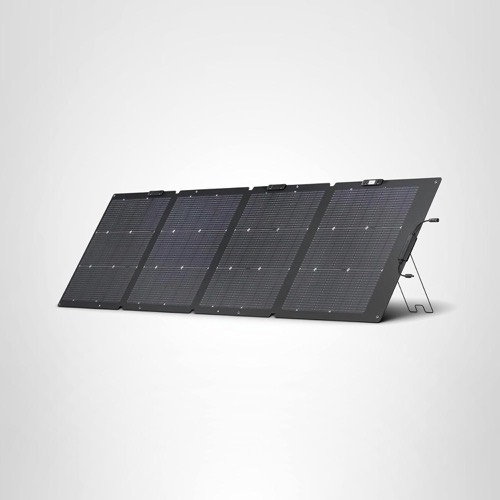
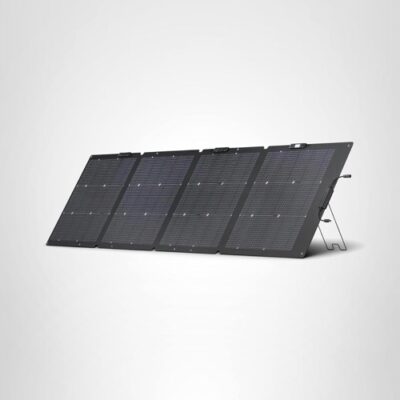
EcoFlow Delta and River owners get the no-guesswork option here: the EF ECOFLOW 220W ships with an MC4-to-XT60i cable that connects straight to the station's solar input, no adapter detour. It edges past the 200W class on raw output too — owners see 200W to 213W in cool clear sun, with cold-weather peaks past 230W, thanks to bifacial N-Type cells that even keep working in snow and overcast. Worth knowing: at a 0.75 factor it averages around 165W, or roughly 660Wh a day, fast enough to refill a River 2 or Delta 2 in 4-5 hours. IP68 weatherproofing shrugs off rain.

Not ideal if you handle gear roughly — the glass cracks easily, the case-as-kickstand is weak in wind, and at 15.4 lb it's a heavy carry.

Wattage220W bifacial N-Type monocrystalline, 25% efficiency (~660Wh/day at 4 PSH, 0.75 factor)
IP RatingIP68
ConnectorMC4 output; MC4-to-XT60i cable included for EcoFlow stations
ControllerNone — uses the connected EcoFlow station's MPPT input
Cable & Mount~6 ft included cable (MC4 extensions available); carry case doubles as 30-60° kickstand
Best Budget 200W Portable

ECO-WORTHY 200W Portable Solar Panel Review: Competitive Wattage at a Lower Price — Is the Trade-Off Worth It?

ECO-WORTHY 200W Portable Solar Panel Review: Competitive Wattage at a Lower Price — Is the Trade-Off Worth It?

Get it now:

Check latest price

What to know

  • 23% PERC cells and a 0.70 factor put real harvest near 560Wh a day — plan around 140W, below the N-Type panels here
  • That 560Wh is steady station recovery, just slower than the 656Wh N-Type and 660Wh bifacial options in this tier
  • PERC cells run a few points behind N-Type, which is the trade for the lowest price per watt in this group
  • Owners measured 29-31V open circuit against the 23.3V spec — meter yours before feeding a strict-input controller
  • Pairing two for an array risks ~20% loss if the units are mismatched, so test both before wiring them together

Best if

  • You want the lowest price per watt in this tier and accept steady rather than fastest recovery
  • You'll meter the panel's high Voc before connecting it to a strict-input controller
  • You charge an EcoFlow, Jackery, or Bluetti and want the adapter cable in the box

Skip if

  • You want the quickest station refill here — N-Type and bifacial panels in this tier harvest more
  • You expect guaranteed rated 200W — real output lands nearer 140W, so test your unit
  • You're pairing two into an array without testing — mismatch can cost about a fifth of output

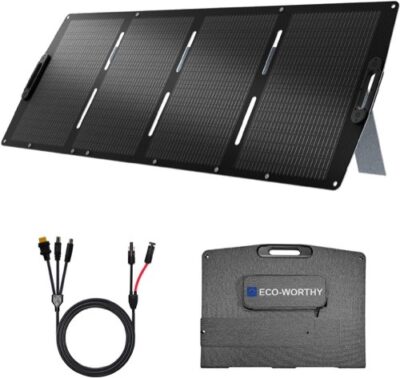
You don't need to pay premium-brand prices to recover a power station in this tier — the ECO-WORTHY 200W proves it. It's the value pick RV boondockers and off-grid weekenders reach for, and owners consistently report happy results charging an EcoFlow Delta 3 or Delta 3 Plus. The standout is the connector pack: the included MC4-to-XT60, DC7909, and DC8020 cable covers EcoFlow, Jackery, Bluetti, and Anker without buying extra adapters. With 23% monocrystalline PERC cells and a realistic 0.70 factor, plan on roughly 140W and 560Wh a day — steady station recovery, just not lab-rated. At 22 lb it's still easy to carry and sets up on kickstands in seconds.

To be fair, it isn't perfect: real output often trails the 200W rating, the 59-inch cable runs short, and some owners measured open-circuit voltage well above spec — meter yours before connecting to a strict input.

Wattage200W monocrystalline PERC, 23% efficiency (~560Wh/day at 4 PSH, 0.70 factor)
IP RatingIP65
ConnectorMC4 output; MC4-to-XT60, DC7909, and DC8020 adapter cable included
ControllerNone — direct to a station's MPPT; add a separate MPPT for 12V (check high Voc)
Cable & Mount59 in MC4 + 59 in adapter cable; 4 adjustable kickstands
Best Connector Variety

EBL 200W Solar Panel Review: Can a Battery Brand Make a Reliable Solar Panel?

EBL 200W Solar Panel Review: Can a Battery Brand Make a Reliable Solar Panel?

Get it now:

Check latest price

What to know

  • MC-4 to 4-in-1 cable — XT60, Anderson, DC barrel, and aviation tips fit most stations
  • Built-in MPPT controller with instant charge resume after cloud cover
  • 200W monocrystalline up to 23.5% — ~590Wh/day at 4 PSH for steady station top-ups
  • IP65 with ETFE lamination and 840D Oxford backing; ~18.6 lb and foldable
  • Separate controller and clips still needed to charge a 12V battery directly

Best if

  • You own several stations and want one cable that fits XT60, Anderson, DC, and aviation inputs
  • You want a built-in MPPT that keeps harvesting through patchy clouds
  • You can keep the whole face in direct sun at a good angle

Skip if

  • You need a depleted 1000Wh+ station refilled in a single grey afternoon
  • You're charging a 12V car or RV battery directly — that needs a separate controller and clips
  • You're installing in partial shade — output collapses when a corner is shadowed

What sets the EBL 200W apart in this tier is the box itself: a single MC-4 to 4-in-1 cable carrying XT60, Anderson, DC 7.9×0.9mm, and aviation tips, so it plugs into the bulk of stations — EcoFlow, Jackery, Bluetti, EBL — without a separate adapter run. It also packs a built-in auto-optimizing MPPT controller, a step up from the bare panels in this price range, which resumes charging fast after a passing cloud. Monocrystalline cells at up to 23.5% and a 0.74 factor put daily harvest near 590Wh, enough to keep a midsize station topped through a weekend. At about 18.6 lb with a rear cable pocket, it's easy to live with.

The catch is that real output often trails the headline, the panel is fussy about shade and angle, and the cable runs short for spread-out placement.

Wattage200W monocrystalline, up to 23.5% efficiency (~590Wh/day at 4 PSH, 0.74 factor)
IP RatingIP65
ConnectorMC-4 to 4-in-1 cable: XT60, Anderson, DC 7.9×0.9mm, aviation
ControllerBuilt-in auto-optimizing MPPT (up to 11.1A); separate controller still needed for 12V batteries
Cable & Mount4-in-1 cable in rear zippered pocket (extension often needed); 4 adjustable kickstands
Best Value Amazon Pick

200W Portable Solar Panel Review: 24% ETFE Efficiency at a Budget Price — What You’re Actually Getting

200W Portable Solar Panel Review: 24% ETFE Efficiency at a Budget Price — What You’re Actually Getting

Get it now:

Check latest price

What to know

  • 200W 24% A+ monocrystalline ETFE — ~600Wh/day at 4 PSH; best case nears rated in clear sun
  • 5-in-1 MC4 cable plus 3 DC adapters — fits Jackery, EcoFlow, Bluetti, Anker, and more
  • Built-in USB-C PD60W, QC3.0, and USB-A ports for charging small gear off the panel
  • 9.8 ft cable; IP65 ETFE surface; magnetic handle; 15.7 lb (a two-person setup)
  • Fire and smoke reports on stations — never leave it charging unattended

Best if

  • You want budget power-station charging with a connector kit that fits nearly every station
  • You're charging a 1000W-class station on camping or RV trips and will watch it work
  • You like built-in USB-C PD60W and QC ports for phones and drones

Skip if

  • You need to leave a panel charging unattended or indoors — fire reports make that a real risk
  • You're filling a 2000W+ station from one panel — it's too slow alone
  • You camp in low winter sun — the short, flimsy kickstands won't hit a steep angle

This TWELSEAVAN 24% ETFE panel lands at roughly half the price of a name-brand 200W, and for attended power-station charging that value is genuinely hard to argue with. The 5-in-1 MC4 cable plus three DC adapters fit nearly every station in this tier — Jackery, EcoFlow, Bluetti, Anker, OUPES — and owners report 180W to 200W feeding a Jackery in clear sun. Built-in USB-C PD60W, QC3.0, and USB-A ports add a handy bonus for phones and drones. At a 0.75 factor, figure about 150W and 600Wh a day, a good match for a 1000W-class station.

The honest caveats matter here: real output often caps at 110-125W for many buyers, it can fade after a few months, and there are real reports of smoking or fire on power stations — so never leave it charging unattended.

Wattage200W A+ monocrystalline ETFE, 24% claimed (~600Wh/day at 4 PSH, 0.75 factor)
IP RatingIP65 (fabric back — no UL/ETL/CE safety cert listed)
ConnectorMC4 output; 5-in-1 cable (XT60 / 8020 / 7909 / 5521 / Anderson); USB-C PD60W, QC3.0, USB-A
ControllerNone — uses the station's controller; separate controller needed for 12V batteries
Cable & Mount9.8 ft MC4 cable; 4 adjustable kickstands (short legs) with magnetic handle

Product Comparison

Feature Renogy RPP200EF-SE Review: A Lightweight 200W Portable Panel for Camping, RVs, and Power Stations BougeRV 200W Solar Panel Review: The Rugged Camping Panel Built for People Who Use Their Gear Hard Jackery SolarSaga 200W Review: Bifacial Cells, IP68 Waterproofing, and Built for Jackery Owners EcoFlow 220W Solar Panel Review: The Ecosystem-Native Panel Built to Plug Straight Into Your EcoFlow ECO-WORTHY 200W Portable Solar Panel Review: Competitive Wattage at a Lower Price — Is the Trade-Off Worth It? EBL 200W Solar Panel Review: Can a Battery Brand Make a Reliable Solar Panel? 200W Portable Solar Panel Review: 24% ETFE Efficiency at a Budget Price — What You're Actually Getting
Product Image
Renogy RPP200EF-SE Review: A Lightweight 200W Portable Panel for Camping, RVs, and Power Stations
BougeRV 200W Solar Panel Review: The Rugged Camping Panel Built for People Who Use Their Gear Hard
Jackery SolarSaga 200W Review: Bifacial Cells, IP68 Waterproofing, and Built for Jackery Owners
EcoFlow 220W Solar Panel Review: The Ecosystem-Native Panel Built to Plug Straight Into Your EcoFlow
ECO-WORTHY 200W Portable Solar Panel Review: Competitive Wattage at a Lower Price — Is the Trade-Off Worth It?
EBL 200W Solar Panel Review: Can a Battery Brand Make a Reliable Solar Panel?
200W Portable Solar Panel Review: 24% ETFE Efficiency at a Budget Price — What You're Actually Getting
Price $220.49 $229.99 $189.99 $379 $549 $299 $189.99 $149.99 $249.99 $149.99 $189.99
Rating
4.5 / 5
4.7 / 5
4.4 / 5
4.6 / 5
4.5 / 5
4.3 / 5
4.4 / 5
Category Solar Panels Solar Panels Solar Panels Solar Panels Solar Panels Solar Panels Solar Panels
Brand Renogy BougeRV Jackery EF ECOFLOW ECO-WORTHY EBL TWELSEAVAN (manufacturer: TCXWPOWER)
Model / SKU RPP200EF-SE (ASIN: B0CNPHD4VY) FS200W (ASIN: B0G64CB1SX) JS-200D (ASIN: B0D8377KV3) 220W-Bifacial-SP (ASIN: B09TKM8PBQ) FD-200Watt (ASIN: B0F4X2D4YP) ESP-200 (ASIN: B0GCN4LZR2) 200W Portable Solar Panel (ASIN: B0DK6TM95M)
Product type Portable solar panel Portable solar panel Portable foldable bifacial solar panel — Jackery ecosystem optimized Portable foldable bifacial solar panel — for EcoFlow power stations, camping, RV, and home backup Portable foldable solar panel for power stations — RV, camping, off-grid, emergency Portable foldable solar panel — for power stations, solar generators, and 12V batteries Portable foldable solar panel — for power stations, 12V battery charging, and USB devices
Solar cell type Monocrystalline silicon, 16BB N-Type cells N-type monocrystalline silicon Bifacial IBC monocrystalline silicon (Interdigitated Back Contact) N-Type monocrystalline, bifacial Monocrystalline silicon (A+ grade, PERC technology) Monocrystalline silicon (6-layer ETFE lamination) Monocrystalline silicon (A+ grade)
Maximum power output 200 W 200 W ±5% 200 W 220 W (rated); 200-213W typical real-world in cool clear sun, 125-170W in extreme heat, per customer testing 200 W (rated, ±3%); ~125-185W typical real-world based on owner testing 200 W (rated; ~130-160W typical real-world in good sun based on owner reports) 200 W (rated; ~135-200W typical real-world, lower for many owners)
Open-circuit voltage (Voc) Not specified (owners commonly measure around 21-23V open circuit, but official Voc is not listed in supplied specs) 21 V ±5% Not specified (estimated ~28-30V typical for 23.2V Vmp IBC panel) Not specified 23.3 V (rated; owners measured 29-31V open circuit) Not specified 23.4 V
Maximum operating voltage (Vmp) 21.6 V 18 V ±5% 23.2 V 21.5 V 19.4 V 18 V 19.8 V
Output voltage 21.6 V DC maximum operating voltage; USB-C and USB-A device outputs also included 18 V DC nominal operating voltage 23.2 V DC 21.5 V 19.4 V (DC) 18 V (DC) 19.8 V (MC4); 5V/9V/12V/15V/20V (USB-C PD); 5 V (USB-A / QC3.0)
Maximum current (Imp) 9.26 A (calculated: 200W ÷ 21.6V) 11.2 A ±5% 8.62 A (calculated: 200W ÷ 23.2V) Not specified 10.32 A 11.1 A 10.1 A
Short-circuit current (Isc) 11.3 A (listed as amperage capacity) 12.22 A ±5% Not specified Not specified 10.94 A Not specified 10.8 A
Cell efficiency 25% 25% 26.7% (IBC — premium tier) 25% (N-Type cells; up to 28% additional energy from the bifacial rear side) 23% Up to 23.5% 24% (claimed; real-world output frequently lands lower)
Charge controller included No (designed for power stations or a separate solar charge controller) No No — designed to pair with Jackery Explorer built-in MPPT management No — designed to use the MPPT input of the connected EcoFlow power station No (direct MC4 output — pairs with the power station's built-in MPPT) Yes — built-in auto-optimizing MPPT controller (separate controller still needed to charge 12V batteries directly) No (MC4 relies on the power station's controller; a separate controller is needed for direct 12V battery charging)
Controller features N/A N/A N/A (MPPT management handled by connected Jackery power station) N/A (charge regulation handled by the EcoFlow station; no standalone controller in the box) N/A (no controller included; add a compatible MPPT for bare 12V battery charging) MPPT tracking, instant charge resume after sun interruption, overcharge protection, up to 11.1A; series and parallel connection support N/A (built-in IC chip regulates the USB ports only; no MPPT/PWM controller for 12V batteries)
Connector type MC4, USB-C PD, USB-A MC4 main connection, XT60 and DC7909 adapter cable DC8020 (Jackery), DC7909, USB-A, USB-C (all on included multi-functional cable) MC4 (MC4-to-XT60i cable included for EcoFlow input) MC4 direct output; includes MC4 to XT60, DC7909 & DC8020 adapter cable MC-4 to 4-in-1 cable: XT60, Anderson, DC 7.9×0.9mm, and aviation connectors MC4 (panel output); 5-in-1 MC4 cable (to Anderson / XT60 / 8020 / 7909 / 5521); USB-C (PD60W), QC3.0 (18W), USB-A (15W)
Cable length Not specified (customers describe the built-in MC4 leads as short and often buy extensions) 8.2 ft 9.8 ft (3 m) (multi-functional cable — note: not weatherproof) Not specified (one owner measured the included EcoFlow cable at about 6 ft; longer MC4 extensions are widely available) 59 in (1.5 m) MC4 cable + 59 in (1.5 m) adapter cable Not specified (4-in-1 charge cable stored in rear zippered pocket; owners often add an extension) 9.8 ft (MC4 connector cable)
Waterproof rating IP65 IP65 IP68 (panel body — highest in this comparison; cable not weatherproof) IP68 (dust-tight and submersion rated; ETFE coating over the cells) IP65 (rain and dust resistant — not submersion rated) IP65 (splash and dust resistant — not submersion rated) IP65 (rain and spray resistant — not submersion rated; fabric back)
Operating temperature range Not specified Not specified −4°F to 149°F (−20°C to 65°C) Not specified (owners report stiff folding in cold and softening plus reduced output in extreme heat) Not specified (upper temperature rating listed as 174°F) Upper temperature rating 60°C (140°F) (lower limit not specified) Not specified (owners report use from winter to hot summer; cells crack if flexed/handled roughly)
Dimensions (L × W × H) 23.72" × 1.97" × 22.99" (folded size) Folded: 23.6" × 22.9" × 1.8"; unfolded: 87.8" × 22.9" × 1.18" 89.72" × 23.5" × 0.98" (unfolded); 24" × 21.7" × 1.8" (folded) 23.2" × 24.2" × 1.3" (folded) 79.06" × 26.22" × 0.16" (unfolded); 20.94" × 26.22" × 1.97" (folded) 85.83" × 22.83" × 0.6" (unfolded); 23.11" × 22.76" × 1.4" (folded) 23" × 82.9" (unfolded); 23" × 22" × 1.9" (folded)
Weight 13.9 lb 13.8 lb 14.3 lb (6.5 kg) 15.4 lb (7 kg) 22.04 lb (10 kg) 18.6 lb (listing also cites 17.94 lb) 15.7 lb
Frame material Not specified (portable foldable panel construction) Aluminum (listed material also includes monocrystalline silicon and tempered glass) Aluminum Not specified (no rigid outer frame; thin edge surround around foldable sections) Not specified (one-piece 7-layer lamination, no rigid frame) Aluminum (840D Oxford fabric backing; no rigid edge frame) Not specified (high-density polyester canvas back; no rigid frame)
Surface / glass material Monocrystalline silicon; surface material not specified Fiberglass-reinforced solar surface; tempered glass listed in product details Tempered glass (front); ETFE film (bifacial rear surface) Tempered glass with ETFE (Ethylene Tetrafluoro Ethylene) coating ETFE coating over monocrystalline cells PET-coated surface over ETFE-laminated monocrystalline silicon ETFE laminated case (over 95% light transmission claimed)
Mounting type Built-in kickstands with 40° / 50° / 60° angle adjustment; reinforced grommets for mounting; optional ground studs not included Built-in folding kickstands with grommets for staking or hanging Built-in kickstand; folds for transport Carry case doubles as a 30-60° adjustable kickstand with integrated solar angle guide; carabiner clips included for hanging 4 adjustable kickstands (multi-angle tilt); integrated mounting holes and reinforced supports 4 adjustable kickstands (push-button mechanism with two front locks) 4 adjustable kickstands (magnetic carry handle; owners report legs are short and flimsy)
Compatible devices / batteries Portable power stations, smartphones, tablets, laptops, cameras, AGM batteries, LiFePO4 batteries, and deep-cycle 12V systems when used with proper controller/adapters Portable power stations with compatible solar input, BougeRV fridge batteries, solar charge controllers, RV/van/boat power setups (verify voltage and connector compatibility) Jackery Explorer 1000Plus / 2000Pro / 2000Plus / 3000Pro (direct DC8020); smartphones, tablets via USB-A / USB-C; 12V batteries (with separate MPPT controller) EcoFlow Delta and River power stations (XT60i cable included); other power stations and 12V battery systems with the correct MC4 adapter cable and a charge controller EcoFlow, Jackery, Bluetti, Anker, ALLWEI and other power stations via included adapters; 12V systems with a separate MPPT controller Power stations / solar generators (EcoFlow, Jackery, Bluetti, GRECELL, ROCKPALS, EBL, and more via 4-in-1 cable); 12V car/RV/boat batteries, LiFePO4, AGM, gel, lead-acid (with separate controller and clips) Jackery, EcoFlow, Bluetti, Anker, OUPES, FlashFish, PAXCESS, Rockpals, Goal Zero and other power stations; 12V AGM, LiFePO4, lead-acid, gel, deep-cycle batteries (via separate controller); phones, tablets, drones via USB
Required sunlight hours Varies by battery capacity and load (typical owners see useful charging with 3-5 peak sun hours) Varies by battery capacity and load (4 peak sun hours can deliver roughly 600+ Wh/day under good conditions) 4 peak sun hours/day delivers ~660 Wh (estimated at 0.82 real-world factor) 4 peak sun hours/day delivers ~660 Wh (estimated at 0.75 real-world factor based on customer testing) 4 peak sun hours/day delivers ~560 Wh (estimated at 0.70 real-world factor) ~4 peak sun hours/day delivers ~590 Wh (estimated at 0.74 real-world factor) ~4 peak sun hours/day delivers ~600 Wh (estimated at 0.75 real-world factor)
Wind / snow load rating Not specified Not specified Not specified Not specified Not specified Not specified Not specified
Safety certifications UL 61730, CE, RoHS, FCC, ISO 9001 facility, CA65, PSE Not specified Not specified Not specified Not specified Not specified Not specified (no UL/ETL/CE listed; multiple fire/smoke incidents reported by owners)
Special features 25% efficiency, foldable quad design, magnetic handle closure, rear accessory pouch, USB-C PD 45W max, USB-A 18W and 15W, MC4 output, IP65 rating Fiberglass-reinforced folding design, N-type cells, 25% efficiency, magnetic handle closure, cable storage pocket, IP65 rating Bifacial IBC cells (26.7% efficiency); IP68 waterproof; native Jackery ecosystem connector; 5-year warranty Bifacial dual-sided cells; N-Type technology; integrated 30-60° kickstand; built-in solar angle guide; MC4-to-XT60i cable for EcoFlow; series-connectable for higher voltage 23% high-efficiency PERC cells; ETFE waterproof surface; 4 adjustable kickstands with 10-second setup; ultra-thin foldable design; wide power station compatibility Built-in MPPT controller; up to 23.5% conversion efficiency; 4-in-1 output cable; series/parallel support; foldable with non-slip handle; rear zippered accessory pocket; push-button kickstands with transport locks ETFE laminated surface; built-in USB-C PD60W, QC3.0, USB-A ports; 5-in-1 MC4 cable + 3 DC adapters; magnetic handle; built-in solar angle guide (sundial); 4 adjustable kickstands
Included in the box 1× 200W EFLEX portable solar panel 1× foldable solar panel, 1× solar charging cable / adapter cable with XT60 and DC7909 connectors 1× SolarSaga 200W bifacial panel, 1× 9.8ft multi-functional charging cable (DC8020/DC7909 + USB-A + USB-C) EcoFlow 220W Bifacial Portable Solar Panel, MC4-to-XT60i Charging Cable, Protective Bag, Quick Start Guide, Safety Instructions & Warranty Card 1× 200W solar panel, 1× 59-inch MC4 cable, 1× 59-inch MC4 to XT60/DC7909/DC8020 cable, 1× user manual 1× 200W foldable solar panel, 1× MC-4 to 4-in-1 solar charge cable (XT60 / Anderson / DC 7.9×0.9mm / aviation connector), 1× user manual 1× TWELSEAVAN 200W solar panel, 1× MC4 connector cable (MC4 to Anderson/XT60/8020/7909/5521), 3× DC adapters, 1× user manual
Warranty 2-year material and workmanship warranty Not specified 5 years Not specified (customers report EcoFlow issuing replacements and refunds for cracked or defective units) 12 months (seller states 24-hour response) Not specified 24 months + 30-day money-back guarantee (owners confirm refunds and replacements are honored)
Expected lifespan Not specified Not specified Not specified (IBC cell technology typically rated for 25+ year performance retention) Not specified (one owner reported the panel and case looking new after six months of near-daily use) Not specified Not specified Not specified (some owners report output dropping to 110-120W within a few months)
Unit count 1 1 1 1 1 1 1
Best for Power station charging, RV and van camping, CPAP backup, sailboat battery support, LiFePO4/AGM battery charging with a controller, blackout prep, and portable off-grid use RV camping, van travel, portable power stations, off-grid cooler use, backup power during outages, and 12V solar experiments with a separate controller Jackery Explorer power station owners; car camping and RV use requiring high-efficiency solar with genuine IP68 outdoor durability EcoFlow Delta and River owners wanting a same-brand plug-and-play panel; camping, RV, off-grid, and emergency backup charging EcoFlow / Jackery / Bluetti power station charging, RV and boondocking supplemental power, sailboat and off-grid battery maintenance Charging power stations on camping and RV trips, off-grid and blackout backup power, and 12V car/RV/boat battery maintenance with a separate controller Charging Jackery/EcoFlow/Bluetti/Anker power stations on camping, RV, van life, and boondocking trips; emergency backup power
Buy Now View Deal View Deal View Deal View Deal View Deal View Deal View Deal

The Final Word

The core split decides almost everything among the best 100w portable solar panels: foldable for power stations and camping versus rigid for a fixed 12V install. For most buyers the ZOUPW is the best overall foldable, the FlexSolar wins on budget and weight at just 4.1 lb, the EBL suits MC4 power-station setups, and the GRECELL is the premium-build pick. If the panel will live bolted down, the rigid Renogy gives you the most output per dollar, or the HQST bifacial adds rear-side gain on bright ground. First-time 12V buyers should grab the DOKIO kit for the controller in the box, and cost-first shoppers can lean on the unbranded Amazon pick. Browse the full lineup any time at our solar panels hub.

One practical warning at this tier: don't treat the "100W" label as the whole story. A panel's real day comes from its cell quality, its controller path, and the connector matching your gear — that's why two identical-on-paper panels hand you different days. Before you buy, confirm your station's input connector, check whether the panel carries a certified IP rating if it'll live outside, and add a charge controller for any bare 12V battery. Get those three right and your 100W panel delivers what it promised.

Frequently Asked Questions

How long does a 200W solar panel take to charge a 1kWh power station?

Plan on about 1.5 to 2 sunny days. At 4 peak sun hours, an N-Type 200W panel like the Renogy or BougeRV delivers roughly 656 Wh/day, so a fully drained 1kWh station recovers most of the way on day one and tops off on day two. A standard-mono ETFE panel at ~624 Wh/day runs slightly slower. Real charge time depends on your sun hours, heat, and how clean your panel angle is — and cloud cover can stretch it well past two days.

Can a 200W solar panel run a 12V fridge?

Yes, on clear days. A 12V compressor fridge draws roughly 400-600 Wh/day depending on size and ambient heat, and a 200W panel collects about 624-656 Wh/day at 4 PSH. That covers the fridge plus phones and lights with a little margin. The catch is cloudy weather, which can drop a 200W panel to 30-60W and leave you short. If your fridge runs hard in summer heat, a second 200W panel or a power station buffer keeps it covered through overcast stretches.

Is 200W enough for an RV?

It depends on your loads. A single 200W panel covers a 12V fridge, phones, lights, and device charging on clear days — roughly 624-656 Wh/day. Full RV essentials, though — fridge, water pump, fans, lights, and devices together — run closer to 800-1,200 Wh/day, which is borderline to no for one panel. For full coverage, pair two 200W panels in parallel or step up to a 400W array. Match the panel count to your real daily Wh draw, not to the size of your RV.

200W vs 100W — which should I buy?

Buy 200W if you want to recover a 500Wh-1kWh power station in a day or support a 12V RV fridge. A 100W panel delivers around 312-328 Wh/day at 4 PSH — fine for a 300-500Wh station and lighter to carry, but slow for bigger jobs. A 200W panel roughly doubles that to 624-656 Wh/day, which is the sweet spot for power-station and RV charging. If you only top off phones and a small station, 100W saves weight and money.

Can I connect two 200W solar panels in parallel?

Yes, and parallel is usually the right choice for power stations. Wiring two 200W panels in parallel keeps the voltage the same (around 18-23V) while adding the current, so you stay inside your station's 11-60V input range. The one thing to confirm first is the station's solar input watt ceiling — a station capped at 220W won't harvest the full output of two 200W panels. Check that limit before buying the second panel, or you'll carry watts you can't use.

What connector do I need for an EcoFlow, Jackery, or Bluetti station with a 200W panel?

Each brand uses its own input. EcoFlow and Anker SOLIX use XT60, so the Renogy, BougeRV, and EcoFlow 220W plug in natively. Jackery uses DC8020 (newer) or DC7909 (older) — the SolarSaga 200W is native, others need an adapter. Bluetti uses a T500 or aviation connector by model; the EBL 200W ships with an aviation/DC plug out of the box. Match the connector to your station first, then compare output. Most panels include MC4 for bare charge controllers too.

Do 200W portable solar panels work on cloudy days?

Yes, but output drops sharply. Full overcast can knock a 200W panel down to 30-60W of real output — enough to slow your station's drain but not enough to refill a 1kWh station in a day. Light haze costs less, often 20-40%. N-Type panels like the Renogy and HQST hold low-light output a touch better than standard mono. For trips with more than two likely cloudy days, plan a second panel or a wall-outlet top-off before you leave home.

Are bifacial 200W solar panels worth it?

Sometimes, if your setup gives them a bright surface behind the panel. Bifacial panels like the EcoFlow 220W and HQST 200W pick up reflected light off the rear — sand, snow, pavement, or a light tarp can add a few percent. The bonus disappears when the back faces dark grass or shade. So the value depends entirely on where you deploy. If your panel will sit near reflective ground, bifacial earns its keep; if it's always flat on a lawn, a good N-Type front-only panel matches it for less.

×

About Solar Power Picks

Portable Solar Power, Backup Power, and Off-Grid Gear Guides

Your trusted source for honest, in-depth product reviews and comparisons.

Quick Links

  • Best Picks
  • Reviews
  • Guides
  • Comparisons
  • Calculator
  • Privacy policy
  • Favorites

Categories

  • Portable Power Stations
  • Solar Panels

© 2026 Solar Power Picks. All Rights Reserved.

We may earn a commission when you purchase through links on our site. Learn more