Renogy 200W Solar Panel Starter Kit Review: The All-In-One Bundle for Getting Off the Grid
At a Glance
KEY FEATURES
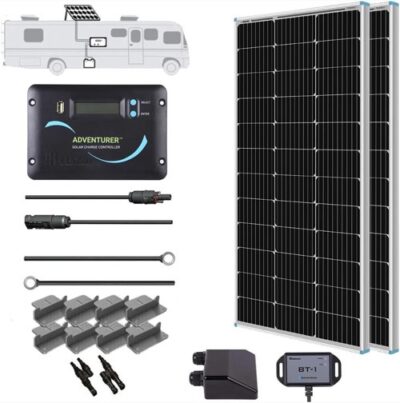
- Renogy 200W Solar Panel Starter Kit: all-in-one 12V solar bundle — two 100W panels plus controller and wiring for RVs, campers, boats, and off-grid 12V systems
- Power output: 200 W (2 × 100W, claimed), monocrystalline silicon
- Output: 12 V DC, MC4 connectors with included Y-branch connectors for parallel wiring
- Cell efficiency: 22% (high-efficiency monocrystalline, per product listing)
- Weatherproofing: Corrosion-resistant aluminum frame, tempered glass; rated to 2400Pa wind and 5400Pa snow load (no IP rating stated)
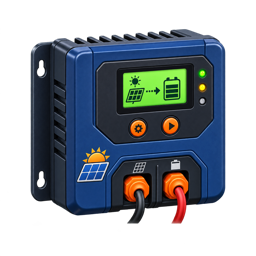
- Charge controller: Adventurer Li 30A PWM (included) — overcharge, overload, short-circuit, and reverse-polarity protection
- Cable & mount: 30 ft 10AWG adapter kit + 16 ft 10AWG tray cable; Z-bracket mounting hardware included; no inline fuses included
- Best for: First-time RV, camper, van, and boat 12V solar systems; off-grid sheds and cabins; battery maintenance during storage
PROS
- Two sturdy 100W mono panels plus controller and wiring in one box
- Keeps RV, camper, and boat batteries reliably topped up
- Works with lead-acid, AGM, gel, and lithium battery types
- Plenty of cable for most RV and camper layouts
- Bundle value beats sourcing parts separately, even on sale
CONS
- Not truly complete — required inline fuses are not included
- PWM controller caps real output around 135-141W from 200W of panels
- Bluetooth module and DC Home app are unreliable and widely disliked
- Roof cable-entry housing has no flange and is hard to seal
- Install instructions cover the controller, not panel wiring or mounting
Editor's Choice
Based on exact documentation and qualitative exact-ASIN Amazon owner evidence; no hands-on test or population-rate claim
This Renogy 200W starter kit review is for the person who wants a real 12V solar system without falling down a parts-research rabbit hole. You get two 100W monocrystalline panels, a 30A charge controller, branch connectors, and a generous run of cable — all from Renogy’s well-established lineup, in a single purchase. For a first solar build, that “it’s all here” promise is the whole appeal.
Here’s the pain it’s trying to solve. You decide you want solar on your RV, van, or cabin, so you buy a panel. Then you realize you need a controller. Then cables, then connectors, then mounting hardware — each sold separately, each with its own compatibility questions. A starter kit cuts that loop short, which is exactly why so many first-timers reach for one.
Worth being honest up front: a Renogy bundle sometimes costs a touch more than sourcing the same parts piece by piece. The premium buys convenience, guaranteed compatibility, and brand support. For a first-time solar buyer, that’s usually money well spent. For a seasoned DIYer who already knows their way around MC4 connectors and controllers, maybe not.
The owner record supports the starter-kit concept while exposing its main weakness: buyers often treat a box of components as a finished electrical design. Successful accounts describe RV, cabin, shed, gate, trailer, and small off-grid systems that reduced generator use or maintained batteries. Difficult accounts cluster around missing hardware, controller behavior, instructions, roof routing, and support. The panels may be healthy while one bundled component is wrong, damaged, or unsuitable for the battery.
Before drilling the first roof hole:
- Inventory the exact panels, controller, Bluetooth module if included, branch connectors, tray cable, solar cable, entry housing, brackets, fuses, and manuals.
- Photograph both module labels and confirm their Voc, Vmp, Isc, and Imp match.
- Confirm the controller model, maximum PV voltage/current/power, battery profiles, terminal capacity, and connection order.
- Design a fused battery-side disconnect and PV isolation method appropriate to the installation.
- Bench-test the complete system and each module independently while returns remain easy.
Bundle revision is crucial. The cluster record retained for ASIN B015DEY2TM describes a 30A PWM-based offer, while Renogy has also marketed similarly named 200W kits with MPPT controllers. Product titles, photos, and old reviews can outlive a bundle change. Do not copy setpoints or array limits from another Renogy controller. The model printed on the unit in the box determines the manual and the safe design.
| Commissioning stage | Healthy evidence | Stop condition |
|---|---|---|
| Panel-by-panel | Similar labels and proportionate Voc/loaded input | Large unexplained mismatch or damaged connector |
| Controller startup | Battery-first connection and correct system voltage/profile | Wrong chemistry, unstable display, heat, or loose terminal |
| Combined array | Voltage/current inside controller limits | Cold-corrected Voc or fault current exceeds a limit |
| Roof installation | Sealed penetrations, strain relief, airflow, and service loops | Cable abrasion, unsupported connector, or inaccessible fuse |
Owner watt readings should be interpreted through system state. A battery near absorption or float can make a healthy array look weak; a PWM controller also operates differently from an MPPT controller. Record irradiance conditions, panel angle, loaded volts and amps, controller mode, battery voltage, and charge stage. Daily energy and the actual load budget matter more than a single midday display.
The practical purchase is for someone who wants compatible starter components and is prepared to finish the engineering. It is not a permit-free, fuse-free, manual-free appliance. Roof structure, wind, conductor protection, grounding, battery overcurrent protection, and local electrical requirements still belong to the installer.
What's in the Starter Kit — and What You Still Need
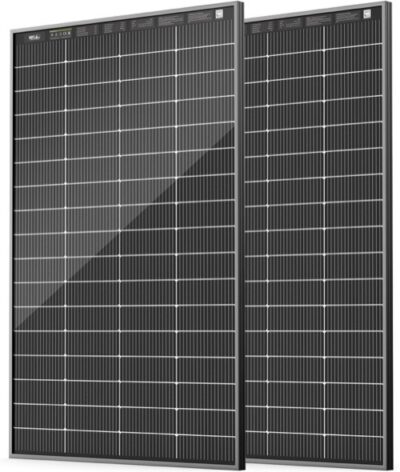
The box is genuinely well stocked, and most owners are happy with what shows up. You get two 100W panels, the controller, mounting brackets, and a lot of cable. The catch is that “starter kit” doesn’t mean “everything you need to flip the switch.”
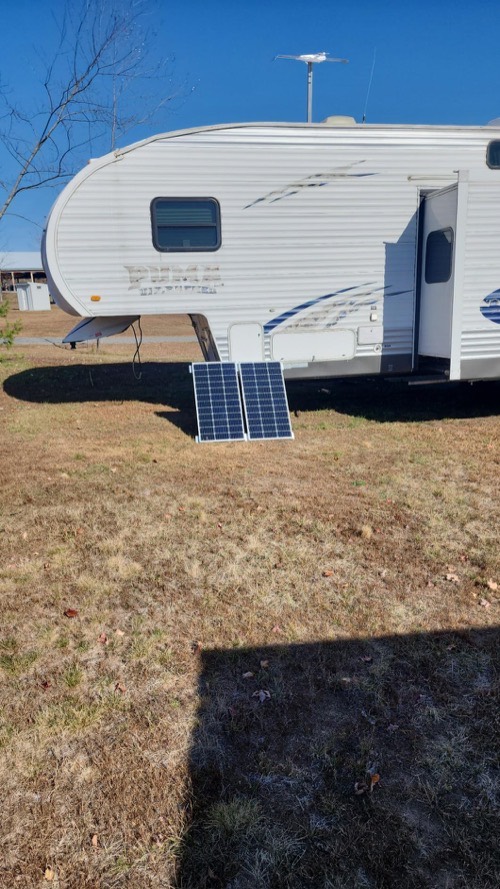
The biggest gap is fuses. The manual calls for inline fuses to protect your wiring and battery, but none are in the box — and buyers find this out only after opening the manual. It’s the single most repeated complaint. Many owners also wish the roof cable-entry housing actually had a flange to screw down, and a few add disconnect switches for safer servicing.
Here’s the honest contents picture:
| Item | Included | Notes |
|---|---|---|
| 2 × 100W monocrystalline panels | Yes | 22% high-efficiency cells, aluminum frame |
| 30A PWM charge controller | Yes | Adventurer Li 30A PWM, flush-mount LCD, BT-1 module |
| MC4 branch (Y) connectors | Yes | For wiring the two panels in parallel |
| MC4-to-controller cable | Yes | 30 ft 10AWG adapter kit |
| Battery (tray) cables | Yes | 16 ft 10AWG tray cable |
| Mounting hardware | Yes | Z-brackets (2 sets), pre-drilled panel holes |
| Cable entry housing | Yes | But no flange or screw holes — owners often replace it |
| Inline fuses | No | Required by the manual — buy a 30A fuse separately |
| Battery | No | Supply your own 12V lead-acid, AGM, gel, or lithium |
| Instructions | Yes | Cover the controller well; light on panel wiring and mounting |
Buyer Heads-Up — Before you start, order a 30A inline fuse for the battery line and consider a flanged roof gland and two disconnect switches. They’re cheap, and they turn a “mostly there” kit into a safe, finished install.
From Box to Roof in How Long?
For a reasonably handy owner, this is a doable weekend project — sometimes a single afternoon, sometimes a careful week if you’re a perfectionist. Owners with basic DIY skills describe the mounting and wiring as intuitive once they sort out cable routing, which is usually the trickiest part.
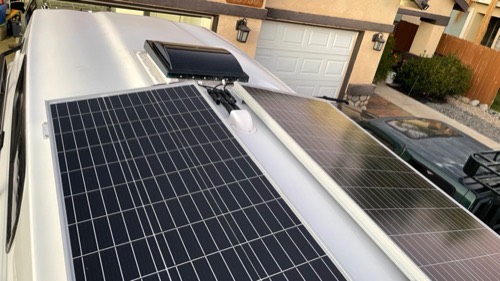
On mounting: the kit includes Z-brackets and the panels have pre-drilled holes, so attaching them to a roof is straightforward if you have solid backing to screw into. Owners on older RVs with thin metal roofs sometimes add strut or extra support, and many take time to tape and seal everything properly so nothing comes loose at highway speed.
On cable: there’s plenty of it. The 30 ft adapter run and 16 ft tray cable cover most RV and camper layouts, and owners regularly note there was enough wire to reach. A few with longer Class C or Class A coaches wished for more, so measure your run before you start. The all-black leads mean you’ll want to tag polarity with tape before feeding them through tight spaces.
Practical Tip — Connect the battery to the controller FIRST, then connect or switch on the panels. Hooking up the panels with no battery on the controller can fry it. A solar disconnect switch makes this safe and easy during install and future servicing.
The most common install complaints? Missing fuses, controller-only instructions that skip panel wiring and mounting, and the flange-less roof gland. None are dealbreakers, but knowing them ahead of time saves a frustrating trip back to the hardware store.
Smart Charging Under the Hood
The kit includes the Adventurer Li 30A PWM controller, and it’s the part that gets the most mixed feedback. PWM uses a simpler on-off charging approach than MPPT — it works fine, but it can’t squeeze the full rated wattage out of the panels, especially in variable light. That’s the trade-off behind the ~140W ceiling owners see.
What the controller does well is protect your system. Owners report it regulates panel input down to a safe charge voltage, holds batteries in float without overcharging, and gives a clear LCD readout of incoming charge and battery voltage. It supports flooded, AGM, gel, and lithium batteries through selectable settings, and lithium owners in particular praise how it manages their bank.
| Feature | Available? | Why It Matters |
|---|---|---|
| Controller type | PWM | Simpler and cheaper than MPPT; less efficient in variable light |
| Overcharge protection | Yes | Cuts charging when the battery is full — prevents damage |
| Overload protection | Yes | Guards against drawing more than the controller can handle |
| Short-circuit protection | Yes | Safeguards wiring against accidental shorts |
| Reverse-polarity protection | Yes | Prevents damage if leads are connected backwards |
| LCD display | Yes | Shows charge current and battery voltage at a glance |
| Bluetooth monitoring | Yes (BT-1) | Works through the DC Home app — but owners find it unreliable |
| Battery type setting | Lead-acid / AGM / Gel / Lithium | Critical for getting the right charge profile per chemistry |
Two honest cautions. The Bluetooth module and DC Home app frustrate nearly everyone — freezing, needing to be re-added every time, or never powering on. And a handful of owners got a controller that was dead on arrival or failed within weeks, prompting an upgrade to a Victron or Renogy Rover MPPT. For most buyers running a standard lead-acid or AGM battery, though, the controller is plug-and-forget once it’s set up.
Real-World Power Output
The kit is rated at 200W, which in strong sun translates to roughly 140W of actual output — or about 560 Wh on a good day. That’s the honest number, and it matters: the gap comes down to the PWM controller, not the panels.
Owners who measured carefully back this up. The most one reported seeing was 141W on a clear, no-cloud day at a good angle; normal output sat around 120W, with others reporting figures in the 98-140W range depending on conditions and battery state. After chatting with Renogy, one owner was told the PWM controller runs 70-80% efficient, so ~140W from two 100W panels is expected. To be fair, that’s how PWM works — it’s not a defect, it’s a design choice.
In practice, this is plenty to keep a 12V house battery topped up and run DC loads. Owners report keeping fridges, fans, lights, laptops, and phones going for days off-grid, and one saw generator run time drop by about 90%. Cloudy days slow it down — expect output to fall to roughly 20-30% of full sun — but most owners say the batteries still recover to full after several overcast days.
| Condition | Estimated Output | What That Means |
|---|---|---|
| Full sun, ideal angle | ~140 W | Charges a 12V bank fast; ~560 Wh on a good day |
| Partly cloudy sky | ~70 W | Still a net gain; keeps batteries climbing, just slower |
| Overcast / heavy clouds | ~40 W | Won’t fully charge fast, but prevents the battery from dying |
| Panel angle 45° off optimal | ~95 W | Minor hit; where most flat RV-roof mounts land |
| Winter sun (northern US) | ~80 W avg | Still charges; fewer peak sun hours than summer |
| Panel in partial shade | ~20-40 W | Big drop; avoid shaded roof spots if you can |
Real-World Math — Using the 0.70 output factor, 200W of panels delivers around 140W in good sun. Over 4 peak sun hours that’s roughly 560 Wh/day — enough to refill a 100Ah lithium bank’s daily use for typical boondocking, with headroom to spare.
These are estimates. Real output depends on panel angle, sky conditions, shading, temperature, and how depleted your battery is.
Camera and Battery Compatibility
The big compatibility question here isn’t about cameras — it’s about battery chemistry. The good news: the controller handles all the common 12V types, so whatever you’ve got in your RV, van, or boat is very likely covered.
| Battery Type | Typical Use | Compatible? | Notes |
|---|---|---|---|
| Flooded lead-acid | RV, truck, tractor | Compatible | Standard 12V charging; owners run flooded banks happily |
| AGM (sealed) | RV, boat, off-grid | Compatible | Set to SEL/AGM mode; great for sealed battery bays |
| Gel cell | Marine, mobility | Compatible | Select gel profile on the controller |
| LiFePO4 (12V) | Van life, RV, backup | Compatible | Owners report excellent charging; use the lithium setting |
| 24V battery bank | Large RV/boat bank | Needs series wiring | This kit is set up for 12V output; verify before going 24V |
The other compatibility note is wiring. For a 12V system, run the two panels in parallel using the included Y-branch connectors — that keeps voltage at panel level while adding current. Owners who wired for the wrong system saw reduced output, so parallel is the default for almost everyone.
Worth Knowing — The controller’s battery-type setting really matters. Charging a gel or lithium bank on a plain lead-acid profile can shorten its life or undercharge it. Take the two minutes to select the right chemistry before you connect.
Durability in the Outdoors
There’s no certified IP rating quoted for this kit — just an aluminum frame, tempered glass, and wind and snow load ratings of 2400Pa and 5400Pa. In plain terms, the panels are built to live outdoors permanently, and owner feedback backs that up.
Customers who mount these on RV roofs, trailers, sheds, and boats report them holding up well through rain, heat, and winters. Two-plus years of trouble-free service shows up more than once, and the corrosion-resistant frame is exactly what you want for marine and full-time-exposure use.
The durability weak spot is the roof cable-entry housing, not the panels. With no flange to fasten it down, owners report adhesive failing in rain and snow, leading to leaks until they bolt it down with sealant or swap in a proper flanged gland.
| Feature | This Panel | What It Means Outdoors |
|---|---|---|
| IP rating | None certified | No official ingress rating; rely on frame and glass quality |
| Frame material | Aluminum | Corrosion-resistant; ideal for marine and full-time outdoor use |
| Panel surface | Tempered glass | Impact-resistant and durable, though heavier than laminate |
| Wind / snow load | 2400Pa / 5400Pa | Handles high winds and real snow loads |
| Cable-entry housing | No flange | The weak link — owners often replace or bolt it down |
| Long-term owner reports | 2+ years, still working | Panels hold up well; controller and gland are the usual fixes |
Long-Term Ownership — Monocrystalline panels degrade only about 0.5% per year, so these should still deliver close to full output a decade out. The first things to fail are usually the controller, the cable gland, or connectors — not the cells. Sealing that roof entry properly pays off in leak-free years.
Living With It Long-Term
No third-party safety certifications (UL, ETL, CE) are listed for this kit, so you’re leaning on Renogy’s brand reputation and build quality rather than a certification stamp. The controller does carry the core electrical protections — overcharge, overload, short-circuit, and reverse-polarity — which cover the everyday risks of a 12V solar setup.
On warranty and support, experiences split. Renogy backs the panels with a 5-year warranty and 24/7 technical support, and some owners report genuinely helpful, knowledgeable reps who quickly walked them through things like the E01 low-voltage error code. Others ran into long hold times, dropped calls, scripted answers, and slow controller replacements. A few buyers received incomplete shipments — panels without the controller or hardware — and had to push to get it sorted.
Reliability-wise, the panels are the strong point and the controller is the variable. Most owners have no trouble, but the occasional dead-on-arrival or early-failure controller is the issue most likely to send someone shopping for an MPPT upgrade.
Best Practice — Test the whole system in your driveway for a few days before committing to a permanent install. Owners who ran it in “test mode” first caught controller or wiring issues early, while returns were still easy.
For a first-time RV or off-grid buyer, the 5-year panel warranty and established brand are reassuring. If you’re depending on this for a critical boat or full-time setup, plan for the possibility of swapping the controller down the road.
Who This Solar Panel Is For — Use-Case Fit Matrix
| Use Case | Fit | Why |
|---|---|---|
| First-time RV / camper 12V solar system | Strong fit | Everything’s in one box; sized right for house-battery maintenance |
| Van conversion off-grid power | Strong fit | Keeps a fridge and DC loads running for days; lithium-friendly |
| Boondocking battery top-up | Strong fit | Refills the bank daily in good sun; cuts generator run time |
| Off-grid shed or cabin (lights, fan, DC loads) | Solid fit | 200W handles modest loads and battery charging well |
| Boat / marine battery maintenance | Solid fit | Aluminum frame suits salt air; seal the cable gland carefully |
| Seasonal RV / vehicle storage maintenance | Strong fit | Holds batteries at full charge over a storage season |
| Buyer who wants max efficiency out of the box | Borderline | PWM controller caps output; consider an MPPT upgrade |
| Running an RV air conditioner or microwave | Skip | 200W won’t power high-draw AC appliances directly |
| Whole-coach off-grid living for a big rig | With caveats | Fine as a starting block; you’ll want more panels and battery |
| Buyer who won’t add fuses or finish the wiring | Skip | The kit needs fuses and a few additions to be safe and complete |
| Experienced DIYer chasing the lowest cost | Borderline | You can sometimes piece parts cheaper, but lose the bundle convenience |
| Permanent install in a shaded roof spot | Skip | Output drops hard in shade; defeats the purpose |
What We Think
The Renogy 200W starter kit review comes down to this: it’s a genuinely good first solar system for RVers, van-lifers, boaters, and off-grid shed owners who want one box that gets them running. The panels are sturdy and reliable, the bundle saves a real research headache, and it keeps 12V batteries — lead-acid, AGM, or lithium — topped up day after day in decent sun. The trade-offs are honest and known: the PWM controller leaves some output on the table, the “kit” needs fuses you’ll buy separately, and the Bluetooth app is the part nearly everyone gives up on.
If you’re new to solar and want a dependable, well-supported way into a 12V system, this Renogy 200W solar panel kit is an easy recommendation — just budget a little extra for fuses, maybe a flanged roof gland, and disconnect switches. If you’re a seasoned DIYer chasing every last watt, buy the panels and pair them with an MPPT controller instead. Either way, the panels are the keeper here, and they earn their reputation.
Renogy 200W starter kit: Decision Snapshot
| Spec | Value |
|---|---|
| Max Power Output | 200 W (2 × 100W monocrystalline) |
| Output Voltage | 12 V DC |
| Connector | MC4 (Y-branch connectors included) |
| Cell Efficiency | 22% |
| Weatherproof Rating | No IP cert; aluminum frame, tempered glass, 2400Pa wind / 5400Pa snow |
| Charge Controller | Adventurer Li 30A PWM (included) |
| Cable Length | 30 ft adapter + 16 ft tray cable |
| Mount Type | Z-brackets (fixed mount) — no inline fuses included |
| Best For | First-time RV, camper, boat, and off-grid 12V solar systems |
How the Kit Is Built
Pick up one of these panels and the first impression is reassuring — solid aluminum frame, tempered glass, real heft at 16.5 pounds each. Owners describe them as sturdy and well made, and that praise holds up over time. More than one customer reports the panels still working great after two years on the roof.
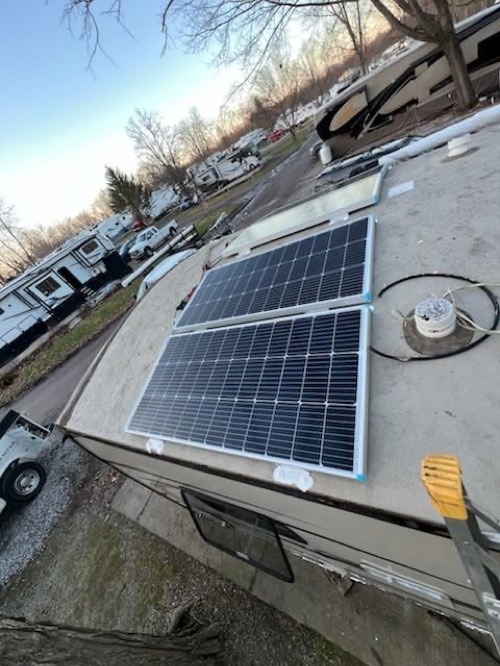
The frame is corrosion-resistant aluminum, which is what you want for permanent outdoor mounting, and the cells are rated to handle serious wind and snow loads. Buyers who boondock and leave their panels exposed season after season say the panels themselves just keep going.
Two small build gripes come up. First, the supplied cables are all black, with no red-and-black color coding, so you have to tag positive and negative yourself before feeding them through tight roof channels. Second — and this one stings — the through-the-roof cable-entry housing ships with no flange and no screw holes. Owners call it the weakest part of the kit, with some dealing with leaks before replacing it with a $10 flanged version.
You'll probably be happy if you want: — Renogy 200W starter kit
- An all-in-one 12V solar system for an RV, van, or camper without researching parts
- Something that keeps house batteries topped up and runs DC loads off-grid for days
- Broad battery support — lead-acid, AGM, gel, or lithium all work
- A weatherproof, well-built panel that survives years of outdoor mounting
- A bundle that’s hard to beat on price once you account for every component
You might want to skip it if you need: — Renogy 200W starter kit
- Enough power to run an air conditioner or microwave directly
- Maximum efficiency without ever touching the controller (PWM caps output)
- A truly complete kit that includes fuses and a sealable roof gland
- Rock-solid Bluetooth monitoring out of the box
- A shaded mounting spot, where output falls off a cliff
This is a different-tool-for-a-different-job situation — it’s a maintain-and-power-DC system, not a whole-home generator.
Renogy 200W Starter Kit: First Impressions and Final Thoughts
If you want a turnkey 12V solar system for an RV, camper, or off-grid shed, the Renogy 200W starter kit review verdict is a confident yes — with a couple of asterisks. The panels are well built, the bundle saves you a research headache, and it keeps house batteries reliably topped up in good sun. Owners running lead-acid, AGM, or lithium all report it does the core job well. Just know going in: the included PWM controller leaves some output on the table, the “kit” doesn’t include the fuses the manual requires, and the Bluetooth app frustrates almost everyone who tries it. Plan to add fuses, maybe a better roof gland, and you’re in good shape.
Pros & Cons Analysis
Based on documented specifications and owner feedback
Pros
- Genuine "everything in one box" convenience — buyers repeatedly say the kit took the guesswork out of a first solar build. Two 100W panels, the charge controller, branch connectors, and plenty of wire arrive together, and several owners describe getting the panels charging the same day they unboxed.
- Solid, well-built monocrystalline panels — the panels themselves earn near-universal praise. Customers call them sturdy, well made, and still working after two years of outdoor mounting. Even reviewers who replaced other parts kept the panels.
- Keeps RV and camper batteries topped up reliably — owners who use it to maintain house batteries on trailers, vans, and motorhomes consistently report full batteries day after day, with one noting generator run time dropped by around 90%.
- Plenty of cable in the box for most installs — the 30 ft adapter run and 16 ft tray cable cover the majority of RV and camper layouts. Multiple owners specifically mention there was enough wire to reach where they needed.
- Works with lead-acid, AGM, gel, and lithium batteries — the controller's selectable battery types let owners run flooded, sealed AGM, gel, or LiFePO4 banks. Lithium users in particular report excellent charge behavior and fast top-ups.
- Renogy brand support and 5-year panel warranty — some owners report genuinely helpful, knowledgeable phone support and quick resolution of low-voltage E01 error codes. The 5-year warranty backs the panels.
- Straightforward to install for the reasonably handy — owners with basic DIY skills describe the mounting and wiring as intuitive once the cable routing is figured out. The plug-and-play MC4 connectors and pre-drilled panel holes help.
- Strong value as a bundle versus buying piecemeal — even owners who later upgraded the controller admit they couldn't have sourced the panels, wire, and connectors separately for less. On a lightning deal, several called it a clear win.
- Y-branch connectors included for parallel wiring — the kit ships with branch connectors so the two panels can be paralleled to keep 12V output, which is what most RV systems need.
Cons
- It's not actually a complete kit — no fuses included — the single most common complaint. The manual requires inline fuses, but none come in the box. Owners consistently report having to order 30A and ANL fuses separately before they can safely finish the install.
- The PWM controller leaves output on the table — careful testers report a hard ceiling around 135-141W from the 200W of panels, because the Adventurer PWM controller runs roughly 70-80% efficient. Several owners swapped it for a Victron or Renogy Rover MPPT and saw better results, especially on cloudy days.
- Bluetooth module and DC Home app are widely panned — a recurring frustration. Buyers describe the BT module freezing, needing to be re-added in the app every connection, or never powering on at all. Some disconnected it entirely; one called the $45 dongle a waste of money.
- The roof cable-entry housing has no flange or mounting holes — owners call the through-the-roof gland one of the worst parts of the kit. With no way to screw it down, several dealt with leaks or threw it out and bought a $10 replacement.
- Instructions cover the controller, not the actual install — buyers say the manual explains the charge controller but says little about series-vs-parallel panel wiring or roof mounting. Many leaned on YouTube to fill the gaps.
- Customer service is hit or miss — for every positive support story there's a frustrated one: long hold times, dropped calls, reps reading from scripts, and slow controller-replacement turnaround. A few buyers received incomplete shipments and struggled to get them resolved.
- Cables are all black and not pre-marked for polarity — a small but repeated annoyance. Both leads are black, so owners have to tag positive and negative with tape before feeding them through tight spaces.
- 200W alone won't run a big AC load — buyers who expected it to power air conditioning or a microwave were let down. It maintains batteries and runs DC loads and modest inverter use well, but it's a trickle-and-maintain system, not a whole-coach generator.
- Occasional dead-on-arrival controllers — a handful of owners report the Adventurer controller never powering on or dying within weeks, forcing a replacement purchase to get the system running.
Our Verdict
Charging performance (3.6/5) — The two 100W monocrystalline panels charge reliably and keep batteries full in good sun, even recovering after cloudy stretches. The score is held down by the PWM controller's efficiency ceiling: careful testers see roughly 135-141W from 200W of panels, which is a known PWM trade-off rather than a panel defect.
Value & compatibility (4.0/5) — Strong bundle value versus piecing components together, broad battery-type support including lead-acid, AGM, gel, and lithium, and a 5-year panel warranty. Held back slightly by inconsistent customer service and the extra parts buyers must purchase to finish the job.
Build & weatherproofing (4.3/5) — The monocrystalline panels and aluminum frames earn strong, repeated praise, with several owners reporting two-plus years of trouble-free outdoor use. The weak link is the flange-less roof cable-entry housing.
Install & usability (3.5/5) — Genuinely doable for handy owners, with plenty of cable and plug-and-play connectors. But the missing fuses, controller-only instructions, all-black unmarked cables, and unreliable Bluetooth app are real friction points.
Bottom line — Best for first-time RV, camper, van, and boat 12V solar systems, off-grid sheds, and seasonal battery maintenance. Skip it if you need to run an air conditioner or microwave, want max efficiency without an MPPT upgrade, or expect a truly complete kit with fuses included.
Frequently Asked Questions
Does the Renogy 200W starter kit come with everything needed to install it?
Almost, but not quite. The kit includes two 100W panels, the Adventurer 30A PWM charge controller, Z-bracket mounting hardware, a 30 ft adapter cable, a 16 ft tray cable, Y-branch connectors, a Bluetooth module, and a cable-entry housing. It does NOT include the inline fuses the manual requires (typically a 30A fuse on the battery line), and it does not include a battery. Most owners order fuses separately before finishing the install. Many also add a disconnect switch and replace the roof cable-entry housing.
How much power does the Renogy 200W kit actually produce?
In strong, direct sun owners typically see around 120-141W of real output from the 200W of panels. The most an owner reported was 141W on a clear day at a good angle. That gap is normal for this kit because it uses a PWM charge controller, which runs roughly 70-80% efficient. If you want closer to the full rating, especially on cloudy days, an MPPT controller will harvest more.
Will the Renogy 200W kit run my RV air conditioner or microwave?
No. 200W of solar maintains and charges your 12V house batteries and comfortably runs DC loads like lights, a 12V fridge, fans, and modest inverter use. Owners report keeping fridges, laptops, phones, and even small TVs going. But it won't power high-draw AC appliances like an air conditioner or microwave directly. For that you need a larger battery bank, a bigger inverter, and more solar.
Does it charge on cloudy days?
Yes, just more slowly. Owners report the panels still bring batteries back to full after several overcast days, though daily output drops to roughly 20-30% of what you'd see in full sun. This is also where the PWM controller costs you the most — owners who upgraded to MPPT specifically called out better cloudy-day performance.
What battery types does the controller support?
The Adventurer Li 30A PWM controller supports flooded lead-acid, sealed AGM, gel, and lithium (LiFePO4) batteries through selectable battery-type settings. Lithium owners report especially strong charge performance. If you run AGM, gel, or lithium, set the correct battery type in the controller before connecting.
Why won't the Bluetooth app connect?
This is the kit's most common gripe. The BT module and DC Home app are unreliable — owners report it freezing, needing to be re-added in the app on every connection, or never powering on. Some pull the wire from the controller to force pairing mode; others give up and run the system without it. The panels and controller work fine without Bluetooth, so don't let app trouble stop your install.
Should I wire the two panels in series or parallel?
For a standard 12V RV or camper system, wire them in parallel using the included Y-branch connectors. Parallel keeps the voltage at panel level (about 12V nominal) while adding current. Series would push voltage up for a 24V system. Wiring two 12V panels in series on a 12V battery setup can cut usable output, so most owners go parallel — the kit includes the connectors for exactly that.
Do I really need to install fuses?
Yes. The manual calls for inline fuses, and they protect your wiring and battery against shorts and overload. A common setup is a 30A fuse between the controller and battery. They are not in the box, so order them before you finish. Many owners also add two heavy-duty disconnect switches — one for the battery and one for the solar panels — for safer servicing.
Why does the roof cable-entry housing leak?
Because it ships without a mounting flange or screw holes, so there's no clean way to fasten it to the roof. Owners report relying on adhesive that fails in rain and snow, leading to leaks. The common fix is to bolt it down yourself with sealant, or replace it with an inexpensive flanged entry gland from any RV or solar supplier.
What happens if I connect the panels before the battery?
You can damage the controller. The manual and multiple owners warn that the battery must be connected and powering the controller BEFORE you connect or switch on the panels. Hook up the battery first, then the panels. A solar disconnect switch makes this easy to control during install and servicing.
How long do the panels last outdoors?
The panels themselves hold up well. Owners report two or more years of trouble-free outdoor mounting, and the aluminum frame with tempered glass is built for long outdoor life. Renogy backs the panels with a 5-year warranty. The parts most likely to need attention are the controller and the cable-entry housing, not the panels.
Technical Specifications
| Brand | Renogy |
|---|---|
| Model / SKU | KIT-RV-200D (ASIN B015DEY2TM) |
| Panel format | Two rigid panels with controller kit |
| Rated output (Pmax) | 200W total; 100W per panel |
| Cell technology | Monocrystalline |
| Module efficiency | — |
| Voltage at maximum power (Vmp) | — |
| Current at maximum power (Imp) | — |
| Open-circuit voltage (Voc) | — |
| Short-circuit current (Isc) | — |
| Power tolerance | — |
| Maximum system voltage | — |
| Maximum series fuse | — |
| Output connector | MC4-compatible connectors and branch pair |
| Output cable | 30 ft 10 AWG solar cable; 16 ft 10 AWG tray cable |
| Deployed dimensions | 41.8 × 20.9 × 1.4 in per panel |
| Folded dimensions | — |
| Weight | 16.5 lb per panel |
| Surface and frame | Tempered glass with aluminum frame |
| Positioning / mounting | Included Z-brackets |
| Environmental protection | — |
| Wind / snow load | 2400Pa wind / 5400Pa snow |
| Operating temperature | — |
| Included accessories | Two panels, 30A PWM controller, cables, branches, Bluetooth module, entry housing, and brackets |
| Product warranty | 5-year panel material and workmanship warranty |