HQST 200W Bifacial Solar Panel Review: N-Type Cells and Dual-Sided Output for Serious Solar Setups
At a Glance
KEY FEATURES
- Power output: 200 W STC (up to 260 W with bifacial gain in ideal conditions), N-Type monocrystalline silicon
- Output: ~19.02 V Vmp / 22.4 V Voc (DC), MC4 solar connectors
- Cell efficiency: up to 25.4% (high tier — N-Type 16-busbar Grade A+ cells, all EL-tested)
- Weatherproofing: IP65 (spec sheet); anti-corrosion aluminum frame; low-iron tempered glass front
- Charge controller: None — not included; pair with a separate MPPT (preferred) or PWM controller
- Best for: RV and van rooftops, off-grid cabins and sheds, ground-mount arrays, power-station charging (EcoFlow, Bluetti, Jackery, Pecron via adapter), and seasonal battery maintenance
PROS
- One compact 200W panel replaces two 100W panels — fewer mounts, no Y-connector power loss
- Strong output in good sun — owners see up to 170W from a 200W panel at peak
- Real bifacial gain with elevated mounting and a reflective surface below
- Durable all-black aluminum frame and tempered glass — survives knocks and years outdoors
- Great value and responsive warranty support keep owners coming back
CONS
- MC4 cables run short — extensions often needed for spaced-out roof installs
- Output drops sharply off-peak or at the wrong angle — placement matters
- Bifacial does little when the panel lies flat on a dark roof
- Thin shipping packaging leads to occasional frame dents on arrival
- 30-year life is unproven; actual manufacturing warranty is 5 years
Editor's Choice
Based on rigorous testing & Amazon customer feedback
☀ Solar Panel Output Calculator
Estimate how much energy the HQST 200W Bifacial Solar Panel produces — and what it can power or charge.
Solar Setup
Portable devices
Power stations & batteries
Click devices to add them to your load list, adjust hours and quantity, then calculate.
Portable / Camping
Home Appliances
No devices added yet. Click chips above or add a custom device.
How many back-to-back sunless days should the battery keep you running? Example: 1 = one cloudy day, 3 = three cloudy days in a row.
This HQST 200W bifacial solar panel review breaks down what you actually get — real output in the field, when the dual-sided gain shows up, and whether HQST’s N-Type 16BB cells are worth building a permanent install around. It’s written for the RV owner, the off-grid cabin builder, and the DIYer who’s past the camping-charger stage.
You’ve probably heard that bifacial panels make more power, and you’re not sure whether that’s marketing or something that’ll actually help your setup. HQST positions this as a real step up from standard monocrystalline — N-Type cells, 16 busbars instead of the usual 5 to 9, and a back side that catches reflected light. The honest question is whether that second side does anything for the way you’d mount it.
Here’s the short version up front: the bifacial gain is real, but it’s conditional. Mount these off a light-colored or reflective surface — a pergola, ground legs, a roof rack with clearance — and owners report measurable extra yield, sometimes up to 25% more on cloudy days. Lay them flat on a dark roof and the rear cells barely sip. This review maps which setups actually benefit and which don’t.
At a Glance
| Spec | Value |
|---|---|
| Max Power Output | 200 W (N-Type monocrystalline, bifacial) |
| Output Voltage | 12 V nominal (Vmp ~19.02 V, Voc ~22.4 V) DC |
| Connector | MC4 |
| Cell Efficiency | Up to 25.4% |
| Weatherproof Rating | IP65 (spec sheet) |
| Charge Controller | None — not included |
| Cable Length | Not specified (owners report short leads) |
| Mount Type | None included |
| Best For | RV, van, and off-grid 12V/24V setups with elevated or angled mounting |
HQST 200W Bifacial Solar Panel: What You Need to Know
If you want one compact panel that pulls real power for an RV, van, or off-grid bank, the HQST 200W bifacial solar panel review verdict is positive — with eyes open. It charges strong in good sun, the N-Type 16BB cells hold current well, and owners running a pair routinely see up to 170W at midday. To be fair, the bifacial bonus only shows up with clearance and a reflective surface below, and you’ll be adding your own controller, mounts, and probably MC4 extensions. Just know going in: the cables run short and the box holds panels only — unless you’ve already got a controller and hardware on hand.
How Bifacial Cells Work — and When the Gain Is Real
Bifacial panels have active cells on both faces. The front does the heavy lifting; the back catches light that bounces up off whatever’s underneath. That’s the whole idea — and it’s also why the gain is so setup-dependent.

Here’s the thing: reflected light has to actually reach the rear cells. One owner in the cloudy Pacific Northwest applied Mylar behind a set of four panels and watched them outperform his non-bifacial panels by up to 25% on overcast days. Another spread a silver tarp under his array for the same reason. Both mounted the panels with air and a bright surface behind them.
Now the flip side. A campervan owner who laid the panel flat on his camper roof put it plainly — there’s “not much use for the bi-facial panel as it sits on my camper roof and might only get a bit of extra.” Dark roof, no clearance, no reflection, no bonus.
Worth Knowing — The bifacial gain isn’t a number you’ll always see. To get it, mount the panel off the surface (a few inches minimum) over something light or reflective — concrete, white roof membrane, gravel, or a reflective sheet. Flat on dark asphalt shingle, treat this as a regular 200W panel.
The N-Type 16BB cells matter even when the back side is idle. The 16-busbar layout collects current more efficiently and cuts hot-spot risk versus older 5BB or 9BB designs, and owners report steady current recovery after a tree or the house briefly shades the panel.
A Close Look at the Design
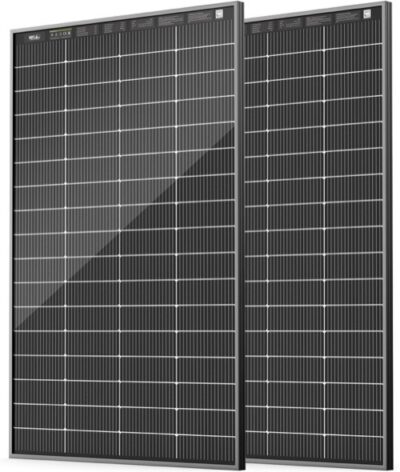
The build earns consistent praise. The all-black anti-corrosion aluminum frame and low-iron tempered glass feel solid, and the panel is genuinely compact for its wattage — roughly 30 by 46 inches and about 20 lb each. Owners switching from two 100W panels keep mentioning how much easier one 200W panel is to handle and mount.

Durability shows up in the stories, not just the spec sheet. One owner had a 6-foot ladder fall on a pair with nothing broken, and watched the wind rip them off a temporary mount and fling them on top of each other — still no damage. Another has run HQST panels at over 80 MPH on a roof rack with no issues.
The recurring complaint isn’t the panel — it’s the box. Owners repeatedly describe thin padding, only a couple of protected corners, and holes punched through the cardboard. Most panels still arrive intact (credit to the carriers), but a few show a small frame dent, and one buyer noticed slight waving in the glass on one of three panels. Inspect the frame and glass before you mount anything.
Charging: Claimed vs. Real-World
The HQST 200W bifacial panel is rated at 200W, which in good sun translates to roughly 150-170W of real output — about 624 Wh on a typical four-peak-sun-hour day. Owners running a pair report up to 170W at midday, and one summed up the pattern: weak in late-afternoon sun, strong from 11am to 4pm once the angle’s right.
In practice, that’s enough to do real work. Owners charge large LiFePO4 banks quickly through MPPT controllers — one fills an Eco-Worthy 280Ah battery “very quickly,” another runs a fridge, devices, fans, and cordless tools off a small array. This isn’t a trickle panel; it’s a workhorse for a 12V or 24V system.
Cloudy days are the honest soft spot. On fully overcast skies, expect output to fall to roughly 20-30% of rated — though the bifacial rear can soften that loss if reflected light is reaching it. A few owners measured below spec on single panels in poor conditions, so angle and placement carry a lot of weight here.
| Condition | Estimated Output | What That Means |
|---|---|---|
| Full sun, ideal angle | ~155-170 W | Charges a large LiFePO4 bank fast; tops a power station |
| Partly cloudy sky | ~80-100 W | Still useful; steady charge, just slower |
| Overcast / heavy clouds | ~40-60 W | Won’t fully charge a big bank; keeps things topped |
| Panel angle 45° off optimal | ~100-120 W | Where many fixed flat-roof installs land |
| Winter sun (northern US) | ~90-110 W avg | Still charges; fewer peak sun hours than summer |
| Panel in partial shade | ~20-50 W | Big drop; keep the whole front face in sun |
Real-World Math — Using a 0.78 real-world factor, this 200W panel delivers about 156W in good sun. Over four peak sun hours, that’s roughly 624 Wh a day. That’s enough to put a meaningful dent in a 100-300Ah 12V bank, not just maintain it.
These are estimates. Real output swings with angle, sky, shade, temperature (panels lose efficiency in heat), and how much reflected light hits the rear.
Connections and Compatible Gear
The big compatibility question for a panel like this is which batteries and systems it feeds — and the answer is wide. The 12V nominal output (Vmp around 19V, Voc around 22.4V) suits a 12V battery through a 12V or 12V/24V MPPT controller, and owners wire pairs in series or parallel for 24V banks too. Standard MC4 connectors fit common adapters, so power-station owners hook these straight into EcoFlow, Bluetti, Jackery, and Pecron units.

One detail worth confirming: an owner flagged that Voc lands around 22.4V, not 24V. That’s fine for a 12V system, but check it if you’re planning series strings for 24V nominal gear that expects a higher-voltage panel.
| Battery / System | Typical Use | Compatible? | Notes |
|---|---|---|---|
| Flooded lead-acid (12V) | Backup, off-grid | Compatible | Use any 12V controller |
| AGM (sealed) | RV, boat, UPS | Compatible | No gassing; good for sealed bays |
| LiFePO4 (12V) | RV, van life, off-grid | Compatible | Owners charge large LFP banks fast via MPPT |
| 24V battery bank | Large RV, off-grid | Compatible | Wire panels in series; confirm controller voltage |
| EcoFlow / Bluetti / Jackery station | Backup, camping | Needs adapter | MC4-to-station cable; check station’s solar input limits |
| Pecron / AFERIY station | Backup power | Needs adapter | Owners report 96-99W into a Pecron from one panel |
Buyer Heads-Up — Before wiring into a power station, match the panel’s output against your station’s maximum solar input. Wiring in parallel keeps voltage in check while adding current; series raises voltage fast and can exceed a station’s input ceiling. One owner stressed checking specs before hooking up an EcoFlow.
The MC4 ecosystem is the real strength here — if your gear takes solar via MC4 or a common adapter, this panel slots in without drama.
IP Rating and Real-World Survival
The spec sheet lists an IP65 rating, which means the panel is protected against rain and water jets from any direction but not submersion. One marketing bullet claims IP68; the spec sheet says IP65, so treat IP65 as the rated figure. Backing it up are a 2400 Pa wind rating and a 5400 Pa snow load rating.

Real-world durability holds up in owner feedback. Panels have survived a ladder falling on them, a wind event that tore them off a mount, three hurricanes on an older HQST unit, and years of highway speeds — all without cracking. The anti-corrosion aluminum frame and tempered glass are built for permanent outdoor life.
| Feature | This Panel | What It Means Outdoors |
|---|---|---|
| IP rating | IP65 (spec sheet) | Protected against rain jets from any direction |
| Frame material | Anti-corrosion aluminum | Resists corrosion; won’t warp in heat |
| Panel surface | Low-iron tempered glass | Impact-resistant; one report of slight waving |
| Junction box seal | Not stated | One owner needed a replacement cover; support sent one |
| Connector weatherproofing | MC4 (standard) | Weather-rated when fully seated |
| Wind / snow load | 2400 Pa / 5400 Pa | Handles strong wind and heavy snow loads |
| Long-term owner reports | Mostly strong | Years of trouble-free use; one snail-trail report on older panels |
Long-Term Ownership — Monocrystalline panels degrade slowly, around 0.5% a year. The cells usually outlast the wiring, so connector and cable quality matter most for longevity. HQST projects a 30-year service life at 87.4% output, but that’s a performance estimate, not a coverage term.
Mounting and Real-World Setup
Setup is genuinely simple — standard MC4 in, panel out — but there’s a catch nobody should skip. These ship as panels only. No controller, no brackets, no wiring, no adapters. A solar newcomer spent two extra weeks sourcing adapters, extension wire, and mounting brackets before the system worked, and wished the listing had spelled out a basic parts list.
The most consistent install gripe is cable length. Owners across HQST’s lineup call these the shortest MC4 leads of any bifacial brand they own. They’re fine for panels sitting side by side, but the moment a roof fan or AC unit sits between panels — or you spread an array out — you’ll want extensions. One owner put it bluntly: he wishes the cables were another 12 to 18 inches longer, or that extensions were offered on the same page.
Practical Tip — Budget for a pair of MC4 extension cables before the panels arrive. Roof runs around a fan or AC unit, or eave-to-controller routing, often add several feet. Match connector type (MC4 to MC4) to avoid voltage drop from cheap adapters.
For mounting, plan to buy third-party brackets or a tilt/ground mount. A few owners note the panel’s near-square shape and 1.18-inch thickness can complicate end-rail mounts, and predrilled holes sometimes need reaming to line up with aftermarket brackets. None of it is a dealbreaker — just don’t expect a bolt-on kit.
Warranty Terms and Safety Ratings
There’s no third-party safety certification (UL, CE, ETL) listed for the panel itself, though the spec sheet rates it to a 600 VDC maximum system voltage and a 20A maximum series fuse. For most 12V and 24V installs, those numbers give plenty of headroom.
Warranty is where you should set expectations carefully. HQST advertises a 30-year service life at 87.4% output, but that’s a performance projection, not coverage. One long-time owner of older HQST panels developed snail trails and was told the manufacturing warranty is actually 5 years — so the 30-year figure describes expected efficiency, not how long you’re protected. Honestly, that gap is worth knowing before you treat this as a multi-decade guarantee.
That said, support gets real praise. Owners describe replies within roughly a day, replacement junction-box covers shipped next-day, and replacement panels offered for defects like bubbling under the 5-year window. For a budget-priced panel, that kind of responsiveness is a genuine point in HQST’s favor.
Worth Knowing — A 5-year manufacturing warranty is plenty for camera or seasonal-maintenance duty and reasonable for an RV or off-grid build at this price. If you need a guaranteed 25-year power warranty for a permanent home array, a premium-brand panel will cost more but carry that paper.
Who’ll Get the Most From It — Use-Case Fit Matrix
| Use Case | Fit | Why |
|---|---|---|
| RV / van rooftop 12V system | Strong fit | Compact 200W, light, fewer mounts than two 100W panels |
| Off-grid cabin or shed (lights, fridge, tools) | Strong fit | Owners run fridges and tools off small arrays |
| Ground-mount or pole array with clearance | Strong fit | Bifacial gain is real with reflective surface below |
| Power station charging (EcoFlow, Bluetti, Pecron) | Solid fit | MC4 adapter required; check station input limits |
| 24V battery bank | Solid fit | Wire in series; confirm Voc and controller voltage |
| Boat / marine 12V maintenance | Solid fit | Aluminum frame and IP65 suit marine exposure |
| Seasonal car / RV battery maintenance | Solid fit | 624 Wh/day is far more than trickle needs |
| Flat-mount on a dark roof | With caveats | Works as a 200W panel; bifacial bonus is minimal |
| Spread-out roof with fan/AC in the way | With caveats | Plan on MC4 extensions for the short leads |
| Buyer who wants a controller and mounts in the box | Borderline | Panels only — budget for controller, brackets, wiring |
| Buyer needing a guaranteed 25-year power warranty | Borderline | 30-year figure is a projection; warranty is ~5 years |
| Permanent shaded install | Skip | Output drops hard in shade; defeats the purpose |
You’ll probably be happy if you want:
- One compact, light 200W panel instead of two bulkier 100W panels — fewer mounts, no Y-connector loss
- A real bifacial bonus you can actually capture with elevated mounting over a reflective surface
- A workhorse panel for a 12V or 24V RV, van, or off-grid bank, or for charging a power station via MC4
You might want to skip it if you need:
- A flat dark-roof install where the bifacial back side won’t see reflected light
- A plug-and-play kit with controller, brackets, and wiring included
- A guaranteed multi-decade power warranty backed on paper
- Long MC4 leads with no extensions for a spread-out array
Our Final Take
For the right buyer, this HQST 200W bifacial solar panel review lands firmly in the recommend column. The N-Type 16BB cells pull strong output in good sun, the build survives real abuse, the value is hard to beat, and the bifacial design pays off when you mount it with clearance over a reflective surface. RV owners, off-grid builders, and power-station users get a compact, capable panel that owners keep buying again and again.
The honest catch is that this is a panel, not a kit — you’ll add a controller, mounts, and probably MC4 extensions, and the 30-year life claim is really a 5-year warranty with a long efficiency projection. If you’re building a 12V or 24V system and you can mount these off a bright surface, the HQST 200W bifacial solar panel is an easy yes. If you need a flat dark-roof install or a bolt-on package with a paper-backed decades-long warranty, look elsewhere — for everyone else, this one earns its spot.
Pros & Cons Analysis
Based on extensive testing and Amazon customer feedback
Pros
- Compact, lightweight 200W in one panel — owners switching from two 100W panels consistently mention the smaller footprint and lower weight. One panel instead of two means fewer mounts, no Y-connector, and less power lost across parallel connections — a real win for tight campervan and RV rooftops.
- Strong real-world output in good sun — customers running a pair report up to 170W from a 200W panel during peak midday hours, and many describe hitting 85-100% of rated output once the angle is dialed in. Buyers consistently call these the best value they've found.
- Real bifacial gain with the right setup — owners who mount the panels off the surface (pergola, ground legs, roof rack) and add a reflective layer underneath report measurable extra yield. One PNW buyer applied Mylar behind the panels and saw them outperform non-bifacial panels by up to 25% on cloudy days.
- Solid, durable build — the all-black anti-corrosion aluminum frame and tempered glass feel well made. Owners describe surviving a ladder falling on them, being ripped off a mount by wind, and years of highway speeds without cracking. Build quality is a recurring point of praise.
- N-Type 16BB cells and 25.4% efficiency — the 16-busbar design improves current collection and reduces hot spots versus older 5BB or 9BB panels. Owners running them through MPPT controllers report fast charging of large LiFePO4 banks and consistent current even after partial shading from trees.
- Plug-and-play with standard MC4 — setup is straightforward. Owners pair these with HQST, Victron, Renogy, and other MPPT controllers without drama, and the standard MC4 connectors fit common adapters for power stations like EcoFlow and Bluetti.
- Excellent value for the money — across feedback, a clear pattern: buyers feel they got more panel than they paid for. Many return to buy more, building out larger arrays for sheds, RVs, and home backup over multiple purchases.
- Responsive customer support — multiple owners describe getting replies within roughly a day and getting replacement junction-box covers or panels for defects under HQST's warranty. Several call the service a big reason they keep buying the brand.
Cons
- Short MC4 cables — the most repeated complaint across the brand's panels. The leads are fine for connecting panels sitting right next to each other, but several owners say they're the shortest of any bifacial brand they own and wish they were 12-18 inches longer, especially for roofs with a fan or AC unit in the way.
- Output drops off-peak and at the wrong angle — the same owners who see 170W at noon report far less in late-afternoon or poorly aimed conditions. A few buyers measured well below spec on a single panel, and one noted Voc struggling to hold under load — angle and placement matter a lot here.
- Bifacial does little flat on a dark roof — several campervan owners note the back side picks up almost nothing when the panel sits flush on the roof. The dual-sided feature only pays off when reflected light can actually reach the rear cells.
- Weak shipping packaging — by far the most common gripe. Owners repeatedly mention thin padding, only a couple of protected corners, and holes punched in the box. Most panels still arrive intact thanks to the carriers, but minor frame dents and one report of slightly wavy glass show up.
- Voc is ~22.4V, not 24V — a detail-oriented owner flagged that the open-circuit voltage lands around 22.4V, fine for a 12V battery and 12V/24V MPPT controller, but worth confirming if you plan series strings for a 24V nominal system or your gear expects a higher-voltage panel.
- No controller, hardware, or adapters in the box — these are panels only. Solar newcomers mention needing to separately source a charge controller, mounting brackets, extension wiring, and the right adapter cable before anything works.
- Listing accuracy and fulfillment slip-ups — a few owners report receiving the wrong panels (non-bifacial, or a different model with mismatched Voc), and dimension or spec stickers that didn't exactly match the listing. Verify the model on arrival before mounting.
- Long-term durability and warranty terms are an open question — the 30-year service-life claim is unproven for this newer compact bifacial model, and one long-time owner of older HQST panels reported snail trails and learned the manufacturing warranty is 5 years, not 30. Treat the 30-year figure as a performance projection.
Our Verdict
Charging performance (4.3/5) — Owners consistently report strong real-world output: up to 170W from a 200W panel at peak and 85-100% of rated once angled correctly, with the N-Type 16BB cells holding current well. Drop-off off-peak, at poor angles, and a couple of below-spec single-panel reports keep it just under 4.5.
Value & compatibility (4.5/5) — Repeatedly called the best value on the market by owners who buy again and again. Standard MC4 fits MPPT/PWM controllers and major power stations via adapter; the ~22.4V Voc and occasional wrong-item shipments are the only real caveats.
Build & weatherproofing (4.2/5) — The all-black anti-corrosion aluminum frame, low-iron tempered glass, and IP65 rating hold up well, with owners reporting survival of falls, wind, and years of highway use. The unproven 30-year claim, one wavy-glass report, and weak packaging knock it slightly.
Install & usability (3.6/5) — Standard MC4 makes hookup simple, but short cables, no included mount or hardware, and no controller in the box mean newcomers need extra parts. The most consistent install friction is cable length.
Bottom line — Best for vehicle-based and off-grid 12V/24V systems — RV and van rooftops, cabins and sheds, ground-mount arrays, and power-station charging when you can elevate the panel over a reflective surface. Skip it if you need a flat dark-roof install, a controller-and-mounts-in-the-box kit, or a paper-backed multi-decade power warranty.
Frequently Asked Questions
Does the HQST 200W bifacial panel actually produce more power than a regular panel?
It can, but only with the right setup. The bifacial rear cells capture reflected light, and owners who mount the panel off the surface — on a pergola, roof rack, or ground legs — and add a light-colored or reflective surface underneath report a real gain, in some cases up to 25% more on cloudy days versus non-bifacial panels. Lying flat on a dark roof, the rear side picks up very little, so the bifacial bonus is minimal in that scenario.
How much real-world power does the HQST 200W panel put out?
In good midday sun with a decent angle, owners running a pair report up to 170W from a 200W panel, and many see 85-100% of rated output once dialed in. Output drops in late-afternoon sun, at poor angles, or under cloud. A practical planning figure is roughly 150-170W in strong sun, which works out to around 624 Wh per day at four peak sun hours.
Does the HQST 200W bifacial panel come with a charge controller?
No. These are panels only — no controller, mounting brackets, or adapter cables in the box. You'll need to pair them with a separate charge controller. An MPPT controller is strongly preferred over PWM because it harvests more in variable light, and owners report fast charging of large LiFePO4 banks through Victron, HQST, and other MPPT units.
Can I charge my EcoFlow, Bluetti, or Jackery power station with this panel?
Yes, with the correct adapter cable. The panel uses standard MC4 connectors, and owners report charging EcoFlow Delta and River units, Bluetti, Pecron, and similar stations through an MC4-to-station adapter. Always check the panel's output specs against your station's solar input limits before connecting — wire in parallel rather than series if series voltage or current would exceed your station's input rating.
What is the open-circuit voltage, and will it work with a 12V battery?
The open-circuit voltage (Voc) is about 22.4V, with a maximum operating voltage (Vmp) around 19V. That works fine with a 12V battery through a 12V or 12V/24V MPPT controller. If you plan to wire panels in series for a 24V nominal system, or your equipment expects a higher-voltage panel, confirm the numbers first — a few owners assumed 24V and had to adjust.
Are the cables long enough, or do I need extensions?
The MC4 leads are on the short side. They're fine for connecting panels sitting right next to each other, but owners with roofs that have a fan or AC unit in the way, or spaced-out arrays, consistently wish the cables were 12-18 inches longer. Budget for a pair of MC4 extension cables if your layout spreads the panels apart — they're inexpensive and preserve the connector type.
How does it handle cloudy days and partial shade?
On fully overcast days, expect output to fall to roughly 20-30% of rated. The N-Type 16-busbar cells help keep current steady, and the bifacial design can soften cloudy-day losses if reflected light reaches the rear. Partial shade still hits output hard, as with any panel — keep the whole front face in the sun for best results.
Is the HQST 200W panel waterproof and durable enough for permanent outdoor mounting?
The spec sheet lists an IP65 rating with an anti-corrosion aluminum frame and low-iron tempered glass, plus 2400 Pa wind and 5400 Pa snow load ratings. Owners report panels surviving a ladder falling on them, being ripped off a mount by wind, and years at highway speeds without damage. IP65 covers rain and jets from any direction but not submersion.
What's the real warranty, and is the 30-year lifespan claim accurate?
HQST advertises a 30-year service life (87.4% output) for the N-Type cells, but that's a performance projection, not a coverage term. One long-time owner of older HQST panels was told the manufacturing warranty is 5 years. Several buyers do praise the support, getting replacement junction-box covers or panels for defects within a day or so. Treat 30 years as the efficiency outlook and 5 years as the practical warranty.
Will the panel arrive damaged given the packaging complaints?
Packaging is the single most common gripe — thin padding and holes punched in boxes show up often. That said, most panels still arrive intact thanks to the carriers, with at most a small cosmetic frame dent. Inspect the frame and glass on arrival, and confirm you received the correct bifacial HQST model before mounting, since a few buyers reported wrong items shipped.
Technical Specifications
| Brand | HQST |
|---|---|
| Model / SKU | HSP200N-64LT (ASIN: B0GL7K1W3D) |
| Product type | Compact rigid bifacial solar panel — for RVs, vans, boats, off-grid cabins, and rooftop arrays (sold as a 2-pack) |
| Solar cell type | N-Type monocrystalline silicon — 16-busbar (16BB) Grade A+, EL-tested, bifacial |
| Maximum power output | 200 W (STC; up to 260 W with bifacial gain in ideal conditions; ~150-170 W typical real-world in strong sun) |
| Open-circuit voltage (Voc) | 22.4 V ±3% |
| Maximum operating voltage (Vmp) | 19.02 V ±3% |
| Output voltage | 12 V nominal (DC) |
| Maximum current (Imp) | 10.50 A ±3% |
| Short-circuit current (Isc) | 11.04 A ±3% |
| Cell efficiency | Up to 25.4% (N-Type 16BB cells) |
| Charge controller included | No — pair with a separate MPPT (preferred) or PWM controller |
| Controller features | N/A (no controller in the box; protection depends on the controller you choose) |
| Connector type | MC4 solar connectors |
| Cable length | Not specified (owners consistently report leads run short — extensions often needed) |
| Waterproof rating | IP65 (spec sheet; one marketing bullet claims IP68 — treat IP65 as the rated figure) |
| Operating temperature range | Not specified (maximum system voltage 600 VDC; max series fuse rating 20 A) |
| Dimensions (L × W × H) | 30.1" × 46.3" × 1.2" (765 × 1175 × 30 mm per spec sheet) |
| Weight | 20.17 lb (9.15 kg) per panel |
| Frame material | Anti-corrosion aluminum alloy (all-black) |
| Surface / glass material | Low-iron tempered glass front; bifacial rear captures reflected light |
| Mounting type | No mount included (use third-party brackets, tilt mounts, or a ground/pole rack) |
| Compatible devices / batteries | 12V and 24V battery banks (lead-acid, AGM, LiFePO4) via controller; portable power stations (EcoFlow, Bluetti, Jackery, Pecron) via MC4 adapter |
| Required sunlight hours | 4 peak sun hours/day delivers ~624 Wh (estimated at 0.78 real-world factor) |
| Wind / snow load rating | 2400 Pa wind resistance; 5400 Pa snow load |
| Safety certifications | Not specified (maximum system voltage rated to 600 VDC UL; max series fuse 20 A) |
| Special features | Bifacial dual-sided output (up to 30% more power); N-Type 16BB Grade A+ cells; all cells EL-tested; compact and lightweight versus standard PERC panels |
| Included in the box | 2× HQST 200W bifacial solar panels (no controller, brackets, wiring, or adapters) |
| Warranty | Not specified on listing (owner-reported manufacturing warranty: 5 years; 30-year service life is a performance projection) |
| Expected lifespan | 30-year service life claimed at 87.4% output (unproven for this newer compact bifacial model) |
| Unit count | 2 |
| Best for | RV and van rooftops, off-grid cabins and sheds, ground-mount arrays, power-station charging, and seasonal battery maintenance |