Solar Power Picks logo with sun, solar panel, and green energy icon

  • Home
  • Reviews
  • Best
    • Best portable power stations
    • Best Solar Panels
  • Guides
    • Portable Power Stations Guides
  • Comparisons
    • Portable Power Stations Comparisons
  • Calculator
Home / Solar Panels / Reviews / ECO-WORTHY 200W Portable Solar Panel Review: Competitive Wattage at a Lower Price — Is the Trade-Off Worth It?

ECO-WORTHY 200W Portable Solar Panel Review: Competitive Wattage at a Lower Price — Is the Trade-Off Worth It?

Brand: ECO-WORTHY

At a Glance

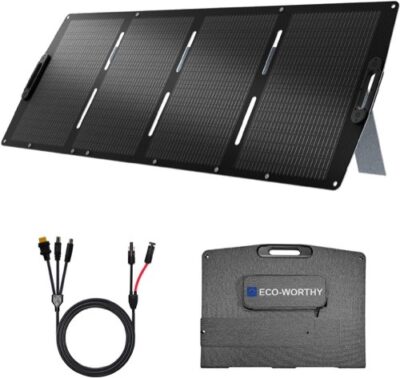
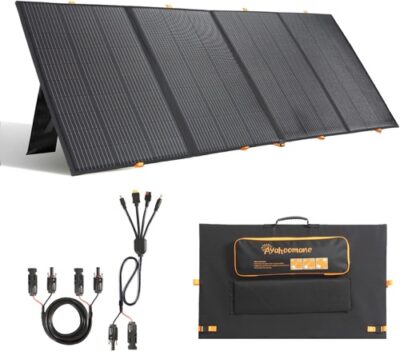
ECO-WORTHY 200W portable solar panel unfolded on its kickstand with the included MC4 adapter cable and folded carry case

KEY FEATURES

  • Power output: 200 W (claimed, ±3%), A+ monocrystalline silicon with PERC technology
  • Output: 19.4 V DC (Vmp), MC4 direct output; includes MC4 to XT60, DC7909 & DC8020 adapter cable
  • Cell efficiency: 23% (high tier for portable monocrystalline)
  • Weatherproofing: IP65 waterproof and dustproof, ETFE-coated surface, 7-layer one-piece lamination
  • Charge controller: None — direct MC4 output (pairs with your power station's built-in MPPT)
  • Best for: EcoFlow / Jackery / Bluetti / Anker power station charging, RV and boondocking supplemental power, sailboat and off-grid maintenance
CHARGING PERFORMANCE 3.4
BUILD & WEATHERPROOFING 3.9
INSTALL & USABILITY 3.8
VALUE & COMPATIBILITY 4.1

PROS

  • Strong value — real power station charging for less than premium brands
  • Lightweight at 22 lbs and folds compact for RV, boat, and camping
  • Wide adapter pack — MC4 to XT60, DC7909, DC8020 covers most power stations
  • Charges on cloudy days and pairs well with EcoFlow Delta 3 / Delta 3 Plus
  • Quick kickstand setup and IP65 ETFE build for outdoor use

CONS

  • Real-world output often lands well below the 200W rating
  • Open-circuit voltage measured higher than the 23.3V spec by some owners
  • 59-inch cable runs short compared with other brands
  • Occasional dead or weak units reported, plus panel-to-panel variation
  • Spec transparency and support response leave room for improvement
Jump to detailed pros & cons analysis
4.5

Editor's Choice

Based on rigorous testing & Amazon customer feedback

Current Price
$189.99 $149.99
Amazon.com
Check Current Price

Price and availability subject to change

Table of Contents

  • Overview
  • Specifications

☀ Solar Panel Output Calculator

Estimate how much energy the ECO-WORTHY 200W Portable Solar Panel produces — and what it can power or charge.

Solar Setup

200W
UK / cloudy north (2–3h)US / EU average (4–5h)Desert / tropics (6–7h)
—
per peak sun hour
—
per day (est.)
—
per month (est.)
V
Portable devices
Power stations & batteries
Estimated charging time—
Energy the battery needs—
Actual charging power from panel—

Click devices to add them to your load list, adjust hours and quantity, then calculate.

Portable / Camping
Home Appliances

No devices added yet. Click chips above or add a custom device.

Total daily device load—
Solar daily output—
Daily surplus / deficit—

Panels needed (at this wattage)—
Recommended battery (1 day backup)—

How many back-to-back sunless days should the battery keep you running? Example: 1 = one cloudy day, 3 = three cloudy days in a row.

Required solar array size—
Panels needed (at this wattage)—
Recommended battery capacity—

This ECO-WORTHY 200W review starts where most buyers actually start: scrolling Amazon, looking at a 200W foldable panel that costs noticeably less than the Jackery SolarSaga, Renogy, or EcoFlow equivalents. The price gap is real, and the obvious question follows — is the cheaper panel a smart deal or a future regret?

Here’s the comparison-shopping moment most people hit. Two 200W panels sit side by side, $50 to $100 apart. Same wattage on paper. Similar-looking specs. Is the cheaper one genuinely worse, or are you just paying extra for a logo?

To be fair, ECO-WORTHY has built a reputation for panels that deliver real output for the money. They’re not premium gear — but for buyers who don’t need a big-brand warranty or a flagship build, they often perform well enough. This review digs into exactly where ECO-WORTHY trims costs and whether those cuts matter for how you’ll actually use the panel.

At a Glance

Spec Value
Max Power Output 200 W (monocrystalline PERC)
Output Voltage 19.4 V DC (Vmp)
Connector MC4 + XT60 / DC7909 / DC8020 adapters
Cell Efficiency 23%
Weatherproof Rating IP65
Charge Controller None — direct (uses power station’s MPPT)
Cable Length 59 in (1.5 m) + 59 in adapter cable
Mount Type 4 adjustable kickstands
Best For Charging EcoFlow / Jackery / Bluetti power stations on RV and off-grid trips

Is the ECO-WORTHY 200W Worth It? Quick Take

If you want real power station charging without paying the premium-brand price, the ECO-WORTHY 200W review verdict is mostly positive. It’s lightweight at 22 lbs, sets up in seconds on its kickstands, and the included adapter cable plugs straight into EcoFlow, Jackery, Bluetti, and Anker stations. Owners charging an EcoFlow Delta 3 are consistently happy. Just know going in: real-world output often lands below the 200W rating, the 59-inch cable runs short for some setups, and a few owners measured open-circuit voltage well above spec — so check yours with a meter before connecting it to anything with a strict input limit.

How Does It Look and Feel?

The ECO-WORTHY 200W solar panel uses a frameless, one-piece laminated build rather than the rigid aluminum-framed slabs you find on fixed panels. ECO-WORTHY says it’s a 7-layer structure with an ETFE-coated surface, and customers describe the construction as adequate and the panels arriving quickly in good condition. At 22 lbs and folding down to a compact 21-by-26-inch slab, it’s genuinely easy to move around a campsite or stow in an RV bay.

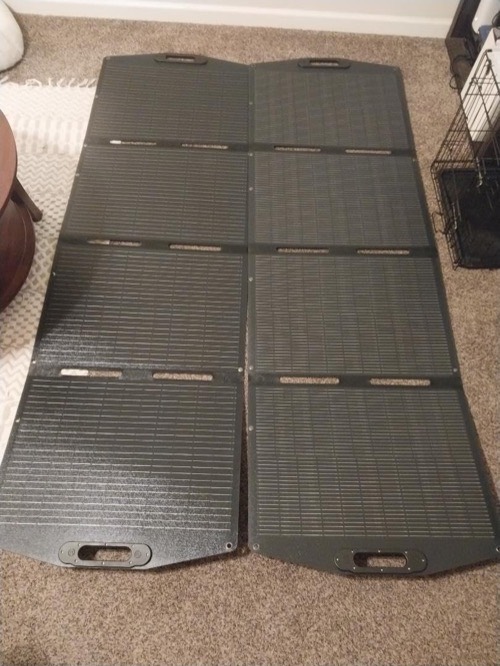
ECO-WORTHY 200W portable solar panel unfolded flat across the floor showing its four-segment quad-fold layout
Unfolded, the quad-fold panel stretches out into four large segments and stows compactly when folded.

In the hand, it reads as a budget-but-solid panel. One owner called it “super light weight for big solar panels,” which captures the appeal — you get 200W of collecting area without the bulk of a glass-and-aluminum unit. The ETFE surface adds scratch and weather resistance without the weight penalty of tempered glass.

The build isn’t flawless, though. The kickstand legs drew one return — a buyer found them a little clumsy and wished for a small LED to confirm the connection was live. More notable: one detailed reviewer received two panels with different internal bus bar counts, which is a real reminder that consistency between units isn’t guaranteed at this price.

Rated Watts vs. Real Watts

The ECO-WORTHY 200W is rated at 200W — which in good sun translates to roughly 140W of actual output, or about 560 Wh on a typical 4-hour peak-sun day. That’s the realistic working number, and it sits below the nameplate for a reason worth understanding.

Power station display showing 181W solar input at 68% charge while connected to the ECO-WORTHY panel through a yellow XT60 adapter
An owner’s power station reads 181W of solar input from the panel through the included XT60 adapter.

On a great day, owners get close. One buyer measured about 185W through a Renogy MPPT controller on a cold December afternoon — impressive, and a sign the cells can deliver. In practice, though, several owners report lower figures: around 125W max in regular use, and a handful of setups stuck near 60W. One longtime ECO-WORTHY customer even got a unit that produced zero. So the spread is wide, which is why testing your specific panel matters.

Cloudy-day behavior is the top question in customer feedback, and here the news is decent. One owner says it charges “absolutely perfectly” on a cloudy day with an EcoFlow Delta 3 Plus, and another had very good results in mixed light around the house. On fully overcast days, expect output to drop to roughly 20-30% of rated — enough to keep topping up a station, just slowly.

Condition Estimated Output What That Means
Full sun, ideal angle ~140 W Steadily refills a power station; ~560 Wh on a 4 PSH day
Partly cloudy sky ~70 W Still useful charging; a Delta 3 refills, just slower
Overcast / heavy clouds ~40 W Trickle-level input; keeps a station topped, won’t refill fast
Panel angle 45° off optimal ~90 W Moderate hit; flat-laid panels land here without kickstand tilt
Winter sun (northern US) ~80 W avg Cold helps the cells; fewer sun hours offsets the gain
Panel in partial shade ~20-40 W Big drop; keep the whole panel in the sun if you can

Real-World Math — Using the 0.70 real-world factor, this 200W panel delivers roughly 140W in good sun. Over a 4-hour peak sun day, that’s about 560 Wh. An EcoFlow Delta 3 holds around 1,024 Wh — so figure on two solid sun days to refill it from empty with this single panel.

These are estimates. Real output swings with panel angle, sky conditions, shading, temperature, and your cable run, so treat the numbers as a planning baseline rather than a promise.

Does It Work With Your Setup?

The first compatibility question for a panel like this is simple: which power stations does it plug into? The answer is most of the popular ones. ECO-WORTHY includes an MC4-to-XT60, DC7909, and DC8020 adapter cable, which covers EcoFlow, Jackery, Bluetti, Anker, ALLWEI, and similar brands without buying anything extra.

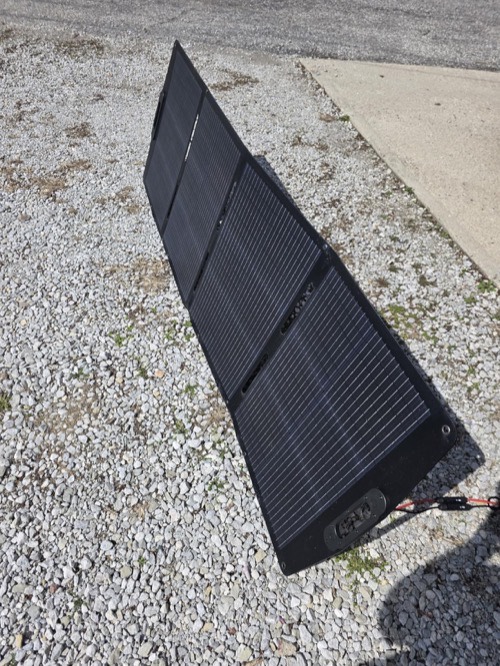
ECO-WORTHY 200W portable solar panel deployed flat on a gravel driveway outdoors with its MC4 leads attached
Set up on a gravel driveway, the panel feeds its MC4 leads straight to a power station.

Owners back this up in practice. Multiple buyers specifically confirm reliable charging with the EcoFlow Delta 3 and Delta 3 Plus, and one praised how fast it charged given how light the panel is. If you run a mainstream power station, odds are good the included adapters already fit it.

Power Station / Connector Included Adapter Compatible? Notes
EcoFlow (XT60 input) MC4 to XT60 Compatible Owners confirm Delta 3 / Delta 3 Plus charging
Jackery (DC8020 input) MC4 to DC8020 Compatible Standard adapter included
Bluetti (DC7909 input) MC4 to DC7909 Compatible Standard adapter included
Anker / ALLWEI stations MC4 + matching adapter Compatible Listed compatible by manufacturer
Bare 12V battery (AGM/lead-acid) None Needs adapter Requires a separate MPPT charge controller
LiFePO4 12V battery None Verify first Needs an MPPT controller with an LFP profile

The one place to slow down is voltage. Several owners measured open-circuit voltage between 29V and 31V against the published 23.3V Voc, and one found that high voltage incompatible with ECO-WORTHY’s own controller.

Device Type Compatible? What to Check
Portable power station (built-in MPPT) Compatible Confirm the station’s solar input voltage ceiling
Separate MPPT controller (12V system) Verify first Controller must handle ~31V open circuit
PWM controller Verify first Higher Voc may exceed cheaper PWM limits

Worth Knowing — The open-circuit voltage some owners measured runs above the spec sheet, which matters when you connect to a controller or station with a strict input limit. Always check open voltage with a meter before plugging in. The connector type is the easy part — the included MC4 adapters cover most stations — but voltage is what can actually cause a mismatch.

Holding Up to Rain and Sun

The ECO-WORTHY 200W carries an IP65 rating — which means it shrugs off rain and dust but isn’t built for submersion. For a panel that lives outdoors during camping trips, RV stops, and off-grid stints, that’s the practical standard. Owners report panels holding up fine in normal outdoor use, with no widespread complaints about water getting in.

The surface is ETFE-coated over a 7-layer one-piece lamination, which is a sensible choice for a portable panel. ETFE is lighter than tempered glass and handles scratches and flexing better, so tossing the folded panel into a gear bay is less of a worry. There’s no rigid aluminum frame here — that keeps weight down, but it also means the panel relies on its lamination rather than a frame for structural protection.

Feature This Panel What It Means Outdoors
IP rating IP65 Protected against rain jets and dust from any direction
Frame material None (laminated) Lighter and packable; no frame to corrode, but less rigid
Panel surface ETFE laminate Scratch- and flex-resistant; lighter than tempered glass
Junction box seal Not stated No specific seal claim; keep connectors out of standing water
Connector weatherproofing Standard MC4 MC4 handles outdoor use; dry the contacts before storing
Operating temperature range Up to 174°F rated Handles hot sun; full cold range not stated
Long-term owner reports Generally positive Panels arrive in good shape; main gripe is output, not weather

Worth Knowing — IP65 means protection against low-pressure water jets, not immersion. That’s plenty for rain, spray, and wet grass during a camping weekend. Just don’t leave the panel face-down in a puddle, and dry the MC4 contacts before you fold and pack it.

Setup and First Deployment

Setup is close to plug-and-play, and that’s one of the panel’s genuine strengths. The four adjustable kickstands unfold and lock within seconds, so you can tilt the panel toward the sun without extra hardware. One owner singled out the built-in supports for making setup easy, and another simply called it an easy portable power setup for anywhere.

The cable is where buyers run into friction. ECO-WORTHY includes a 59-inch (1.5m) MC4 cable plus a 59-inch adapter cable, and more than one owner notes that’s shorter than what competing brands ship. For a panel sitting right next to your power station at camp, the length is fine. The catch is, if you want to park the panel in a sunny spot 10 or 15 feet from your gear, you’ll be reaching for an extension.

Connector-wise, the MC4 leads are standard and click together securely. Just remember there’s no charge controller in the box — this panel is meant to feed a power station’s built-in MPPT directly. If you’re charging a bare 12V battery instead, you’ll need to add your own controller.

Practical Tip — Budget $12-20 for an MC4 extension cable before your first trip. A 59-inch lead doesn’t give you much room to chase the sun, and a 15- to 25-foot MC4 extension lets you place the panel where the light is while your power station stays in the shade. Match MC4 to MC4 to avoid voltage drops from cheap adapters.

Safety, Support, and Certifications

The ECO-WORTHY 200W doesn’t list specific third-party safety certifications on its product page — the IP65 weather rating is the main certified spec, alongside a stated upper temperature rating of 174°F. For a panel that connects to a power station with its own protection circuitry, the absence of extra logos is less of a concern than it would be on a controller-equipped kit.

What’s worth flagging from owner feedback is the voltage and consistency story. Open-circuit voltage measured 29-31V on some units against a 23.3V spec, and one detailed reviewer documented two panels with different bus bar counts and current profiles. Neither is a safety hazard with a power station that manages its own input, but both are reasons to test your panel early rather than assume it matches the sheet.

ECO-WORTHY backs the panel with a 12-month warranty and says it responds to issues within 24 hours. One owner did report trouble reaching support after the return window closed, so the practical advice is straightforward: meter your panel’s output and open voltage when it arrives, and raise any problem with the seller while you’re still inside the return period.

Long-Term Ownership — Monocrystalline cells like these typically degrade around 0.5% per year, so a healthy panel should still deliver most of its output years from now. On portable panels, the cable, MC4 connectors, and folding hinges usually wear out before the cells do — so keep the contacts dry and don’t over-flex the panel when packing it.

Is This Right for You? — Use-Case Fit Matrix

Use Case Fit Why
Charging an EcoFlow / Jackery / Bluetti power station Strong fit Adapters included; owners confirm Delta 3 charging works well
RV / camper supplemental power Solid fit Lightweight, foldable; one owner paralleled two for a camper
Boondocking and off-grid trips Solid fit Portable and quick to set up; a buyer bought three for boondocking
Sailboat / marine battery top-up With caveats IP65 handles spray; check open voltage against your controller
Bare 12V battery maintenance Borderline Works only if you add a separate MPPT controller
LiFePO4 12V battery charging With caveats Needs an MPPT controller with an LFP profile and high Voc tolerance
Emergency / blackout backup Solid fit Refills a power station steadily over a sunny day or two
Buyer needing the panel far from the station Borderline 59-inch cable is short; plan on an MC4 extension
Pairing multiple panels in series/parallel Borderline Unit-to-unit variation can cause ~20% loss; measure before pairing
Buyer wanting guaranteed rated 200W output With caveats Real-world output often lands lower; test your specific panel
Install in full shade Skip Output drops to a trickle; defeats the purpose
Buyer who wants certified, exact specs before buying With caveats Measured Voc and output can differ from the published sheet

You’ll probably be happy if you want:

  • A budget-friendly 200W panel that charges EcoFlow, Jackery, or Bluetti stations out of the box
  • A lightweight, foldable panel for RV trips, boondocking, and off-grid weekends
  • Quick kickstand setup with no controller to configure
  • Real charging on cloudy days, just at a slower rate

You might want to skip it if you need:

  • Guaranteed full 200W output without testing your own unit
  • A long cable to place the panel far from your power station
  • Perfectly matched panels for a multi-panel array
  • A panel for a shaded location or for charging a bare 12V battery without adding a controller

Is It Worth the Money?

For most buyers comparing Amazon listings, the ECO-WORTHY 200W review answer comes down to expectations. If you want a lightweight, foldable 200W panel that plugs straight into a mainstream power station and costs less than the big brands, this one earns its place. Owners charging EcoFlow Delta 3 units are happy, the kickstands make setup quick, and the value is genuinely strong for the wattage.

The trade-offs are real but manageable. Plan around roughly 140W of usable output rather than a clean 200W, budget for an MC4 extension if you need reach, and meter your panel’s open voltage before connecting it to any controller with a strict input limit. Do those three things and the ECO-WORTHY 200W solar panel is an easy recommendation for power station charging on a budget. If you need certified, guaranteed-to-spec output or a premium warranty, that’s exactly where the extra money for a Jackery or Renogy goes — and only you can decide if it’s worth it for your setup.

Pros & Cons Analysis

Based on extensive testing and Amazon customer feedback

Pros

  • Strong value for the wattage — the single most repeated theme. Customers describe it as "great for the price" and "good for the price," with several buyers happy enough to come back and order more units for boondocking and camper setups.
  • Works well with popular power stations — owners specifically mention reliable charging with the EcoFlow Delta 3 and Delta 3 Plus, including one buyer who praised fast charging from such a lightweight panel.
  • Lightweight and genuinely portable — at 22 lbs and folding to a compact slab, customers call it "super light weight for big solar panels" and easy to carry for RV, sailboat, and off-grid use.
  • Charges on cloudy days — one owner reports it performs "absolutely perfectly" on a cloudy day with a Delta 3 Plus, and another had very good results testing it around the house in mixed light.
  • Easy setup with built-in kickstands — buyers describe quick, fuss-free deployment, with one noting the built-in supports "make for easy setup" and another calling it an easy portable power setup for anywhere.
  • Good for supplementing an existing system — RV and camper owners report running a few items as needed, and one buyer successfully paralleled two sets to expand capacity.
  • Solid build for outdoor use — ETFE surface and IP65 weather resistance hold up, and buyers describe the construction as adequate and the panels arriving quickly in good condition.
  • Wide adapter compatibility out of the box — the included MC4-to-XT60, DC7909, and DC8020 cable covers EcoFlow, Jackery, Bluetti, Anker, and other popular power stations without buying extra adapters.

Cons

  • Real-world output below the 200W rating — a recurring complaint. One owner measured roughly 125W max charge rate, another saw about 185W on a cold December afternoon through a Renogy MPPT controller, and a few reported much lower figures in the 60W range across different setups.
  • Cable runs short for some setups — multiple buyers note the 59-inch (1.5m) cable is shorter than what other brands include, which forces awkward panel placement or an extension purchase.
  • Open-circuit voltage runs higher than the spec sheet — owners with meters measured 29.1V to 31.3V open circuit against a 23.3V published Voc. One buyer found it incompatible with the matching ECO-WORTHY controller because of the over-voltage.
  • Occasional dead-on-arrival units — a longtime ECO-WORTHY buyer reported this flexible 200W panel produced zero wattage, and another said theirs only put out about 60W across several setups.
  • Kickstand legs feel clumsy to some — one returning customer found the legs a little awkward and wished for a small LED to confirm the connection and contacts were live.
  • Panels can vary between units — one detailed reviewer received two "200W" panels with different bus bar counts and very different voltage/current profiles, making them hard to pair without a roughly 20% performance loss.
  • Spec transparency complaints — one buyer flagged contradictory documentation (200W in the title vs. lower figures in paperwork) and asked for a proper technical data sheet to clear up the confusion.
  • Short return-window risk — one owner discovered a fault only after the return window closed and reported difficulty reaching support, which is worth weighing on a budget panel.

Our Verdict

Charging performance (3.4/5) — Best-case reports are genuinely strong, with one owner seeing 185W through an MPPT controller on a cold December day and several happily charging EcoFlow Delta 3 units. The score is pulled down by a cluster of underperformance reports — 125W max, around 60W on a few setups, and one zero-output unit — that point to inconsistency rather than a clean rated-output match.

Value & compatibility (4.1/5) — The standout category: buyers consistently call it a strong buy for the price, and the included adapter pack covers EcoFlow, Jackery, Bluetti, and Anker out of the box. The 12-month warranty and some support friction stop it short of a top score.

Build & weatherproofing (3.9/5) — The ETFE surface, IP65 rating, and 7-layer lamination earn solid marks, and panels arrive in good condition. It's held back slightly by the unit-to-unit variation one detailed reviewer documented between two supposedly identical panels.

Install & usability (3.8/5) — Kickstand deployment is quick and the included adapter cable covers most power stations out of the box. The short 59-inch cable and one buyer's "clumsy legs" comment keep it from scoring higher.

Bottom line — Best for budget power station charging — EcoFlow, Jackery, and Bluetti top-ups on RV, boondocking, and off-grid trips. Skip it if you need guaranteed full 200W output, a long cable, perfectly matched panels for an array, or a shaded-location setup.

View Best Price

Frequently Asked Questions

Does the ECO-WORTHY 200W charge on cloudy days?

Yes, customers report it still charges in overcast conditions, just at a reduced rate. One owner said it performed perfectly on a cloudy day with an EcoFlow Delta 3 Plus. On fully overcast days, expect output to drop to roughly 20-30% of the rated wattage, which is enough to keep topping up a power station but not at full speed.

Will it actually put out 200 watts?

In ideal sun with a good angle, you can get close. One owner measured about 185W through a Renogy MPPT controller on a cold December afternoon. That said, several buyers report lower real-world numbers — around 125W in regular use, and a few setups only seeing about 60W. Plan around roughly 140W of usable output in good conditions, and check your panel against a meter when it arrives.

Which power stations does it work with?

The included MC4-to-XT60, DC7909, and DC8020 adapter cable covers EcoFlow, Jackery, Bluetti, Anker, ALLWEI, and other popular brands. Owners specifically confirm reliable charging with the EcoFlow Delta 3 and Delta 3 Plus. Check your station's solar input voltage limit before connecting, since this panel's open-circuit voltage can run high.

Why is the open-circuit voltage higher than the listed 23.3V?

Several owners measured open-circuit voltage between 29V and 31V against the published 23.3V spec. Open voltage is highest with no load and in cold, bright conditions, so it isn't automatically a fault, but it does matter. One buyer found the high voltage incompatible with ECO-WORTHY's own charge controller, so always check open voltage with a meter before plugging the panel into any controller or power station with a strict input limit.

Is the cable long enough?

The panel ships with a 59-inch (about 1.5 meter) MC4 cable plus a 59-inch adapter cable. Multiple buyers note this is shorter than what some competing brands include. For most camp-side or RV-side placements next to the power station it's fine, but if you need to park the panel far from your gear, budget for an MC4 extension cable.

Can I connect two of these panels together?

One owner successfully paralleled two sets for a camper. The catch: another detailed buyer received two units with different internal bus bar counts and different voltage and current profiles, which caused roughly a 20% performance loss when paired. If you plan to combine panels, measure the open voltage and short-circuit current of each one first and only pair units with matching numbers.

Does it need a charge controller?

No separate controller is included, and most buyers connect it straight to a portable power station, which has its own built-in MPPT controller to manage the input. If you want to charge a bare 12V battery instead, you'll need to add a compatible MPPT controller, and you should confirm it can handle this panel's higher-than-rated open-circuit voltage.

How do I set it up?

It's close to plug-and-play. The four adjustable kickstands unfold and lock within seconds, letting you tilt the panel toward the sun. Connect the MC4 leads to the matching adapter for your power station, point it at the sun, and you're charging. Owners describe the built-in supports as making setup easy.

How well does it hold up outdoors?

The panel uses a 7-layer one-piece lamination with an ETFE-coated surface and carries an IP65 rating, meaning it shrugs off rain and dust. Customers report panels arriving in good condition and holding up in normal outdoor use. IP65 covers rain and spray but not submersion, so don't leave it sitting in standing water.

What's the warranty?

ECO-WORTHY lists a 12-month warranty with a stated 24-hour response time to contact. One buyer reported difficulty getting support after the return window closed, so if you spot an issue with output or voltage, test the panel early and contact the seller right away rather than waiting.

Technical Specifications

BrandECO-WORTHY
Model / SKUFD-200Watt (ASIN: B0F4X2D4YP)
Product typePortable foldable solar panel for power stations — RV, camping, off-grid, emergency
Solar cell typeMonocrystalline silicon (A+ grade, PERC technology)
Maximum power output200 W (rated, ±3%); ~125-185W typical real-world based on owner testing
Open-circuit voltage (Voc)23.3 V (rated; owners measured 29-31V open circuit)
Maximum operating voltage (Vmp)19.4 V
Output voltage19.4 V (DC)
Maximum current (Imp)10.32 A
Short-circuit current (Isc)10.94 A
Cell efficiency23%
Charge controller includedNo (direct MC4 output — pairs with the power station's built-in MPPT)
Controller featuresN/A (no controller included; add a compatible MPPT for bare 12V battery charging)
Connector typeMC4 direct output; includes MC4 to XT60, DC7909 & DC8020 adapter cable
Cable length59 in (1.5 m) MC4 cable + 59 in (1.5 m) adapter cable
Waterproof ratingIP65 (rain and dust resistant — not submersion rated)
Operating temperature rangeNot specified (upper temperature rating listed as 174°F)
Dimensions (L × W × H)79.06" × 26.22" × 0.16" (unfolded); 20.94" × 26.22" × 1.97" (folded)
Weight22.04 lb (10 kg)
Frame materialNot specified (one-piece 7-layer lamination, no rigid frame)
Surface / glass materialETFE coating over monocrystalline cells
Mounting type4 adjustable kickstands (multi-angle tilt); integrated mounting holes and reinforced supports
Compatible devices / batteriesEcoFlow, Jackery, Bluetti, Anker, ALLWEI and other power stations via included adapters; 12V systems with a separate MPPT controller
Required sunlight hours4 peak sun hours/day delivers ~560 Wh (estimated at 0.70 real-world factor)
Wind / snow load ratingNot specified
Safety certificationsNot specified
Special features23% high-efficiency PERC cells; ETFE waterproof surface; 4 adjustable kickstands with 10-second setup; ultra-thin foldable design; wide power station compatibility
Included in the box1× 200W solar panel, 1× 59-inch MC4 cable, 1× 59-inch MC4 to XT60/DC7909/DC8020 cable, 1× user manual
Warranty12 months (seller states 24-hour response)
Expected lifespanNot specified
Unit count1
Best forEcoFlow / Jackery / Bluetti power station charging, RV and boondocking supplemental power, sailboat and off-grid battery maintenance

You Might Also Like

View All Solar Panels
EBL 200W Solar Panel Review: Can a Battery Brand Make a Reliable Solar Panel?

EBL 200W Solar Panel Review: Can a Battery Brand Make a Reliable Solar Panel?

HQST Bifacial 100W Solar Panel Review: The 12V Panel That Pulls Extra Power From Reflected Light

HQST Bifacial 100W Solar Panel Review: The 12V Panel That Pulls Extra Power From Reflected Light

Jackery SolarSaga 200W Review: Bifacial Cells, IP68 Waterproofing, and Built for Jackery Owners

Jackery SolarSaga 200W Review: Bifacial Cells, IP68 Waterproofing, and Built for Jackery Owners

200W Portable Solar Panel Review: 24% ETFE Efficiency at a Budget Price — What You’re Actually Getting

200W Portable Solar Panel Review: 24% ETFE Efficiency at a Budget Price — What You’re Actually Getting

ALL CATEGORIES

Portable Power Stations

Portable Power Stations

Solar Panels

Solar Panels

× Product Image

About Solar Power Picks

Portable Solar Power, Backup Power, and Off-Grid Gear Guides

Your trusted source for honest, in-depth product reviews and comparisons.

Quick Links

  • Best Picks
  • Reviews
  • Guides
  • Comparisons
  • Calculator
  • Privacy policy
  • Favorites

Categories

  • Portable Power Stations
  • Solar Panels

© 2026 Solar Power Picks. All Rights Reserved.

We may earn a commission when you purchase through links on our site. Learn more