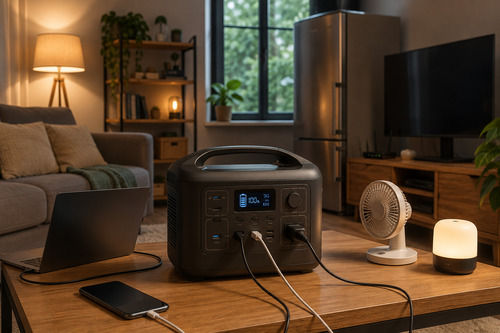
Can you use a portable power station indoors? A battery power station can normally operate indoors when its manual permits the environment and the unit is dry, undamaged, ventilated, and connected within its electrical limits. That answer does not extend to gasoline, propane, or diesel generators, which produce combustion exhaust and must stay outside.
A battery power station stores electricity; a fuel generator creates electricity through combustion. Never let the shared word “generator” erase that safety difference.
Sort the Equipment Before Choosing the Room
| Equipment | Indoor operating rule | Primary concern |
|---|---|---|
| Battery portable power station | Often permitted; follow exact manual | Heat, damage, moisture, overload |
| Fuel-powered generator | Never operate indoors or in a garage | Carbon monoxide and fire |
| Vehicle engine / alternator source | Never idle in enclosed or partly enclosed space | Exhaust and CO |
| Loose lead-acid battery setup | Only as designed with appropriate ventilation/protection | Gas, acid, short circuit |
| Permanently connected backup system | Professional installation and code compliance | Backfeed, transfer, grounding |
The CDC’s outage guidance says fuel-burning generators and engines must not run inside a home, basement, or garage. A battery station does not create CO while discharging, but damaged cells and overloaded wiring still demand respect.
Use a Room-by-Room Placement Test
A bedroom may be suitable for a quiet CPAP station but not for fast charging if fan noise or display light disrupts sleep. A kitchen counter can keep fridge cabling short, yet it must remain away from sinks and cooking heat. Garages vary widely in temperature and moisture, so “indoors” is not one environment.
Ventilation Still Matters Without Exhaust
Battery stations need airflow for electronics and thermal management. Keep the manufacturer’s vent clearances, avoid enclosing the unit in furniture, and do not drape clothing or bedding over it. Fans moving air are not evidence of toxic exhaust; they are evidence that heat must leave the enclosure.
- ✅ Keep all intake and exhaust openings unobstructed.
- ✅ Use a firm surface where the unit cannot tip or be stepped on.
- ⚠️ Stop charging or discharging if odor, swelling, smoke, unusual heat, or crackling appears.
- ⚠️ Move people away and follow the manufacturer’s emergency instructions for a battery event.
- ❌ Never cool a hot or burning lithium battery with improvised advice from a generic article.
Cords and Loads Create the Everyday Indoor Risk
Most indoor problems begin with placement and connections: a damaged extension cord, a heater that consumes the inverter’s full output, a cord under a rug, or several appliances on an undersized strip. Plug high-demand equipment directly into an approved station outlet when the manual requires it.
| Connection check | Acceptable direction | Reject |
|---|---|---|
| Total running load | Below continuous output with margin | Using peak watts as continuous |
| Motor startup | Within time-rated surge capability | Repeated overload trips |
| Extension cord | Correct gauge/rating, visible, undamaged | Under rugs or through pinched doors |
| Power strip | Listed and within all ratings | Daisy-chained strips |
| Home wiring | Approved transfer equipment and electrician | Backfeeding a receptacle |
Space heaters, kettles, and hot plates can be within output limits and still be poor battery loads because they turn stored energy into heat very quickly. Keep heat-producing appliances away from the station and supervise them according to their manuals.
Charging Indoors Requires Its Own Check
- Inspect: enclosure, ports, charger, and cables before connecting power.
- Place: use a dry, ventilated, temperature-controlled location.
- Match: use the supplied or manufacturer-approved charging method.
- Observe: remain alert during the first charge after storage, transport, or impact.
- Store: follow the exact state-of-charge and temperature instructions after use.
Fast charging can create more heat and fan noise than slow charging. Adjustable input is useful when a shared circuit is near its limit, but settings do not replace correct wiring or a sound outlet.
Indoor Backup Is Not the Same as Whole-Home Connection
Running a refrigerator or router from station outlets is different from energizing household circuits. A transfer switch, inlet, subpanel, neutral/ground arrangement, and 120/240V behavior are installation questions. Use listed compatible equipment and qualified help.
Can I connect it to a wall outlet?
Only through a manufacturer-approved charging or transfer method. Never use a male-to-male cord or backfeed a branch circuit.
Can it stay plugged in?
Only if the manual supports the intended UPS/EPS or pass-through mode. Test restoration behavior, output timeouts, charge limits, and alarms.
Can I place it beside a furnace?
Do not expose the station to heat, combustion equipment, blocked service access, or unapproved hardwiring. A furnace blower may also have surge and bonding requirements.
Can I charge from an outdoor generator?
Potentially through an approved AC input, while the fuel generator remains outside at the safe distance specified by public guidance and its manual.
Build a Nighttime and Evacuation Plan
Place the station where an alarm, warning light, or abnormal sound can be noticed. Keep exits clear and make sure everyone knows how to disconnect loads without moving a hot or damaged unit. Smoke and CO alarms remain part of general home safety even though a battery station does not burn fuel during discharge.
For device planning, continue with the refrigerator backup guide or CPAP backup guide. Those pages address load-specific constraints after indoor placement is safe.
Apartment, RV, and Basement Are Three Different Indoor Cases
An apartment may have stable temperature and limited solar access, so fast wall recharge and cord routing dominate. An RV adds movement, confined compartments, shore-power transfer, vibration, and hot storage. A basement may be cool but damp and vulnerable to flooding. “Indoor-safe” cannot erase those environmental differences.
| Location | Useful advantage | Placement question |
|---|---|---|
| Apartment | No combustion during battery discharge | Can cables remain short and exits clear? |
| Bedroom | Quiet backup for small loads | Will fan/display/alarm behavior be noticed? |
| Basement | Near some essential loads | Is flooding or condensation possible? |
| RV living area | Accessible and climate controlled | Is it secured and ventilated for travel/use? |
| Garage | Space and easy vehicle access | Does temperature/moisture stay within limits? |
Water Exposure Changes the Answer Immediately
Most indoor stations should not sit on a floor that can flood, beside a sink, under a leaking window, or where wet footwear and pets reach ports. An enclosure’s outdoor-looking shape is not an IP rating. Follow the exact moisture limits and keep plugs dry.
If a station has been flooded, dropped, crushed, or exposed to suspected internal moisture, do not reconnect it merely because the display turns on. Isolate it as safely as the manufacturer directs and obtain qualified service or disposal guidance.
Children, Pets, and Mobility Need a Layout Review
- Keep controls, plugs, and hot air paths away from curious hands and animals.
- Avoid unstable stools, soft furniture, and shelves that cannot carry the weight.
- Route cords where mobility aids and evacuation paths remain clear.
- Do not lock the unit in a box that prevents heat or alarms from escaping.
- Place emergency instructions where another adult can find them quickly.
A childproof location still needs adult access and ventilation. A heavy 3kWh station may be safer in a dedicated operating position than repeatedly lifted between rooms.
Write a Simple Indoor Emergency Card
Post the approved operating location, loads that may be connected, ventilation clearances, low-battery trigger, shutdown steps, and manufacturer support contact near the station. Include a prominent reminder that combustion generators, grills, and fuel-burning heaters remain outside and away from openings. The card should be understandable without opening an app or finding this article.
Also label the one condition that ends indoor use immediately: smoke, swelling, hissing, unusual heat or odor, liquid intrusion, damaged cables, or repeated protective shutdown. Move people to safety and follow emergency and manufacturer guidance; do not improvise a repair or carry a distressed battery through an occupied path.
Bottom Line: Battery Indoors, Combustion Outdoors
You can use a portable power station indoors when the exact manual permits it and the station is intact, dry, ventilated, correctly loaded, and safely placed. Fuel-powered generators remain outside—never in a house, basement, garage, or near openings.
Before the next outage, perform one supervised indoor setup drill. Correct cable routes, test the intended loads, verify alarms, and document where the station will operate and charge.