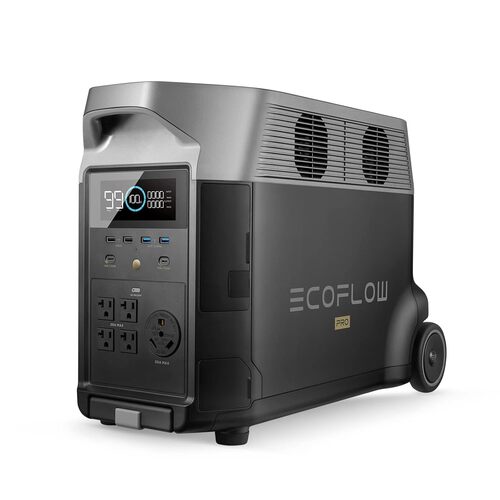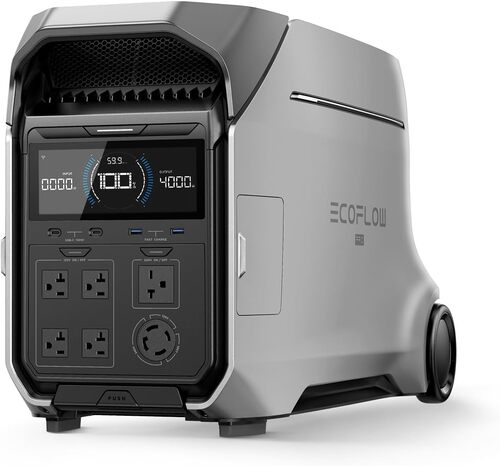
EcoFlow DELTA Pro vs DELTA Pro 3 is partly a product comparison and partly an ecosystem-migration decision. The original stores 3,600Wh and supplies 3,600W. DELTA Pro 3 raises those figures to 4,096Wh and 4,000W, adds native 120/240V capability, dual solar inputs totaling up to 2,600W, a 10ms transfer specification, and a quieter operating target under moderate load.
Existing DELTA Pro owner
Audit extra batteries, cables, generators, panels, home equipment, and app routines before replacing a working system.
New large-system buyer
Start with DELTA Pro 3 when native 120/240V, dual solar windows, or its current integration path is required.
The full shared specification table appears automatically below. This body concentrates on migration cost and electrical fit. A new base unit can invalidate or complicate older accessories, while a legacy unit can be poor value when achieving 240V requires additional hardware. Verify current EcoFlow compatibility charts for every exact accessory.
DELTA Pro Migration Map: Stay, Replace, or Start With Gen 3
If prices are close, the Delta Pro 3 is the cleaner long-term buy. If the original Delta Pro is heavily discounted, it can still be the smarter practical choice.
The New Generation Changes More Than Capacity
| Migration variable | Original DELTA Pro | DELTA Pro 3 | Why it matters |
|---|---|---|---|
| Base energy | 3,600Wh | 4,096Wh | Useful but smaller than an extra-battery decision. |
| Continuous output | 3,600W | 4,000W | More headroom, still subject to circuit limits. |
| Solar topology | One broad input, 1,600W | High- and low-voltage inputs, 2,600W total | Enables more deliberate mixed-array design. |
| Transfer | EPS-style; retained record lacks exact time | 10ms specified | Exact equipment still requires cutover tests. |
The Delta Pro 3 is not just a small refresh. It changes the use case.
The original EcoFlow Delta Pro is best viewed as a powerful 120V backup station. It can handle a fridge, freezer, router, lights, laptops, coffee maker, microwave, tools, and some RV loads with careful planning.
The EcoFlow Delta Pro 3 is more of a home-backup platform. Its 4000W output, 4096Wh battery, 120V/240V support, 2600W solar input, and larger expansion ceiling make it better for buyers thinking about transfer switches, well pumps, RV systems, and longer outage planning.
That said, the upgrade doesn’t make it unlimited. Space heaters, electric ovens, central AC units, dryers, and long high-watt loads can still drain either battery fast.
Match the Electrical Job Before the Generation
A 496Wh Gain Is Only One Part of Migration
Value gained = avoided integration hardware + usable extra output + faster daily recovery + accessory value retained − new accessories − labor − stranded legacy equipment.
The extra 496Wh may add useful reserve, but it seldom justifies migration alone. Expansion configuration, 120/240V requirements, solar array design, and home-connection equipment usually dominate the project.
The Delta Pro 3 has more battery on paper: 4096Wh vs 3600Wh. That’s useful, but it isn’t a night-and-day runtime jump.
After typical AC inverter losses and a small reserve, the Delta Pro gives roughly 2750Wh of practical AC energy. The Delta Pro 3 lands closer to 3100Wh. Those are estimates, not lab measurements.
Fridges and coolers are especially variable because compressors cycle. A fridge in a cool room may run far longer than one sitting in summer heat.
Native 240V does not establish simultaneous 120V/240V outlet behavior or every backup mode. Use the 120V/240V circuit-fit worksheet before choosing on voltage wording.
Native 120/240V Changes the Circuit Conversation
Output is where the Delta Pro 3 starts to separate itself.
The EcoFlow Delta Pro has 3600W continuous output, which is already strong. It can run many high-priority outage loads: fridge, freezer, router, lights, microwave, coffee maker, laptops, medical devices, and some tools.
The EcoFlow Delta Pro 3 increases that to 4000W continuous output and adds 120V/240V support. That matters if you’re thinking about well pumps, selected home circuits, RV connections, or a more structured backup setup.
However, don’t treat either unit like a blank check. Heat-making devices are still battery killers. A kettle, space heater, air fryer, or induction cooktop can technically run, but not for long.
Appliance winner: Delta Pro 3. The original Delta Pro is strong, but the newer model gives you better electrical flexibility.
Dual Solar Inputs and Faster Multi-Source Recovery
Wall charging is strong on both, but the story changes depending on your setup.
The original Delta Pro lists about 2.7 hours from a standard 1800W wall outlet and about 1.8 hours from 240V / 3000W charging. That faster option is useful if you have the right charging source.
The Delta Pro 3 lists about 1800W AC input, with full recharge usually around 3 hours in the supplied product data. Some owners report faster results depending on outlet, settings, and starting charge level.
Solar favors the newer unit. The Delta Pro’s solar ceiling is about 1600W, while the Delta Pro 3 can accept up to 2600W. If you’re building a serious panel setup, that difference matters.
A useful outage strategy is generator pairing: run a gas generator during the day to recharge the battery, then use the EcoFlow quietly overnight. This helps reduce fuel use, noise, and generator runtime.
Noise, Wheels, and Cable Clearance Matter Indoors
Legacy asset audit
- Extra batteries and their exact generation.
- Smart generator model and control cable.
- EV charging adapters and alternator hardware.
- Smart Home Panel or transfer equipment.
- PV strings, connectors, voltage windows, and cable routes.
- Remote controls, app automations, and operating procedures.
Mark every item as compatible, replaceable, or stranded. A sale price on DELTA Pro 3 is meaningful only after this inventory has a cost.
Neither model is “portable” in the way a 1kWh camping station is portable.
The Delta Pro weighs 99 lb, and the Delta Pro 3 weighs 115 lb. Both have wheels and pull handles, but stairs, gravel, door thresholds, and vehicle loading still matter.
Here’s the practical weight context:
- Under 10 lb: true grab-and-go
- 10–30 lb: easy car camping and room-to-room power
- 30–50 lb: movable, but not fun to carry far
- 50+ lb: semi-portable backup gear
- 100+ lb: wheels matter more than handles
Fan noise also deserves a mention. Both can stay fairly quiet under lighter loads, but fans can ramp up during fast charging, heavy AC output, or hot-garage use. For CPAP or bedroom backup, placement matters.
The EcoFlow app is useful for monitoring and settings. Still, buyers should expect some learning curve around firmware, charge limits, bonding settings, accessories, and outage behavior.
Audit Legacy Batteries and Accessories Before Migrating
Both models use LiFePO4 / LFP battery chemistry. That’s the right chemistry for this kind of backup station because it’s better suited to frequent cycling and long-term ownership than older short-cycle lithium-ion packs.
The Delta Pro 3 has clearer lifespan data in the supplied snapshot: about 4,000 cycles to 80% capacity. The Delta Pro uses LFP too, but the supplied product data does not specify a cycle-life number.
Expansion also favors the Delta Pro 3. The Delta Pro is listed up to 25kWh, while the Delta Pro 3 is listed up to 48kWh with compatible batteries and generators.
The DELTA Pro 3 Migration Threshold
The Delta Pro 3 is the better machine on paper. That doesn’t automatically make it the better purchase.
If the Delta Pro costs much less, it can be a great buy for standard 120V backup. It gives you plenty of battery, lots of output, and enough ports for practical outage loads.
If prices are close, the Delta Pro 3 is easier to justify. You get a newer platform, more solar input, more output, 120V/240V flexibility, and a clearer upgrade path.
For a new system, commission DELTA Pro 3 as an electrical platform. Verify both solar input windows independently, test every required 120V and 240V load, record transfer behavior, and time recovery from the sources available during an outage. A 4,000W rating still requires load sequencing when several high-demand devices share the station.
For an existing DELTA Pro system, compare improvement against disruption. A working 3,600Wh platform with compatible batteries and a practiced outage routine may deliver more operational confidence than a newly purchased unit whose cables, app rules, and home equipment have not been tested. Migration is justified when it creates a simpler and more capable complete system—not when it merely increases the model number.
Map solar strings before valuing the dual-input upgrade. DELTA Pro 3 separates high-voltage and low-voltage channels, so an existing array may need to be regrouped rather than simply reconnected. Calculate cold open-circuit voltage, operating current, shading behavior, cable loss, and disconnect requirements for each channel. Then estimate daily harvest using seasonal sun, not a short laboratory peak.
Noise should also be treated as a duty-cycle question. EcoFlow documents a low sound target for DELTA Pro 3 under specified moderate-load conditions, but high-rate charging, hot ambient air, or sustained output can change fan behavior. Place the unit where ventilation is adequate and sleeping or working occupants are not dependent on an idealized sound figure.
Finally, rehearse a rollback plan. If a firmware update, app account, generator handshake, or home component behaves unexpectedly, users need a documented safe state and an alternate charging route. Keep old equipment connected only when the manufacturer explicitly permits the topology; a temporary improvised mix can defeat the purpose of a planned migration.
A transfer-time figure is another migration input, not a universal UPS certification. Connect the exact router, workstation, storage appliance, or control equipment; simulate utility loss; allow the station to approach its reserve; and restore power. Check not only whether the device stays on, but whether networking, storage, and application services recover correctly. Critical medical equipment requires a manufacturer-approved backup design.
Plan end-of-outage recovery too. A larger and faster system can still be constrained by a 120V branch circuit, generator duty, limited sun, or other household charging loads. Document which source can recharge the station while essential loads remain powered and how long the process takes. Without that recovery plan, extra capacity postpones the same energy shortage rather than solving it.
Evidence boundary: owner experiences from both rebuilt product reviews help identify noise, mobility, charging, app, high-load, and support questions. They do not prove that one generation is categorically more reliable. Use the current exact manuals and local acceptance tests for the final decision.
Mobility deserves a measured route, not the portable label. Both generations weigh around one hundred pounds or more, so inspect thresholds, stairs, vehicle loading height, wheel clearance, and cable storage. A unit parked permanently beside integration equipment should be evaluated as installed storage. A unit intended to travel needs a safe loading method and protection from rain, dust, impact, and blocked ventilation.
Review warranty and remedy logistics before finalizing migration. Record serial numbers, seller identity, delivery condition, working firmware, and commissioning results. Heavy equipment can be difficult to return, and clear evidence makes troubleshooting more efficient if a fault appears. Keep those records with the system throughout ownership.